How to Write Better Deep Research Prompts: A Practical Guide With Examples
Deep Research is much more useful when you tell it what a good investigation should look like before it starts searching.
A weak research request usually names a topic:
Research the AI video generation market.That leaves important decisions unresolved:
- What decision will the research support?
- Which market definition should be used?
- Which countries or customer segments matter?
- How recent should the evidence be?
- Which sources should be trusted most?
- How should conflicting claims be handled?
- What counts as verified evidence versus inference?
- What should the final report actually help the reader do?
A stronger Deep Research prompt answers those questions up front.
A good Deep Research prompt defines the research problem, evidence boundaries, source priorities, comparison framework, uncertainty rules, and final decision artifact before the agent starts searching.
This guide shows how to build that prompt systematically.
Quick Answer
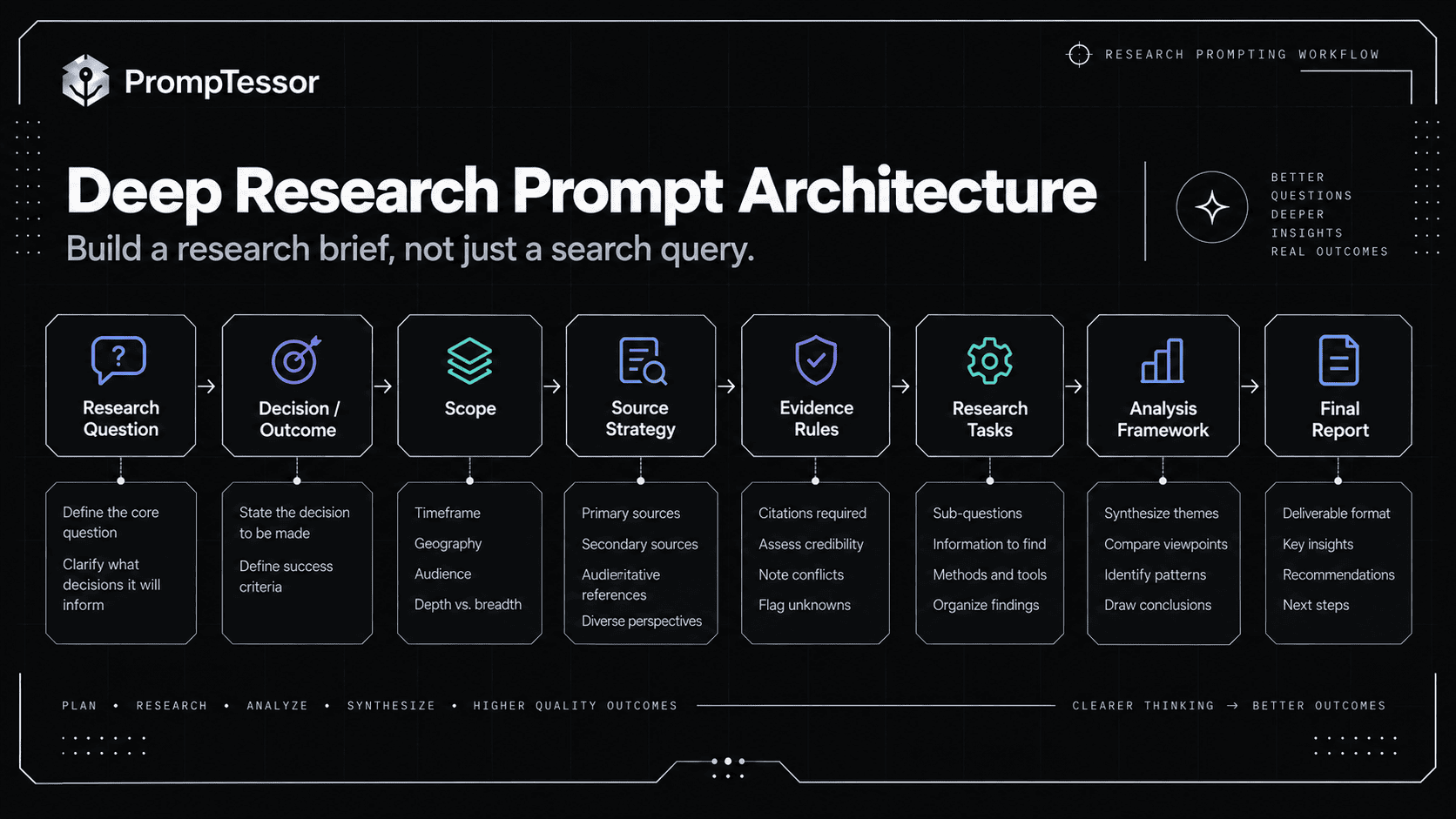
A strong Deep Research prompt usually contains seven layers:
1. RESEARCH OUTCOME
What decision, question, or deliverable should this research support?

2. SCOPE
What is included, excluded, and bounded by time, geography, audience, or category?

3. SOURCE STRATEGY
Which sources should be prioritized, allowed, restricted, or excluded?

4. EVIDENCE RULES
How should recency, citations, conflicting evidence, estimates, and unknowns be handled?

5. RESEARCH TASKS
What should the agent discover, verify, compare, calculate, or synthesize?

6. ANALYSIS FRAMEWORK
Which dimensions should be used to compare findings?

7. OUTPUT
What report, table, recommendation, risk section, and source list should be returned?
The exact length depends on the task. A narrow research question may need only a few lines. A strategic market study may need a much richer brief.
More detail is useful only when it reduces ambiguity that actually matters.
Key Takeaways
- Start with the decision or outcome, not only the topic.
- Define what the research should include and exclude.
- Specify recency, geography, audience, and time horizon when they matter.
- Prioritize primary and official sources for claims that can be verified directly.
- Use secondary reporting for synthesis, context, and independent analysis.
- Use community discussions as qualitative evidence, not as unquestioned fact.
- Tell the research system how to handle conflicting sources.
- Require a distinction between verified facts, vendor claims, estimates, opinions, and inference.
- Ask for uncertainty and unanswered questions explicitly.
- Define the comparison dimensions before asking for recommendations.
- Ask for citations or source links close enough to claims that they can be checked.
- Review the research plan before the run starts when the product exposes one.
- Steer or interrupt the research when the evidence path is drifting.
- Use Deep Research for multi-source synthesis; use ordinary search for quick lookups.
- PrompTessor can help structure the research prompt, but the research and source verification happen in the target research tool.
Table of Contents
- What Is Deep Research Prompting?
- Search vs. Deep Research
- The Deep Research Prompt Architecture
- 1. Define the Research Outcome
- 2. Bound the Scope Before Searching
- 3. Build a Source Strategy
- 4. Define Evidence and Verification Rules
- 5. Break the Research Into Explicit Tasks
- 6. Define the Comparison Framework
- 7. Specify the Final Research Artifact
- How Deep Research Prompting Changes by Product
- ChatGPT Deep Research
- Gemini Deep Research
- Review the Research Plan Before the Run
- Steer the Research While It Runs
- Deep Research Prompt Examples
- Reusable Deep Research Prompt Template
- How to Evaluate a Deep Research Report
- Common Deep Research Prompting Mistakes
- Where PrompTessor Fits
- Deep Research Prompt Checklist
- Related PrompTessor Guides and Tools
- Official Resources
- FAQ
What Is Deep Research Prompting?
Deep Research prompting is the practice of writing an instruction for an AI research workflow that will search, inspect, compare, and synthesize evidence across multiple sources before producing a documented report.
The prompt does more than state the subject. It acts like a research brief.
Compare:
Research electric vehicle adoption.with:
Research electric vehicle adoption in Indonesia from 2023 to the present
for a strategy team evaluating charging-infrastructure opportunities.

Focus on:
- passenger EV adoption,
- charging-station growth,
- government incentives,
- major automakers and charging providers,
- adoption barriers,
- regional differences,
- electricity and grid constraints.

Prioritize:
1. Indonesian government and regulator sources,
2. official company disclosures,
3. international energy and transport organizations,
4. reputable industry research,
5. established reporting.

Separate:
- verified facts,
- company claims,
- forecasts,
- estimates,
- analyst interpretation.

For conflicting numbers, show both values, source dates, methodology differences,
and which estimate appears better supported.

Return:
1. executive summary,
2. key market metrics,
3. competitor/infrastructure map,
4. opportunity areas,
5. risks,
6. unanswered questions,
7. recommended validation steps,
8. source list.
The second prompt is not stronger because it is longer. It is stronger because the important research decisions are explicit.
Search vs. Deep Research
Deep Research is not necessary for every current-information question.
OpenAI's current Deep Research documentation distinguishes quick search from deeper multi-step research: search is better for fast facts and orientation, while Deep Research is designed for more thorough investigations that combine and analyze information across multiple sources.
| Use Search When | Use Deep Research When |
|---|---|
| You need one recent fact | You need a multi-source evidence synthesis |
| You need a quick answer | You need a structured report |
| The source set is small | The evidence is scattered across many sources |
| You do not need a research plan | You need explicit scope and source control |
| You are orienting yourself | You are supporting a consequential decision |
| A short list of links is enough | You need comparisons, disagreements, risks, and citations |
Do not turn a simple lookup into a long research task merely because Deep Research exists. Use depth when depth changes the quality of the decision.
The Deep Research Prompt Architecture
RESEARCH QUESTION
       ↓
OUTCOME / DECISION
       ↓
SCOPE
Included
Excluded
Timeframe
Geography
Audience
       ↓
SOURCE STRATEGY
Primary
Official
Independent
User-provided
Connected
Community
       ↓
EVIDENCE RULES
Recency
Citation
Conflicts
Unknowns
Claims vs facts
       ↓
RESEARCH TASKS
Discover
Verify
Compare
Calculate
Synthesize
       ↓
ANALYSIS FRAMEWORK
Dimensions
Criteria
Tradeoffs
       ↓
OUTPUT
Summary
Evidence
Tables
Risks
Unknowns
Next steps
Sources
This framework is provider-neutral. The target product can then add its own source controls, files, connected apps, plan review, or report formats.
1. Define the Research Outcome
A research topic is not the same as a research outcome.
Weak:
Research AI coding agents.Stronger:
Research current AI coding agents to help a three-person SaaS team decide
whether to adopt one for repository-wide feature implementation.
Now the research has a purpose.
Useful Outcome Types
- choose between vendors,
- decide whether to enter a market,
- prepare an executive brief,
- understand an academic field,
- evaluate an investment thesis,
- identify product opportunities,
- design a technical architecture,
- prepare a policy memo,
- or map contradictory evidence.
The outcome changes what evidence matters. A founder evaluating market entry needs pricing, demand evidence, competitors, distribution, and barriers. A scientist needs literature quality, methodology, replication, limitations, and open questions.
State the Audience
Audience:
A technical founder who understands APIs but is not a specialist in healthcare regulation.
This helps calibrate terminology, explanation depth, and final format without relying on generic persona theater.
2. Bound the Scope Before Searching
Broad research prompts often fail because the research expands faster than the useful question.
Timeframe
Use evidence from January 2025 to the present for current product capabilities.
Use older sources only for historical context.
Geography
Focus on the United States and Canada.
Mention Europe only when regulation materially affects the market.
Market Definition
Include:
browser-based AI video generators,
API-first video generation providers,
professional creative platforms with native generation.

Exclude:
traditional video editors that only add AI transcription or captioning.
Population
Focus on independent creators and small marketing teams,
not enterprise film studios.
Decision Horizon
Evaluate what is viable for a product launch within the next 6-12 months,
not speculative capabilities beyond that horizon.
Scope is also where you prevent the research from overgeneralizing evidence from the wrong population or time period.
3. Build a Source Strategy
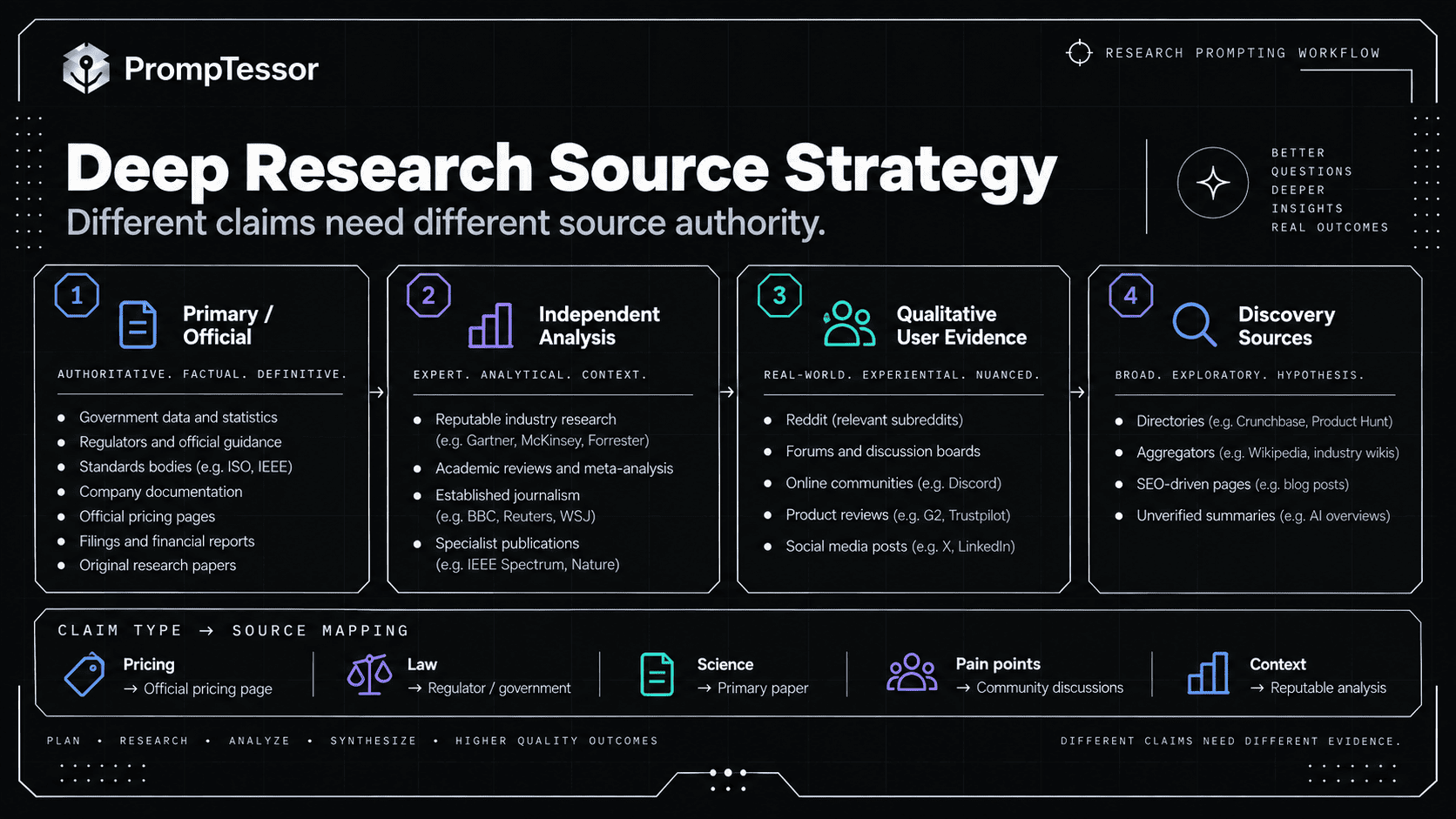
Not all sources should have equal authority.
A good Deep Research prompt tells the agent what kinds of sources should answer which kinds of questions.
A Practical Source Hierarchy
TIER 1 — PRIMARY / OFFICIAL
Government data
Regulators
Standards bodies
Company documentation
Pricing pages
Official filings
Original research papers

TIER 2 — INDEPENDENT ANALYSIS
Reputable industry research
Academic reviews
Established journalism
Specialist publications

TIER 3 — QUALITATIVE USER EVIDENCE
Reddit
Forums
Communities
Reviews
Social posts

TIER 4 — DISCOVERY SOURCES
Directories
Aggregators
Unverified summaries
The hierarchy is not absolute. A vendor pricing page is authoritative for its current listed price, but not necessarily for claims about market leadership. Reddit is weak evidence for total market size, but can be valuable for recurring user complaints.
Assign Source Roles
Use official pricing pages for pricing.
Use regulatory sources for legal requirements.
Use primary papers for scientific claims.
Use independent reporting to contextualize vendor announcements.
Use community discussions only for qualitative pain points and sentiment.
This is more precise than saying “use trustworthy sources.”
Use Product Source Controls Where Available
Current ChatGPT Deep Research lets users restrict research to specified websites or prioritize selected sites while still allowing broader web research. It can also use uploaded files and supported connected sources where available.
Current Gemini Deep Research uses Google Search by default and can add sources such as Gmail, Drive, uploaded files, and NotebookLM notebooks when available and connected.
That makes source strategy a product control, not only prompt prose.
4. Define Evidence and Verification Rules
Research quality depends as much on evidence handling as source discovery.
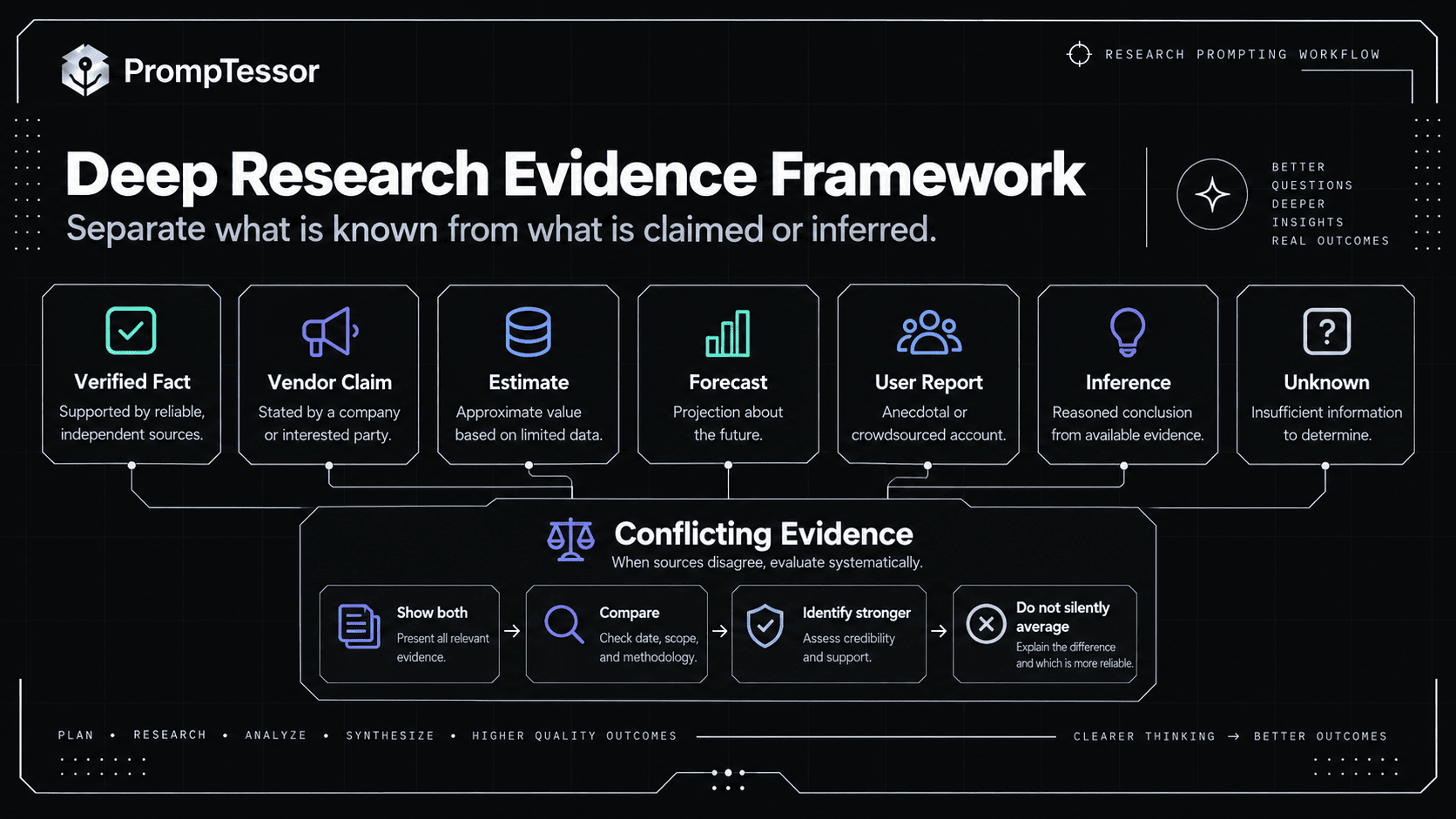
Separate Evidence Classes
- Verified fact — directly supported by a reliable source.
- Vendor claim — stated by an interested party but not independently verified.
- Estimate — based on assumptions or modeled data.
- Forecast — a future projection.
- User report — anecdotal or qualitative experience.
- Inference — a conclusion drawn from several pieces of evidence.
- Unknown — information that could not be established reliably.
Handle Conflicting Evidence Explicitly
When credible sources disagree:
1. show both claims,
2. include source dates,
3. explain differences in methodology or scope,
4. identify which source is more directly relevant,
5. do not silently average conflicting values.
Set Recency Rules
For product features and pricing:
prefer sources updated within 90 days.

For market size:
use the latest credible dataset and state the measurement year.

For historical context:
older sources are acceptable when clearly labeled.
Require Evidence Near Claims
Instead of requesting “include sources” only at the end, ask for citations or source links close to important claims. This makes verification faster and reduces ambiguity about which source supports which statement.
Require Unknowns
If reliable evidence is unavailable, say "Not established"
and explain what source or test would be needed to verify it.
This is one of the strongest ways to prevent a research report from turning every information gap into confident prose.
5. Break the Research Into Explicit Tasks
Deep Research can perform broad multi-step work, but it still benefits from a clear task map.
Discover
Identify the major products currently serving this workflow.Verify
Verify current pricing on each vendor's official pricing page.Compare
Compare the products on deployment model, pricing, workflow coverage,
integrations, and user complaints.
Calculate
Calculate effective monthly cost for 10,000 requests using the published rates.
Show assumptions.
Synthesize
Identify patterns that appear across at least three independent sources.Challenge
Look specifically for evidence that contradicts the initial opportunity thesis.That final step is especially useful for decision research. A research agent should not only gather evidence that supports the questioner's original assumption.
6. Define the Comparison Framework
If the research compares products, markets, methods, or policies, define the dimensions before asking for a recommendation.
For a software vendor comparison:
Compare:
- target customer
- core workflow
- required integrations
- pricing
- usage limits
- deployment options
- security controls
- API availability
- implementation effort
- switching cost
- known limitations
For academic methods:
Compare:
- research question
- dataset
- sample size
- methodology
- baseline
- outcome measure
- statistical significance
- limitations
- replication status
For product opportunity research:
Compare:
- problem importance
- existing alternatives
- willingness-to-pay evidence
- competition
- distribution difficulty
- technical complexity
- regulatory constraints
- solo-founder feasibility
- validation cost
The point is not to force a scorecard everywhere. The point is to ensure the report compares evidence on dimensions relevant to the decision.
7. Specify the Final Research Artifact
Deep Research should produce something usable, not only a long narrative.
Executive Report
Return:
1. executive summary,
2. key findings,
3. evidence table,
4. disagreements,
5. risks,
6. unknowns,
7. recommended next actions,
8. sources.
Decision Memo
Return:
- decision to be made,
- strongest evidence for each option,
- strongest evidence against each option,
- assumptions,
- irreversible risks,
- reversible experiments,
- information still needed.
Competitor Map
Return:
- competitor table,
- positioning clusters,
- pricing patterns,
- feature gaps,
- recurring customer complaints,
- underserved segments,
- validation questions.
Literature Review
Return:
- research themes,
- key papers,
- methodology table,
- consensus,
- disagreements,
- limitations,
- open questions,
- annotated bibliography.
OpenAI's current Deep Research documentation explicitly recommends describing the desired outcome and final report structure in the initial request.
How Deep Research Prompting Changes by Product
The core research brief is portable, but the controls available around it differ by product.
ChatGPT Deep Research
Current ChatGPT Deep Research follows a plan → research → synthesize workflow.
According to OpenAI's current help documentation, users can describe the outcome, audience, constraints, and desired output; provide uploaded files; use supported connected sources where available; review and modify a proposed research plan; restrict or prioritize websites; follow progress; interrupt the task to refine focus; and receive a structured report with citations or source links.
Completed reports in Chat can also be reviewed in a dedicated report view and exported in formats including Markdown, Word, and PDF.
Prompting Implication
- define what decision matters,
- which evidence matters,
- which sites or source classes deserve priority,
- what contradictions to investigate,
- and what report structure to return.
Then use the product's plan and site controls to enforce those decisions where possible instead of repeating everything in prose.
Gemini Deep Research
Current Gemini Deep Research includes Google Search by default and lets users add or change research sources.
Google's current documentation lists source workflows including Google Search, Gmail, Drive, uploaded files, and NotebookLM notebooks. Gemini creates a research plan that can be edited before the report is generated.
Prompting Implication
Be explicit about the relationship between source types.
Use Drive documents as the source of truth for our internal strategy.
Use public web sources to verify current competitor facts.
Use Gmail only for customer feedback relevant to pricing objections.
Do not treat internal forecasts as verified market data.
That kind of source-role instruction becomes especially important when a research workflow can combine private and public evidence.
Review the Research Plan Before the Run
If the product shows you a proposed research plan, treat it as part of the prompting workflow.
Do not click Start automatically. Check:
- Does the plan answer the actual decision?
- Are any important subquestions missing?
- Is it overinvesting in background history?
- Does it include the source types you care about?
- Does it verify current pricing or capabilities from primary sources?
- Does it include contradicting evidence?
- Is the scope too broad?
Bad Plan
1. Define the industry.
2. Explain its history.
3. List some companies.
4. Summarize trends.
Better Plan for a Purchase Decision
1. Define the exact workflow requirements.
2. Identify eligible vendors.
3. Verify current pricing and limits.
4. Compare implementation requirements.
5. Find independent evidence of reliability.
6. Investigate recurring user complaints.
7. Calculate expected cost under our usage.
8. Identify risks and switching costs.
9. Highlight unresolved questions.
A weak research plan produces a weak report even when the individual searches are competent.
Steer the Research While It Runs
Research is not always a one-shot process.
OpenAI's current Deep Research workflow allows users to monitor progress and interrupt the task to refine focus or adjust sources.
Useful interventions include:
You're spending too much time on historical background.
Prioritize current pricing, customer adoption, and distribution evidence.
The report is relying heavily on vendor blogs.
Add independent sources for the performance claims.You found conflicting market-size numbers.
Pause synthesis and investigate the methodologies behind the three estimates.Do not continue expanding the competitor list.
Focus on the six products that actually match the workflow requirements.Steering is most valuable when the research path is drifting, not when you simply want to micromanage every search query.
Deep Research Prompt Examples
Example 1: Market Research
Research the current market for {product_category} in {region}
for a founder deciding whether to enter the market.

Decision:
Determine whether there is a realistic entry opportunity for a small team
within the next 12 months.

Research:
- market definition,
- target customer segments,
- major jobs-to-be-done,
- existing alternatives,
- leading competitors,
- pricing and packaging,
- distribution channels,
- recent launches,
- adoption barriers,
- recurring customer complaints,
- underserved workflows,
- regulatory or technical barriers.

Source priority:
1. government / regulator sources where relevant,
2. official company documentation and pricing,
3. reputable industry research,
4. established reporting,
5. community discussions for qualitative pain points only.

Evidence rules:
- prioritize current evidence,
- date time-sensitive claims,
- separate facts, vendor claims, estimates, and inference,
- show credible conflicting evidence rather than hiding it,
- mark unknowns clearly.

Return:
1. executive summary,
2. market map,
3. competitor table,
4. demand evidence,
5. recurring pain points,
6. opportunity hypotheses,
7. risks,
8. unanswered questions,
9. low-cost validation experiments,
10. source list.
Example 2: Competitor Research
Research these competitors:
{competitor_list}

My product:
{product_description}

Target customer:
{target_customer}

Goal:
Understand where the products genuinely differ and where the market is commoditized.

Verify for each competitor:
- current positioning,
- target audience,
- core workflow,
- key features,
- pricing,
- usage limits,
- integrations,
- API / developer support,
- distribution channels,
- recent launches,
- recurring user complaints.

Use official sources for product facts and pricing.
Use independent sources for market interpretation.
Use communities only to identify recurring qualitative pain points.

Do not infer missing features from silence.

Return:
- comparison table,
- positioning clusters,
- common feature baseline,
- real differentiation,
- pricing patterns,
- recurring complaints,
- underserved segments,
- evidence gaps,
- questions to validate manually.
Example 3: Product Opportunity Research
Research whether this product idea has a real opportunity:

Idea:
{idea}

Target user:
{target_user}

Problem:
{problem}

Constraints:
- small team,
- low operational complexity,
- no dependence on proprietary live-data collection,
- no physical-store partnerships,
- must be realistically shippable within {timeframe}.

Investigate:
- evidence the problem exists,
- how people solve it today,
- direct and indirect competitors,
- willingness-to-pay signals,
- existing pricing,
- switching costs,
- distribution possibilities,
- technical dependencies,
- operational complexity,
- regulatory risks,
- obvious substitutes,
- evidence against the idea.

Separate verified evidence, community anecdotes, assumptions,
and your own inferences.

Return:
1. strongest evidence for demand,
2. strongest evidence against demand,
3. current alternatives,
4. opportunity gaps,
5. major risks,
6. assumptions that remain unverified,
7. cheapest validation experiments,
8. source list.
Example 4: Academic Literature Review
Conduct a literature review on:
{research_question}

Scope:
- peer-reviewed research where available,
- publication period: {date_range},
- population: {population},
- exclude studies outside {exclusions}.

For each major study, record:
- citation,
- research question,
- sample,
- methodology,
- intervention/exposure,
- outcome measure,
- key finding,
- limitations,
- conflicts of interest if reported.

Synthesize:
- areas of consensus,
- major disagreements,
- methodological differences,
- evidence quality,
- replication status,
- unanswered questions.

Do not treat one study as consensus.
Distinguish observational evidence from causal evidence.

Return:
1. structured review,
2. study comparison table,
3. consensus,
4. disagreements,
5. methodological limitations,
6. research gaps,
7. annotated source list.
Example 5: Company / Investment Research
Research {company} for a decision memo.

Focus on:
- business model,
- revenue drivers,
- customer concentration,
- major products,
- competitive position,
- recent financial performance,
- capital structure,
- regulatory exposure,
- management claims,
- major risks,
- catalysts,
- evidence that contradicts the bull case.

Prioritize:
1. regulatory filings,
2. earnings materials,
3. official disclosures,
4. reputable financial reporting,
5. independent industry analysis.

Separate reported facts, management guidance, analyst estimates,
market expectations, and your own inference.

Do not provide investment advice.
Return an evidence-backed research memo with uncertainties and source links.
Example 6: Technical Architecture Research
Research architecture options for:
{technical_problem}

System context:
{system_context}

Constraints:
- scale: {scale},
- latency target: {latency},
- budget: {budget},
- team size: {team_size},
- deployment environment: {environment}.

Compare viable approaches on:
- architecture,
- operational complexity,
- implementation effort,
- failure modes,
- performance,
- scalability,
- security,
- vendor lock-in,
- cost,
- ecosystem maturity.

Prioritize official technical documentation and primary engineering sources.

For benchmarks, record hardware, dataset/workload, configuration, date,
and whether results are vendor-reported or independent.

Return:
1. architecture options,
2. comparison table,
3. tradeoffs,
4. failure modes,
5. recommended proof-of-concept tests,
6. unknowns,
7. source list.
Example 7: Vendor / Software Buying Decision
Research the best options for:
{software_category}

Our requirements:
{requirements}

Hard constraints:
{hard_constraints}

Expected usage:
{usage}

Budget:
{budget}

Research:
- eligible products,
- current pricing,
- included limits,
- API/integration support,
- security/compliance,
- onboarding effort,
- support,
- exportability,
- cancellation terms,
- recurring complaints.

Do not rank products that fail a hard requirement.
Calculate estimated monthly cost under our expected usage.
Show assumptions.

Return:
1. eligible shortlist,
2. requirement matrix,
3. cost table,
4. tradeoffs,
5. implementation risks,
6. questions to ask vendors,
7. source list.
Example 8: Current Policy or Regulation Research
Research the current status of:
{policy_or_regulation}

Jurisdiction:
{jurisdiction}

As-of date:
{date}

Prioritize:
- enacted law,
- regulator guidance,
- official government publications,
- court decisions where relevant.

Use reporting and commentary only to explain context.

Clearly distinguish:
- enacted rules,
- proposed rules,
- guidance,
- litigation,
- commentary,
- unresolved interpretation.

For every major requirement, include:
- effective date,
- affected population,
- practical obligation,
- primary source.

Return:
1. current status,
2. timeline,
3. obligations,
4. affected groups,
5. unresolved issues,
6. practical questions to verify with qualified counsel,
7. primary sources.
Reusable Deep Research Prompt Template
DEEP RESEARCH BRIEF

RESEARCH QUESTION
{what you want investigated}

DECISION / OUTCOME
This research will be used to:
{decision, audience, or final purpose}

SCOPE
Include:
{included topics}

Exclude:
{excluded topics}

Timeframe:
{date range / recency requirement}

Geography:
{region / jurisdiction}

Population / customer / domain:
{target population}

SOURCE STRATEGY
Prioritize:
1. {primary / official sources}
2. {independent sources}
3. {industry sources}
4. {community sources for qualitative evidence}

Use these specific sources when relevant:
{sites / files / connected sources}

Avoid or de-prioritize:
{source types}

EVIDENCE RULES
- Cite or link important factual claims.
- Prefer primary sources when they directly establish a fact.
- Date time-sensitive claims.
- Separate verified facts from vendor claims, estimates, forecasts,
  user reports, and inference.
- When credible sources disagree, show the disagreement and explain
  scope/methodology differences.
- Do not invent missing information.
- Mark unresolved questions explicitly.

RESEARCH TASKS
1. Discover: {what to identify}
2. Verify: {what must be checked from authoritative sources}
3. Compare: {what should be compared}
4. Analyze: {patterns, relationships, tradeoffs}
5. Challenge: {what contrary evidence to seek}

ANALYSIS FRAMEWORK
Compare findings on:
{dimensions / criteria}

OUTPUT
Return:
1. Executive summary
2. Key findings
3. Evidence / comparison table
4. Contradictions or disagreements
5. Risks and limitations
6. Unknowns
7. Recommended next steps
8. Source list

QUALITY CHECK
Before finalizing:
- confirm the report answers the original decision,
- verify important claims against their cited sources,
- remove unsupported conclusions,
- label uncertainty,
- and identify what still needs manual validation.
How to Evaluate a Deep Research Report
A long report is not automatically a good report.
| Dimension | Question |
|---|---|
| Scope coverage | Did the report answer the research question rather than drift into adjacent topics? |
| Source quality | Were important claims supported by the right kinds of sources? |
| Recency | Were time-sensitive claims current enough? |
| Evidence traceability | Can you verify which source supports each important claim? |
| Conflict handling | Did the report surface credible disagreements? |
| Uncertainty | Were unknowns and estimates labeled? |
| Comparison quality | Were alternatives compared on the dimensions that matter? |
| Decision usefulness | Does the report reduce uncertainty for the intended decision? |
| Actionability | Are next steps grounded in the evidence? |
Verify the Sources
OpenAI's current Deep Research documentation explicitly tells users to review citations and confirm that sources support the claims before using or sharing the output.
Check:
- Does the cited source say what the report claims?
- Is the citation attached to the correct claim?
- Is the source current?
- Is a primary source available?
- Is a forecast being presented as current fact?
- Did the report generalize beyond the source population?
Common Deep Research Prompting Mistakes
1. Naming Only the Topic
“Research X” leaves the outcome and evidence standard undefined.
2. No Decision Context
The same topic requires different research depending on whether the reader is buying, investing, building, teaching, or regulating.
3. “Use Reliable Sources” With No Source Roles
Define which sources should answer which questions.
4. No Time Boundary
Current product research can easily mix outdated pricing and discontinued capabilities into the report.
5. No Geographic Boundary
Markets, laws, pricing, and availability can vary dramatically by jurisdiction.
6. Asking for a Recommendation Before Defining Criteria
Make the comparison dimensions explicit first.
7. Treating Vendor Claims as Verified Facts
Label interested-party claims and look for independent support where it matters.
8. Treating Reddit as Market Data
Community discussions are useful for qualitative pain points, not population-level measurement.
9. Ignoring Contradictory Evidence
Ask the research process to search for evidence against the initial thesis.
10. Hiding Unknowns
A strong report says what could not be established.
11. Over-Specifying the Search Process
Do not force dozens of exact search queries unless the task genuinely requires them. Specify the evidence target and source policy instead.
12. Overloading the Prompt With Generic Roles
“You are the world's best researcher” adds less value than a clear research question, source strategy, and output contract.
13. Never Reviewing the Research Plan
If the plan is wrong, the final report can be thoroughly wrong in the same direction.
14. Accepting the Final Report Without Source Checking
Citations are verification tools, not guarantees.
Where PrompTessor Fits
PrompTessor can help turn a rough research idea into a more structured research prompt before it is sent to ChatGPT Deep Research, Gemini Deep Research, or another research-capable AI workflow.
PrompTessor's current methodology includes Research as an explicit Prompt Generator type. Its prompt-generation process can structure elements such as task, context, constraints, source boundaries, output format, validation criteria, variables, and model fit.
The public AI Prompt Generator can turn a broad research goal into a reusable prompt with clearer instructions, context, constraints, and expected output.
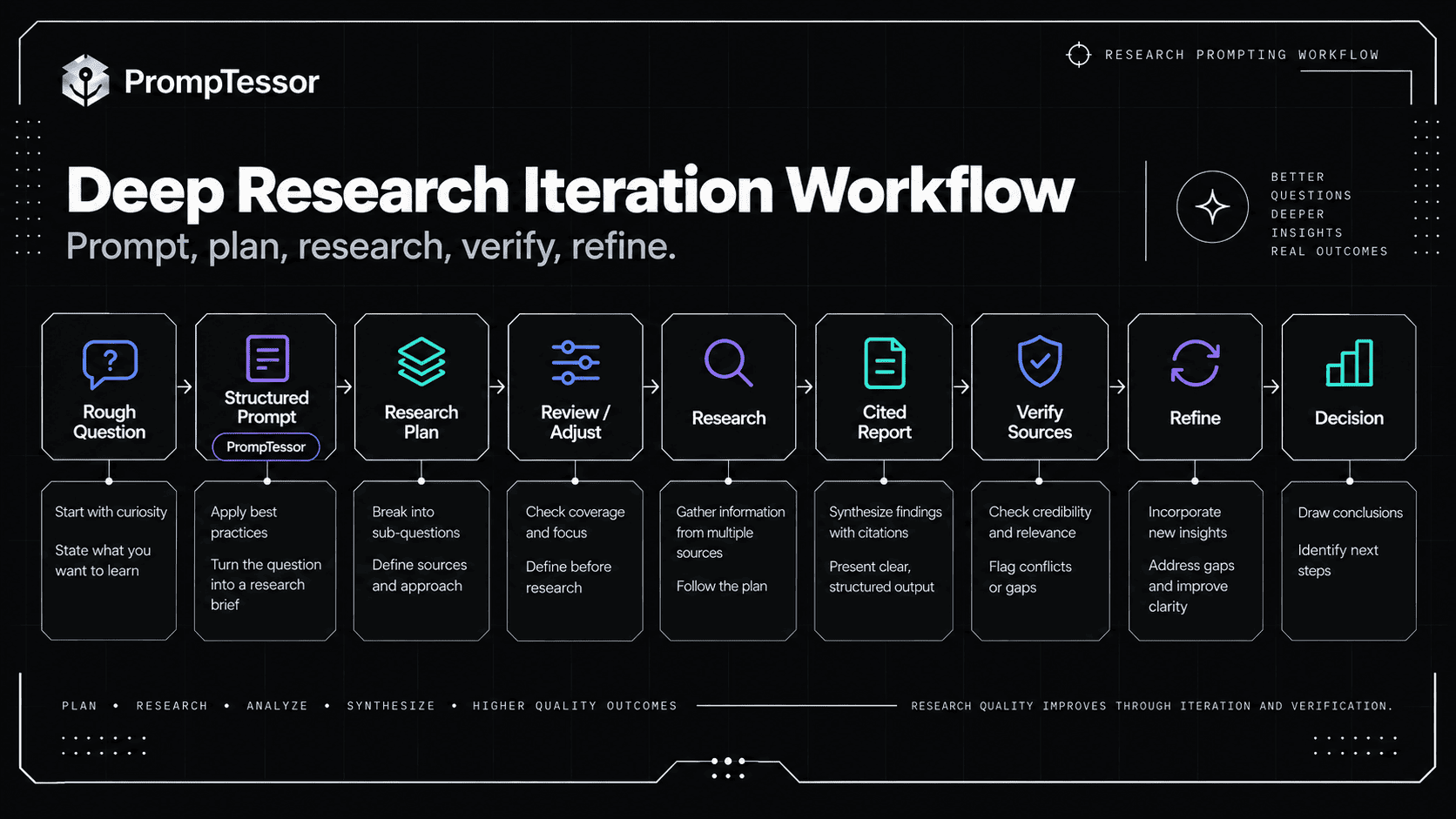
ROUGH RESEARCH IDEA
        ↓
PrompTessor
Research prompt structure
        ↓
DEEP RESEARCH TOOL
        ↓
RESEARCH PLAN
        ↓
REVIEW / ADJUST
        ↓
RESEARCH REPORT
        ↓
VERIFY SOURCES
        ↓
REFINE PROMPT IF NEEDED
PrompTessor is not the research engine in this workflow.
It does not automatically perform the target product's full Deep Research run, choose private connected sources on your behalf, guarantee source accuracy, or replace manual verification of consequential claims.
Use PrompTessor to improve the research brief. Use the target research tool to investigate the evidence. Verify the resulting sources before making important decisions.
Deep Research Prompt Checklist
- What exact question am I trying to answer?
- What decision or deliverable will the research support?
- Who is the audience?
- What is included?
- What is excluded?
- What time period matters?
- What geography or jurisdiction matters?
- What population, customer, or market segment matters?
- Which sources should be treated as authoritative?
- Which claims require primary-source verification?
- Which user-provided files or connected sources should be used?
- Which sources should be excluded or de-prioritized?
- How recent should product, pricing, or policy information be?
- Should community discussions be used only for qualitative evidence?
- How should vendor claims be labeled?
- How should estimates and forecasts be labeled?
- What should happen when credible sources disagree?
- Should the research actively seek counter-evidence?
- What key facts need direct verification?
- What comparison dimensions matter?
- What hard constraints should eliminate an option?
- What calculations are required?
- Which assumptions must be shown?
- What final report structure is useful?
- Do I need an executive summary?
- Do I need evidence or comparison tables?
- Do I need risks and limitations?
- Do I need unanswered questions?
- Do I need recommended validation steps?
- Do I need a source list?
- Can I review the research plan before execution?
- Should I restrict or prioritize specific sites?
- Do I need to steer the run if research drifts?
- Will I manually verify the most consequential claims?
Related PrompTessor Guides and Tools
- AI Prompt Generator
- Context Engineering
- AI Prompt Evaluation
- How to Write Prompts for ChatGPT, Claude, Gemini, and Grok
- Best ChatGPT Prompts
- Best Gemini Prompts
Official Resources
- OpenAI — Deep Research in ChatGPT
- OpenAI Academy — ChatGPT for Research
- OpenAI Academy — Search and Deep Research
- Google — Use Deep Research in Gemini Apps
- Google — Deep Research and Deep Research Max
FAQ
What is a Deep Research prompt?
A Deep Research prompt is a research brief for an AI research workflow. It defines the question, outcome, scope, source priorities, evidence rules, analysis tasks, and final report structure.
How is a Deep Research prompt different from a normal prompt?
A normal prompt may request one response. A Deep Research prompt usually guides a multi-step process that searches or accesses multiple sources, builds a research plan, compares evidence, and produces a documented report.
How detailed should a Deep Research prompt be?
Detailed enough to remove important ambiguity. A narrow factual investigation can be short. A strategic market or vendor study should usually define scope, source strategy, evidence rules, comparison criteria, and output.
What should I include in a Deep Research prompt?
Include the research question, intended decision, scope, timeframe, geography where relevant, source priorities, evidence and citation rules, research tasks, comparison criteria, and desired report structure.
Should I specify sources in a Deep Research prompt?
Yes when source choice materially affects the result. Assign source roles such as official sources for pricing, regulatory sources for legal requirements, and community sources for qualitative user pain points.
What sources should Deep Research prioritize?
It depends on the claim. Prefer primary and official sources when they directly establish facts, then use reputable independent sources for context and synthesis. Community sources are useful for qualitative evidence but should not be treated as population-level fact.
How should Deep Research handle conflicting sources?
Ask it to show credible conflicting claims, include source dates and scope, explain methodology differences, and identify which evidence is more directly relevant instead of silently choosing or averaging values.
How do I reduce hallucinations in Deep Research?
Define source boundaries, require citations for important claims, distinguish facts from inference, instruct the system not to invent missing information, and explicitly request unknowns and contradictions. Then verify the most consequential citations manually.
Should I ask Deep Research for recommendations?
You can, but define the decision criteria first. A recommendation is more useful when the report shows the evidence, tradeoffs, assumptions, and uncertainty behind it.
Can ChatGPT Deep Research use specific websites?
Yes. Current ChatGPT Deep Research lets users restrict research to specified sites or prioritize selected sites while still allowing broader web search. Availability and controls can vary by product context and account.
Can ChatGPT Deep Research use uploaded files and connected sources?
Yes. Current ChatGPT Deep Research can use uploaded files and supported connected sources available to the account or workspace, subject to permissions and product availability.
What sources can Gemini Deep Research use?
Google Search is included by default. Current Gemini documentation also describes source options such as Gmail, Drive, uploaded files, and NotebookLM notebooks when available and connected.
Should I review the research plan before starting?
Yes when the product exposes one. Check whether the plan matches the decision, includes the right subquestions, uses appropriate sources, and is not drifting into unnecessary background research.
Can I change direction while Deep Research is running?
In ChatGPT's current Deep Research workflow, users can monitor progress and interrupt to refine the focus or source access. Product capabilities differ, so use the controls available in the target tool.
How do I know if a Deep Research report is good?
Evaluate scope coverage, source quality, recency, evidence traceability, conflict handling, uncertainty, comparison quality, and usefulness for the intended decision. Verify important sources directly.
Can PrompTessor create Deep Research prompts?
PrompTessor's Prompt Generator includes a Research prompt type and can help structure a rough research goal into a reusable prompt with clearer context, constraints, source boundaries, output format, and model-aware guidance. The actual Deep Research run happens in the target research tool.
Conclusion
Deep Research works best when the prompt is treated as a research brief rather than a search query.
QUESTION
   ↓
DECISION
   ↓
SCOPE
   ↓
SOURCE STRATEGY
   ↓
EVIDENCE RULES
   ↓
RESEARCH TASKS
   ↓
COMPARISON FRAMEWORK
   ↓
REPORT
   ↓
SOURCE VERIFICATION
Start with what the research needs to accomplish.
Bound the scope.
Tell the system which sources should establish which facts.
Define how evidence, estimates, vendor claims, disagreements, and unknowns should be handled.
Specify the analysis framework before requesting a recommendation.
Review the research plan.
Steer the run when it drifts.
And verify the citations before using the report for an important decision.
The best Deep Research prompt does not tell the agent every search query to run. It tells the agent what evidence would be sufficient to answer the decision responsibly.
Turn a Rough Research Idea Into a Better Research Brief
When you know what you want to investigate but the research request is still broad, PrompTessor can help structure the prompt around the goal, context, source boundaries, evidence requirements, output format, and reusable variables before you send it to a Deep Research workflow.
Build better prompts in one workspace
Generate prompts from ideas, analyze and optimize quality, refine with feedback, reverse-engineer content, and save reusable prompts in your Prompt Library.
Try PrompTessor Free