Best ChatGPT Prompts for Work Writing Marketing and Coding in 2026
ChatGPT can help with writing, marketing, coding, research, planning, learning, and everyday tasks, but the quality of its response depends heavily on the prompt you provide.
A short instruction such as “write a blog post” or “help me with marketing” may produce an answer, but the result will often be broad, generic, or difficult to use.
A stronger prompt gives ChatGPT a clear task, useful context, a target audience, an output format, relevant constraints, and a definition of what a successful answer should look like.
This guide contains reusable ChatGPT prompts for common professional and everyday tasks. Each prompt includes placeholders that you can customize for your own topic, audience, goal, tone, format, and workflow.
You can copy these prompts directly, replace the variables inside curly brackets, and adapt them to your specific needs.
Quick Answer
The best ChatGPT prompts clearly explain the task, context, audience, output format, constraints, and expected result. Instead of using one-line instructions, use reusable prompts with variables such as {topic}, {audience}, {goal}, {tone}, and {output_format}.
Key Takeaways
- Specific ChatGPT prompts usually produce more relevant and useful answers than vague instructions.
- Reusable placeholders make it easier to adapt the same prompt to different topics and workflows.
- Output format instructions help ChatGPT return tables, outlines, checklists, drafts, JSON, or step-by-step plans.
- Constraints help control length, tone, scope, accuracy, and unwanted content.
- Important facts, calculations, code, and recommendations should still be reviewed before being used.
Table of Contents
- What Makes a Good ChatGPT Prompt?
- How to Customize These ChatGPT Prompts
- ChatGPT Prompts for Writing
- ChatGPT Prompts for Marketing
- ChatGPT Prompts for Coding
- ChatGPT Prompts for Research
- ChatGPT Prompts for Productivity
- ChatGPT Prompts for Business
- ChatGPT Prompts for Learning
- ChatGPT Prompts for Everyday Tasks
- How to Improve Weak ChatGPT Prompts
- Common Mistakes When Using ChatGPT Prompts
- How PrompTessor Helps With ChatGPT Prompts
- FAQ About ChatGPT Prompts
What Makes a Good ChatGPT Prompt?
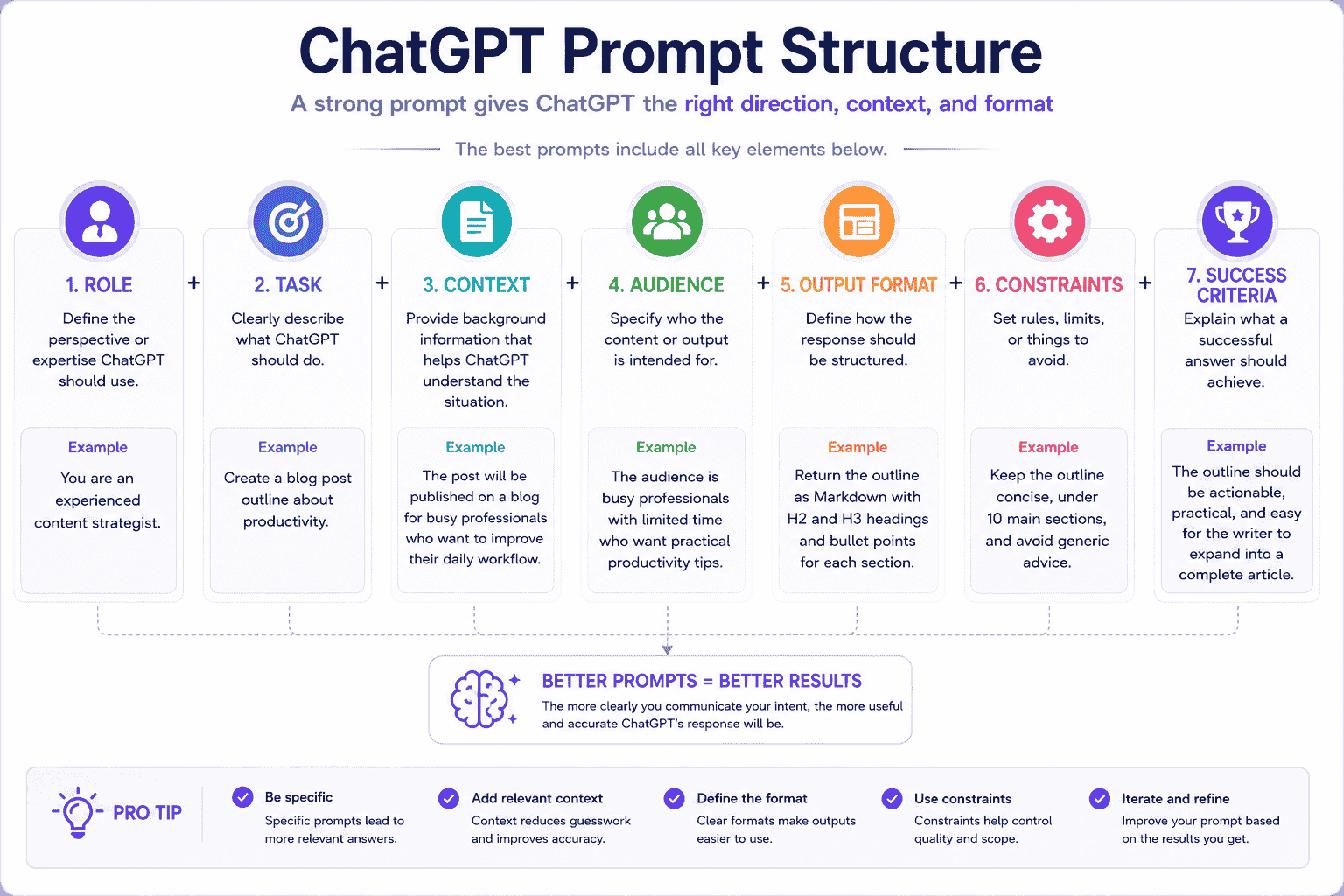
A good ChatGPT prompt does more than describe a topic. It explains what the AI should do, why the task matters, who the output is for, and how the answer should be structured.
Most effective prompts include several core elements.
1. A Clear Role
A role gives ChatGPT a useful perspective for the task.
Examples:
- You are an experienced content strategist.
- You are a senior JavaScript developer.
- You are a product marketing consultant.
- You are a patient tutor for beginners.
A role is most useful when it adds relevant expertise or changes how the answer should be approached.
2. A Specific Task
The prompt should clearly describe the action ChatGPT needs to perform.
Instead of:
Help me with my article.
Use:
Review the following article draft and identify unclear sections, repetitive ideas, weak transitions, and opportunities to add practical examples.
3. Useful Context
Context helps ChatGPT understand your situation.
You may include:
- Product or project information
- Target audience
- Current problem
- Business goal
- Brand voice
- Available resources
- Source material
- Previous attempts
4. A Target Audience
The audience affects vocabulary, tone, depth, examples, and explanation style.
For example, an explanation for non-technical founders should be different from one written for senior engineers.
5. A Defined Output Format
Tell ChatGPT how the response should be structured.
Possible formats include:
- Table
- Checklist
- Markdown outline
- Email draft
- JSON
- Step-by-step plan
- Comparison matrix
- Decision memo
6. Relevant Constraints
Constraints prevent the response from becoming too broad or unsuitable for your workflow.
Examples:
- Keep the answer under 800 words.
- Use simple English.
- Avoid exaggerated claims.
- Do not invent facts or sources.
- Return only valid JSON.
- Include practical examples.
7. Success Criteria
Success criteria tell ChatGPT what a useful result should achieve.
Example:
The final answer should be practical, specific, easy to execute, and suitable for a solo founder with limited time and budget.
For a deeper guide to reusable prompt structures, read AI Prompt Templates You Can Reuse for ChatGPT Claude Gemini and Other AI Tools.
How to Customize These ChatGPT Prompts
The prompts in this article use placeholders inside curly brackets.
For example:
You are a {role}.

Create a {content_type} about {topic} for {audience}.

The goal is to {goal}.

Use a {tone} tone and return the result as {output_format}.

Follow these constraints:
{constraints}
Replace each placeholder with information from your own task.
Common variables include:
| Variable | What to Add | Example |
|---|---|---|
{role} |
The perspective or expertise ChatGPT should use | SEO content strategist |
{topic} |
The main subject | AI productivity for small businesses |
{audience} |
Who the output is intended for | Non-technical founders |
{goal} |
The result you want to achieve | Educate readers and encourage sign-ups |
{tone} |
The desired style or voice | Practical and conversational |
{output_format} |
How the answer should be structured | Markdown outline with H2 and H3 headings |
{constraints} |
Limits, rules, or things to avoid | Under 1,000 words, no hype, include examples |
The more relevant information you add, the less ChatGPT needs to guess.
ChatGPT Prompts for Writing
These prompts can help with outlines, first drafts, editing, rewriting, and social content.
1. Blog Post Outline Prompt
You are an experienced content strategist.

Create a detailed blog post outline about {topic} for {audience}.

The primary goal is to {goal}.

Include:
- Search intent
- Recommended article angle
- Introduction direction
- H2 and H3 headings
- Key points for every section
- Practical examples
- Common mistakes
- FAQ questions
- Conclusion direction

Use a {tone} tone.

Avoid repetitive sections and generic advice.

The outline should be detailed enough for a writer to create a complete article without guessing what each section should cover.
2. Long-Form Article Prompt
You are a professional writer with expertise in {industry_or_topic}.

Write a {word_count}-word article about {topic} for {audience}.

The goal is to {goal}.

Use the following structure:
1. Engaging introduction
2. Clear explanation of the topic
3. Practical sections with examples
4. Common mistakes or limitations
5. Actionable recommendations
6. Frequently asked questions
7. Concise conclusion

Use a {tone} tone.

Requirements:
- Use clear H2 and H3 headings
- Keep paragraphs easy to scan
- Include specific examples
- Avoid filler and exaggerated claims
- Do not invent statistics or sources
- Explain technical terms when necessary

The final article should be informative, practical, and ready for human review.
3. Editing and Improvement Prompt
You are a senior editor.

Review the following draft:

{draft}

The intended audience is {audience}, and the goal is to {goal}.

Analyze the draft for:
- Clarity
- Structure
- Repetition
- Weak transitions
- Unnecessary wording
- Unsupported claims
- Missing examples
- Tone consistency
- Alignment with the intended audience

Return:
1. A brief overall assessment
2. A list of the most important issues
3. Specific improvement recommendations
4. A revised version of the draft

Preserve the original meaning and voice unless a change is necessary for clarity or accuracy.
4. Social Media Post Prompt
You are a social media content strategist.

Create {number_of_variations} posts for {platform} about {topic}.

The target audience is {audience}.

The goal is to {goal}.

Each version should:
- Start with a strong but natural hook
- Explain one clear idea
- Include practical value
- Be easy to scan
- End with a takeaway or relevant CTA
- Use a {tone} tone

Avoid clickbait, exaggerated claims, generic motivational language, and unnecessary hashtags.

Return each version with:
- Hook
- Main post
- CTA
- Suggested visual concept
ChatGPT Prompts for Marketing
These prompts can help you create strategies, advertisements, emails, and landing page recommendations.
5. Marketing Campaign Strategy Prompt
You are a growth marketing strategist.

Create a marketing campaign plan for {product_or_service}.

Context:
- Target audience: {audience}
- Main problem solved: {problem}
- Primary campaign goal: {goal}
- Available budget: {budget}
- Campaign duration: {duration}
- Available channels: {channels}
- Current assets: {assets}
- Main constraints: {constraints}

Return the strategy in these sections:
1. Positioning
2. Audience insight
3. Core message
4. Campaign angle
5. Channel strategy
6. Content ideas
7. Execution timeline
8. Metrics to track
9. Risks and assumptions
10. Immediate next steps

Prioritize realistic actions that match the available budget, team size, and campaign duration.
6. Advertisement Copy Prompt
You are a performance copywriter.

Create {number_of_variations} advertisement copy variations for {product_name}.

Product description:
{product_description}

Target audience:
{audience}

Primary benefit:
{benefit}

Main objection:
{objection}

Campaign goal:
{goal}

Platform:
{platform}

For each variation, provide:
- Advertising angle
- Headline
- Primary text
- Supporting line
- CTA
- Why the angle may work

Use a {tone} tone.

Avoid misleading claims, fake urgency, excessive punctuation, and unsupported promises.
7. Email Campaign Prompt
You are an email marketing strategist.

Create a {number_of_emails}-email campaign for {product_or_offer}.

Audience:
{audience}

Campaign goal:
{goal}

Offer details:
{offer_details}

Brand voice:
{brand_voice}

Build a logical sequence that moves readers from awareness to action.

For each email, provide:
- Email purpose
- Subject line
- Preview text
- Main body
- CTA
- Recommended sending stage
- Optional personalization variables

Use clear and persuasive language without sounding aggressive or overly promotional.

Do not use false scarcity or unsupported claims.
8. Landing Page Review Prompt
You are a conversion-focused landing page strategist.

Review the following landing page copy:

{landing_page_copy}

Product:
{product_description}

Target audience:
{audience}

Primary conversion goal:
{conversion_goal}

Evaluate:
- Headline clarity
- Value proposition
- Audience relevance
- Problem and benefit communication
- Feature-to-benefit connection
- Trust and credibility
- Objection handling
- CTA clarity
- Page flow
- Unnecessary friction

Return:
1. Overall assessment
2. Strongest elements
3. Main conversion issues
4. Priority recommendations
5. Revised headline and subheading
6. Improved section structure
7. CTA alternatives

Keep recommendations aligned with the actual product capabilities.
ChatGPT Prompts for Coding
ChatGPT can assist with debugging, code explanation, feature planning, and code review. Always test generated code before using it in production.
9. Debugging Prompt
You are a senior {programming_language} developer.

Help me diagnose and fix the following issue.

Expected behavior:
{expected_behavior}

Actual behavior:
{actual_behavior}

Error message:
{error_message}

Relevant code:
{code}

Environment and dependencies:
{environment}

Please:
1. Identify the most likely cause
2. Explain why the problem occurs
3. Provide a minimal and safe fix
4. Show the corrected code
5. Mention relevant edge cases
6. Suggest tests that verify the fix

Do not rewrite unrelated parts of the code.

Clearly label any assumptions you make.
10. Code Explanation Prompt
You are a patient software engineering mentor.

Explain the following {programming_language} code:

{code}

The explanation is for {audience_level} developers.

Cover:
- What the code does
- How data flows through it
- The purpose of each important function or block
- Important language or framework concepts
- Potential edge cases
- Possible performance or security concerns
- How the code could be simplified

Use clear language and short code examples when helpful.

Do not assume advanced knowledge unless necessary.
11. Feature Implementation Plan Prompt
You are a senior software architect.

Create an implementation plan for this feature:

{feature_description}

Current stack:
{technology_stack}

Existing architecture:
{architecture_context}

User requirements:
{requirements}

Constraints:
{constraints}

Return:
1. Requirement clarification
2. Recommended architecture
3. Data model changes
4. API or service changes
5. Frontend changes
6. Validation and error handling
7. Security considerations
8. Testing strategy
9. Migration or rollout plan
10. Key risks and trade-offs

Do not provide final implementation code unless requested.

Clearly identify missing information and assumptions.
12. Code Review Prompt
You are a senior code reviewer.

Review the following code:

{code}

Language and framework:
{language_and_framework}

Intended behavior:
{intended_behavior}

Evaluate:
- Correctness
- Readability
- Maintainability
- Error handling
- Security
- Performance
- Accessibility if relevant
- Testability
- Framework best practices
- Edge cases

Return findings in a table with:
- Issue
- Severity
- Explanation
- Suggested fix

Then provide an improved version of only the sections that require changes.

Do not change behavior unless you explain why.
ChatGPT Prompts for Research
Research prompts should clearly define the provided source material and prevent unsupported additions.
13. Source-Grounded Summary Prompt
You are a research assistant.

Analyze only the source material provided below:

{source_material}

Create a summary for {audience}.

Include:
- Main argument
- Key findings
- Important supporting evidence
- Method or approach
- Limitations
- Unanswered questions
- Practical takeaways

Clearly separate information stated in the source from your interpretation.

Do not add facts that are not present in the source.

When information is unavailable, say that it is not provided.
14. Compare Multiple Sources Prompt
You are an analytical research assistant.

Compare the following sources:

Source A:
{source_a}

Source B:
{source_b}

Source C:
{source_c}

The research question is:
{research_question}

Evaluate:
- Main claims
- Supporting evidence
- Areas of agreement
- Areas of disagreement
- Different assumptions
- Methodological differences
- Limitations
- Information gaps

Return:
1. A comparison table
2. A balanced synthesis
3. Questions that require further research

Do not present a conclusion as certain when the available sources disagree or provide insufficient evidence.
15. Research Plan Prompt
You are a research strategist.

Create a research plan for this question:

{research_question}

The final research will be used for:
{purpose}

Target audience:
{audience}

Available time:
{timeframe}

Available resources:
{resources}

Return:
1. Scope and definitions
2. Main research questions
3. Subquestions
4. Recommended source types
5. Search terms
6. Evaluation criteria
7. Evidence collection method
8. Analysis framework
9. Known risks and biases
10. Suggested final report structure

Focus on creating a realistic research process rather than answering the research question immediately.
16. Customer Feedback Analysis Prompt
You are a customer research analyst.

Analyze the following customer feedback:

{customer_feedback}

The product is:
{product_context}

Identify:
- Repeated problems
- Desired outcomes
- Positive themes
- Negative themes
- Feature requests
- Confusing product areas
- Customer language that may be useful for messaging
- High-priority issues
- Contradictory feedback

Return:
1. Executive summary
2. Theme table
3. Frequency estimates based only on the provided data
4. Representative examples
5. Recommended actions
6. Questions requiring more customer research

Do not invent customer counts or percentages that cannot be supported by the supplied feedback.
ChatGPT Prompts for Productivity
These prompts can help organize priorities, meetings, recurring processes, and weekly plans.
17. Weekly Planning Prompt
You are a practical productivity coach.

Help me create a realistic weekly plan.

My goals:
{goals}

Tasks:
{tasks}

Deadlines:
{deadlines}

Available working hours:
{working_hours}

Existing commitments:
{commitments}

Energy or focus limitations:
{limitations}

Return:
1. Top three weekly priorities
2. Recommended daily schedule
3. Tasks to defer, delegate, or remove
4. Focus blocks
5. Buffer time
6. End-of-week review questions

Do not fill every available hour.

Prioritize realistic execution and leave room for unexpected work.
18. Task Prioritization Prompt
You are an operations advisor.

Prioritize the following tasks:

{task_list}

My primary objective is:
{objective}

Relevant deadlines:
{deadlines}

Available resources:
{resources}

For every task, evaluate:
- Expected impact
- Urgency
- Effort
- Dependencies
- Risk of delay

Return a table with:
- Task
- Priority
- Reasoning
- Recommended action
- Next step

Then identify:
- What I should do first
- What can wait
- What can be delegated
- What may not need to be done
19. Meeting Notes Prompt
You are an executive assistant.

Convert the following meeting transcript or notes into a structured meeting summary:

{meeting_notes}

Return:
- Meeting objective
- Key discussion points
- Decisions made
- Open questions
- Risks or blockers
- Action items
- Owner for each action when stated
- Deadline for each action when stated
- Recommended follow-up agenda

Do not assign owners or deadlines unless they are explicitly stated.

Clearly label missing owners and deadlines as “Not specified.”
20. Standard Operating Procedure Prompt
You are an operations documentation specialist.

Turn the following process into a clear standard operating procedure:

{process_description}

The procedure is intended for:
{audience}

Include:
1. Purpose
2. Scope
3. Required tools or access
4. Responsibilities
5. Step-by-step instructions
6. Decision points
7. Quality checks
8. Common errors
9. Escalation process
10. Completion checklist

Use simple, direct instructions.

Identify missing information instead of inventing process details.
ChatGPT Prompts for Business
These prompts can support idea evaluation, competitor research, internal decisions, and customer interviews.
21. Business Idea Evaluation Prompt
You are a skeptical startup advisor.

Evaluate this business idea:

{business_idea}

Target customer:
{target_customer}

Problem:
{problem}

Proposed solution:
{solution}

Revenue model:
{revenue_model}

Available resources:
{resources}

Evaluate:
- Problem importance
- Target customer clarity
- Existing alternatives
- Differentiation
- Willingness to pay assumptions
- Distribution challenges
- Operational complexity
- Key risks
- Validation difficulty

Return:
1. Strongest assumptions
2. Weakest assumptions
3. Questions that must be answered
4. Low-cost validation experiments
5. Evidence that would support or reject the idea
6. Recommended next step

Do not treat unsupported assumptions as verified facts.
22. Competitor Analysis Prompt
You are a product strategy consultant.

Analyze the following competitors based only on the information I provide:

{competitor_information}

My product:
{product_information}

Target audience:
{audience}

Compare:
- Positioning
- Target customers
- Core features
- Pricing approach
- Strengths
- Weaknesses
- Distribution channels
- Messaging
- Differentiation opportunities

Return:
1. Competitor comparison table
2. Market patterns
3. Positioning gaps
4. Differentiation opportunities
5. Risks of copying existing competitors
6. Questions requiring additional research

Do not invent competitor details that are not included in the provided information.
23. Decision Memo Prompt
You are a strategic decision advisor.

Help me evaluate this decision:

{decision}

Available options:
{options}

Primary objective:
{objective}

Decision criteria:
{criteria}

Constraints:
{constraints}

Known information:
{known_information}

Uncertainties:
{uncertainties}

Return a decision memo with:
1. Decision summary
2. Evaluation criteria
3. Option comparison
4. Benefits and risks
5. Reversible vs irreversible consequences
6. Missing information
7. Recommended option
8. Confidence level and explanation
9. Conditions that would change the recommendation
10. Immediate next action

Do not hide uncertainty or treat assumptions as facts.
24. Customer Interview Questions Prompt
You are a customer discovery researcher.

Create an interview guide for people who experience this problem:

{problem}

Target participant:
{participant_profile}

Research goal:
{research_goal}

Create questions that explore:
- Current behavior
- Existing alternatives
- Frequency of the problem
- Consequences of the problem
- Previous attempts to solve it
- Buying or decision process
- Workarounds
- Desired outcomes
- Relevant constraints

Avoid leading questions and hypothetical questions about whether they would buy a future product.

Return:
1. Interview introduction
2. Core questions
3. Follow-up probes
4. Questions to avoid
5. Post-interview analysis checklist
ChatGPT Prompts for Learning
These prompts can help explain concepts, build study plans, create quizzes, and practice skills.
25. Explain a Difficult Concept Prompt
You are a patient tutor.

Explain {concept} to a {learner_level} learner.

The learner already understands:
{existing_knowledge}

The learner is confused about:
{confusing_part}

Use:
- Simple definitions
- A step-by-step explanation
- One practical analogy
- One concrete example
- A common misconception
- A short summary

Then ask three questions to check understanding.

Do not introduce advanced terminology without explaining it.
26. Study Plan Prompt
You are a learning strategist.

Create a {duration} study plan for learning {subject_or_skill}.

Current level:
{current_level}

Target level:
{target_level}

Available study time:
{available_time}

Preferred learning style:
{learning_style}

Resources already available:
{resources}

Return:
1. Learning milestones
2. Weekly topics
3. Daily activities
4. Practice exercises
5. Review schedule
6. Progress checks
7. Final project or assessment

Keep the workload realistic and prioritize active practice over passive reading.
27. Quiz Generator Prompt
You are an educational assessment designer.

Create a quiz about {topic} for {learner_level} learners.

Include:
- {number} multiple-choice questions
- {number} short-answer questions
- {number} application questions

Cover these areas:
{areas}

After the questions, provide:
- Answer key
- Explanation for every answer
- Common misconception tested
- Difficulty level

Avoid ambiguous questions and ensure each question can be answered from the stated topic scope.
28. Deliberate Practice Prompt
You are a skills coach.

Help me practice {skill}.

My current ability:
{current_ability}

My target:
{target}

Create a progressive practice session with:
1. Warm-up exercise
2. Basic exercise
3. Intermediate challenge
4. Realistic application
5. Self-evaluation checklist
6. Feedback criteria
7. Next practice recommendation

Do not reveal the ideal answer before I attempt each exercise.

Wait for my response after presenting one exercise at a time.
ChatGPT Prompts for Everyday Tasks
ChatGPT can also help organize personal decisions, plans, routines, and written communication.
29. Compare Options Prompt
You are a neutral decision assistant.

Help me compare these options:

{options}

My goal:
{goal}

Important criteria:
{criteria}

Constraints:
{constraints}

Known information:
{known_information}

For each option, evaluate:
- Benefits
- Drawbacks
- Cost or effort
- Risks
- Long-term suitability
- Fit with my stated goal

Return:
1. Comparison table
2. Best option for each type of priority
3. Overall recommendation
4. Main trade-off
5. Information I should verify before deciding

Do not invent missing product details, prices, or specifications.
30. Personal Schedule Prompt
You are a realistic planning assistant.

Create a schedule for {day_or_period}.

Tasks and activities:
{activities}

Fixed commitments:
{fixed_commitments}

Available time:
{available_time}

Priorities:
{priorities}

Personal limitations:
{limitations}

Build a schedule that includes:
- Focus time
- Short breaks
- Travel or preparation time when relevant
- Buffer time
- A realistic stopping point

Do not create an overly packed schedule.

Highlight tasks that may need to be postponed.
31. Meal Planning Prompt
You are a practical meal-planning assistant.

Create a {number_of_days}-day meal plan.

Preferences:
{preferences}

Foods to avoid:
{foods_to_avoid}

Available ingredients:
{ingredients}

Cooking skill:
{skill_level}

Available cooking time:
{cooking_time}

Budget preference:
{budget_preference}

Return:
- Breakfast, lunch, and dinner ideas
- Simple preparation notes
- Ingredient reuse across meals
- Consolidated shopping list
- Storage or preparation suggestions

Do not make medical or nutritional claims.

Clearly flag any ingredient that may conflict with the stated restrictions.
32. Difficult Message Draft Prompt
You are a thoughtful communication advisor.

Help me write a message about this situation:

{situation}

Recipient:
{recipient}

My goal:
{goal}

Important context:
{context}

Tone:
{tone}

What I want to avoid:
{things_to_avoid}

Write a message that:
- Clearly communicates the main point
- Shows appropriate empathy
- Avoids unnecessary blame
- Sets boundaries when needed
- Includes a practical next step

Provide:
1. Recommended version
2. Softer alternative
3. More direct alternative

Keep all versions respectful and natural.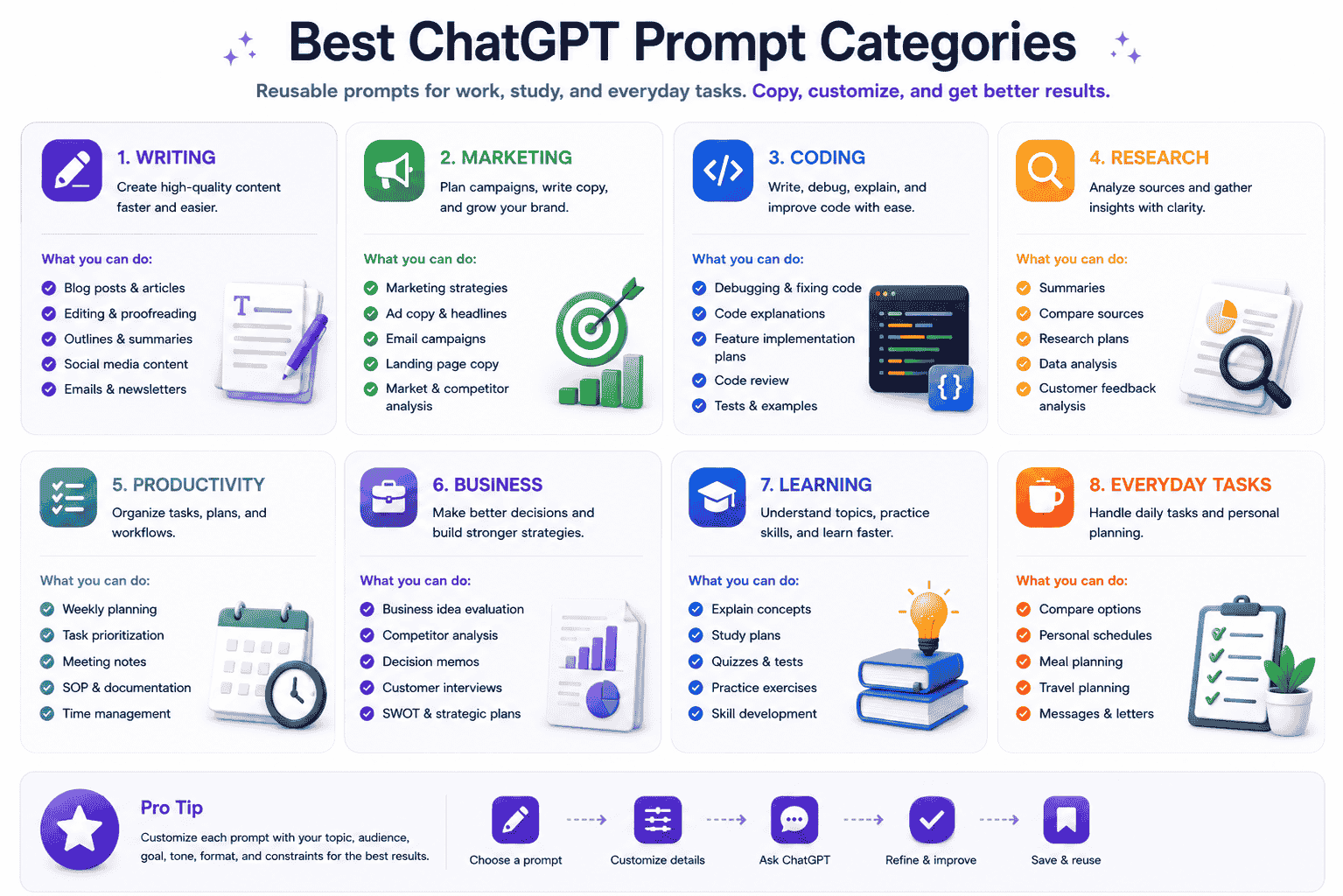
How to Improve Weak ChatGPT Prompts
A prompt does not become better simply because it becomes longer.
The goal is to add information that helps ChatGPT understand the task and produce a more useful output.
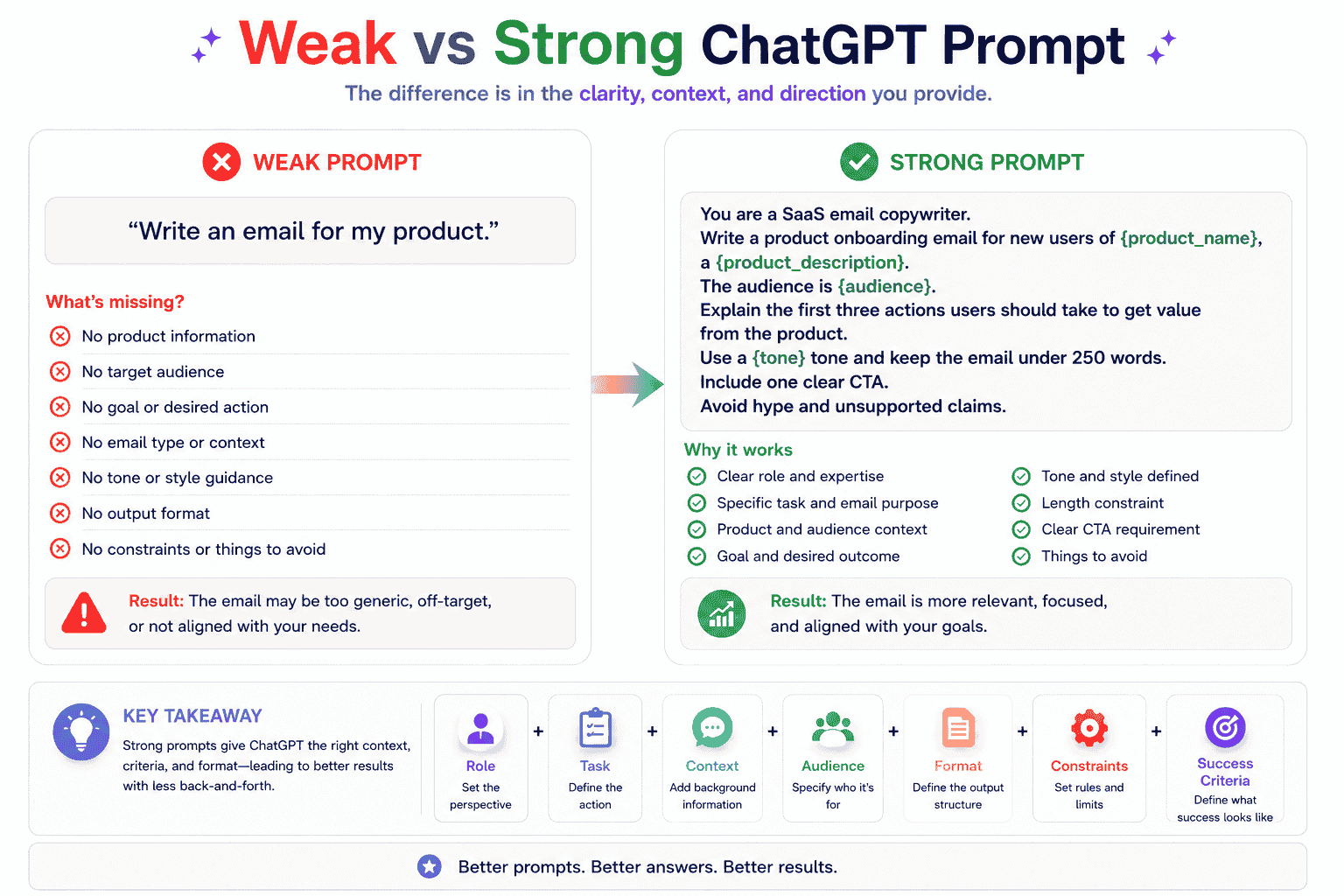
Consider this weak prompt:
Write an email for my product.
The prompt does not explain:
- What the product is
- Who will receive the email
- What action the reader should take
- What tone should be used
- What type of email is needed
- What claims should be avoided
A stronger version would be:
You are a SaaS email copywriter. Write a product onboarding email for new users of {product_name}, a {product_description}. The audience is {audience}. Explain the first three actions users should take to get value from the product. Use a friendly and practical tone. Keep the email under 250 words and include one clear CTA. Avoid hype and unsupported claims.
To improve a weak prompt, review these elements:
- Task: What should ChatGPT do?
- Context: What background information does it need?
- Audience: Who is the output for?
- Goal: What should the output achieve?
- Format: How should the response be structured?
- Constraints: What should be included, limited, or avoided?
- Success criteria: What would make the answer useful?
For a complete optimization process, read AI Prompt Optimization How to Improve Weak Prompts for Better AI Results.
Common Mistakes When Using ChatGPT Prompts
1. Using Prompts Without Customizing Them
A copied prompt still needs context.
Replace placeholders and add information that reflects your actual task, audience, resources, and constraints.
2. Asking for Too Many Unrelated Tasks at Once
A single prompt that asks ChatGPT to research, plan, write, edit, evaluate, and publish something may produce shallow results.
For complex workflows, divide the task into clear stages.
3. Leaving the Output Format Undefined
If you need a table, checklist, JSON object, outline, or email, specify it directly.
4. Adding Unnecessary Roles
A role should provide a useful perspective.
Adding several exaggerated roles does not automatically improve the answer and may make the task less focused.
5. Treating AI Output as Automatically Correct
ChatGPT may produce inaccurate, outdated, incomplete, or unsupported information.
Review important facts, code, calculations, references, and recommendations before relying on them.
6. Not Providing Source Material
When you want ChatGPT to summarize, analyze, or rewrite something, provide the relevant content whenever possible.
7. Asking ChatGPT to Invent Missing Information
For research, analysis, and business tasks, tell ChatGPT to identify missing information rather than guessing.
8. Using the First Prompt Version as the Final Version
Test the prompt, evaluate the output, and refine the instructions when the result does not meet your goal.
How PrompTessor Helps With ChatGPT Prompts
PrompTessor helps users create and manage prompts as part of a broader AI prompt workflow.
You can start with a rough idea, generate a structured prompt, analyze its quality, optimize weak elements, refine it with feedback, and save the best version for future use.
PrompTessor can support different stages of working with ChatGPT prompts:
- Generate prompts from ideas, goals, and tasks
- Analyze prompt clarity, specificity, context, structure, and constraints
- Create optimized prompt versions
- Refine prompts using feedback
- Reformat prompts into structured formats
- Save useful prompts in a reusable Prompt Library
- Track previous prompts and versions through Prompt History
This can be useful when you want to turn one-time ChatGPT instructions into reusable prompt assets for writing, marketing, coding, research, business, or everyday workflows.
FAQ About ChatGPT Prompts
What are ChatGPT prompts?
ChatGPT prompts are instructions, questions, context, examples, or source material given to ChatGPT to guide the response it generates.
What makes a good ChatGPT prompt?
A good ChatGPT prompt usually includes a clear task, relevant context, target audience, goal, output format, constraints, and success criteria.
How can I get better answers from ChatGPT?
Provide more specific instructions, include relevant context, define the output format, set useful constraints, and explain what a successful answer should accomplish.
Should ChatGPT prompts be long?
Not necessarily. A prompt should be long enough to provide useful direction but concise enough to remain focused. Relevant information is more important than word count.
Can I reuse ChatGPT prompts?
Yes. You can create reusable prompts by replacing task-specific information with variables such as {topic}, {audience}, {goal}, and {tone}.
Do these prompts work with other AI models?
Many of the same prompt structures can be adapted for other AI models, although the output may vary between tools and model versions.
Can ChatGPT prompts guarantee accurate results?
No. Better prompts can improve clarity and relevance, but important facts, calculations, code, and recommendations should still be independently reviewed.
How do I improve a weak ChatGPT prompt?
Identify what is missing, then add a clearer task, useful context, audience, output format, constraints, examples when necessary, and success criteria.
Can PrompTessor create ChatGPT prompts?
Yes. PrompTessor helps users generate, analyze, optimize, refine, save, and reuse prompts that can be used with ChatGPT and other AI models.
Build Better Workflows With Reusable ChatGPT Prompts
The best ChatGPT prompts are not necessarily the longest or most complicated.
They are the prompts that communicate your intent clearly.
When ChatGPT understands the task, context, audience, format, constraints, and expected result, it has a better foundation for producing a useful answer.
Start with one of the reusable prompts in this guide, replace the placeholders, test the output, and refine the instructions based on what you receive.
Over time, the prompts that work well can become reusable assets for your writing, marketing, coding, research, productivity, business, learning, and everyday workflows.
Do not collect more prompts than you can use. Build prompt workflows that you can improve and reuse.
Build better prompts in one workspace
Generate prompts from ideas, analyze and optimize quality, refine with feedback, reverse-engineer content, and save reusable prompts in your Prompt Library.
Try PrompTessor Free