AI Prompt Optimization How to Improve Weak Prompts for Better AI Results
AI tools can produce impressive results, but the quality of those results still depends heavily on the prompt.
A clear prompt can help an AI model understand your goal, context, audience, format, and constraints. A weak prompt can lead to vague, generic, or incomplete answers.
This is why AI prompt optimization matters.
Prompt optimization is the process of improving a weak or incomplete prompt so it gives the AI better direction. Instead of asking AI a vague question and hoping for a good answer, you improve the prompt before using it.
A better prompt can help AI produce outputs that are more accurate, relevant, structured, and useful.
In this guide, you will learn what AI prompt optimization is, why weak prompts produce weak outputs, how to identify prompt problems, and how to improve prompts step by step for better AI results.
Quick Answer
AI prompt optimization is the process of improving a prompt so an AI model can better understand the task, context, audience, output format, and constraints. A strong optimized prompt is usually clearer, more specific, better structured, and easier for AI tools like ChatGPT, Claude, Gemini, and other models to follow.
Key Takeaways
- AI prompt optimization helps turn weak prompts into clearer and more useful instructions.
- Weak prompts often fail because they lack context, structure, audience, output format, or constraints.
- A good optimized prompt should include a clear task, useful context, output format, constraints, and success criteria.
- Prompt optimization is different from prompt refinement because optimization improves the core prompt quality, while refinement adjusts the prompt based on feedback or a specific goal.
- PrompTessor helps users analyze, optimize, refine, save, and reuse better prompts inside a complete AI prompt workspace.
Table of Contents
- What Is AI Prompt Optimization?
- Why Weak Prompts Produce Weak AI Outputs
- Common Signs of a Weak Prompt
- Before and After Prompt Optimization Examples
- How to Optimize AI Prompts Step by Step
- Prompt Optimization vs Prompt Engineering
- Prompt Optimization vs Prompt Refinement
- Prompt Optimization for ChatGPT Claude Gemini and Other AI Models
- Common Prompt Optimization Mistakes
- How PrompTessor Helps With AI Prompt Optimization
- FAQ About AI Prompt Optimization
- Start Optimizing Better Prompts With PrompTessor
What Is AI Prompt Optimization?
AI prompt optimization is the process of improving a prompt so an AI model can produce a better output.
It usually involves making the prompt clearer, more specific, better structured, and more complete.
A prompt can be optimized by adding:
- A clearer task
- More useful context
- A target audience
- A desired output format
- Constraints
- Examples
- Success criteria
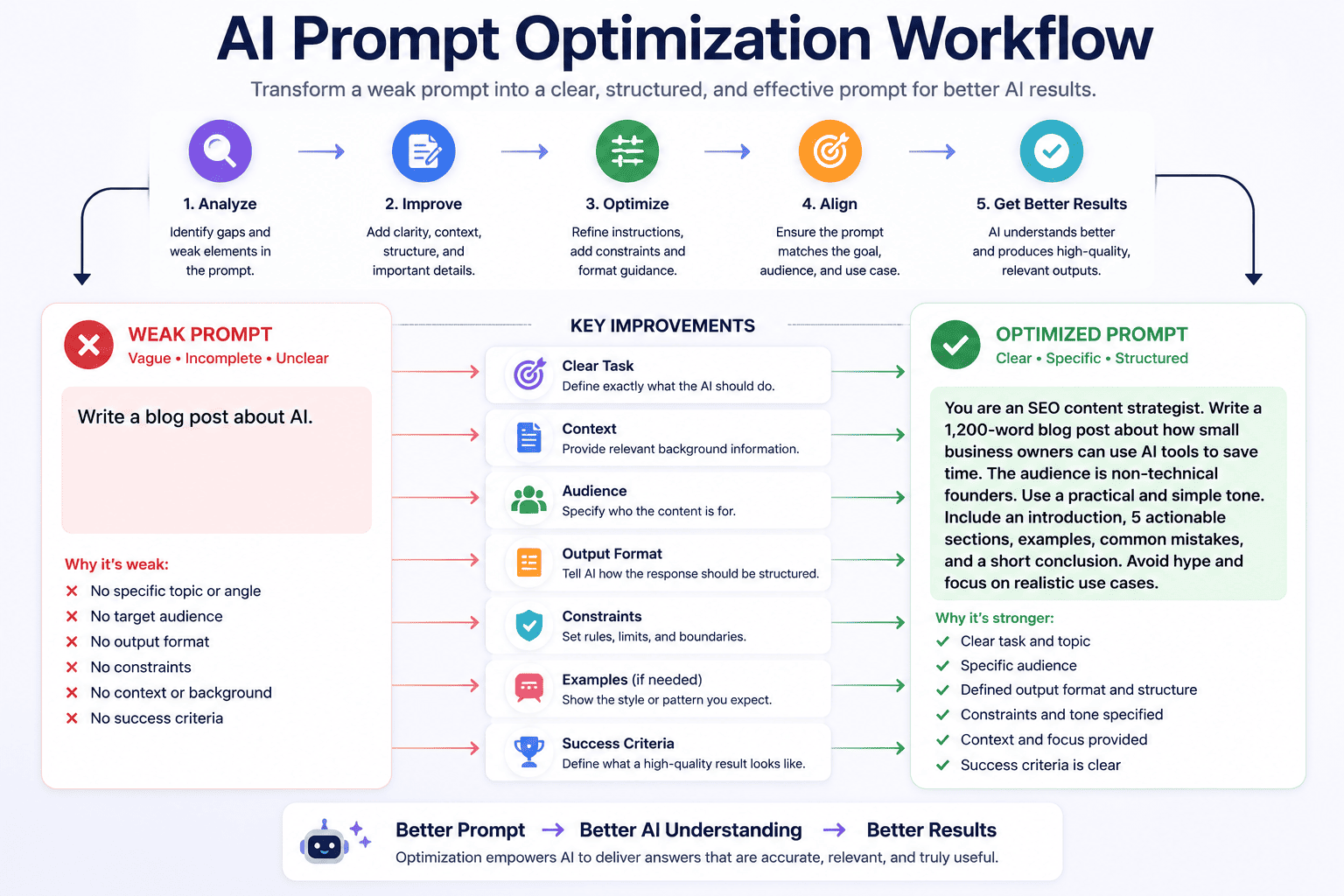
For example, this is a weak prompt:
Write a blog post about AI.
This prompt may produce an answer, but the output will likely be broad because the AI does not know the audience, goal, tone, length, structure, or topic angle.
An optimized version could be:
You are an SEO content strategist. Write a 1,200-word blog post about how small business owners can use AI tools to save time. The audience is non-technical founders. Use a practical and simple tone. Include an introduction, 5 actionable sections, examples, common mistakes, and a short conclusion. Avoid hype and focus on realistic use cases.
The optimized prompt is stronger because it gives the AI clearer direction.
Why Weak Prompts Produce Weak AI Outputs
AI models can generate useful answers, but they do not automatically know what you want unless the prompt explains it well.
If a prompt is too vague, the AI has to guess.
For example:
Give me marketing ideas.
This prompt does not explain the product, audience, budget, channel, campaign goal, brand voice, or timeline.
Because of that, the AI may return generic ideas such as posting on social media, running ads, writing blog posts, or sending emails.
Those ideas are not always wrong, but they may not be useful.
A better prompt would explain the situation:
You are a SaaS growth marketer. Give me 10 low-budget marketing ideas for launching an AI writing tool for solo founders. Focus on SEO, founder-led content, directories, social proof, and community distribution. Return the ideas in a table with effort level, expected impact, and execution steps.
This prompt gives the AI a clearer path.
Weak prompts usually produce weak outputs because they miss important information. A prompt without context creates generic answers. A prompt without format creates messy answers. A prompt without constraints may become too long, too broad, or irrelevant.
Prompt optimization helps fix those problems before the output is generated.
Common Signs of a Weak Prompt
A weak prompt is not always obvious. Sometimes a prompt looks fine, but the output still feels generic or incomplete.
Here are common signs that a prompt needs optimization.
1. The Task Is Too Vague
If the AI does not know exactly what to do, the response will likely be broad.
Weak prompt:
Help me with my website.
Better direction:
Review this landing page copy and suggest improvements for clarity, positioning, CTA strength, and conversion flow.
2. The Prompt Has No Context
Context helps the AI understand the background behind the task.
Without context, the AI may give advice that is technically correct but not relevant to your situation.
3. The Audience Is Missing
A response for beginners should not sound the same as a response for developers, marketers, executives, students, or founders.
Adding the target audience helps the AI adjust language, depth, examples, and tone.
4. The Output Format Is Undefined
If you want a table, checklist, JSON object, email draft, content brief, or step-by-step plan, say it clearly.
Without format instructions, the AI may return a structure that is hard to use.
5. The Prompt Has No Constraints
Constraints help control the output.
Examples:
- Keep it under 500 words
- Use simple English
- Do not use hype words
- Return only valid JSON
- Include examples
- Avoid unsupported claims
6. The Prompt Is Too Broad
A prompt that asks for too many things at once may produce a shallow answer.
If the task is complex, break it into sections or define the output structure clearly.
Before and After Prompt Optimization Examples
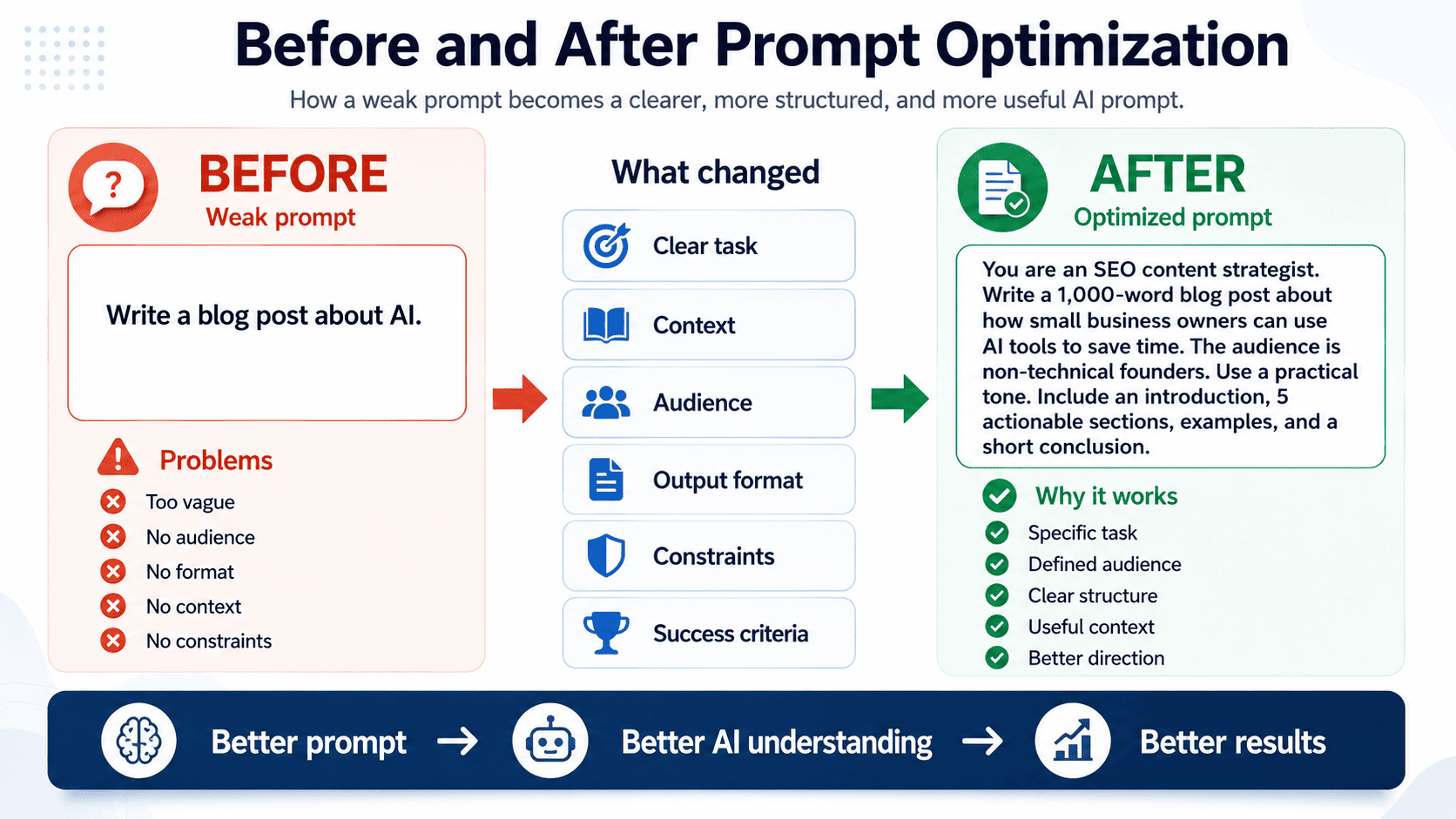
The easiest way to understand prompt optimization is to compare weak prompts with improved versions.
Example 1 Content Writing
Weak prompt:
Write an article about productivity.
Optimized prompt:
You are a productivity writer. Write a 1,000-word article about practical productivity habits for remote workers. The audience is busy professionals who struggle with focus. Include an introduction, 5 actionable tips, examples, common mistakes, and a short conclusion. Use a friendly and practical tone. Avoid generic advice like “make a to-do list” unless you explain how to apply it realistically.
Example 2 Marketing
Weak prompt:
Create ad copy for my app.
Optimized prompt:
You are a performance marketer. Create 10 ad copy variations for {app_name}, a productivity app for solo founders. Focus on saving time, reducing task overload, and helping users stay organized. Include headline, primary text, CTA, and angle for each variation. Use direct language and avoid exaggerated claims.
Example 3 Coding
Weak prompt:
Fix this code.
Optimized prompt:
You are a senior JavaScript developer. Review the following code and identify the likely cause of the bug. Explain the issue, suggest a safe fix, and provide the corrected code. Also mention any edge cases I should test. Do not rewrite unrelated parts of the code.
Example 4 Research
Weak prompt:
Summarize this article.
Optimized prompt:
You are a research assistant. Summarize the following article for a non-technical audience. Include the main argument, key findings, supporting evidence, limitations, and 3 practical takeaways. Use clear language and avoid adding information that is not in the source.
How to Optimize AI Prompts Step by Step
Prompt optimization becomes easier when you follow a repeatable process.
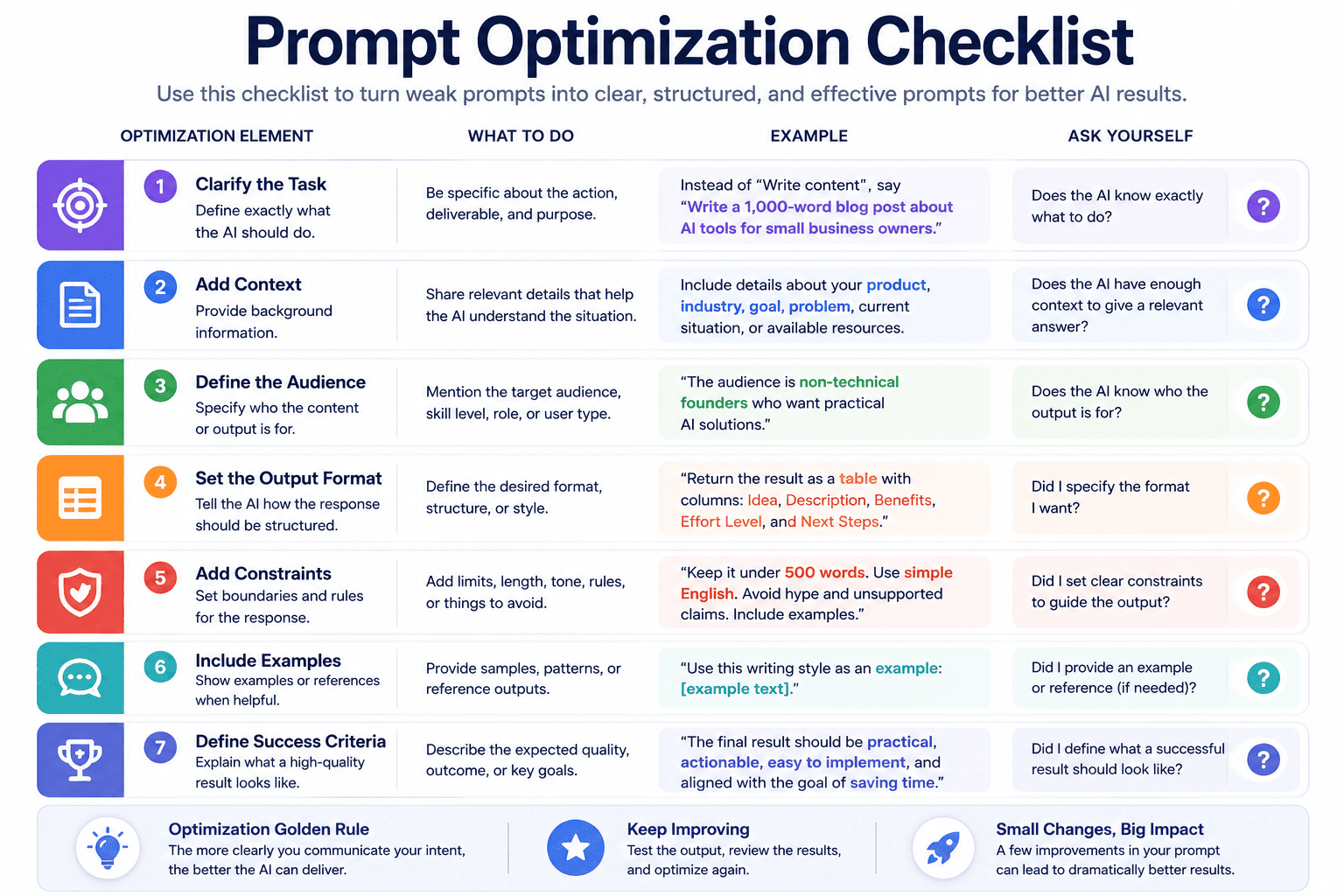
Step 1 Clarify the Task
Start by making the task specific.
Instead of saying:
Help me write content.
Say what kind of content you need:
Create a blog outline for an article about AI prompt optimization.
The AI should know exactly what action to perform.
Step 2 Add Context
Context explains the situation behind the prompt.
You can include:
- Product details
- Business goal
- Background information
- Target user
- Source material
- Current problem
- Desired outcome
More relevant context usually leads to more useful results.
Step 3 Define the Audience
The audience affects tone, examples, depth, and language.
For example, a prompt for beginners should ask for simple explanations. A prompt for developers can include technical terms. A prompt for executives should focus on strategy and decisions.
Step 4 Set the Output Format
Output format makes the response easier to use.
Examples:
- Return the answer as a table
- Use bullet points
- Create a Markdown outline
- Return valid JSON
- Write an email draft
- Create a step-by-step plan
Step 5 Add Constraints
Constraints help prevent unwanted outputs.
For example:
Keep the answer under 700 words. Use simple English. Avoid hype words. Include examples. Do not make unsupported claims.
Constraints give the AI boundaries.
Step 6 Include Examples When Useful
Examples help the AI understand the style, format, or quality level you want.
If you want a certain tone or structure, include a short example or describe the pattern clearly.
Step 7 Add Success Criteria
Success criteria explain what a good output should achieve.
Example:
The final result should be practical, specific, easy to execute, and suitable for a solo founder with limited time.
This helps the AI understand the standard you want.
Prompt Optimization vs Prompt Engineering
Prompt optimization and prompt engineering are related, but they are not exactly the same.
Prompt engineering is the broader practice of designing prompts, workflows, instructions, examples, and systems that guide AI behavior.
Prompt optimization is more focused. It is the process of improving a specific prompt so it performs better.
| Concept | Meaning | Example |
|---|---|---|
| Prompt Engineering | The broader practice of designing effective AI instructions and workflows | Building a full AI workflow for research, content, or automation |
| Prompt Optimization | Improving a specific prompt for better output quality | Adding context, structure, constraints, and output format to a weak prompt |
For a broader foundation, read What Is Prompt Engineering?.
Prompt Optimization vs Prompt Refinement
Prompt optimization and prompt refinement are also related, but they happen at slightly different stages.
Prompt optimization improves the core quality of a prompt. It fixes missing context, vague tasks, weak structure, unclear format, and poor constraints.
Prompt refinement usually happens after that. It adjusts the prompt based on feedback, preferences, model behavior, tone, format, or specific use case.
For example:
- Optimization makes the prompt clearer and stronger.
- Refinement makes the prompt more suitable for a specific goal.
A prompt may be optimized first, then refined several times.
This is why a complete AI prompt workflow often includes both optimization and refinement.
Prompt Optimization for ChatGPT Claude Gemini and Other AI Models
AI prompt optimization is useful across many AI models.
Whether you use ChatGPT, Claude, Gemini, image generation tools, coding assistants, or other AI systems, the same basic principles still matter.
A strong prompt usually includes:
- Clear task
- Useful context
- Target audience
- Output format
- Constraints
- Examples
- Success criteria
However, different models may respond differently.
For ChatGPT, direct instructions and clear formatting often work well. For Claude, longer context and structured evaluation criteria can be useful. For Gemini, prompts may include multimodal context such as images, documents, or visual references.
The goal is not to create a completely different prompt for every model. The goal is to create a strong base prompt that can be adapted when needed.
For model-agnostic prompt workflows, you can read AI Prompt Generator for Any AI Model.
Common Prompt Optimization Mistakes
Prompt optimization can improve AI results, but only when done carefully.
1. Making the Prompt Longer Without Making It Clearer
A longer prompt is not always better.
The goal is not to add more words. The goal is to add useful direction.
2. Adding Too Many Instructions
If a prompt contains too many unrelated instructions, the AI may lose focus.
Keep the prompt structured and purposeful.
3. Forgetting the Output Format
Many users add context but forget to define the output format.
If you need a table, outline, JSON object, checklist, or draft, specify it clearly.
4. Not Defining the Audience
Without an audience, the AI may use the wrong level of detail or tone.
A prompt for beginners should not be optimized the same way as a prompt for experts.
5. Using Generic Constraints
Constraints should match the task.
For example, “be concise” is helpful, but “keep the answer under 300 words and include only 5 bullet points” is more specific.
6. Treating the First Optimized Prompt as Final
The first optimized version may be better than the original, but it may still need refinement.
Test the prompt, review the output, and improve it when needed.
How PrompTessor Helps With AI Prompt Optimization
PrompTessor helps users improve prompts inside a broader AI prompt workspace.
Instead of manually guessing why a prompt is weak, users can analyze prompt quality, identify missing elements, generate optimized versions, refine prompts with feedback, and save useful prompts for future use.
PrompTessor helps with AI prompt optimization by supporting key workflow steps:
- Analyze prompt quality
- Identify weak or missing prompt elements
- Improve clarity, specificity, context, structure, and constraints
- Generate optimized prompt versions
- Refine prompts based on feedback
- Save optimized prompts in a Prompt Library
- Track prompt changes through Prompt History and Versioning
This makes PrompTessor useful for creators, marketers, developers, founders, students, researchers, prompt engineers, and everyday AI users who want better results from AI tools.
For a broader overview of the product, read Understanding PrompTessor.
FAQ About AI Prompt Optimization
What is AI prompt optimization?
AI prompt optimization is the process of improving a prompt so an AI model can better understand the task, context, audience, output format, and constraints. The goal is to get more useful and consistent AI results.
How do you optimize an AI prompt?
To optimize an AI prompt, clarify the task, add context, define the audience, set the output format, add constraints, include examples when useful, and explain what a successful result should look like.
Why are my AI prompts not working well?
Your prompts may not work well if they are vague, missing context, too broad, lacking output format, or missing constraints. Prompt optimization helps fix these issues.
What is the difference between prompt optimization and prompt engineering?
Prompt engineering is the broader practice of designing effective AI instructions and workflows. Prompt optimization focuses on improving a specific prompt so it produces better results.
What is the difference between prompt optimization and prompt refinement?
Prompt optimization improves the core quality of a prompt. Prompt refinement adjusts the prompt further based on feedback, tone, format, model behavior, or a specific use case.
Can prompt optimization improve ChatGPT outputs?
Yes. Prompt optimization can improve ChatGPT outputs by making the task clearer, adding relevant context, defining the output format, and setting useful constraints.
Does prompt optimization work for Claude and Gemini?
Yes. The same core principles of prompt optimization can work across Claude, Gemini, and other AI models, although each model may respond differently to formatting, context, and detail level.
Can PrompTessor optimize AI prompts?
Yes. PrompTessor helps users analyze prompt quality, generate optimized prompt versions, refine prompts with feedback, and save reusable prompts in a Prompt Library.
Start Optimizing Better Prompts With PrompTessor
Better AI results often start with better prompts.
If your prompts are too vague, too broad, or missing important details, the output will usually reflect that.
AI prompt optimization helps you improve weak prompts by adding clarity, context, structure, constraints, and better output direction.
Instead of rewriting prompts manually or guessing what went wrong, you can use a structured workflow to analyze and improve them.
PrompTessor helps users generate, analyze, optimize, refine, save, and reuse better prompts inside one AI prompt workspace.
If you want better AI outputs, start by optimizing the prompt.
Build better prompts in one workspace
Generate prompts from ideas, analyze and optimize quality, refine with feedback, reverse-engineer content, and save reusable prompts in your Prompt Library.
Try PrompTessor Free