What Is Prompt Engineering? How to Write Better AI Prompts
You ask an AI tool to write a product launch email.
The first result sounds generic.
You try again with more details.
The tone gets better, but it still misses the audience.
You try one more time, and the result finally becomes usable, but the structure still needs editing.
This is a common experience for many AI users.
The problem is not always the AI model. In many cases, the real issue is the prompt.
That is why people search for what is prompt engineering. They are not only looking for a technical definition. They want to understand how to get better, clearer, and more useful results from AI.
Prompt engineering is the practical skill of giving AI better instructions so it can return better outputs.
Instead of typing a vague request and hoping for the best, prompt engineering helps you define the task, provide context, shape the output, set constraints, test the result, and refine the prompt until it works more reliably.
In simple terms:
Prompt engineering is how you communicate better with AI.
Quick Answer
Prompt engineering is the practice of writing clear, structured instructions that help AI models understand a task, use the right context, follow constraints, and return a more useful output. A strong prompt usually defines the goal, audience, format, context, and boundaries of the response.
Key Takeaways
- Prompt engineering helps AI understand what task to perform and how the output should be structured.
- A strong prompt usually includes context, a clear goal, audience, output format, and useful constraints.
- Good prompting is not about magic words. It is about reducing ambiguity.
- Prompt quality improves when you test, evaluate, optimize, and refine prompts over time.
- Tools like PrompTessor can help analyze prompt quality, generate optimized prompt versions, refine prompts with feedback, and manage prompt history.
Why Prompt Engineering Is a Skill You Need Now
Most AI frustration comes from a simple mismatch. You know what outcome you want, but the model only sees the words you typed. If your request is broad, under-specified, or missing context, the output often sounds polished while still being wrong.
That is why prompt engineering matters. It is the discipline of turning intent into instructions a model can follow. Instead of treating prompting like casual chat, you treat it like task design.
The Business Reason People Are Paying Attention
Prompt engineering is not a niche hobby anymore. Grand View Research estimates that the global prompt engineering market was valued at USD 222.1 million in 2023, with projections reaching USD 2.06 billion by 2030, implying a CAGR of 32.8% from 2024 to 2030, according to Grand View Research's prompt engineering market report.
That growth shows something important: people are not only experimenting with AI. They are starting to build repeatable workflows around it.
When a prompt is used once, trial and error may be acceptable.
But when a prompt is reused in a business process, content workflow, support system, internal tool, or AI-powered product, it needs to be more reliable.
A reusable prompt should be treated more like a workflow asset, not just a casual chat message.
What Changes When You Approach Prompting as a Skill
When people first use a chatbot, they often write prompts like they are texting a colleague. That works for light brainstorming. It breaks down when accuracy, structure, and repeatability matter.
A stronger prompt usually does a few things at once:
- Defines the task clearly so the model knows what job it is doing.
- Adds context so the answer fits your situation, not a generic average case.
- Specifies the format so the result is ready for use.
- Sets boundaries so the model does not wander into extra assumptions.
A marketer might ask, “Write a LinkedIn post about our new analytics feature.” That prompt may produce decent copy. But if the true need is a post for SaaS founders, under a certain length, with one customer pain point and one call to action, the original prompt was missing the conditions that matter.
Prompt engineering closes that gap. It reduces cleanup, helps teams standardize outputs, and makes AI more useful for recurring work.
Where People Get Confused
Many readers assume prompt engineering means memorizing special phrases. It does not. There are useful patterns, but there is not a magic formula that fixes every task.
The core skill is clearer than that. You are designing instructions so the model can interpret your request with less ambiguity. The better you define the job, the better chance the model has of doing it well.
Prompt Engineering Is a Skill, Not a Trick
Many people think prompt engineering means finding the perfect phrase.
But good prompting is not about magic words.
It is about designing clear instructions.
A good prompt usually answers questions like:
- What should the AI do?
- What context does it need?
- Who is the output for?
- What format should the answer follow?
- What should the AI avoid?
- How should success be judged?
For example, this prompt is vague:
Analyze this meeting transcript.
A better version is:
Analyze this meeting transcript and return three sections: Key Decisions, Open Questions, and Next Steps. Write for a project manager who needs a quick summary before the next team meeting.
The improved version does not use complicated language. It simply gives the AI a clearer job.
That is the core of prompt engineering.
You are not trying to make prompts sound impressive. You are trying to make them easier for AI to follow.
The Art and Science of AI Communication
A helpful way to understand prompt engineering is to think of the AI model as a talented actor and the prompt as the direction it receives.
A director does not simply say, “Do it better.” They give context, intention, emotional cues, scene direction, and the expected outcome.
Effective prompts work in a similar way. They guide the AI toward a clearer performance by explaining what the task is, what matters, what to avoid, and what the final output should look like.

Why Wording Alone Is Not Enough
People often reduce prompt engineering to “better wording.” But wording is only one part of the process.
A strong prompt also defines the role, context, input boundaries, output structure, audience, and success criteria.
For example, if you tell an AI, “Analyze this meeting transcript,” you may get a loose summary.
But if you say, “Analyze this meeting transcript and return three sections: Risks, Decisions, and Next Steps. Write for an executive audience that needs a quick update before the next planning meeting,” you have moved from a vague request to a controlled task.
The second prompt is better because it tells the AI what to analyze, how to structure the answer, who the answer is for, and what kind of output is useful.
How the Discipline Became Repeatable
Early AI users often treated prompts as one-time instructions. They typed something, looked at the result, and tried again if the answer was not good enough.
That can work for casual use, but it becomes unreliable when prompts are used for real workflows.
Over time, prompt engineering becomes more repeatable when users start applying structured methods such as:
- Zero-shot prompting: asking the AI to complete a task without examples.
- One-shot prompting: giving one example to anchor the style or format.
- Few-shot prompting: giving multiple examples so the AI can follow a pattern.
- Prompt chaining: breaking a complex workflow into smaller prompt steps.
- Structured output prompting: defining the exact format the AI should return.
A strong prompt usually combines intention and scaffolding. It tells the AI what to do and shows what a successful output should look like.
This is why prompt engineering sits between art and science. The art is in expressing human intent clearly. The science is in structuring and testing the prompt so it performs consistently.
For example, if a team wants AI to turn raw interview notes into customer insight summaries, a casual prompt may work once. But a structured prompt with examples, labels, and formatting rules can become a reusable asset for the whole team.
That is the point where prompting stops being clever wording and becomes a repeatable workflow.
The Six Pillars of an Effective Prompt
When people ask what makes a prompt “good,” they often expect a hidden trick. In practice, good prompts are usually built from a small set of visible qualities. If you strengthen those qualities, the model has less room to guess wrong.

At PrompTessor, prompt quality is often viewed through six core dimensions:
- Clarity
- Specificity
- Context
- Goal orientation
- Structure
- Constraints
These six pillars help explain why some prompts work better than others.
Six Ways Strong Prompts Reduce Confusion
Strong prompts reduce confusion by making the task easier for the AI to understand. They do not rely on secret phrases. They make the task, context, and expected output visible.
1. Clarity
Clarity means the prompt is easy to understand.
A clear prompt tells the AI exactly what task it needs to complete.
Weak prompt:
Make this better.
Improved prompt:
Rewrite this product description in simple English for first-time buyers.
2. Specificity
Specificity means the prompt avoids vague instructions.
Weak prompt:
Write a summary.
Improved prompt:
Summarize this report in five bullet points for a sales manager.
3. Context
Context gives the AI the background it needs to produce a relevant answer.
Weak prompt:
Draft an email update.
Improved prompt:
Draft an email update to our executive team about a delayed mobile app release. Mention the cause, revised timeline, and next steps.
4. Goal Orientation
Goal orientation means the prompt explains the desired outcome.
Weak prompt:
Talk about our pricing page.
Improved prompt:
Identify three reasons our pricing page may confuse trial users and suggest improvements to increase plan selection clarity.
5. Structure
Structure organizes the prompt so the AI can follow it more easily.
Weak prompt:
Review this landing page and tell me what you think.
Improved prompt:
Review this landing page copy. Return your answer in three sections: Messaging Issues, Missing Objections, and CTA Improvements.
6. Constraints
Constraints define the boundaries of the output.
Weak prompt:
Write a response.
Improved prompt:
Write a response under 120 words, in a calm tone, without making legal claims.
Constraints help keep the AI output aligned with your needs. They can control length, tone, format, risk, style, audience, and content boundaries.
What These Pillars Look Like in Practice
Notice what changed in each pair above. The improved version did not use secret keywords. It reduced ambiguity.
That matters because ambiguity creates extra work. Someone has to re-prompt, reformat, verify, or rewrite the output.
A useful checklist for prompt review looks like this:
| Pillar | Question to Ask |
|---|---|
| Clarity | Could two people read this prompt and interpret it the same way? |
| Specificity | Have I clearly stated what kind of output I want? |
| Context | Did I provide the background the AI needs? |
| Goal orientation | Is the desired outcome clear? |
| Structure | Is the prompt organized enough for the AI to follow easily? |
| Constraints | Have I set the boundaries that matter? |
Practical shortcut: When a prompt fails, do not only ask “Was the model bad?” Ask which pillar was weak.
This framework is useful when evaluating prompts manually or with prompt optimization software. Each pillar points to a different type of improvement. If the prompt lacks clarity, rewrite the instruction. If it lacks context, add relevant background. If it lacks constraints, define clearer boundaries.
That shift is important. You stop treating prompt quality as a gut feeling and start diagnosing it like a design problem.
What Makes a Prompt Good?
A good prompt does not have to be long. It has to be useful.
Some prompts are short and effective because the task is simple. Other prompts need more context because the task is complex.
The goal is not to add more words. The goal is to remove confusion.
A good prompt usually includes:
- A clear task: What should the AI do?
- Relevant context: What background does the AI need?
- A defined audience: Who is the output for?
- A specific format: How should the response be structured?
- Useful constraints: What should the AI include or avoid?
- Success criteria: What would make the answer useful?
When these elements are missing, AI has to fill in the gaps. That is when outputs become generic, incomplete, or misaligned.
Common Prompting Patterns and Techniques
Once you understand the basics, you can start using different prompting techniques depending on the task.
There is no single best prompt for every situation. The best prompt depends on what you want the AI to do.
Zero-Shot Prompting
Zero-shot prompting means asking the AI to complete a task without giving examples.
Example:
Summarize this article in five bullet points.
One-Shot Prompting
One-shot prompting gives the AI one example before asking it to complete a similar task.
Few-Shot Prompting
Few-shot prompting gives the AI multiple examples. This is helpful when you want consistent output, such as classification, tagging, content formatting, or style matching.
Chain-of-Thought Style Prompting
Chain-of-thought style prompting is useful for complex reasoning tasks. Instead of asking the AI to jump directly to the answer, you guide it through a structured evaluation process.
Prompt Chaining
Prompt chaining means breaking a larger workflow into smaller steps.
- Step 1: Summarize customer feedback.
- Step 2: Extract the main pain points.
- Step 3: Generate product improvement ideas.
- Step 4: Format the final output for a roadmap discussion.
Retrieval and Function-Oriented Workflows
Retrieval and function-oriented workflows are useful when the AI needs grounded information or access to external tools.
For more practical formats and use cases, you can read this guide on AI prompt examples and techniques.
Comparison of Common Prompting Techniques
| Technique | Description | Best For | Example Snippet |
|---|---|---|---|
| Zero-shot prompting | Give a direct instruction without providing examples. | Simple writing, summarization, or straightforward tasks. | Summarize this transcript in three bullet points. |
| One-shot prompting | Provide one example before asking the AI to complete a similar task. | Tone matching, simple formatting, or style guidance. | Here is one example. Now follow the same format for this item. |
| Few-shot prompting | Provide several examples so the AI can follow a clear pattern. | Classification, extraction, tagging, and consistent formatting. | Here are three examples. Follow the same structure for the new case. |
| Prompt chaining | Split a larger workflow into multiple smaller prompts. | Multi-stage workflows such as research, summarize, rewrite, and format. | Step 1: summarize the input. Step 2: turn the summary into an email. |
People often confuse these prompting patterns with model tricks. They are better understood as task design choices.
How to Evaluate and Iterate on Your Prompts
Prompt engineering is not only about writing prompts. It is also about testing, evaluating, and improving them.
A prompt that works once may not work reliably across different inputs. That is why evaluation matters.

Before rewriting a prompt, ask:
- Did the AI complete the task?
- Was the output accurate and useful?
- Did it follow the requested format?
- Did it stay within the constraints?
- Did it make assumptions?
- Would the output still work with a different input?
This helps you understand what actually needs improvement.
If the output is too generic, the prompt may need more context. If the output is too long, it may need a length constraint. If the structure is wrong, the prompt may need a clearer output format. If the answer misses the goal, the prompt may need a better success definition.
The key is to diagnose the prompt instead of randomly rewriting it.
A Simple Prompt Engineering Workflow
A practical prompt engineering workflow looks like this:
-
Draft the Prompt
Start with the task you want the AI to perform. Include the important context, audience, goal, output format, and constraints so the AI understands what a good answer should look like.
-
Generate the AI Output
Run the prompt and review the response. The goal is not only to get an answer, but to see how well the prompt guides the AI.
-
Evaluate the Output
Check whether the output completed the task, followed the requested format, stayed within the constraints, avoided unsupported assumptions, and matched the intended audience or use case.
-
Optimize and Refine the Prompt
Improve the prompt based on what failed. You may need to add more context, define the output format more clearly, tighten the constraints, clarify the goal, or make the instruction easier to follow.
-
Repeat Until the Output Works
Run the optimized prompt again and compare the result. Prompt engineering becomes stronger when you treat it as an iterative process instead of a one-time request.
-
Save the Prompt for Reuse
If the prompt produces useful results consistently, save it as a reusable prompt for future work. This helps you build a library of prompts that can be improved over time.
This is where prompt engineering becomes more than trial and error. It becomes a repeatable process for creating better AI outputs.
Prompt Engineering Tools and Professional Workflows
As people use AI more often, prompts become harder to manage manually.
A prompt may start as a simple instruction, but over time it may become part of a content workflow, customer support process, internal tool, research system, or automation pipeline.
This creates new problems:
- Which prompt performs best for a specific task?
- What changed between the original prompt and the optimized version?
- Why did the output improve or get worse?
- How do you evaluate prompt quality?
- How do you reuse prompts across projects?
This is where prompt engineering tools can help.
A prompt engineering tool can make it easier to analyze prompt quality, generate optimized prompt versions, refine prompts with feedback, and keep track of prompt history.
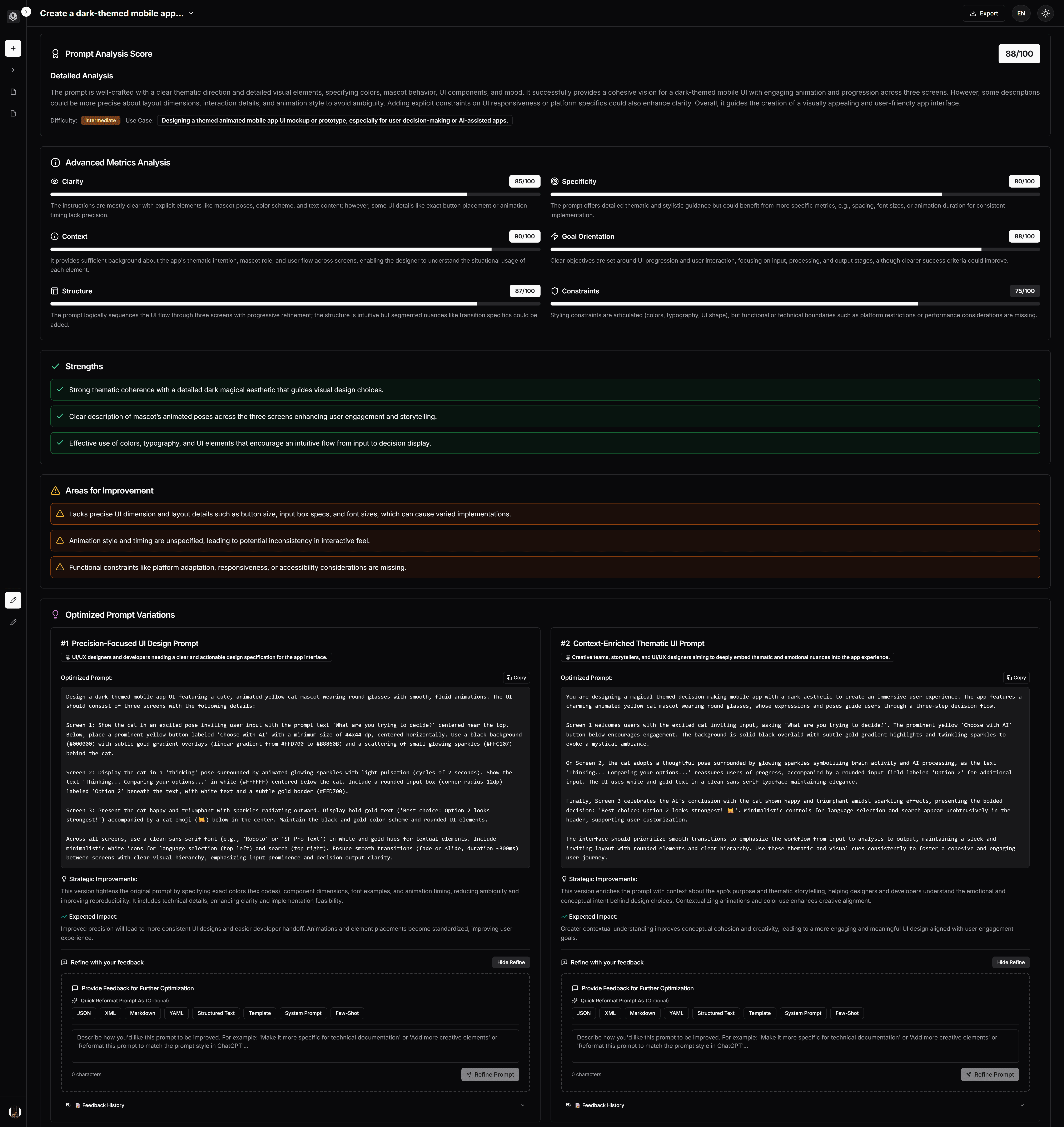
For example, PrompTessor is an AI prompt optimization tool designed to help users analyze prompt quality, get optimization suggestions, generate improved prompt versions, refine prompts with feedback, and manage prompt history in one place.
How PrompTessor Fits Into Prompt Engineering
PrompTessor supports prompt engineering by helping users analyze whether a prompt is clear, specific, contextual, structured, goal-oriented, and properly constrained. It then provides optimization suggestions, improved prompt versions, and refinement options so users can turn weak prompts into reusable workflow assets.
PrompTessor is built for users who want a repeatable prompt engineering workflow, not just one-time prompt rewriting. It connects prompt analysis, prompt optimization, feedback-based refinement, reverse prompting, and prompt history into one workflow.
To learn more about the product behind this workflow, read this overview of the PrompTessor AI prompt optimization tool.
This kind of workflow helps move prompt improvement away from guesswork.
Instead of asking, “Why did this AI output fail?”, you can review the prompt itself and identify what is missing.
What a Professional Prompt Engineering Workflow Looks Like
A strong prompt workflow looks a lot like asset management. Instead of rewriting prompts from scratch every time, users can keep clear versions of prompts for important tasks and improve them over time.
For example, a marketer might keep one prompt for LinkedIn posts, one for email campaigns, and one for product descriptions. A developer might save prompts for code review, documentation, or debugging. Each prompt has a defined purpose, expected input, output rules, and a clear use case.
| Problem | Workflow Response |
|---|---|
| Users rewrite prompts from scratch repeatedly | Track prompt history and optimized versions |
| Users recreate similar prompts repeatedly | Reuse proven prompt structures and saved prompt history |
| Prompt quality depends on gut feel | Use structured analysis, testing, and review |
Prompt Engineering Examples
Here are a few simple examples of how prompt engineering improves AI outputs.
Example 1: Content Writing
Weak prompt:
Write a blog post about productivity.
Improved prompt:
Write a 1,200-word blog post about productivity for remote workers. Use a practical and friendly tone. Include an introduction, five actionable tips, real examples, and a short conclusion.
Example 2: Data Analysis
Weak prompt:
Analyze this data.
Improved prompt:
Analyze this customer purchase dataset. Identify three trends by region, summarize the biggest revenue driver, and suggest two possible business actions.
Example 3: Email Writing
Weak prompt:
Write a follow-up email.
Improved prompt:
Write a polite follow-up email to a potential customer who joined a demo last week but has not replied. Keep it under 120 words and end with a soft question about the next step.
Common Prompt Engineering Mistakes
- Being too vague: The prompt does not explain what the AI should actually do.
- Missing context: The AI does not know the background or audience.
- No output format: The result is hard to use because the structure is undefined.
- Too many goals at once: The prompt asks for too much in one response.
- No constraints: The AI produces content that is too long, too broad, or off-tone.
- Not testing variations: The prompt is judged based on one output instead of repeated use.
The solution is not always to make the prompt longer. Often, the solution is to make the prompt more intentional.
Is Prompt Engineering Still Important as AI Models Improve?
Yes. Better AI models can understand more complex instructions, but they still need clear direction.
As AI models become more capable, prompts may become less about “tricks” and more about communication design. The skill is not just knowing what words to type. It is knowing how to define the task, context, structure, and success criteria.
Careers, Ethics, and the Future of Prompt Engineering
Prompt engineering now appears across many roles, not only in AI or software development. Marketers use it to shape campaign drafts. Product teams use it to define AI feature behavior. Analysts use it to summarize and classify information. Educators use it to create guided explanations and learning materials.
But the skill also comes with responsibility. A prompt can introduce bias, invite fabricated details, or push an AI model into unsafe territory if the instructions are careless.
The future of prompt engineering is not just about writing clever prompts. It is about creating repeatable ways to turn human intent into useful AI outputs.
FAQ About Prompt Engineering
What is prompt engineering in simple terms?
Prompt engineering is the skill of giving AI clear and structured instructions so it can produce more useful, accurate, and relevant outputs.
What makes a good AI prompt?
A good AI prompt usually includes a clear task, relevant context, the target audience, the desired output format, useful constraints, and success criteria.
Is prompt engineering still useful with better AI models?
Yes. Better AI models can understand complex requests, but they still perform better when the task, context, format, and boundaries are clearly defined.
What is the difference between prompt engineering and prompt optimization?
Prompt engineering is the broader practice of designing instructions for AI. Prompt optimization is the process of improving an existing prompt so it produces better or more consistent results.
Can PrompTessor help with prompt engineering?
Yes. PrompTessor helps users analyze prompt quality, identify weak areas, generate optimized prompt versions, refine prompts with feedback, and manage prompt history.
Conclusion
Prompt engineering is the practical skill of giving AI clearer instructions so it can produce better results.
It helps reduce ambiguity, define context, structure outputs, set constraints, and improve AI responses through testing and refinement.
The key idea is simple:
Better prompts lead to better AI results.
Build better prompts in one workspace
Generate prompts from ideas, analyze and optimize quality, refine with feedback, reverse-engineer content, and save reusable prompts in your Prompt Library.
Try PrompTessor Free