AI Agent Reliability: How to Prevent Failures, Recover Safely, and Verify Results
AI agent reliability is easy to misunderstand.
A model can be accurate and the agent can still fail.
The agent may choose the correct tool but call it twice. A payment request may time out after the charge already succeeded. A long-running workflow may crash after six completed steps and restart from the beginning. An agent may lose important state after context compression. A tool may return an error while the agent confidently tells the user the task is complete.
Those are not only model-quality problems.
They are reliability problems.
A reliable AI agent is not an agent that never fails. It is an agent that detects failure, limits damage, preserves valid progress, recovers safely, and never pretends a failed action succeeded.
Modern agent runtimes increasingly treat durability as a separate engineering layer. OpenAI's Agents API is designed for long-running tasks where the managed harness saves progress and provides an environment where agents can work with files, run code, and keep intermediate results. OpenAI's Agents API announcement.
Microsoft Agent Framework provides workflow checkpoints that capture executor state, pending messages, requests, responses, and shared state so workflows can resume later rather than starting over. Its Durable Extension goes further by persisting sessions and workflow progress across distributed workers and recovering after failures. Microsoft workflow checkpoints and Microsoft Durable Extension.
This guide explains how to think about agent reliability as a complete production-system problem.
Quick Answer: What Is AI Agent Reliability?
AI agent reliability is the ability of an agent system to produce correct and verifiable outcomes consistently, recover safely from expected failures, avoid duplicating external side effects, preserve valid state, and stop or escalate when it cannot continue safely.
GOAL
  ↓
PLAN / ACT
  ↓
TOOL OR EXTERNAL ACTION
  ↓
OBSERVE REAL RESULT
  ↓
DID IT SUCCEED?
  ├─ YES → UPDATE DURABLE STATE
  │        ↓
  │      VERIFY
  │
  └─ NO / UNKNOWN
          ↓
CLASSIFY FAILURE
          ↓
SAFE TO RETRY?
  ├─ YES → bounded retry
  ├─ NO  → reconcile / alternate path
  └─ UNCLEAR → stop / human review
          ↓
RECOVER OR FAIL GRACEFULLY
The key word is verifiable. Reliability should be based on what actually happened in the system, not what the model expected to happen.
Key Takeaways
- Agent reliability is broader than model accuracy.
- Tool execution, state persistence, retries, approvals, external systems, and verification all affect whether an agent is reliable.
- A timeout means the result may be unknown. It does not prove that a write failed.
- Retries should be bounded and applied only when repeating the operation is safe.
- Mutating operations should be idempotent or reconcilable whenever possible.
- Long-running agents need durable checkpoints so valid progress survives crashes and restarts.
- Checkpointing does not by itself prove whether an external side effect committed.
- Agents should distinguish retryable infrastructure failure from invalid input, permission failure, policy failure, and business-rule failure.
- Loop detection and execution budgets prevent agents from spending indefinitely without making progress.
- Completion should be verified against external state or explicit success criteria.
- Graceful failure is a valid outcome: blocked, partial, or needs-human-review can be more reliable than a fabricated success.
- Reliability improves through traces, evaluations, incident review, and turning repeated failures into regression tests.
Table of Contents
- What Is AI Agent Reliability?
- Why Agent Reliability Is Harder Than LLM Reliability
- The AI Agent Reliability Model
- Common Agent Failure Classes
- Tool Call Failures
- Invalid Tool Arguments
- Partial Success
- False Completion
- Retry Safety
- Idempotency
- Ambiguous Writes
- Backoff, Jitter, and Retry Limits
- Checkpoints
- Crash Recovery
- Durable State
- Stale State
- Goal Drift
- Loop Detection
- Timeouts and Circuit Breakers
- Human Escalation
- Verification Before Success
- Graceful Failure
- Reliability Budgets
- Reliability Metrics
- Practical Examples
- Common Reliability Mistakes
- Production Checklist
- Where PrompTessor Fits
- FAQ
What Is AI Agent Reliability?
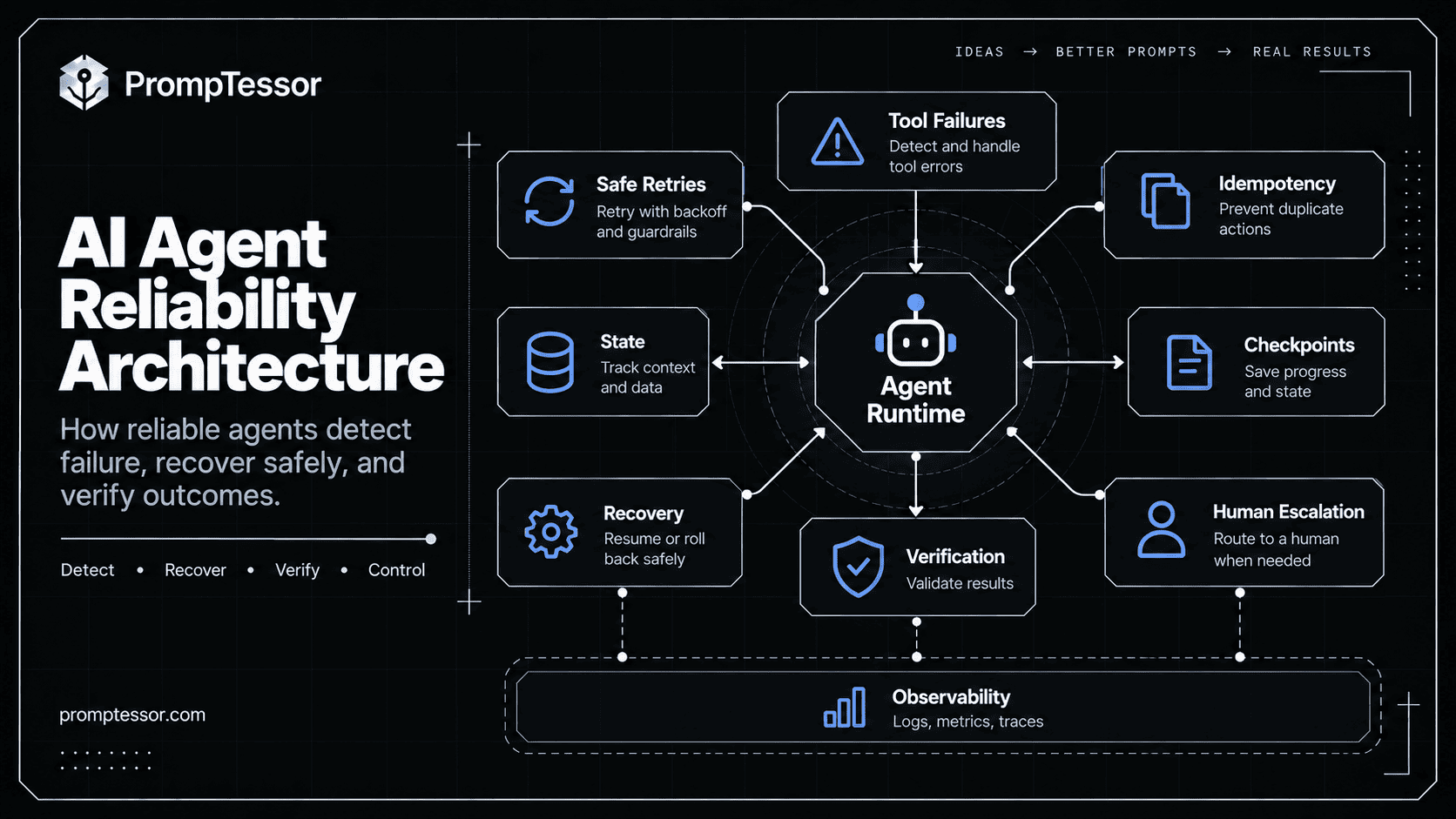
AI agent reliability is the ability of the complete agent system—not only the language model—to behave predictably enough that users and operators can trust the workflow.
That system may include the model, instructions, tool schemas, APIs, retrieval, memory, workflow state, planning, orchestration, approvals, background jobs, checkpoint storage, and external services.
A reliable result therefore depends on the entire trajectory.
Why Agent Reliability Is Harder Than LLM Reliability
A normal model call has a relatively narrow failure surface:
INPUT
  ↓
MODEL
  ↓
OUTPUT
An agent can create a much longer trajectory:
INPUT
 ↓
PLAN
 ↓
TOOL A
 ↓
OBSERVE
 ↓
TOOL B
 ↓
WRITE EXTERNAL STATE
 ↓
SUBAGENT
 ↓
APPROVAL
 ↓
TOOL C
 ↓
VERIFY
 ↓
FINAL RESPONSE
Every additional boundary introduces another place where the workflow can fail or become inconsistent.
That means an agent can have a good final response while the underlying workflow is wrong. OpenAI's trace-grading guidance reflects this distinction: traces capture the end-to-end sequence of model calls, tool calls, guardrails, and handoffs so developers can evaluate where an agent succeeded or failed rather than grading only the final text. OpenAI Trace Grading.
The AI Agent Reliability Model
| Layer | Reliability Question |
|---|---|
| Decision | Did the agent choose the correct next action? |
| Tool contract | Were the tool and arguments valid? |
| Execution | Did the external action actually happen? |
| State | Does the agent still know what has and has not happened? |
| Recovery | Can the workflow continue safely after failure? |
| Verification | Can the system prove the intended outcome exists? |
Reliability is strongest when each layer has an explicit mechanism rather than depending on the model to infer everything from conversation history.
Common Agent Failure Classes
| Failure Type | Example | Typical Response |
|---|---|---|
| Transient infrastructure | 429, temporary 503, short network interruption | Bounded retry with backoff |
| Invalid input | Missing required tool field | Repair arguments; do not blindly retry |
| Permission | Agent is not authorized to perform action | Stop or request approval |
| Business rule | Refund exceeds policy | Escalate or change plan |
| Unknown commit state | Payment API times out after request was sent | Reconcile before retry |
| Stale state | Price or recipient changed while workflow paused | Refresh and revalidate |
| Repeated no-progress loop | Agent retries same failed step indefinitely | Stop, replan, or escalate |
| Verification failure | Agent says deployment succeeded but health check fails | Repair or fail explicitly |
Tool Call Failures
Tool failure can occur before, during, or after the external operation. A failure at the validation layer means something different from a timeout after the remote service may already have changed state.
The agent runtime should record tool name, arguments, operation ID, attempt count, start time, timeout, result or exception, and whether the effect was verified.
Invalid Tool Arguments
If a tool rejects arguments, the correct response is usually repair, not repetition.
Tool: create_refund
Error: required field "order_id" missing

BAD
retry same invalid call

BETTER
identify missing field
→ retrieve safely if possible
→ rebuild arguments
→ otherwise ask / stop
Structured schemas and deterministic validation reduce the chance that invalid arguments reach sensitive tools.
Partial Success
Long workflows often succeed partially.
1. Create customer record ✓
2. Create subscription ✓
3. Send welcome email ✗
4. Update CRM status pending
The workflow is not simply “failed.” It has a mixed state. A reliable system records which steps committed, which did not, which can be retried safely, which require compensation, and which later steps must remain blocked.
False Completion
One of the most damaging reliability failures is when the agent reports success without evidence.
Agent:
"Your refund has been processed."

Reality:
refund API timed out
and final transaction state is unknown.
A reliable completion policy should require proof:
refund request sent
      ↓
retrieve transaction status
      ↓
refund = confirmed?
  ├─ YES → tell user completed
  ├─ NO  → recover
  └─ UNKNOWN → tell user pending / escalate
Retry Safety
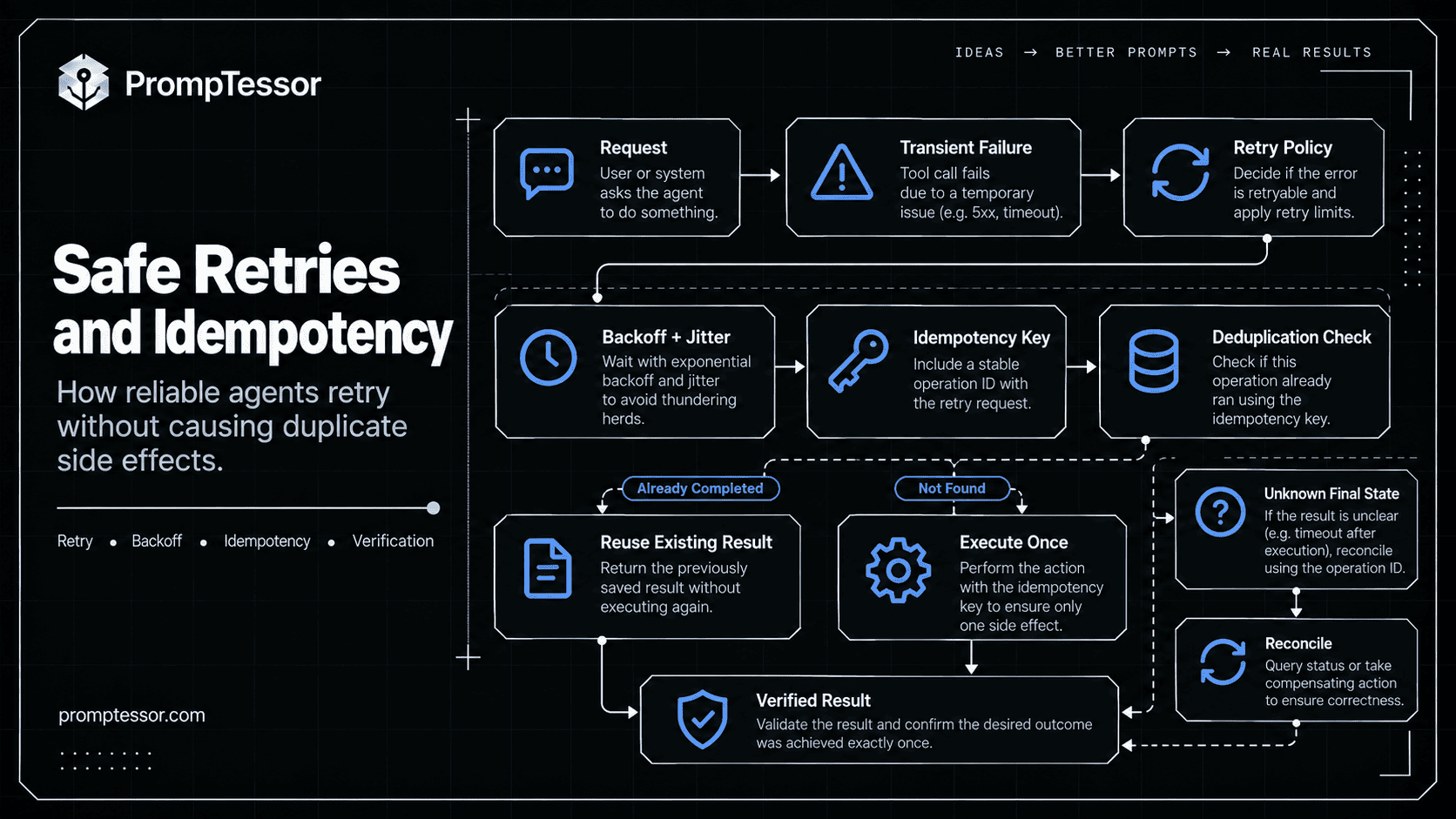
Retries are useful for transient failures, but retries can also create duplicate side effects.
A retry policy should ask two separate questions: Is this failure likely to improve if we try again? And is repeating the operation safe?
FAILURE
  ↓
TRANSIENT?
  ├─ NO → repair / replan / escalate
  └─ YES
       ↓
SIDE EFFECT?
  ├─ NO → retry with backoff
  └─ YES
       ↓
IDEMPOTENT OR RECONCILABLE?
  ├─ YES → safe bounded retry
  └─ NO  → inspect state / stop
AWS reliability guidance recommends limiting retries, using exponential backoff and jitter, and avoiding retries for non-idempotent operations because repeated calls can create duplicate side effects. AWS retry guidance.
Idempotency
An operation is idempotent when repeating the same intended request does not create an additional effect.
operation_id = refund_order_948_420

attempt 1
→ timeout

attempt 2
→ same operation_id

payment system:
"Already processed"
→ return original result
→ no second refund
AWS recommends idempotency tokens for mutating operations so repeated requests can be recognized as the same intended action rather than executed again. AWS Well-Architected idempotency guidance.
For agent systems, the important detail is that the operation identity should belong to the intended business effect, not to each model attempt.
Ambiguous Writes
A timeout after a write is particularly dangerous.
Agent → charge $100
          ↓
remote service processes charge
          ↓
network response lost
          ↓
agent sees timeout
The agent does not know whether the charge happened. Blindly repeating the call can charge twice.
Use stable idempotency keys, read-after-write reconciliation, transaction receipts, operation-status endpoints, or human review when the final state cannot be determined safely.
AWS documentation on mutating API calls explicitly notes that timeouts can occur after resources have already changed, making it unclear whether the operation succeeded and creating duplication risk on retry. AWS idempotency example.
Backoff, Jitter, and Retry Limits
Even safe retries should be bounded.
attempt 1
wait ~1s

attempt 2
wait ~2s + jitter

attempt 3
wait ~4s + jitter

max attempts reached
→ stop / alternate path / escalate
Backoff gives a struggling dependency time to recover. Jitter reduces synchronized retry spikes. A hard retry limit prevents a degraded service from consuming unlimited agent time and cost.
Retries should also have one clear owner. If the tool client, workflow runtime, and model all retry independently, a small failure can become a retry storm.
Checkpoints
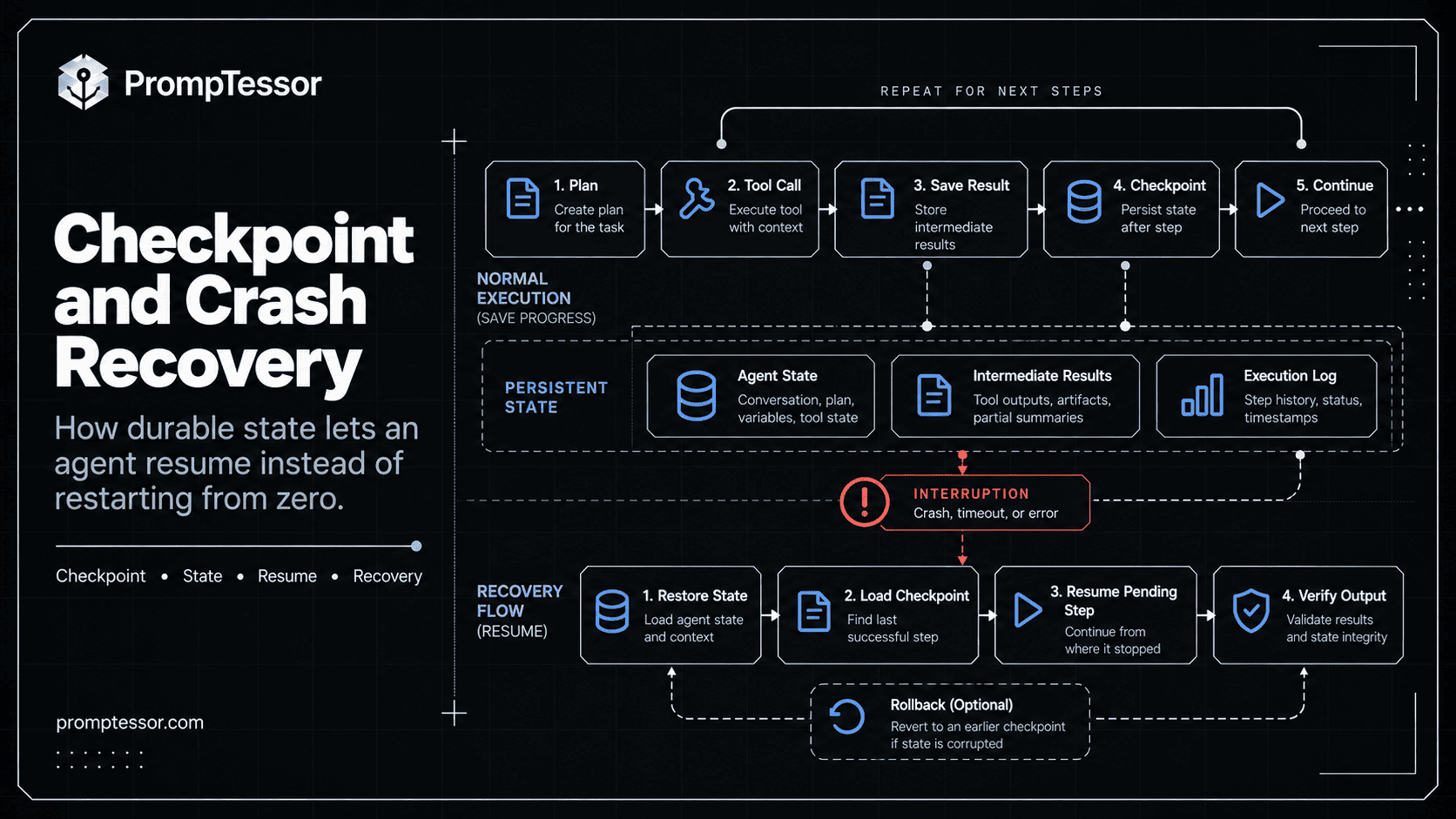
Long-running workflows should save progress at meaningful boundaries.
Task A ✓
   ↓
CHECKPOINT
   ↓
Task B ✓
   ↓
CHECKPOINT
   ↓
Task C crashes
After restart:
restore latest valid checkpoint
      ↓
A already complete
B already complete
      ↓
verify external state
      ↓
resume at C
Microsoft Agent Framework checkpoints capture workflow state so runs can resume later, which is especially useful for long-running workflows, pause/resume flows, auditing, and migration across environments. Microsoft checkpoint documentation.
Crash Recovery
A process crash should not imply a workflow restart.
Step 1 ✓
Step 2 ✓
Step 3 ✓
Step 4 crashes

BAD
restart from Step 1

BETTER
load checkpoint
→ identify completed steps
→ reconcile external writes
→ resume unfinished work
Microsoft's Durable Extension persists agent sessions and workflow progress across worker executions, supports recovery after failures, and can pause for external events or human input without keeping compute active while waiting. Microsoft Durable Extension.
Durable State
Reliable agents should represent important workflow facts as explicit state rather than relying only on the conversation transcript.
{
  "workflow_id": "wf_221",
  "goal": "process approved refund",
  "status": "executing",
  "completed_steps": [
    "verify_order",
    "check_policy",
    "manager_approval"
  ],
  "current_step": "issue_refund",
  "operation_id": "refund_948_420",
  "attempts": 1,
  "effect_status": "unknown",
  "last_checkpoint": "cp_17"
}
The context window should not be the source of truth for irreversible external effects.
Stale State
An agent can make a correct decision using outdated facts. A price may change, a user may revoke permission, a ticket may already be resolved, or the environment may change while the workflow waits.
Before a consequential write, refresh any state whose freshness matters.
PLAN BASED ON STATE v12
        ↓
workflow waits
        ↓
current state = v15
        ↓
material difference?
  ├─ NO → continue
  └─ YES → revalidate / replan / reapprove
This is closely related to the approval-revalidation pattern described in Human-in-the-Loop AI Agents.
Goal Drift
Long-running agents can gradually optimize for the current subtask rather than the original objective.
current action
      ↓
current subtask
      ↓
current plan
      ↓
original goal
      ↓
constraints / non-goals
If the current path no longer serves the goal, the agent should replan instead of continuing because tasks remain on the list.
See AI Agent Planning for task decomposition, replanning, progress tracking, and completion criteria.
Loop Detection
An agent can remain technically active while making no progress.
search
→ same result
→ rephrase search
→ same result
→ rephrase again
→ same result
Useful loop signals include materially repeated tool calls, the same error across several attempts, no new artifacts or state transitions, repeated replanning that returns to the same plan, or rising cost with no reduction in unresolved work.
if no_material_progress >= N attempts:
    stop current strategy
    summarize blocker
    choose alternate path or escalate
Timeouts and Circuit Breakers
Timeouts bound how long one dependency may block the workflow. Circuit breakers solve a different problem: when a dependency is persistently failing, the system temporarily stops sending more work to it.
DEPENDENCY FAILURE RATE HIGH
        ↓
OPEN CIRCUIT
        ↓
stop new requests
        ↓
wait / fallback
        ↓
probe recovery
        ↓
close circuit when healthy
This prevents agents from repeatedly hammering a service that is already degraded.
Human Escalation
Some reliability failures should not be solved automatically.
Escalate when the external state cannot be determined, the action is high-impact and recovery is ambiguous, required permission is missing, a policy exception is needed, the safe retry budget is exhausted, or the agent cannot resolve conflicting evidence.
The reviewer should receive attempted actions, current state, evidence, error history, and recommended next choices rather than reconstructing the workflow manually.
For approval and escalation design, see Human-in-the-Loop AI Agents.
Verification Before Success
The most important reliability question is: How does the system know the task actually succeeded?
Completion criteria should be external and observable where possible.
Payment
payment status = settled
AND amount = expected
AND operation ID matches
Deployment
deployment completed
AND health check passes
AND expected version is liveprovider accepted send
AND recipient matches
AND message ID storedResearch
required scope covered
AND material claims have evidence
AND unresolved uncertainty is surfaced
OpenAI's agent evaluation guidance recommends inspecting end-to-end traces because correctness can depend on tool selection, handoffs, guardrails, and intermediate behavior rather than final output alone. OpenAI agent evaluations.
Graceful Failure
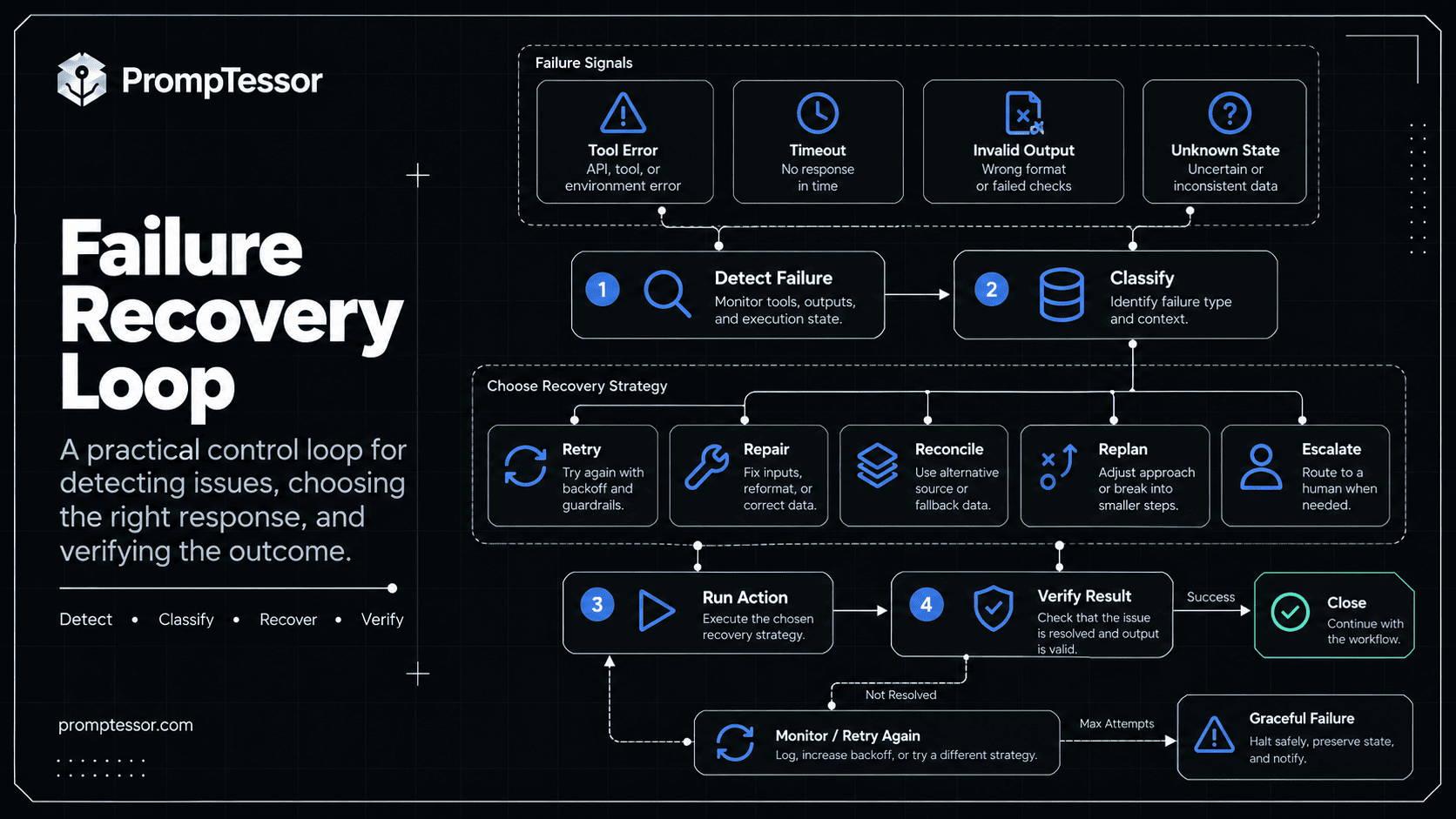
Reliable systems know how to fail honestly.
COMPLETE
verified outcome achieved

PARTIAL
some required work completed

BLOCKED
required dependency unavailable

WAITING
human or external event required

FAILED_SAFE
task stopped before unsafe action

UNKNOWN_EFFECT
external side effect cannot be confirmed
These states are more useful than forcing everything into “success” or “error.”
Reliability Budgets
An agent should have operational limits:
- maximum attempts per tool,
- maximum total retries,
- maximum workflow duration,
- maximum model turns,
- maximum tool calls,
- maximum replans,
- maximum cost,
- and maximum unresolved failures before escalation.
Budgets prevent reliability mechanisms themselves from becoming a source of uncontrolled cost or looping.
AI Agent Reliability Metrics
| Metric | What It Measures |
|---|---|
| Verified task success rate | Runs where the actual outcome was confirmed |
| False completion rate | Runs claiming success without successful outcome |
| Tool failure rate | Failed tool attempts by tool and error class |
| Safe retry success rate | Transient failures recovered without duplicate effects |
| Duplicate side-effect rate | Repeated sends, charges, creates, or updates |
| Checkpoint recovery rate | Interrupted workflows successfully resumed |
| Loop / stall rate | Runs making no material progress before intervention |
| Human escalation rate | Runs requiring manual decision or recovery |
| Mean recovery time | Time from detected failure to safe resolution |
| Cost per verified success | Model and tool cost relative to actual completed outcomes |
Observability helps explain these metrics. See LLM Observability.
Evaluation helps turn recurring failure modes into regression tests. OpenAI's trace-grading tools are designed to score end-to-end agent traces and identify where decisions, tool calls, or workflow behavior fail. OpenAI Trace Grading. See also AI Agent Evaluation.
Practical Reliability Examples
1. Research Agent
GOAL
Produce an evidence-backed market brief.

FAILURE
Primary source temporarily unavailable.

RELIABILITY RESPONSE
1. Mark source retrieval as failed.
2. Preserve completed research.
3. Retry within bounded policy.
4. Check approved alternate primary source.
5. Do not invent missing evidence.
6. If material evidence remains unavailable,
   return partial result with uncertainty.
2. Coding Agent
GOAL
Fix checkout regression.

FLOW
reproduce
→ patch
→ targeted tests
→ broader tests
→ review diff
→ deploy
→ health check

FAILURE
deployment succeeds
but health check fails.

RELIABILITY RESPONSE
do not report complete
→ inspect deployment state
→ rollback / repair
→ rerun verification
→ report final verified state
3. Transactional Agent
GOAL
Issue approved $420 refund.

1. Verify approval.
2. Refresh order state.
3. Create stable refund operation ID.
4. Send refund request.
5. Timeout occurs.
6. Query payment provider by operation ID.
7. Refund already committed.
8. Record receipt.
9. Do not retry.
10. Confirm final customer-facing state.
Common AI Agent Reliability Mistakes
1. Retrying Every Error
Invalid input, denied permission, and policy failure do not become correct because they are repeated.
2. Treating Timeout as Failure
A timed-out write may already have committed.
3. Generating a New Operation ID on Every Retry
This defeats deduplication.
4. Restarting the Entire Workflow After a Crash
Completed side effects may be repeated.
5. Keeping Critical State Only in Conversation History
State can be lost, compressed, or misinterpreted.
6. Letting Multiple Layers Retry Independently
Retries can multiply unexpectedly.
7. Trusting the Agent's Own “Done” Statement
Success should come from external verification.
8. Hiding Partial Failure
Users and operators need to know exactly what completed and what did not.
9. No Loop Detection
An agent can spend indefinitely without making progress.
10. No Safe Human Takeover Path
Some states are too ambiguous or high-impact for automatic recovery.
AI Agent Reliability Production Checklist
Tool Contracts
- Are tool schemas strict and validated?
- Are read and write operations distinguishable?
- Do sensitive writes have stable operation IDs?
- Are tool timeouts explicit?
Retry Policy
- Which failures are retryable?
- Are retries bounded?
- Is backoff + jitter applied where appropriate?
- Is there one clear retry owner?
- Are non-idempotent operations protected from blind retry?
State and Checkpoints
- Is workflow state durable?
- Are checkpoints created at useful boundaries?
- Can the run resume after process failure?
- Are committed external effects reconciled before replay?
Progress and Loops
- Can the system measure material progress?
- Is repeated no-progress behavior detected?
- Are step, turn, time, and cost budgets defined?
Verification
- Does every high-impact action have a verification step?
- Are completion criteria observable?
- Can the system return unknown / partial instead of claiming success?
Human Recovery
- When should the workflow escalate?
- Does the reviewer receive evidence and attempted steps?
- Can a reviewer safely resume, modify, compensate, or abandon the workflow?
Observability and Evaluation
- Are tool attempts, retries, state transitions, and checkpoints traceable?
- Can you identify false completion?
- Are repeated incidents converted into eval cases?
- Can you compare reliability before and after model, prompt, or tool changes?
Where PrompTessor Fits
PrompTessor works at the instruction layer of agent reliability.
SUCCESS
What evidence proves the task is complete?

TOOL FAILURE
Which errors should be retried, repaired, or escalated?

UNCERTAINTY
When should the agent say the result is unknown?

RETRY BOUNDARY
What must not be repeated blindly?

STATE
What facts must be refreshed before acting?

VERIFICATION
What external check is required after execution?

ESCALATION
When must a human take over?

COMPLETION
What is the difference between complete, partial, blocked, and failed?
The ChatGPT Prompt Generator can help turn a rough workflow responsibility into a structured instruction draft. The AI Prompt Analyzer can help identify missing failure behavior, unclear verification criteria, ambiguous retry instructions, or weak escalation rules. The AI Prompt Optimizer can generate stronger instruction candidates after a reliability failure is understood.
For adjacent production layers, see AI Agent Planning, AI Agent Orchestration, Human-in-the-Loop AI Agents, LLM Guardrails, and AI Agent Prompts.
PrompTessor does not replace durable state, idempotency, checkpoint storage, retry infrastructure, external reconciliation, observability, or runtime authorization.
Use PrompTessor to make expected behavior, failure handling, verification, and escalation clearer. Use the runtime and external systems to make those reliability guarantees enforceable.
Official Resources
- OpenAI — Introducing the Agents API
- OpenAI — Agents
- OpenAI — Trace Grading
- OpenAI — Evaluate Agent Workflows
- Microsoft — Workflow Checkpoints
- Microsoft — Durable Extension
- AWS — Make Mutating Operations Idempotent
- AWS — Control and Limit Retry Calls
FAQ
What is AI agent reliability?
AI agent reliability is the ability of an agent system to produce verifiable outcomes consistently, recover safely from expected failures, preserve valid progress, avoid duplicate side effects, and stop or escalate when it cannot continue safely.
Why is agent reliability harder than chatbot reliability?
Agents can use tools, modify external systems, run for long periods, coordinate multiple steps, and pause for approvals. Each boundary introduces additional failure states beyond the quality of the model's final text.
Should an AI agent retry every failed tool call?
No. Retry only failures that are plausibly transient and only when repeating the operation is safe. Invalid input, permission failures, policy failures, and ambiguous writes usually require repair, reconciliation, replanning, or escalation.
What is idempotency in AI agents?
Idempotency means that repeating the same intended mutating operation does not create an additional side effect. Stable operation IDs or idempotency keys can help external services recognize retries as the same action.
Why are timeouts dangerous for AI agent writes?
A timeout means the caller did not receive a result, not necessarily that the external system failed to perform the action. The agent should reconcile the destination state or use idempotency before retrying.
What is a checkpoint in an AI agent workflow?
A checkpoint is a durable snapshot of workflow progress and state that can be restored later, allowing a long-running workflow to resume after failure or pause without repeating all completed work.
Do checkpoints make retries automatically safe?
No. A checkpoint can show what the workflow believed had happened, but external side effects may still require reconciliation or idempotency to determine whether an action actually committed.
How do you prevent an AI agent from looping forever?
Use progress detection, maximum retry counts, turn and tool-call limits, timeouts, cost budgets, replanning limits, and explicit escalation or blocked states.
What is false completion in an AI agent?
False completion occurs when an agent tells the user a task succeeded even though the real external outcome was not verified or actually failed.
How should AI agents fail gracefully?
Return an explicit state such as partial, blocked, waiting, failed-safe, or unknown-effect. Preserve completed work, explain the blocker, and provide the next safe action instead of fabricating success.
How do you measure AI agent reliability?
Useful metrics include verified task success, false completion, duplicate side effects, safe retry recovery, checkpoint recovery, loop rate, escalation rate, mean recovery time, and cost per verified success.
Can PrompTessor make an AI agent reliable?
PrompTessor can improve the instruction layer by making failure handling, retry boundaries, verification, and escalation clearer. Runtime mechanisms such as durable state, idempotency, checkpoints, authorization, and external reconciliation must still be implemented by the agent system.
Conclusion
Reliable AI agents are not defined by uninterrupted success.
They are defined by what happens when reality disagrees with the plan.
ACT
 ↓
OBSERVE
 ↓
VERIFY
 ↓
FAILURE?
 ├─ NO → continue
 └─ YES
      ↓
CLASSIFY
      ↓
RETRY / REPAIR / RECONCILE / ESCALATE
      ↓
PRESERVE VALID STATE
      ↓
VERIFY AGAIN
      ↓
COMPLETE OR FAIL GRACEFULLY
Start by making tool contracts explicit. Treat timeouts as uncertain outcomes rather than automatic failures. Use stable identifiers for mutating operations. Bound retries. Persist workflow state. Checkpoint long-running progress. Detect loops. Revalidate stale state. Verify external outcomes. Give operators a safe takeover path.
And when the system cannot prove that the task succeeded, do not let the agent invent certainty.
The most reliable agent is not the one that always says “done.” It is the one that knows exactly when “done” is true.
Build better prompts in one workspace
Generate prompts from ideas, analyze and optimize quality, refine with feedback, reverse-engineer content, and save reusable prompts in your Prompt Library.
Try PrompTessor Free