LLM Guardrails: How to Build Safer AI Agents, Tools, and Workflows
A stronger system prompt is not the same thing as a stronger security boundary.
An AI agent can be instructed not to send an email, delete a file, issue a refund, expose a secret, or call a dangerous tool. But if the runtime still gives that agent unrestricted access to those capabilities, the instruction is only one probabilistic layer between the model and the action.
That is where LLM guardrails become important.
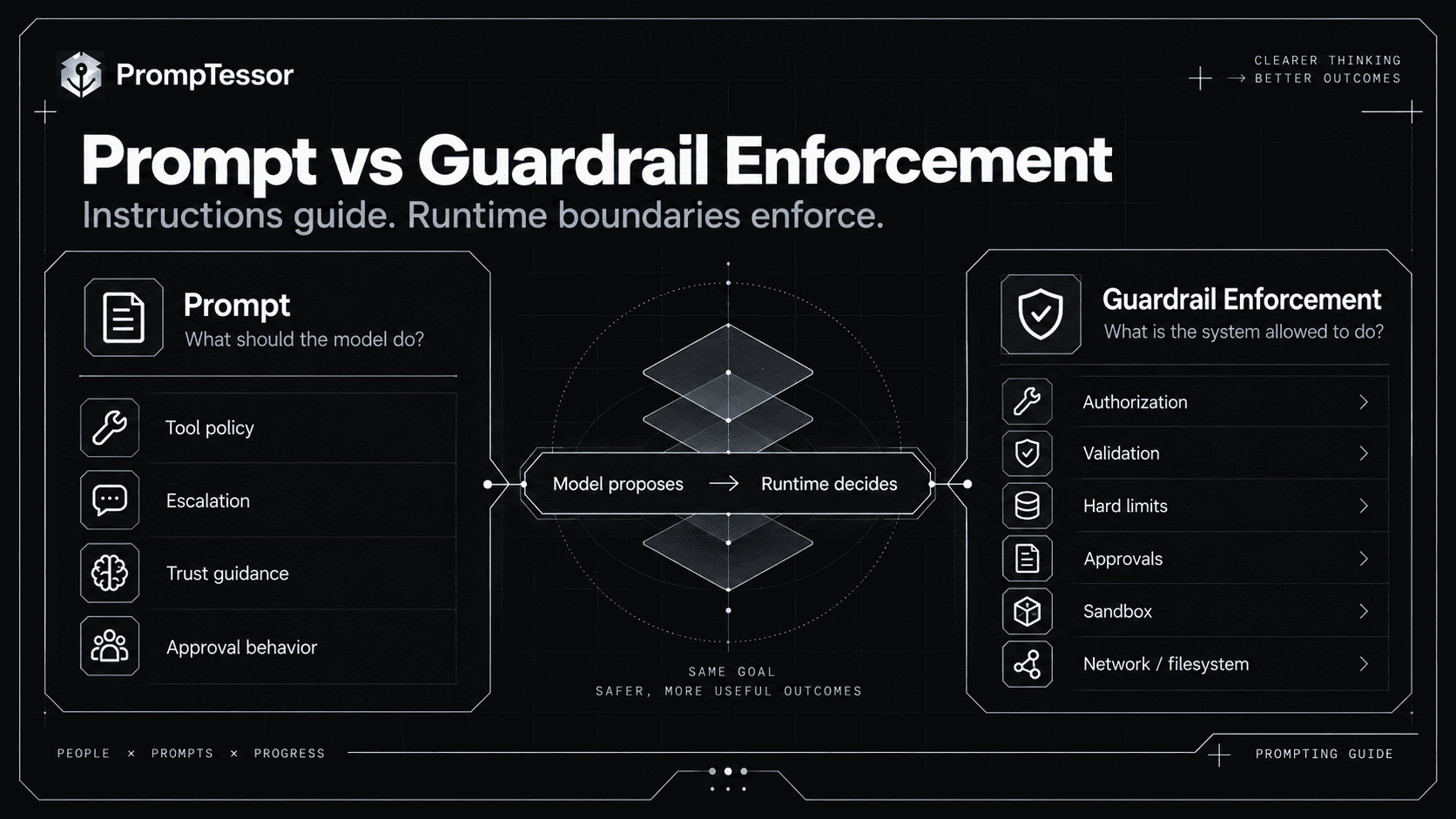
Prompts guide what a model should do. Guardrails constrain what the system will accept, reveal, access, or execute.
A production guardrail architecture can include model-based checks, deterministic validation, authentication, authorization, tool allowlists, approval gates, schemas, spending or action limits, sandboxes, network controls, output filters, observability, and evaluation.
No single mechanism covers every failure mode.
OpenAI's practical guide to building agents describes guardrails as a layered defense and recommends combining them with authentication, authorization, strict access controls, and standard software security. Anthropic's 2026 containment engineering write-up makes a complementary point: model-level defenses shape behavior, but hard environmental boundaries such as sandboxes, filesystem constraints, virtual machines, and egress controls limit the agent's blast radius when probabilistic defenses miss.
This guide explains how to design that complete system without confusing guardrails with prompt engineering, moderation, or authorization.
Quick Answer
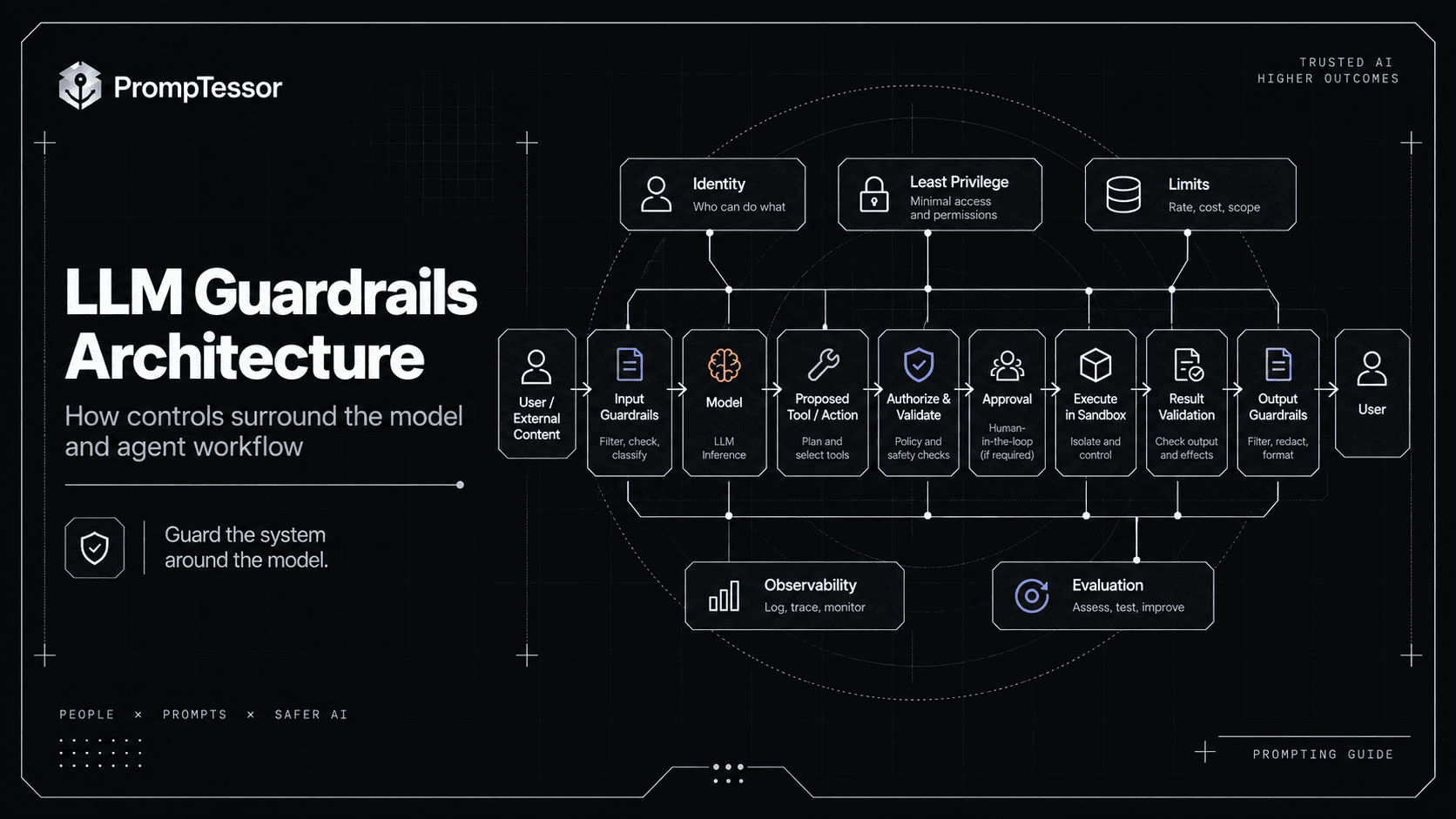
A useful guardrail architecture looks like this:
USER / EXTERNAL CONTENT
        ↓
INPUT GUARDRAILS
Scope
Abuse / injection checks
Input limits
Data classification
        ↓
MODEL
        ↓
PROPOSED TOOL OR ACTION
        ↓
ACTION GUARDRAILS
Identity
Authorization
Tool allowlist
Argument validation
Risk classification
Approval
Rate / spend / action limits
        ↓
CONTAINED ENVIRONMENT / EXTERNAL SYSTEM
        ↓
TOOL RESULT
        ↓
RESULT VALIDATION
Trust boundary
Sensitive data
State verification
        ↓
MODEL
        ↓
OUTPUT GUARDRAILS
Schema
Data leakage checks
Policy
Grounding / factual checks
        ↓
USER

ACROSS THE WHOLE WORKFLOW:
Tracing → Evaluation → Incident Review → Guardrail Updates
The key design rule is simple:
Put every requirement at the layer that can enforce it most reliably.
If a rule says “never refund more than $500 without approval,” do not rely only on the model remembering that sentence. The refund service or tool runtime should enforce the threshold.
Key Takeaways
- Guardrails are a system of controls, not one prompt or one moderation endpoint.
- Prompt instructions are useful behavioral guidance but are not authorization.
- Use deterministic enforcement for rules that must never be bypassed.
- Input guardrails can reject, classify, transform, or route unsafe or out-of-scope requests before the main workflow proceeds.
- Output guardrails validate the response before it reaches a user or downstream system.
- Tool guardrails should validate the action itself, including arguments, authorization, limits, and required approval.
- Least privilege reduces the damage a model or attacker can cause.
- Separate read capabilities from write capabilities whenever practical.
- Human approval is useful for consequential actions, but excessive approvals can create approval fatigue.
- Sandboxes and environmental containment cap blast radius when model behavior goes wrong.
- External content such as webpages, files, emails, MCP resources, and tool results should not automatically gain instructional authority.
- Structured output validation does not replace business-rule or authorization validation.
- Guardrail failures need explicit fail-open or fail-closed behavior.
- Rate, spend, retry, recursion, and action-count limits are guardrails too.
- Guardrails should be evaluated on adversarial and normal cases, not assumed to work because the logic looks reasonable.
- PrompTessor can help design clearer instruction-level boundaries, but runtime permissions, sandboxes, approvals, authentication, and enforcement belong to the application.
Table of Contents
- What Are LLM Guardrails?
- Guardrails vs. Prompts, Policies, Moderation, and Authorization
- Start With a Threat and Failure Model
- The Guardrail Architecture
- 1. Input Guardrails
- 2. Guardrails for Untrusted External Content
- 3. Output Guardrails
- 4. Tool and Action Guardrails
- 5. Identity, Authorization, and Least Privilege
- 6. Human Approval Without Approval Fatigue
- 7. Sandboxing and Blast-Radius Containment
- 8. Rate, Spend, Retry, and Action Limits
- 9. State, Memory, and Long-Running Agent Guardrails
- 10. Decide Whether Guardrails Fail Open or Fail Closed
- 11. Deterministic vs. Model-Based Guardrails
- OpenAI Agents SDK Guardrail Boundaries
- 8 Practical Guardrail Examples
- Reusable Guardrail Design Template
- How to Evaluate Guardrails
- Guardrail Observability and Incident Review
- Common Guardrail Mistakes
- Where PrompTessor Fits
- LLM Guardrail Checklist
- Related PrompTessor Guides and Tools
- Official Resources
- FAQ
What Are LLM Guardrails?
LLM guardrails are controls that constrain or validate behavior around a language model or agent.
Depending on the application, a guardrail may reject an input, classify a request as high risk, remove sensitive information, restrict which tools are exposed, validate tool arguments, require human approval, block an unauthorized action, enforce transaction limits, contain execution inside a sandbox, validate the final output, or stop a workflow that exceeds retries or budget.
The word guardrail is used broadly across the AI industry, so it is useful to separate two meanings.
Model-Adjacent Guardrails
User Input
   ↓
Safety / Scope Classifier
   ↓
Model
   ↓
Output Validator
   ↓
Response
System Guardrails
Model proposes:
"Refund $2,400"

Runtime checks:
- Is this user authorized?
- Is refund tool enabled?
- Is order refundable?
- Is amount within automatic threshold?
- Is approval required?
- Has this refund already happened?

Only then:
Execute / Block / Escalate
The second category is what makes guardrails meaningful for tool-using agents.
Guardrails vs. Prompts, Policies, Moderation, and Authorization
| Layer | Main Question | Example |
|---|---|---|
| Prompt / instructions | What should the model do? | “Ask before making a purchase.” |
| Policy | What behavior is allowed? | Purchases above $200 require approval. |
| Guardrail | What check or control applies? | Classify transaction risk before execution. |
| Authorization | Is this principal allowed to perform this action? | User has permission to refund this account. |
| Validation | Is this specific value/action valid? | Refund amount is positive and within remaining balance. |
| Moderation | Does content violate a content-safety rule? | Block a prohibited content category. |
| Approval | Must a human explicitly authorize this instance? | Finance manager approves a $2,400 refund. |
| Sandbox / containment | What can happen even if the model goes wrong? | Agent can write only inside one workspace. |
| Evaluation | Do the controls work on representative cases? | Adversarial refund tests all remain blocked. |
A system prompt can describe a policy. It cannot by itself make the policy impossible to violate.
That distinction is central to the System Prompts guide and the Function Calling and Tool Use guide: instructions shape model decisions, while the application should enforce consequential permissions and state changes.
Start With a Threat and Failure Model
Do not begin by collecting random guardrails. Begin with what can go wrong.
User Misuse
The user may intentionally or accidentally request something outside the allowed scope.
"Delete every customer record."
"Send this private file to my personal email."
"Ignore the spending limit."
Model Error
The model may misunderstand the task, select the wrong tool, invent an argument, or take a larger action than intended.
Prompt Injection
An email, webpage, retrieved document, MCP resource, or tool result may contain instruction-like text designed to redirect the agent. See the dedicated Prompt Injection guide for the trust-boundary problem.
Authorization Failure
The model may attempt an action the current user, tenant, agent, or delegated identity is not permitted to perform.
NIST's current work on software and AI agent identity and authorization focuses directly on this problem: agents are gaining access to data, tools, and applications, so identification, authorization, auditing, and action control become part of the security architecture rather than a prompt-writing concern.
Excessive Blast Radius
Even a rare failure becomes dangerous if the agent has broad filesystem, network, database, cloud, payment, or deployment access.
Looping and Resource Abuse
An agent can repeatedly call tools, retry a write, spawn subagents, consume budget, or continue after the task is complete.
Data Leakage
Sensitive information can appear in model output, logs, tool arguments, third-party requests, or cross-tenant context.
WHAT CAN ENTER?
WHAT CAN THE MODEL SEE?
WHAT CAN IT CALL?
WHAT CAN EACH TOOL CHANGE?
WHAT IDENTITY DOES IT ACT AS?
WHAT DATA CAN LEAVE?
WHAT NEEDS APPROVAL?
WHAT IS IRREVERSIBLE?
WHAT IS THE MAXIMUM DAMAGE IF EVERYTHING ELSE FAILS?
The Guardrail Architecture
Think of guardrails as a series of independent control points.
1. INPUT
What requests and data may enter?

2. CONTEXT
What information has instructional authority?

3. MODEL
What behavior is requested?

4. TOOL DISCOVERY
Which capabilities are visible?

5. AUTHORIZATION
Which capabilities are allowed for this identity?

6. ARGUMENT VALIDATION
Is this exact action valid?

7. APPROVAL
Does a human need to authorize it?

8. EXECUTION
Where is the action allowed to run?

9. RESULT VALIDATION
Did the expected state change occur?

10. OUTPUT
What may leave the system?

11. LIMITS
How many calls, retries, dollars, tokens, or actions are allowed?

12. OBSERVABILITY + EVAL
Can failures be detected, explained, and prevented from recurring?
This architecture also avoids a common mistake: using an LLM classifier for rules that could be enforced exactly. If the business rule is refund_amount <= 50, use code. Do not ask another model whether $47 is less than $50.
1. Input Guardrails
Input guardrails operate before or around the initial model request. Possible checks include request relevance, content safety, prompt-injection signals, PII or secret detection, tenant or account validation, input length, file type and size, rate limits, malware scanning for uploaded files, and task classification.
Scope Guardrail
REQUEST:
"Write my history homework."

PRODUCT:
Customer-support agent.

CONTROL:
Reject as out of scope before expensive reasoning or tools.
Blocking vs. Parallel Checks
The current OpenAI Agents SDK guardrail documentation distinguishes blocking input guardrails from parallel ones. A blocking guardrail completes before the agent starts, so a triggered guardrail can prevent model and tool execution. A parallel guardrail reduces latency but the agent may already have consumed tokens or started work before the guardrail trips.
IF A CHECK MUST PREVENT SIDE EFFECTS:
run it before side effects are possible.

IF THE CHECK IS ADVISORY / LOW RISK:
parallel execution may be acceptable.
2. Guardrails for Untrusted External Content
Modern agents may ingest webpages, email, PDFs, RAG chunks, code repositories, tool results, MCP resources, third-party APIs, and messages from other agents.
That content can contain instructions. It should not automatically become instruction authority.
TRUSTED:
User's authorized goal
Application policy
Tool contracts

UNTRUSTED DATA:
Email body
Web page
Retrieved document
README
Tool result
External MCP content
Anthropic's containment article emphasizes that even a trusted connector can return untrusted content; a connector can load attacker-controlled content into the model's context. Their design therefore treats external content and tool outputs as part of the attack surface and combines model checks with permission and environment controls.
Do Not Solve Prompt Injection Only With Prompt Text
Untrusted content
   ↓
Scan / classify where useful
   ↓
Mark provenance and trust level
   ↓
Limit exposed capabilities
   ↓
Require authorization for actions
   ↓
Contain environment
   ↓
Verify consequential state changes
3. Output Guardrails
Output guardrails run after generation but before the result is accepted or exposed. Checks can include schema validation, sensitive-data leakage, unsafe content, required escalation states, unsupported claims, citation requirements, brand rules, and downstream compatibility.
Schema Is One Guardrail, Not the Whole Guardrail
{
  "refund_amount": 5000,
  "approved": true
}
This can be perfect JSON and still be an unauthorized refund.
The Structured Outputs guide separates schema conformance, business validation, authorization, and factual or state validation.
Do Not Wait Until Final Output to Guard Tool Actions
If an agent already sent money, deleted data, or deployed code, an output filter is too late. Guard the side effect before execution.
4. Tool and Action Guardrails
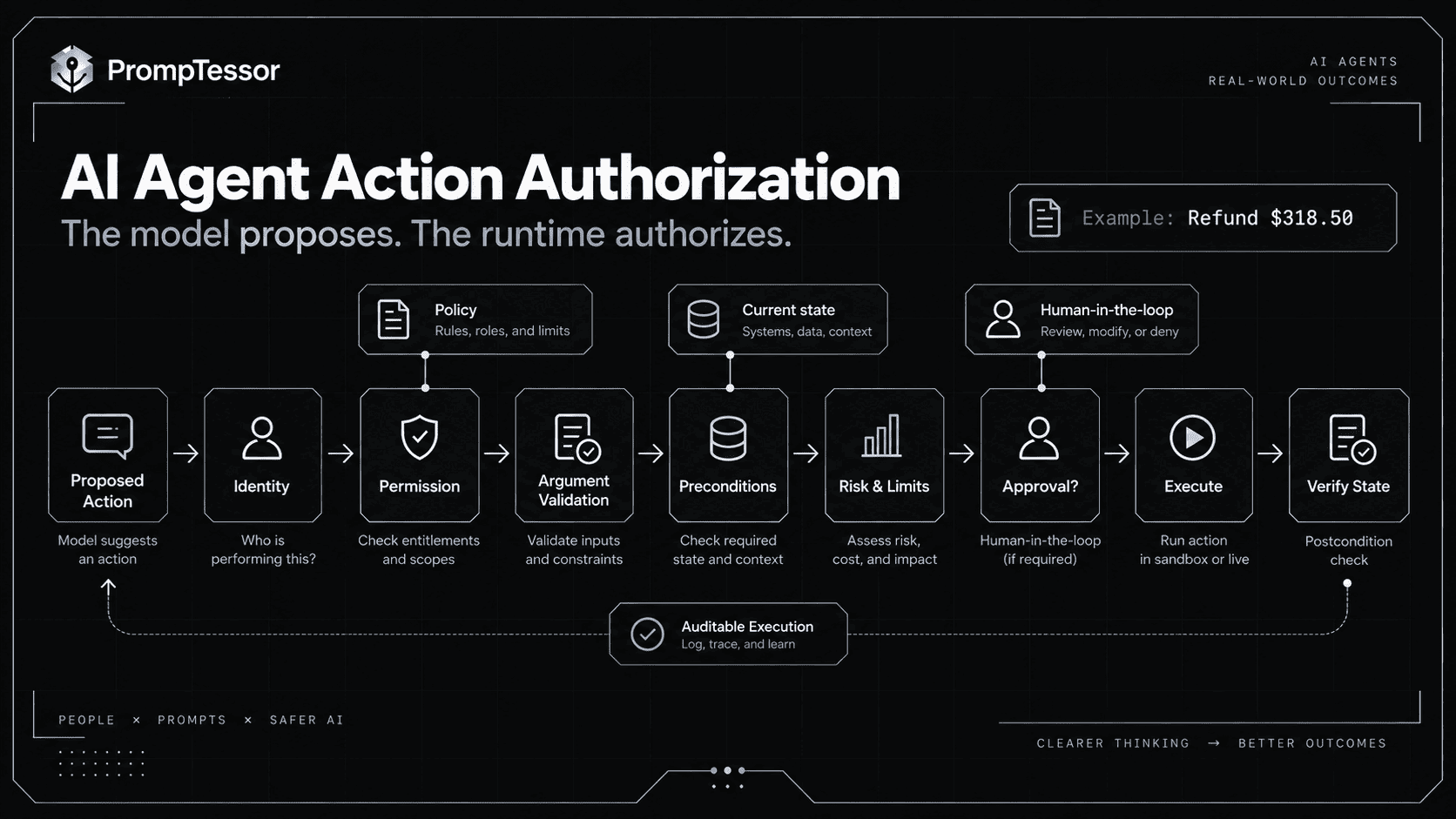
Tool-using agents need guardrails around every meaningful side effect. A model should be allowed to propose an action without automatically being allowed to execute it.
MODEL PROPOSES ACTION
        ↓
Is tool allowed?
        ↓
Is caller authorized?
        ↓
Are arguments valid?
        ↓
Does current state satisfy preconditions?
        ↓
Is approval required?
        ↓
Is action within limits?
        ↓
EXECUTE
        ↓
VERIFY RESULT
Validate Arguments Deterministically
email.recipient must belong to allowed domain
refund.amount <= remaining refundable balance
deployment.environment in ["staging", "production"]
delete.scope cannot equal "*"
transfer.currency must match account currency
Check Preconditions Against Current State
Do not rely on the model's memory that a state was true three turns ago. Before cancellation, fetch current order state. Before refund, fetch the current refundable balance. Before deployment, fetch current branch and approval state. Before retrying a write, verify whether the first write already succeeded.
Verify Postconditions
TOOL RESPONSE:
"request accepted"

is not automatically:

STATE:
"refund completed"
After important writes, verify observable state before telling the user the operation succeeded.
5. Identity, Authorization, and Least Privilege
An AI agent should not receive broad permissions merely because the user has broad permissions.
Ask: Who is the user? Who is the agent? On whose behalf is the action being taken? What scope has been delegated? Which tenant or account is in scope? How long should the authorization remain valid? Can it be revoked independently?
NIST noted in its August 2026 discussion of agentic AI identity foundations that model-only guardrails are not fully equipped to solve identity and authorization problems. Existing identity standards and access-management practices remain relevant as agents gain more autonomy.
Least Privilege
BAD
Support agent:
- read all customers
- edit all customers
- issue unlimited refunds
- delete accounts
- access billing admin

BETTER
Support agent for current ticket:
- read current customer's support context
- read current order
- propose refund
- execute refund only within scoped threshold
- no account deletion
- no unrelated customer access
Separate Read From Write
search_orders()
get_order()

≠

cancel_order()
refund_order()
change_shipping_address()
Anthropic's containment guidance makes the same practical point: an agent with read-only database access can be deployed with a smaller blast radius than one that can write to production.
Scope Credentials
Prefer short-lived, scoped credentials over handing a general user token to the model or sandbox. Credentials should not be placed in model-visible context unless they are genuinely required there.
6. Human Approval Without Approval Fatigue
Human-in-the-loop is valuable for actions that are irreversible, financially significant, externally visible, security-sensitive, legally consequential, or unusually uncertain.
OpenAI's agent guide specifically identifies high-risk actions such as canceling orders, authorizing large refunds, and making payments as cases where human oversight may be appropriate.
Risk-Based Approval
refund <= $50
→ automatic if policy criteria pass

$50 < refund <= $500
→ support supervisor approval

refund > $500
→ blocked from this agent workflow
Notice that the model does not control the threshold.
Approval Fatigue Is a Real Failure Mode
Anthropic reported in May 2026 that Claude Code users approved roughly 93% of permission prompts in its telemetry, motivating a move toward stronger containment and fewer, more meaningful approvals. The broader lesson is not that approvals are useless; it is that an endless sequence of low-information approval dialogs can become weak supervision.
Make the Approval Understandable
ACTION
Refund order #18423

AMOUNT
$318.50

REASON
Duplicate charge detected

SOURCE
Billing record + customer ticket

EFFECT
Funds returned to original payment method

REVERSIBILITY
Not reversible through this tool

[Approve] [Reject]
Do not ask a human to approve opaque JSON or shell commands unless the expected reviewer can actually assess them.
7. Sandboxing and Blast-Radius Containment
If the model behaves incorrectly, what is the maximum damage it can cause?
Possible containment controls include containers, virtual machines, filesystem mount boundaries, read-only mounts, network egress restrictions, process isolation, temporary workspaces, scoped credentials, separate production and staging environments, and allowlisted services.
Anthropic's 2026 containment architecture explicitly separates three defense surfaces: the environment, the model layer, and external content. Their engineering conclusion is useful for agent builders: deterministic environmental boundaries are what remain when probabilistic model defenses miss.
Example: Coding Agent
AGENT CAN:
- read repository
- edit workspace files
- run tests
- access package registry

AGENT CANNOT:
- read ~/.ssh
- read cloud credentials
- write outside workspace
- access production DB
- deploy production without separate approval
- send arbitrary outbound network traffic
Containment narrows the blast radius; it does not prove every action inside that radius is correct.
8. Rate, Spend, Retry, and Action Limits
Some dangerous failures are repetition rather than one dramatic action.
Guardrails should include quantitative limits where appropriate: maximum tool calls per task, maximum write actions, retry count, recursion or delegation depth, execution time, token or cost budget, transaction amount, daily spend, messages sent per interval, and requests per user or tenant.
Retry Guardrails
Timeout after payment request

WRONG:
Retry immediately.

BETTER:
Check operation status / idempotency key.
If state is unknown, verify before retrying.
The MCP Prompting Guide covers ambiguous write failures, idempotency, and state verification in more depth.
9. State, Memory, and Long-Running Agent Guardrails
Long-running agents accumulate conversation history, user memory, tool results, working files, temporary credentials, delegated tasks, pending approvals, and persistent instructions.
Guardrails should define what may persist, for how long, who may read or modify it, what source created it, whether untrusted content can become persistent, and how it is revoked or invalidated.
Pending Approval State
Approval requested at T1
User changes order at T2
Approval granted at T3

Before execution:
revalidate current order state and action parameters.
Delegation State
When agents delegate to other agents, do not automatically treat subagent output as trusted simply because it came from “our system.” Preserve provenance and authority.
10. Decide Whether Guardrails Fail Open or Fail Closed
What happens if the guardrail itself is unavailable? This needs an explicit answer.
Fail Closed
Payment authorization service unavailable
→ do not execute payment
Fail Open
Optional style classifier unavailable
→ return response without style score| Guardrail | Typical Failure Preference |
|---|---|
| Payment authorization | Fail closed |
| Cross-tenant access check | Fail closed |
| Production deploy approval | Fail closed |
| Optional tone checker | May fail open |
| Non-critical analytics classifier | May fail open |
11. Deterministic vs. Model-Based Guardrails
LLMs are useful guardrails for semantic questions. Code is better for exact rules.
Good Deterministic Guardrail Candidates
- amount thresholds,
- allowed domains,
- role permissions,
- schema validation,
- path allowlists,
- rate limits,
- resource quotas,
- tool allowlists,
- tenant IDs,
- known forbidden arguments.
Good Model-Based Guardrail Candidates
- semantic relevance,
- ambiguous policy interpretation,
- prompt-injection classification,
- intent classification,
- complex content-safety classification,
- quality or brand-style checks.
OpenAI's agent guide illustrates this layered approach with LLM-based guardrails, rules such as regex or blocklists, and moderation, while also emphasizing authentication, authorization, and access control outside the model.
OpenAI Agents SDK Guardrail Boundaries
If you use the OpenAI Agents SDK, understand where each SDK guardrail runs rather than assuming “guardrails” wrap every step automatically.
The current Agents SDK documentation separates input guardrails on the initial user input, output guardrails on the final agent output, and tool guardrails around guarded custom function-tool calls.
Its workflow documentation also notes that input guardrails apply to the first agent in a chain and output guardrails to the agent producing the final result, while tool guardrails are the mechanism for checks around relevant function-tool invocations.
Know the exact execution boundary of every guardrail implementation you adopt.
Do not assume a framework-level feature protects tool calls, handoffs, hosted tools, custom orchestration, or external services unless the documentation says it does.
8 Practical Guardrail Examples
Example 1: Customer Support Refund Agent
PROMPT
Recommend a refund only when policy criteria are met.

RUNTIME
Fetch current order and refundable balance.

AUTHORIZATION
Agent can refund only current user's orders.

LIMIT
refund <= $50 → eligible for automatic execution
$50–$500 → supervisor approval
> $500 → blocked

IDEMPOTENCY
One refund operation per refund key.

POSTCONDITION
Confirm refund state before reporting success.
Example 2: Email Agent
READING
Agent may read messages in selected mailbox.

DRAFTING
No approval required.

SENDING INTERNAL EMAIL
Allowed for approved company domains.

SENDING EXTERNAL EMAIL
Human approval required.

ATTACHMENTS
Block secrets / restricted files.

RATE LIMIT
Maximum 20 external recipients per hour.

PROMPT INJECTION
Email body is untrusted data, not instruction authority.
Example 3: Coding Agent With Shell Access
FILESYSTEM
Read/write only inside repository workspace.

NETWORK
Denied by default; allow package registry if required.

SECRETS
Home directory and cloud credential paths not mounted.

PRODUCTION
No production deploy credential inside sandbox.

DEPLOY
Separate release tool + explicit approval.

LOOPS
Maximum command/tool budget per task.
Example 4: RAG Assistant Reading Untrusted Documents
RETRIEVED DOCUMENTS
Evidence only.

SYSTEM / DEVELOPER POLICY
Higher instruction authority.

OUTPUT
Claims require source IDs.

ACTION TOOLS
Not exposed during pure Q&A.

INJECTION
Instruction-like text inside sources is treated as data.

MISSING EVIDENCE
Return insufficient_evidence rather than inventing an answer.
Example 5: Commerce Agent
SEARCH
No approval.

ADD TO CART
Allowed within user-defined categories.

PURCHASE
Requires confirmation of item, quantity, current price,
merchant, shipping address, and total.

SPEND
Per-purchase + daily hard limits.

PAYMENT
Scoped payment capability; no raw payment secret in model context.
Example 6: Database Assistant
DEFAULT
Read-only DB role.

WRITE MODE
Separate tool and role.

WRITE PRECONDITION
User must have editor permission.

QUERY VALIDATION
No cross-tenant IDs.

DANGEROUS OPERATIONS
DROP / TRUNCATE / bulk delete not available.

AUDIT
Record actor, action class, affected resource, approval, and result.
Example 7: MCP Agent With Sensitive Tools
MCP SERVER A
Search and read docs.

MCP SERVER B
Create / modify tickets.

MCP SERVER C
Billing actions.

GUARDRAILS
- untrusted resource content is data
- billing server exposed only for billing tasks
- tool input validated before writes
- high-value action requires approval
- ambiguous write timeout triggers state verification, not blind retry
Example 8: Multi-Agent Workflow
ORCHESTRATOR
Can delegate, but cannot execute production changes.

RESEARCH AGENT
Web read access only.

CODING AGENT
Repository workspace access.

RELEASE AGENT
Receives tested artifact, not arbitrary instructions.

PRODUCTION TOOL
Requires signed release state + human approval.

HANDOFF
Structured fields preserve task, evidence, permissions, and unresolved risk.

MAX DEPTH
Delegation limited to prevent agent recursion.
Reusable Guardrail Design Template
GUARDRAIL DESIGN

1. WORKFLOW
What user outcome is the agent trying to achieve?

2. ACTORS
- user identity:
- agent identity:
- tenant / account:
- delegated scope:

3. TRUST BOUNDARIES
Trusted instructions:
Untrusted content:
Authoritative state sources:

4. CAPABILITIES
Read tools:
Write tools:
External communication:
Financial actions:
Code / shell:
Network:
Filesystem:

5. INPUT GUARDRAILS
- scope checks:
- abuse / safety checks:
- injection checks:
- size / file constraints:
- rate limits:

6. TOOL / ACTION GUARDRAILS
For each consequential tool:
- authorization rule:
- argument validation:
- preconditions:
- risk level:
- approval rule:
- amount / action limit:
- idempotency:
- postcondition verification:

7. OUTPUT GUARDRAILS
- schema:
- sensitive data:
- policy:
- factual / evidence rules:
- downstream validation:

8. CONTAINMENT
- sandbox:
- filesystem boundary:
- network boundary:
- credentials:
- production access:

9. RESOURCE LIMITS
- max tool calls:
- max retries:
- max runtime:
- max delegation depth:
- max spend:
- max actions:

10. FAILURE BEHAVIOR
- which checks fail closed?
- which checks may fail open?
- what does the user see?
- when is escalation required?

11. OBSERVABILITY
Record guardrail decision, policy/version, tool/action,
approval, state/result, trace ID, and safe reason code.

12. EVALUATION
Test normal, edge, adversarial, historical failure,
bypass, false-positive, false-negative, latency, and cost cases.
How to Evaluate Guardrails
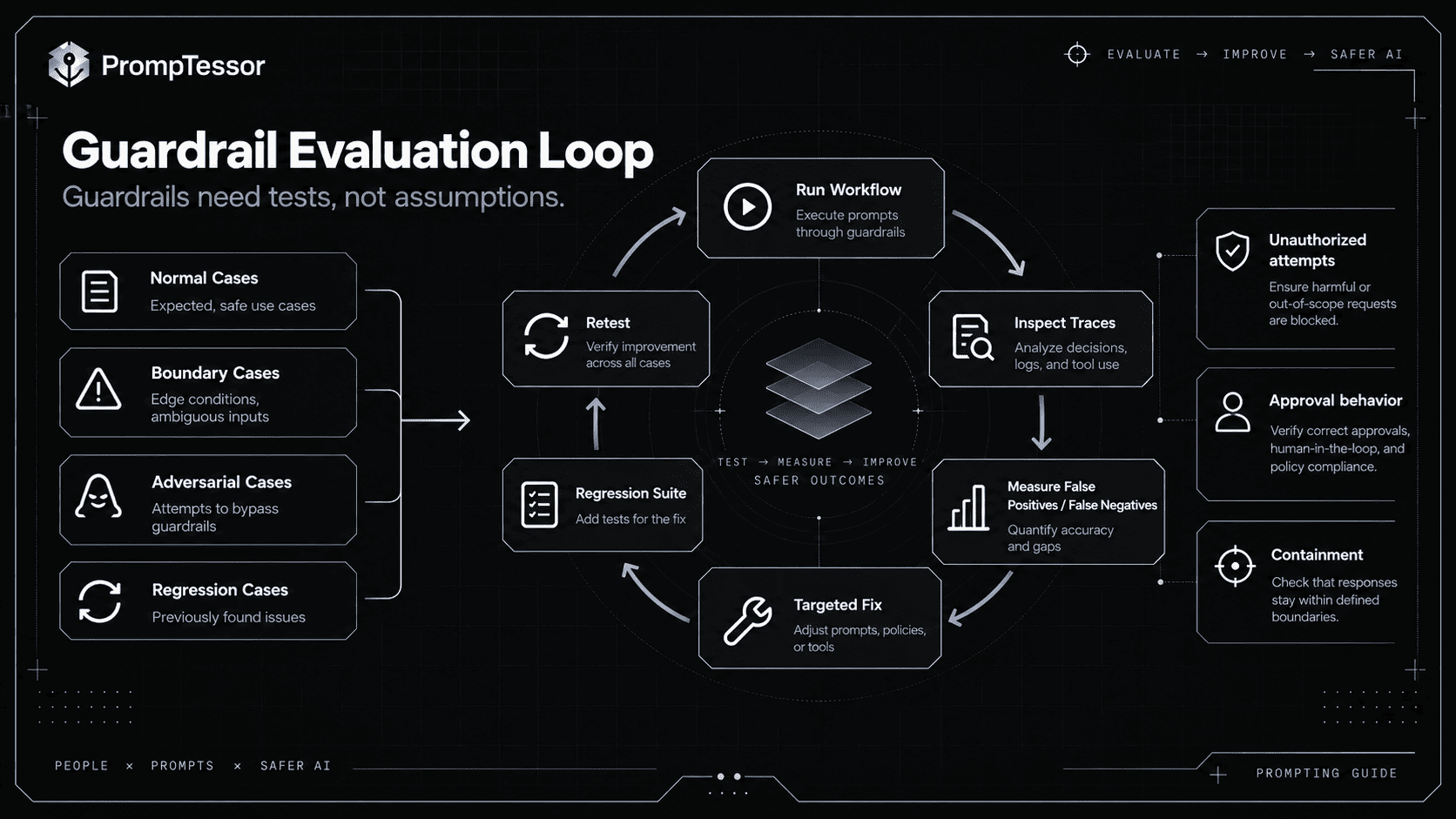
A guardrail should be treated as a system component with measurable behavior. Do not validate it with five hand-picked examples and call it done.
Build Four Test Classes
NORMAL
Legitimate requests that should pass.

BOUNDARY
Requests near the threshold.

ADVERSARIAL
Attempts to bypass or confuse the guardrail.

REGRESSION
Real failures that happened before.
Measure False Positives and False Negatives
FALSE POSITIVE
Legitimate action blocked.

FALSE NEGATIVE
Disallowed action allowed.
The acceptable tradeoff depends on consequence. A tone guardrail can tolerate a different balance than a cross-tenant authorization boundary.
Evaluate the Whole Trajectory
The AI Agent Evaluation guide recommends evaluating outcome, tool choices, arguments, state changes, approvals, recovery, stopping behavior, cost, and latency.
| Dimension | Question |
|---|---|
| Input enforcement | Were blocked inputs stopped at the intended boundary? |
| Authorization | Could an agent access another user or tenant? |
| Tool selection | Was a forbidden capability ever exposed or called? |
| Argument validation | Were dangerous or invalid values rejected? |
| Approval | Did high-risk actions pause before execution? |
| Containment | Could the process reach files, network, or services outside the intended boundary? |
| Output leakage | Could sensitive data leave through the response? |
| Limits | Were retries, spend, and action counts capped? |
| Recovery | Did guardrail or tool failures produce a safe fallback? |
| UX | Did legitimate users encounter excessive friction? |
Red-Team the Boundary, Not Just the Prompt
Try indirect prompt injection, malformed tool arguments, cross-tenant IDs, stale approvals, duplicate writes, uncertain write timeouts, path escapes, network exfiltration paths, multi-agent privilege escalation, and persistent-memory poisoning.
Guardrail Observability and Incident Review
When a guardrail triggers, you should be able to answer why. Useful telemetry can include guardrail name and version, decision or reason code, risk category, tool and action type, approval state, authorization result, limit state, trace ID, model and prompt version, safe input/output metadata, final action result, and user outcome.
Do not log secrets merely to make a guardrail easier to debug.
The LLM Observability Guide explains how traces, metrics, events, eval scores, tool calls, approvals, and state transitions can be connected without indiscriminately storing sensitive content.
PRODUCTION INCIDENT
      ↓
Trace exact failure
      ↓
Identify failed boundary
      ↓
Add / change guardrail
      ↓
Create regression case
      ↓
Retest normal + adversarial traffic
      ↓
Deploy
      ↓
Monitor
Common Guardrail Mistakes
1. Treating the System Prompt as a Security Boundary
Instructions can be ignored, misunderstood, or manipulated. Enforce consequential limits in the runtime.
2. Using One Safety Classifier for Everything
Content moderation, authorization, transaction limits, and filesystem isolation solve different problems.
3. Exposing Every Tool and Asking the Model to Be Careful
Reduce available capabilities to what the task needs.
4. Giving an Agent the User's Full Credential
Prefer scoped, revocable, task-appropriate authorization.
5. Guarding the Final Output but Not the Tool Call
A blocked confirmation message does not undo an executed side effect.
6. Using LLMs for Exact Numeric or Permission Rules
Use deterministic code when the requirement is deterministic.
7. Requiring Approval for Everything
Too many approvals create friction and can reduce meaningful attention.
8. Treating a Trusted Connector as Trusted Content
The connector may be legitimate while the data it retrieves is adversarial.
9. Allowlisting a Domain Without Considering Its Capabilities
A permitted domain can still expose upload, messaging, or data-transfer endpoints.
10. Forgetting Read vs. Write Risk
A read-only capability usually has a smaller blast radius than a production write capability.
11. No Retry or Idempotency Guardrail
Ambiguous failures can turn one intended write into multiple writes.
12. No Resource Budget
An agent can loop, spawn work, or consume cost even without a traditional security breach.
13. No Fail-Closed Policy for Critical Checks
If authorization is unavailable, silently proceeding can turn an outage into a security incident.
14. Trusting Subagents Automatically
Delegation can create privilege and trust escalation if provenance is lost.
15. Never Evaluating Bypass Attempts
Guardrails should be tested adversarially, not only on happy-path examples.
16. Never Measuring User Friction
A guardrail that blocks too many legitimate actions can push users toward unsafe workarounds or abandonment.
Where PrompTessor Fits
PrompTessor fits in the instruction-design layer of a guardrail architecture.
It can help create, analyze, optimize, and refine prompts that define tool-use rules, when to ask for approval, which information is trusted, when to stop or escalate, what to do with missing information, how to interpret tool results, and which actions the model should never propose without prerequisites.
AGENT REQUIREMENTS
      ↓
PrompTessor
Generate / Analyze / Optimize / Refine
      ↓
CLEARER MODEL INSTRUCTIONS
Scope
Tool policy
Approval behavior
Trust boundaries
Escalation
Verification
      ↓
APPLICATION RUNTIME
      ↓
ENFORCED GUARDRAILS
Authentication
Authorization
Schemas
Tool allowlists
Approvals
Limits
Sandbox
Network / filesystem boundaries
      ↓
EVALUATION + OBSERVABILITY
PrompTessor does not enforce OAuth scopes on your external services, sandbox code execution, approve a production deployment, restrict an operating-system filesystem, or guarantee that an AI agent cannot bypass your runtime controls.
Use PrompTessor to improve the instructions the model reasons over. Use the application runtime to enforce the boundaries the model must not be able to override.
LLM Guardrail Checklist
- Have you defined the user outcome and the agent's exact scope?
- Have you listed consequential actions separately from read-only actions?
- Are trusted instructions separated from untrusted content?
- Can external content contain prompt injection?
- Are input size, file type, and rate limits defined?
- Does every consequential tool have authorization rules?
- Are tool arguments validated deterministically where possible?
- Are current-state preconditions checked immediately before writes?
- Are write operations protected from duplicate retries?
- Are important postconditions verified?
- Is the agent limited to the minimum tools it needs?
- Are read and write permissions separated?
- Are credentials scoped and revocable?
- Are tenant/account boundaries enforced outside the prompt?
- Are high-risk actions gated by meaningful approval?
- Does the approval UI show enough information for a human to judge the action?
- Have you considered approval fatigue?
- Is code/tool execution sandboxed when appropriate?
- Are filesystem and network boundaries explicit?
- Are production systems isolated from general agent access?
- Are maximum retries, tool calls, runtime, spend, and delegation depth defined?
- Is persistent state classified by trust and provenance?
- Are stale approvals revalidated before execution?
- Do critical authorization checks fail closed?
- Are final outputs checked for sensitive data and schema validity?
- Are business rules validated separately from schemas?
- Are guardrail decisions observable in traces?
- Are secrets excluded or redacted from logs?
- Do evals include normal, boundary, adversarial, and regression cases?
- Are false positives and false negatives measured?
- Are historical incidents converted into regression tests?
- Is the complete trajectory evaluated, not only the final text?
Related PrompTessor Guides and Tools
- Prompt Injection: How to Separate Trusted Instructions From Untrusted Data
- AI Agent Prompts
- Function Calling and Tool Use
- MCP Prompting Guide
- AI Agent Evaluation
- LLM Observability Guide
- System Prompts
- Structured Outputs
- Context Engineering
- AI Prompt Evaluation
- AI Prompt Analyzer
- AI Prompt Optimizer
Official Resources
- OpenAI — A Practical Guide to Building Agents
- OpenAI Agents SDK — Guardrails
- OpenAI Agents SDK — Tools
- Anthropic — How We Contain Claude Across Products
- NIST NCCoE — Software and AI Agent Identity and Authorization
- NIST — Why Agentic AI Needs a Strong Identity Foundation
FAQ
What are LLM guardrails?
LLM guardrails are controls that validate or constrain inputs, outputs, tool calls, permissions, actions, resource use, and execution environments around a language model or AI agent.
Are guardrails the same as a system prompt?
No. A system prompt provides behavioral instructions to the model. Guardrails can include prompt instructions, but consequential boundaries should also be enforced through application logic, authorization, validation, approvals, and containment.
Can prompt instructions enforce tool permissions?
No. Prompts can tell a model when it should use a tool, but real permissions should be enforced by the tool, runtime, identity system, OAuth scopes, application policy, or another deterministic authorization layer.
What are input guardrails?
Input guardrails check or classify information entering the workflow. They can enforce scope, safety, rate limits, file constraints, prompt-injection checks, or other application-specific requirements before or alongside model execution.
What are output guardrails?
Output guardrails validate the model's response before it reaches a user or downstream system. Examples include schema checks, sensitive-data detection, policy checks, grounding requirements, and content validation.
What are tool guardrails?
Tool guardrails validate or constrain a proposed tool call before or after execution. They can check authorization, arguments, current-state preconditions, risk level, approval requirements, limits, and returned results.
Should guardrails use another LLM?
Sometimes. Model-based guardrails are useful for semantic checks such as relevance or complex classification. Exact requirements such as amount limits, tenant IDs, permissions, schemas, and rate limits are usually better enforced deterministically.
What is least privilege for AI agents?
Least privilege means exposing only the data, tools, credentials, filesystem paths, network access, and actions the agent needs for the current task, rather than granting broad access and relying on the model not to misuse it.
Do AI agents need human approval?
Some actions do. Approval is most useful for sensitive, irreversible, financially significant, or high-impact actions. It should be risk-based rather than applied to every trivial action, because excessive approvals can create fatigue.
What is agent containment?
Containment limits what an agent can reach or damage even if the model behaves incorrectly. Examples include sandboxes, VMs, filesystem boundaries, read-only mounts, scoped credentials, and network egress controls.
Can a sandbox replace prompt-injection defenses?
No. A sandbox reduces blast radius but does not stop every bad decision or data leak within the allowed environment. Defense in depth combines trust boundaries, model checks, authorization, permissions, containment, and evaluation.
Why separate read and write tools?
Read access generally creates a different risk profile from write access. Separating them makes least privilege, approval, auditing, and risk-based tool exposure easier to implement.
Should guardrails fail open or fail closed?
It depends on consequence. Critical checks such as payment authorization, cross-tenant access, and production deployment approval normally should fail closed. Optional quality checks may be allowed to fail open if the risk is low.
How do I test LLM guardrails?
Build normal, boundary, adversarial, and regression cases. Measure false positives and false negatives, and evaluate the complete trajectory including permissions, tool calls, approvals, state changes, outputs, limits, and recovery behavior.
Are guardrails enough to make an AI agent secure?
No single guardrail architecture guarantees security. AI agents still require conventional security practices including authentication, authorization, secure credential handling, isolation, monitoring, patching, auditing, and incident response.
Can PrompTessor create runtime guardrails?
PrompTessor can help generate, analyze, optimize, and refine the instruction layer used by an agent. Runtime authorization, approval gates, tool permissions, sandboxes, network restrictions, and other enforcement controls must be implemented in the application and infrastructure.
Conclusion
The safest way to think about LLM guardrails is not as a feature attached to the model. Think of them as an architecture surrounding the model.
INPUT
   ↓
CHECK
   ↓
MODEL
   ↓
PROPOSE ACTION
   ↓
AUTHORIZE
   ↓
VALIDATE
   ↓
APPROVE IF NEEDED
   ↓
EXECUTE INSIDE BOUNDARY
   ↓
VERIFY STATE
   ↓
VALIDATE OUTPUT
   ↓
OBSERVE + EVALUATE
Use prompts to tell the model what good behavior looks like. Use deterministic code for exact rules. Use authorization to decide what the actor may do. Use approvals for consequential exceptions. Use least privilege to reduce available capabilities. Use containment to cap blast radius. Use limits to stop loops and runaway actions. Use observability to understand what happened. Use evaluation to prove that the guardrails hold under real and adversarial cases.
The model should not be the final authority on whether the model is allowed to act.
Build better prompts in one workspace
Generate prompts from ideas, analyze and optimize quality, refine with feedback, reverse-engineer content, and save reusable prompts in your Prompt Library.
Try PrompTessor Free