Structured Outputs: How to Make AI Return Reliable JSON and Schemas
Getting an AI model to return JSON is easy.
Getting it to return the right JSON every time is a different problem.
A prompt such as:
Return the result as JSON.may work in a demo. But production software usually needs something stricter:
- the same field names every time,
- the right data types,
- required properties that are not silently omitted,
- controlled values for fields such as status or priority,
- predictable nesting,
- machine-readable failure states,
- and a contract that downstream code can validate.
That is the purpose of structured outputs.
Structured outputs constrain a model response to a predefined schema instead of relying only on natural-language formatting instructions.
A useful mental model is:
UNSTRUCTURED GENERATION

Task
 ↓
Model
 ↓
"Here are the three opportunities I found..."
 ↓
Custom parsing
 ↓
Hope the format did not change


STRUCTURED GENERATION

Task
+
Schema
 ↓
Model
 ↓
Schema-conformant data
 ↓
Application validation
 ↓
Downstream system
OpenAI, Anthropic, and Google now all provide native mechanisms for schema-constrained structured responses in their model APIs. The exact parameters, supported schema subsets, and compatibility rules differ, but the architectural idea is the same: define the shape you need, have the model produce data that conforms to that shape, then validate the meaning before your application trusts it.
This guide explains what structured outputs are, how they differ from JSON mode and function calling, how JSON Schema works, how to design reliable schemas, how to validate model outputs, how structured outputs fit into prompt chains, RAG systems, and agents, and how to handle failure cases in production.
Quick Answer
Structured outputs are model responses constrained to a predefined machine-readable schema, usually JSON Schema.
Instead of asking a model:
Return JSON with a name, score, and reason.you define a contract such as:
{
  "type": "object",
  "properties": {
    "name": {
      "type": "string"
    },
    "score": {
      "type": "integer"
    },
    "reason": {
      "type": "string"
    }
  },
  "required": ["name", "score", "reason"],
  "additionalProperties": false
}
The model then generates an output that follows the supported schema constraints.
This improves structural reliability, but it does not prove that the values are factually correct, current, authorized, or valid according to your business rules.
SCHEMA CONFORMANCE
Does the output have the required shape?

BUSINESS VALIDATION
Are the values allowed by the application?

FACTUAL / STATE VALIDATION
Are the values actually correct and current?
Reliable AI applications typically need all three layers.
Key Takeaways
- Structured outputs are more reliable than asking for JSON through prompt wording alone.
- Valid JSON and schema-conformant JSON are not the same thing.
- OpenAI distinguishes Structured Outputs from JSON mode: both can produce valid JSON, but Structured Outputs enforce a supported schema.
- Anthropic provides schema-constrained JSON outputs and strict tool use for schema-valid tool inputs.
- Gemini can generate JSON that adheres to a provided supported JSON Schema.
- Provider support is not identical; each platform supports a subset of JSON Schema and has its own API surface and limitations.
- A schema is an interface contract, not a substitute for good instructions.
- Use meaningful field names, descriptions, strong types, enums, and intentional required fields.
- Very large or deeply nested schemas can increase complexity and may exceed provider limits.
- Structured outputs are ideal for extraction, classification, application state, workflow steps, and machine-readable responses.
- Natural language remains better for many conversational, explanatory, and creative tasks.
- Structured outputs and function calling solve different problems: one structures a response; the other requests an action or external capability.
- Schema-valid output can still be semantically wrong.
- Applications should validate ranges, cross-field relationships, current state, permissions, and factual claims separately.
- Unknown or impossible inputs need an explicit representation inside the schema or a defined refusal/failure path.
- Structured intermediate outputs can make prompt chains easier to validate and debug.
- Schema versioning matters when downstream consumers depend on a stable contract.
- Production systems should distinguish schema failures, semantic failures, missing evidence, tool failures, and model refusals.
- PrompTessor can help improve the prompt-design and refinement layer around structured generation, while native schema enforcement and runtime validation remain responsibilities of the model API and application.
Table of Contents
- What Are Structured Outputs?
- Why Structured Outputs Matter
- Valid JSON vs. Structured Outputs
- JSON Mode vs. Structured Outputs
- What Is JSON Schema?
- Anatomy of a Structured Output Schema
- Prompt Formatting vs. Schema Enforcement
- Structured Outputs Across OpenAI, Claude, and Gemini
- How to Design a Good Output Schema
- Structured Outputs as Interface Contracts
- Structured Outputs vs. Function Calling
- Structured Outputs vs. Natural Language
- Schema Validation vs. Semantic Validation
- Handling Unknown, Missing, and Impossible Values
- Structured Outputs in Prompt Chaining
- Structured Outputs in RAG
- Structured Outputs in AI Agents
- Schema Versioning
- Error Handling and Recovery
- How to Evaluate Structured Outputs
- Structured Output Examples
- Reusable Structured Output Templates
- Common Structured Output Mistakes
- Using PrompTessor With Structured Output Prompts
- Structured Output Checklist
- Official Resources
- FAQ
What Are Structured Outputs?
Structured outputs are responses generated according to a predefined data structure.
In modern LLM APIs, this usually means providing a JSON Schema or a schema derived from a typed model such as Pydantic or Zod, then using a provider feature that constrains the generated response to that supported structure.
For example, instead of receiving:
The customer sounds frustrated. I would classify this as negative
sentiment with high confidence.
an application can receive:
{
  "sentiment": "negative",
  "confidence": 0.94
}
with a schema such as:
{
  "type": "object",
  "properties": {
    "sentiment": {
      "type": "string",
      "enum": ["positive", "neutral", "negative"]
    },
    "confidence": {
      "type": "number"
    }
  },
  "required": ["sentiment", "confidence"],
  "additionalProperties": false
}
This changes the role of the model output.
It is no longer only text for a human to read. It becomes data that software can consume.
Structured Output Does Not Mean “JSON-Looking Text”
A model can produce text that looks like JSON without any schema guarantee.
{
  "sentiment": "negative",
  "confidence": "very high"
}
That is valid JSON, but if your application expects confidence to be numeric, the response still breaks the contract.
Structured outputs aim to constrain both syntax and shape according to the provider's supported schema semantics.
Why Structured Outputs Matter
Natural-language outputs are flexible. Software interfaces are not.
A parser may expect:
{
  "priority": "high",
  "category": "billing",
  "needs_human": true
}
but an unconstrained model might return:
Category: Billing
Priority: Urgent
Human review is probably needed.
or:
{
  "issue_type": "billing",
  "urgency": 10,
  "escalate": "yes"
}
Both may make sense to a person. Neither matches the software contract.
1. Reliable Field Names
Downstream code should not need to guess whether the model will return priority, urgency, or severity.
2. Reliable Types
A boolean should not sometimes be true, sometimes "yes", and sometimes "probably".
3. Controlled Values
Enums reduce unexpected variants:
"priority": "high"instead of:
"priority": "very urgent"4. Predictable Nesting
Applications can rely on stable objects and arrays instead of parsing text heuristically.
5. Easier Validation
A schema gives the application a formal boundary between generated data and downstream logic.
6. Better Workflow Composition
One AI step can produce a structured artifact that another step consumes.
Extract
  ↓
{
  "facts": [...]
}
  ↓
Analyze
  ↓
{
  "opportunities": [...]
}
  ↓
Act / Present
7. Easier Observability
If a workflow fails, structured fields make it easier to inspect whether the problem was missing data, an invalid value, a bad classification, or a downstream rule.
Valid JSON vs. Structured Outputs
Valid JSON answers a syntax question:
Can a JSON parser read this?
Structured outputs answer a stronger question:
Does this JSON follow the data contract the application expects?
Consider:
{
  "status": "done",
  "score": "ninety",
  "notes": ["Looks good"]
}
This is valid JSON.
But suppose the schema requires:
{
  "status": "approved | rejected",
  "score": "integer",
  "reason": "string"
}
The JSON is syntactically valid and structurally wrong.
This distinction is the foundation for understanding structured outputs.
JSON Mode vs. Structured Outputs
OpenAI explicitly distinguishes JSON mode from Structured Outputs.
| JSON Mode | Structured Outputs |
|---|---|
| Produces valid JSON | Produces valid JSON that adheres to a supported schema |
| Shape can still vary | Shape is constrained |
| Required keys can still be missing | Supported required fields are enforced by the schema |
| Unexpected values can appear | Supported enum/type constraints can restrict them |
| Useful when arbitrary JSON is acceptable | Better when downstream software expects a contract |
OpenAI recommends Structured Outputs instead of JSON mode when possible for cases that require schema adherence.
The general lesson extends beyond one provider:
"Return JSON"
        ↓
Formatting request

JSON mode
        ↓
Syntax constraint

Structured output + schema
        ↓
Data contract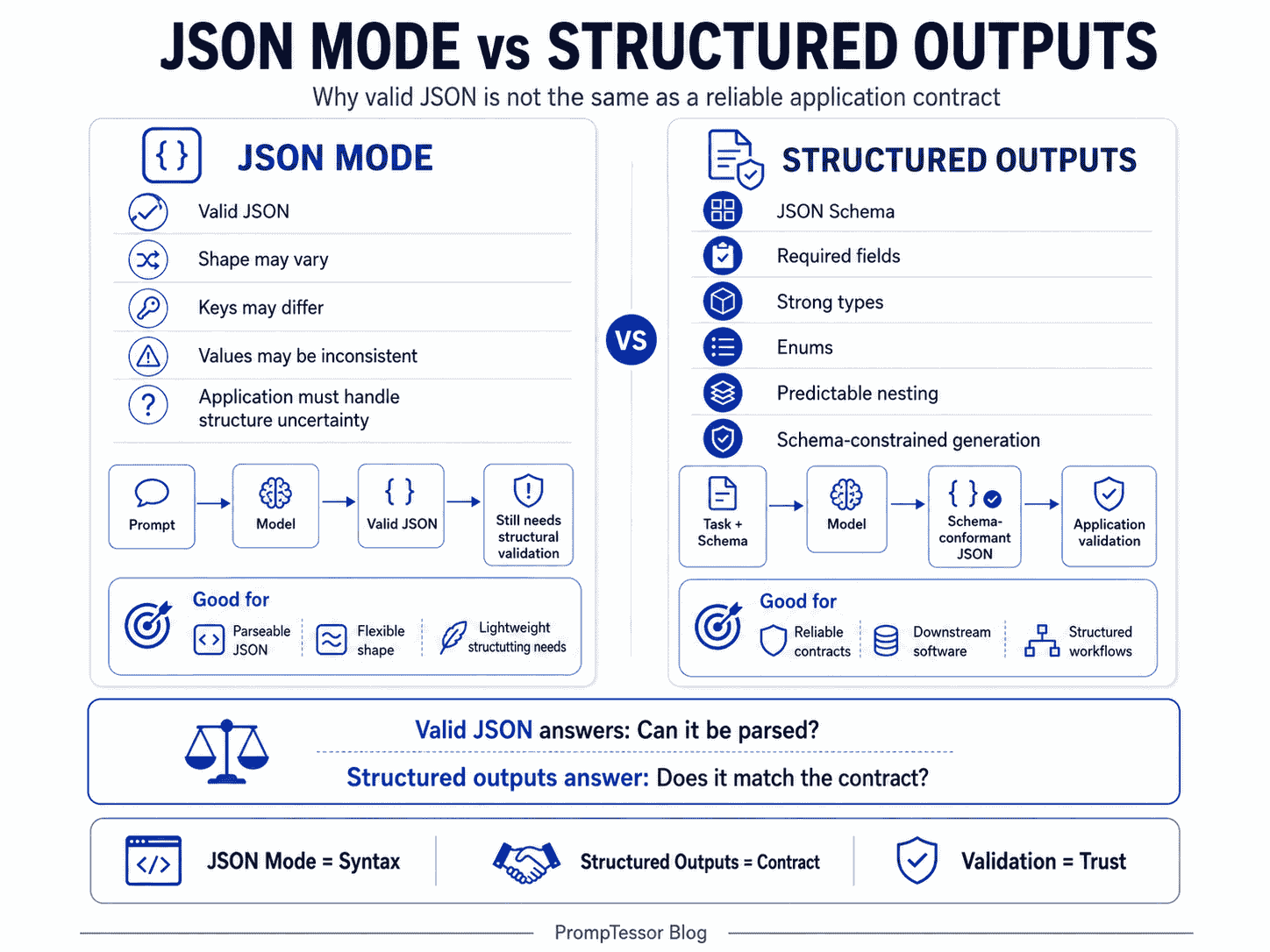
What Is JSON Schema?
JSON Schema is a vocabulary for describing the expected structure and constraints of JSON data.
A schema can describe:
- objects,
- arrays,
- strings,
- numbers,
- integers,
- booleans,
- required fields,
- enumerated values,
- nested objects,
- and other constraints supported by the implementation.
Example:
{
  "type": "object",
  "properties": {
    "category": {
      "type": "string",
      "enum": ["bug", "feature_request", "billing", "other"],
      "description": "Primary category of the request."
    },
    "priority": {
      "type": "string",
      "enum": ["low", "medium", "high"],
      "description": "Operational priority."
    },
    "summary": {
      "type": "string",
      "description": "One-sentence summary of the issue."
    }
  },
  "required": ["category", "priority", "summary"],
  "additionalProperties": false
}
That schema does more than tell the model to “return JSON.” It defines the interface.
Provider Subsets Matter
Do not assume every JSON Schema feature is available in every AI API.
OpenAI documents support for a subset of JSON Schema. Anthropic states that its structured outputs use standard JSON Schema with limitations. Gemini likewise supports a subset and warns that very large or deeply nested schemas may be rejected.
So portable schema design should start with the supported subset of the model provider you actually use.
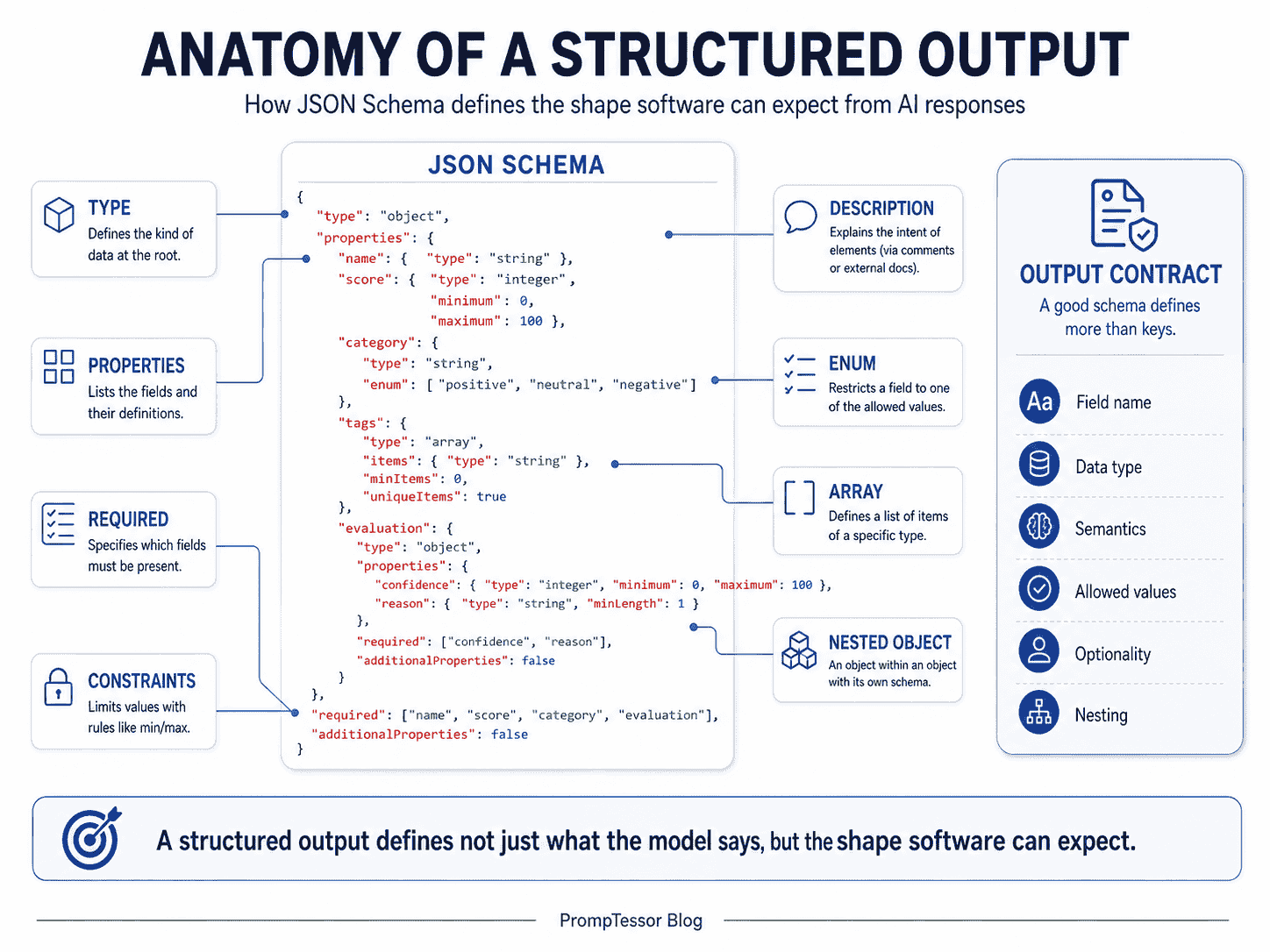
Anatomy of a Structured Output Schema
1. Type
The type describes what kind of JSON value is allowed.
{
  "type": "string"
}
or:
{
  "type": "object"
}
2. Properties
For objects, properties defines the expected fields.
{
  "type": "object",
  "properties": {
    "name": {"type": "string"},
    "score": {"type": "integer"}
  }
}
3. Required Fields
required makes the contract explicit about fields that must be present.
{
  "required": ["name", "score"]
}
A good schema should make optionality intentional rather than accidental.
4. Enums
Enums are valuable when a field has a finite set of legal values.
{
  "type": "string",
  "enum": ["low", "medium", "high"]
}
This is usually better than asking the model to invent its own labels.
5. Arrays
Arrays make repeated items predictable.
{
  "type": "array",
  "items": {
    "type": "string"
  }
}
6. Nested Objects
Nested objects help separate related groups of fields.
{
  "type": "object",
  "properties": {
    "evaluation": {
      "type": "object",
      "properties": {
        "score": {"type": "integer"},
        "reason": {"type": "string"}
      },
      "required": ["score", "reason"],
      "additionalProperties": false
    }
  }
}
7. Descriptions
A field name defines the key. A description explains its semantics.
Weak:
"score": {
  "type": "integer"
}
Better:
"score": {
  "type": "integer",
  "description": "Overall quality score from 0 to 100, where 100 is best."
}
Google's Gemini guidance explicitly recommends clear descriptions and strong typing. Good descriptions also reduce ambiguity across providers.
8. Additional Properties
When supported, disabling unspecified properties prevents the model from inventing extra fields that downstream software does not understand.
"additionalProperties": false9. Constraints
Depending on provider support, schemas can express constraints beyond basic types.
But do not rely on a JSON Schema feature before confirming that the target API supports it. The provider's schema subset is the actual contract.
Prompt Formatting vs. Schema Enforcement
Before native structured-output features, developers often used prompting techniques such as:
Return ONLY valid JSON.
Do not include markdown.
Use exactly these keys:
name, score, reason.
Never include any additional text.
This can improve consistency, but it is still a request made in natural language.
Native schema enforcement is stronger.
INSTRUCTIONS
What the model should do

        +

JSON SCHEMA
What the output must look like

        +

PROVIDER STRUCTURED OUTPUT FEATURE
Constrains generation to the supported schema
The prompt still matters.
A schema can define:
{
  "winner": "string",
  "reason": "string"
}
but it does not define enough task logic to know:
- what is being compared,
- which criteria matter,
- how evidence should be weighed,
- what to do when information is missing,
- or when the correct answer is “insufficient evidence.”
Schema enforcement solves output shape. Prompt engineering still defines the task.
Structured Outputs Across OpenAI, Claude, and Gemini
The same broad pattern exists across major AI platforms, but the implementation details are different.
OpenAI Structured Outputs
OpenAI's current API documentation describes Structured Outputs as a way to ensure text responses adhere to a supplied JSON Schema.
OpenAI exposes structured output for model responses and also supports strict schemas in function calling.
The platform distinguishes two use cases:
- structured response format when the model's final response should follow a schema,
- function calling when the model needs to interact with tools, functions, or application capabilities.
OpenAI also distinguishes Structured Outputs from JSON mode: both can produce valid JSON, but only Structured Outputs provide schema adherence for supported schemas.
Important implementation detail: OpenAI supports a subset of JSON Schema, so schemas should be designed against the documented supported features rather than arbitrary JSON Schema features.
Claude Structured Outputs
Anthropic's current Claude API supports JSON outputs with a provided schema through output_config.format.
Claude also provides strict tool use, where strict: true constrains tool inputs to the tool's JSON Schema.
Anthropic treats these as two complementary features:
- JSON outputs control what Claude returns as the response,
- strict tool use controls the structure of tool arguments.
Anthropic documents schema limitations and notes that compiled grammar artifacts are cached, which can introduce additional first-request latency for a new schema.
Gemini Structured Outputs
Google's Gemini API can generate responses that adhere to a provided JSON Schema through structured output configuration.
Google describes structured outputs as useful for:
- data extraction,
- structured classification,
- and agentic workflows that need structured inputs for tools or APIs.
Gemini also distinguishes structured outputs from function calling:
- structured outputs format the final response,
- function calling is for requesting an action during the interaction.
Google explicitly recommends validating values in the application even when the output is syntactically correct and warns that schema-compliant responses can still be semantically incorrect.
Do Not Assume Provider Parity
| Concept | OpenAI | Claude | Gemini |
|---|---|---|---|
| Schema-constrained final JSON | Yes, on compatible models/APIs | Yes, on compatible models/platforms | Yes, on compatible models/APIs |
| JSON Schema | Supported subset | Supported with documented limitations | Supported subset |
| Typed SDK helpers | Available in supported SDK workflows | Available across several SDKs | Pydantic/Zod support in GenAI SDKs |
| Tool argument schemas | Supported through function/tool schemas | Supported through strict tool use | Function calling uses its own parameter schemas; Gemini 3 can also combine function calling with structured output |
| Exact API parameters | Provider-specific | Provider-specific | Provider-specific |
The portable architectural principle is:
Design the data contract first, then adapt it to the supported structured-output mechanism of the target provider.
How to Design a Good Output Schema
A technically valid schema can still be a poor application contract.
Good schema design starts with the decision the application needs to make.
1. Make Fields Task-Specific
Weak:
{
  "data": {}
}
Better:
{
  "winner": "string",
  "confidence": "number",
  "criteria": "array",
  "risks": "array"
}
Generic containers move ambiguity downstream.
2. Prefer Explicit Semantics
Weak field:
"score": 82What does 82 mean?
Better:
"overall_score": {
  "type": "integer",
  "description": "Overall fit score from 0 to 100, where 100 represents the strongest fit."
}
3. Use Strong Types
If a value is numeric, make it numeric.
Weak:
"confidence": "high"Better when a numeric value is useful:
"confidence": 0.91Or, if the application needs discrete categories:
"confidence": "high"with an enum:
"enum": ["low", "medium", "high"]4. Use Enums for Closed Sets
Enums are useful for:
- status,
- priority,
- category,
- action type,
- sentiment,
- approval state,
- and workflow transitions.
They reduce output vocabulary drift.
5. Make Required Fields Deliberate
Do not make everything optional just to avoid failures.
If downstream software cannot operate without category and priority, those fields are part of the contract.
For truly unknown information, model the unknown state explicitly.
OpenAI-specific note: OpenAI Structured Outputs currently requires all fields or function parameters to be listed as required. Optional semantics can be modeled with a union that includes null. Other providers have their own schema rules, so design required and optional values against the target provider's supported subset.
6. Avoid Ambiguous Nullability
Do not use null for five different meanings.
For example:
{
  "price": null
}
could mean:
- price not found,
- price unavailable,
- not applicable,
- retrieval failed,
- or user lacks permission.
A clearer contract is:
{
  "price": null,
  "price_status": "not_found"
}
with an enum for price_status.
7. Keep Nesting Meaningful
Nested objects are useful when they reflect real conceptual boundaries.
{
  "evaluation": {
    "score": 88,
    "confidence": 0.91
  },
  "evidence": [
    {
      "source_id": "doc_42",
      "claim": "..."
    }
  ]
}
But deeply nested schemas can become harder to prompt, validate, evolve, and sometimes even support within provider complexity limits.
8. Separate Classification From Explanation
Useful:
{
  "category": "billing",
  "priority": "high",
  "explanation": "The user reports a duplicate charge after cancellation."
}
This lets downstream code use the machine-readable fields while humans can still inspect the rationale summary.
9. Separate Evidence From Conclusions
{
  "conclusion": "Competitor A has the lowest entry price.",
  "evidence": [
    {
      "source": "pricing_page_a",
      "value": "$9"
    }
  ]
}
This makes validation easier than embedding evidence inside one long prose field.
10. Keep the Schema as Small as the Task Allows
Do not create a universal 80-field response object for every task.
Smaller task-specific schemas are often easier to:
- understand,
- prompt,
- validate,
- version,
- and test.
Structured Outputs as Interface Contracts
Structured outputs are easiest to reason about when treated as API contracts.
PROMPT
Defines the task

SCHEMA
Defines the output interface

MODEL
Produces candidate data

VALIDATION
Checks the contract and meaning

APPLICATION
Consumes the approved result
This framing changes several design decisions.
Schema Changes Become Breaking Changes
Renaming:
"score"to:
"overall_score"may be harmless to the model and breaking to every consumer.
Consumers Should Not Depend on Undocumented Behavior
If a property is not guaranteed by the schema, downstream code should not silently assume it is always present.
Business Semantics Belong in the Contract
If confidence is 0–1, document that.
If priority means operational urgency rather than customer sentiment, document that.
If a field may be null, define what null means.
Structured Outputs vs. Function Calling
Structured outputs and function calling both use schemas, but they represent different interaction patterns.
Structured Output
User / Application
       ↓
Model
       ↓
Structured Response
       ↓
Application consumes data
Example:
{
  "sentiment": "negative",
  "priority": "high"
}
Function Calling
User / Application
       ↓
Model
       ↓
Structured Tool Request
       ↓
Application executes tool
       ↓
Tool Result
       ↓
Model / Workflow continues
Example tool request:
{
  "name": "get_order",
  "arguments": {
    "order_id": "ORD-123"
  }
}
OpenAI's current documentation explicitly recommends function calling when connecting the model to tools, functions, data, or actions, and structured response formats when the final model response itself should follow a schema.
Gemini documents the same broad distinction: structured outputs format the final answer, while function calling requests an action.
Anthropic similarly separates JSON outputs from strict tool use.
They Can Work Together
A workflow can use both:
User Request
     ↓
Model
     ↓
Strict Tool Call
     ↓
Database / API
     ↓
Tool Result
     ↓
Model
     ↓
Structured Final Response
This is a common pattern in production agents.
Structured Outputs vs. Natural Language
Structured output is not always the best output.
Use Structured Outputs When
- software consumes the result,
- you need extraction,
- you need classification,
- you need predictable workflow state,
- you need stable API-like fields,
- you need machine-readable evidence,
- you need database insertion,
- or another model step expects a contract.
Use Natural Language When
- the primary consumer is a person,
- the task is explanation,
- the task is creative writing,
- flexible expression matters,
- the output does not need programmatic parsing,
- or a rigid schema would reduce usefulness.
Hybrid Outputs Are Often Useful
You can return structured data that contains selected natural-language fields:
{
  "decision": "approve",
  "confidence": 0.92,
  "explanation": "The request satisfies all mandatory criteria.",
  "next_steps": [
    "Create the account",
    "Send onboarding email"
  ]
}
The structure supports software. The prose fields support humans.
Schema Validation vs. Semantic Validation
This is one of the most important distinctions in structured AI systems.
Suppose the schema says:
{
  "type": "object",
  "properties": {
    "price": {"type": "number"}
  },
  "required": ["price"]
}
and the model returns:
{
  "price": 19.99
}
The output can be perfectly schema-valid and factually wrong.
Layer 1: Schema Validation
Questions:
- Are required fields present?
- Are data types correct?
- Are enum values allowed?
- Is nesting correct?
- Are unexpected fields prohibited when required?
Layer 2: Business Validation
Questions:
- Is the score within an application-defined range?
- Is this workflow transition legal?
- Can this account perform this action?
- Do cross-field relationships make sense?
Example:
{
  "status": "refunded",
  "refund_amount": 200,
  "original_charge": 100
}
All fields may have valid types, but the business relationship may be impossible.
Layer 3: Factual or State Validation
Questions:
- Is the price current?
- Does the cited source actually support the claim?
- Is inventory still available?
- Does the user really have this plan?
- Did the tool result change since the model received it?
Layer 4: Policy and Permission Validation
Questions:
- Is the requested action authorized?
- Should this data be visible to this user?
- Does this output comply with application rules?
STRUCTURED OUTPUT
       ↓
Schema Valid?
       ↓
Business Valid?
       ↓
Fact / State Valid?
       ↓
Policy / Permission Valid?
       ↓
Safe to consume
Google's current Gemini guidance explicitly recommends application-side validation because syntactically correct structured JSON can still contain semantically incorrect values.
Handling Unknown, Missing, and Impossible Values
A schema should define what happens when the model cannot honestly provide a field.
This is especially important because schema-constrained generation creates pressure to fill the required shape.
OpenAI warns that when user-generated input cannot meaningfully produce a valid response for the schema, the model may still try to satisfy the schema, which can create hallucinated values unless the prompt and schema define how to handle the case.
Weak Design
{
  "company_revenue": {
    "type": "number"
  }
}
What if revenue is not present in the source?
Better Design
{
  "revenue": {
    "type": ["number", "null"]
  },
  "revenue_status": {
    "type": "string",
    "enum": ["verified", "not_found", "conflicting", "not_applicable"]
  }
}
depending on the target provider's supported schema syntax.
Another pattern is to make uncertainty explicit:
{
  "answer_status": "insufficient_evidence",
  "answer": null,
  "missing_information": [
    "Current enterprise pricing"
  ]
}
Design Failure States as First-Class Outputs
Useful status enums can include:
success
insufficient_evidence
needs_clarification
tool_failed
not_applicable
conflicting_sources
refused
The exact set should reflect your application, not a generic template.
Structured Outputs in Prompt Chaining
Prompt chains become more reliable when each stage has a clear input/output contract.
Without structured intermediate outputs:
Research
  ↓
Long prose blob
  ↓
Analyze
  ↓
Another prose blob
  ↓
Write
With structured outputs:
STEP 1 — EXTRACT

{
  "facts": [
    {
      "claim": "...",
      "source": "...",
      "confidence": 0.94
    }
  ]
}

        ↓

STEP 2 — ANALYZE

{
  "opportunities": [
    {
      "title": "...",
      "evidence_ids": ["fact_1", "fact_4"],
      "priority": "high"
    }
  ]
}

        ↓

STEP 3 — WRITE
This improves:
- stage isolation,
- debugging,
- validation,
- retry behavior,
- and observability.
For more on decomposing workflows, see Prompt Chaining: How to Build Better Multi-Step AI Workflows.
Structured Outputs in RAG
RAG systems often use structured outputs to separate the answer from evidence metadata.
{
  "answer": "The policy allows refunds within 30 days.",
  "sources": [
    {
      "document_id": "refund-policy-v4",
      "section": "Eligibility"
    }
  ],
  "answer_status": "supported"
}
This can help downstream systems:
- render citations,
- verify source IDs,
- reject unsupported answers,
- track retrieval quality,
- and distinguish “no evidence found” from a normal answer.
Schema Does Not Ground the Answer by Itself
A model can return:
{
  "answer": "Refunds are allowed within 90 days.",
  "source_id": "refund-policy-v4"
}
while the cited source says 30 days.
The structure is valid. The claim is not.
Grounding validation remains necessary.
For the broader information-selection layer, see Context Engineering: How to Give AI the Right Information at the Right Time.
Structured Outputs in AI Agents
Agents frequently need structured decisions because their output controls what happens next.
Example planning object:
{
  "next_action": "search_docs",
  "query": "enterprise cancellation policy",
  "reason": "The current context does not contain the applicable policy.",
  "requires_confirmation": false
}
But architecture matters.
The model should not be treated as the final authority for permissions, financial limits, destructive actions, or other deterministic rules merely because it returned a valid schema.
Good Pattern
Model Decision
     ↓
Structured Action Proposal
     ↓
Application Validation
     ↓
Permission / Policy Check
     ↓
Execute Tool
     ↓
Return Result
Strict Tool Inputs
OpenAI and Anthropic both support schema-constrained tool arguments in their respective tool/function mechanisms. Anthropic's strict tool use, for example, uses grammar-constrained sampling so tool inputs match the JSON Schema for the function.
This reduces malformed arguments, but application-side authorization and business validation remain necessary.
Schema Versioning
Once downstream software depends on a structured output, the schema becomes part of your application's contract surface.
That means schema changes should be versioned deliberately.
Version 1
{
  "name": "Product A",
  "score": 91
}
Version 2
{
  "name": "Product A",
  "score": {
    "overall": 91,
    "confidence": 0.88
  }
}
Version 2 may be better, but a consumer that expects score to be an integer may fail immediately.
Breaking Changes Can Include
- renaming a field,
- changing a type,
- moving a field into a nested object,
- changing enum values,
- making an optional field required,
- changing the meaning of an existing field,
- or changing nullability.
Non-Breaking Changes Are Context-Dependent
Even adding a new optional field can break a consumer that rejects unknown properties.
So “non-breaking” should be defined by the actual consumers, not by intuition.
A Practical Versioning Pattern
{
  "schema_version": "2.0",
  "result": {
    ...
  }
}
or version the endpoint / internal contract rather than embedding the version in every output.
The important point is to make change explicit.
Test Producer and Consumer Together
Your model can generate perfectly valid version 2 output while an application silently expects version 1.
Contract tests should cover both sides.
Error Handling and Recovery
Structured generation does not eliminate failure. It makes some failure modes easier to categorize.
1. Schema Failure
The response does not satisfy the expected contract.
Possible handling:
- retry,
- repair,
- fall back to a simpler schema,
- or fail safely.
Native structured-output features reduce this class of failure significantly for supported schemas, but applications should still handle API errors, truncation, unsupported schemas, refusals, and other exceptional states.
2. Semantic Failure
The schema is valid, but the values do not make sense.
{
  "priority": "high",
  "confidence": 1.8
}
or:
{
  "start_date": "2026-09-10",
  "end_date": "2026-09-01"
}
if the business logic requires the end date to be after the start date.
3. Missing Evidence
The model has the right fields but not enough source information to fill them honestly.
Use an explicit status such as:
{
  "status": "insufficient_evidence",
  "missing_fields": ["current_price"]
}
4. Tool Failure
A structured workflow may depend on a tool call whose result is unavailable.
{
  "status": "tool_failed",
  "tool": "get_inventory",
  "retryable": true
}
5. Model Refusal
Providers may expose refusal states separately from normal schema output. Your application should not assume that every response will contain the normal business object.
6. Truncation or Token-Limit Failure
Large arrays or overly verbose fields can exceed output limits.
Possible mitigation:
- reduce requested output size,
- paginate,
- split the task,
- return summaries rather than raw records,
- or generate data in multiple calls.
7. Unsupported Schema
Providers support subsets of JSON Schema and may reject complex or unsupported definitions.
Validate schemas at development time rather than discovering incompatibilities in production.
A Production Recovery Flow
MODEL
  ↓
STRUCTURED OUTPUT
  ↓
SCHEMA / API OK?
  ├─ NO → Retry / Simplify / Fail safely
  │
  └─ YES
      ↓
SEMANTIC VALID?
  ├─ NO → Repair / Re-run / Escalate
  │
  └─ YES
      ↓
EVIDENCE / STATE VALID?
  ├─ NO → Retrieve / Refresh / Ask
  │
  └─ YES
      ↓
POLICY / PERMISSION VALID?
  ├─ NO → Reject / Escalate
  │
  └─ YES → CONSUME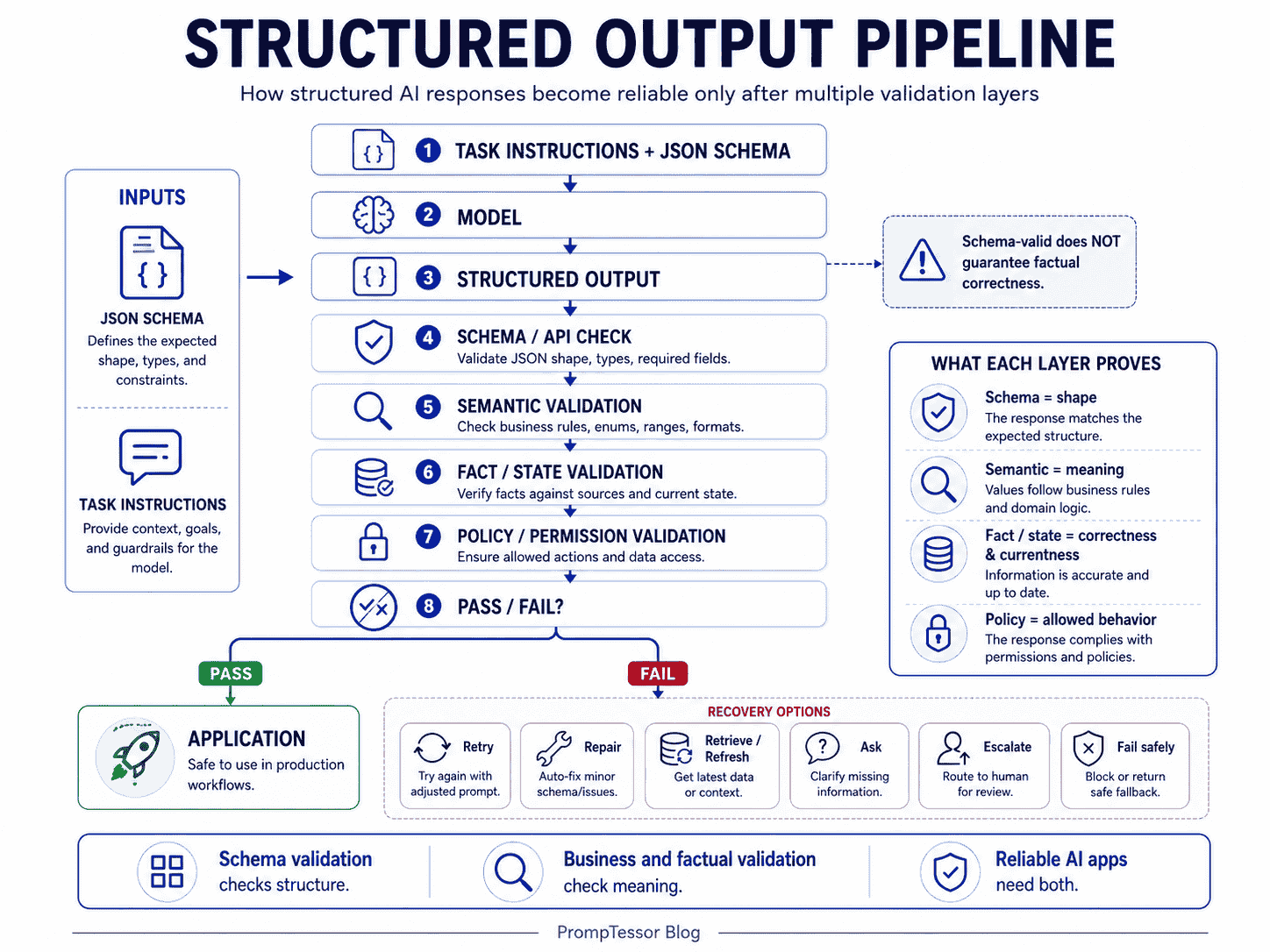
How to Evaluate Structured Outputs
Structured-output evaluation should measure both contract reliability and task quality.
1. Schema Conformance Rate
Measure how often the output satisfies the intended schema under real inputs.
With native structured-output features, schema conformance should be strong for supported schemas, but you should still measure end-to-end success, including API errors and exceptional states.
2. Field Accuracy
For each important field, compare generated values with expected values.
Examples:
- classification accuracy,
- entity extraction precision and recall,
- numeric accuracy,
- correct source ID,
- correct action type,
- and correct boolean decisions.
3. Missing-Information Behavior
Test whether the model uses the defined unknown/failure state instead of inventing values.
4. Cross-Field Consistency
Fields can each look valid while contradicting one another.
{
  "approved": false,
  "next_action": "issue_refund"
}
if the application's rules say refunds require approval.
5. Enum Confusion
Evaluate whether categories are semantically distinguished correctly.
A schema can force the output to one of:
bug
feature_request
billing
other
but it cannot guarantee the model chooses the correct category.
6. Boundary Cases
Test:
- empty input,
- very long input,
- contradictory evidence,
- missing fields,
- multiple valid classifications,
- ambiguous dates,
- out-of-range values,
- and unrelated input.
7. Provider / Model Regression
If you change model, provider, prompt, schema, or SDK, rerun the evaluation set.
A contract may remain syntactically compatible while field accuracy changes.
8. Latency and Cost
Structured output can introduce provider-specific processing characteristics, especially for schema compilation or large schemas.
Measure:
- first-request latency,
- steady-state latency,
- input and output tokens,
- retry rate,
- and validation overhead.
9. Consumer Success Rate
The ultimate metric is whether downstream software successfully uses the output.
A schema that is technically elegant but constantly triggers manual exceptions is not successful.
10. Compare Against an Unstructured Baseline
Run the same task with:
A. Natural-language formatting instructions
B. JSON mode
C. Native structured outputs
Then compare:
- format failures,
- field accuracy,
- retry rate,
- latency,
- cost,
- and downstream complexity.
For broader prompt testing, see AI Prompt Evaluation: How to Test, Compare, and Improve Prompts.
Structured Output Examples
These examples focus on the contract design rather than any one provider's API syntax.
Example 1: Sentiment Classification
{
  "sentiment": "negative",
  "confidence": 0.93,
  "reason": "The customer reports repeated failures and requests a refund."
}
Useful schema choices:
- enum for sentiment,
- number for confidence,
- string for concise explanation.
Example 2: Support Ticket Routing
{
  "category": "billing",
  "priority": "high",
  "route_to": "billing_support",
  "requires_human": true
}
Use enums for routing values so downstream systems never receive an unknown queue name.
Example 3: Lead Qualification
{
  "qualified": true,
  "score": 82,
  "reasons": [
    "Company size matches ICP",
    "Requested enterprise security features"
  ],
  "missing_information": [
    "Implementation timeline"
  ]
}
Example 4: Customer Feedback Analysis
{
  "themes": [
    {
      "name": "slow onboarding",
      "frequency": 27,
      "severity": "medium",
      "example_ids": ["r12", "r44", "r87"]
    }
  ]
}
This separates aggregate conclusions from evidence references.
Example 5: Product Comparison
{
  "winner": "Product B",
  "confidence": 0.86,
  "criteria": [
    {
      "name": "price",
      "winner": "Product A"
    },
    {
      "name": "automation",
      "winner": "Product B"
    }
  ],
  "risks": [
    "Product B has a higher monthly cost"
  ]
}
Example 6: Research Extraction
{
  "claims": [
    {
      "claim": "The company launched Product X in May.",
      "source_id": "source_3",
      "support": "direct",
      "confidence": 0.97
    }
  ]
}
Example 7: SEO Metadata
{
  "meta_title": "Structured Outputs: Reliable JSON from AI",
  "meta_description": "Learn how structured outputs and JSON Schema make AI responses more predictable.",
  "slug": "structured-outputs",
  "focus_keyword": "structured outputs"
}
Example 8: Article Outline
{
  "title": "Context Engineering",
  "sections": [
    {
      "heading": "What Is Context Engineering?",
      "intent": "definition",
      "key_points": [
        "context is broader than prompts",
        "relevance matters more than volume"
      ]
    }
  ]
}
Example 9: Image Prompt Generation
{
  "subject": "futuristic city",
  "composition": "wide aerial view",
  "lighting": "blue hour",
  "style": "cinematic photorealism",
  "camera": {
    "lens": "35mm",
    "depth_of_field": "deep"
  }
}
Example 10: Code Review
{
  "issues": [
    {
      "file": "billing.ts",
      "line": 142,
      "severity": "high",
      "category": "authorization",
      "description": "Tenant ownership is not verified before refund lookup."
    }
  ],
  "overall_risk": "high"
}
Example 11: RAG Answer
{
  "status": "supported",
  "answer": "The trial lasts 14 days.",
  "sources": [
    {
      "document_id": "pricing-doc",
      "section": "Trial"
    }
  ]
}
Example 12: Agent Action Selection
{
  "action": "retrieve_policy",
  "parameters": {
    "policy_type": "refund"
  },
  "reason": "Current context does not contain the applicable refund rule."
}
The application should still enforce whether that action is allowed.
Example 13: Expense Extraction
{
  "merchant": "Example Cafe",
  "date": "2026-08-12",
  "currency": "USD",
  "total": 34.50,
  "tax": 2.50,
  "line_items": [
    {
      "name": "Lunch",
      "amount": 32.00
    }
  ]
}
Example 14: Meeting Action Items
{
  "action_items": [
    {
      "task": "Send updated pricing model",
      "owner": "Alex",
      "due_date": "2026-08-20",
      "status": "open"
    }
  ]
}
Example 15: Content Moderation Category
{
  "category": "allowed",
  "confidence": 0.95,
  "needs_review": false
}
Moderation policy decisions should still be implemented according to the actual policy and system architecture, not inferred from schema shape alone.
Example 16: E-commerce Extraction
{
  "products": [
    {
      "name": "Model X",
      "price": 499,
      "currency": "USD",
      "in_stock": true
    }
  ],
  "retrieved_at": "2026-08-15T12:00:00Z"
}
Example 17: Resume Parsing
{
  "candidate_name": "Jane Doe",
  "skills": ["Python", "PostgreSQL", "AWS"],
  "experience": [
    {
      "company": "Example Inc.",
      "role": "Software Engineer",
      "years": 3
    }
  ]
}
Example 18: Prompt Evaluation
{
  "clarity": {
    "score": 82,
    "issues": [
      "The target audience is not specified."
    ]
  },
  "specificity": {
    "score": 70,
    "issues": [
      "The output length is undefined."
    ]
  },
  "recommended_changes": [
    "Define the target audience.",
    "Specify the output structure."
  ]
}
Reusable Structured Output Templates
Template 1: Classification
{
  "type": "object",
  "properties": {
    "label": {
      "type": "string",
      "enum": ["class_a", "class_b", "other"]
    },
    "confidence": {
      "type": "number"
    },
    "reason": {
      "type": "string"
    }
  },
  "required": ["label", "confidence", "reason"],
  "additionalProperties": false
}
Template 2: Extraction With Missing-Value Status
{
  "type": "object",
  "properties": {
    "value": {
      "type": ["string", "null"]
    },
    "status": {
      "type": "string",
      "enum": [
        "verified",
        "not_found",
        "conflicting",
        "not_applicable"
      ]
    },
    "source_id": {
      "type": ["string", "null"]
    }
  },
  "required": ["value", "status", "source_id"],
  "additionalProperties": false
}
Adapt nullability syntax to the supported subset of your target provider.
Template 3: Ranked Recommendations
{
  "type": "object",
  "properties": {
    "recommendations": {
      "type": "array",
      "items": {
        "type": "object",
        "properties": {
          "rank": {"type": "integer"},
          "name": {"type": "string"},
          "score": {"type": "integer"},
          "reason": {"type": "string"},
          "risks": {
            "type": "array",
            "items": {"type": "string"}
          }
        },
        "required": ["rank", "name", "score", "reason", "risks"],
        "additionalProperties": false
      }
    }
  },
  "required": ["recommendations"],
  "additionalProperties": false
}
Template 4: Evidence-Backed Answer
{
  "type": "object",
  "properties": {
    "status": {
      "type": "string",
      "enum": [
        "supported",
        "insufficient_evidence",
        "conflicting_evidence"
      ]
    },
    "answer": {
      "type": ["string", "null"]
    },
    "sources": {
      "type": "array",
      "items": {
        "type": "object",
        "properties": {
          "source_id": {"type": "string"},
          "claim": {"type": "string"}
        },
        "required": ["source_id", "claim"],
        "additionalProperties": false
      }
    }
  },
  "required": ["status", "answer", "sources"],
  "additionalProperties": false
}
Template 5: Workflow Decision
{
  "type": "object",
  "properties": {
    "next_action": {
      "type": "string",
      "enum": [
        "continue",
        "retrieve_more",
        "ask_user",
        "escalate",
        "stop"
      ]
    },
    "reason": {"type": "string"},
    "required_context": {
      "type": "array",
      "items": {"type": "string"}
    }
  },
  "required": ["next_action", "reason", "required_context"],
  "additionalProperties": false
}
Template 6: Evaluation Result
{
  "type": "object",
  "properties": {
    "overall_score": {"type": "integer"},
    "dimensions": {
      "type": "array",
      "items": {
        "type": "object",
        "properties": {
          "name": {"type": "string"},
          "score": {"type": "integer"},
          "issues": {
            "type": "array",
            "items": {"type": "string"}
          }
        },
        "required": ["name", "score", "issues"],
        "additionalProperties": false
      }
    },
    "recommendations": {
      "type": "array",
      "items": {"type": "string"}
    }
  },
  "required": ["overall_score", "dimensions", "recommendations"],
  "additionalProperties": false
}
Common Structured Output Mistakes
1. Asking for JSON Only Through Prompt Wording
If the provider offers native schema-constrained output, use it instead of relying entirely on “return only JSON” instructions.
2. Confusing Valid JSON With Schema Conformance
JSON can parse correctly and still have the wrong fields, types, values, or nesting.
3. Treating Schema Validity as Factual Correctness
A number can be the correct type and the wrong value.
4. Making Field Names Too Generic
value, data, result, and score need clear semantics when multiple interpretations are possible.
5. Skipping Descriptions
A strongly typed field can still be semantically ambiguous. Use descriptions to explain what the field means.
6. Making Everything Optional
This weakens the contract. Make fields optional because the business domain requires optionality, not because the model might fail.
7. Making Everything Required Without Modeling Unknowns
If a value may genuinely be unavailable, forcing a required concrete value can encourage fabrication.
8. Using Free-Form Strings for Closed Categories
Use enums when the legal value set is known.
9. Creating Huge Universal Schemas
Task-specific schemas are easier to maintain than one giant output object used for unrelated tasks.
10. Excessive Nesting
Deep structures increase complexity and may run into provider schema limits.
11. Duplicating the Same Information Across Fields
For example:
{
  "priority": "high",
  "priority_text": "This is a high-priority issue.",
  "urgency": "high"
}
unless each field has a distinct consumer.
12. Mixing Data and Presentation
Do not embed HTML, markdown, UI styling, and machine-readable values into the same field unless that is genuinely the intended contract.
13. No Explicit Failure State
If evidence is missing, the model needs a legal way to say so.
14. Using Null Without Defined Semantics
Define whether null means unknown, unavailable, not applicable, or failed retrieval.
15. No Cross-Field Validation
Schema fields can each be valid while the combination is impossible.
16. Letting the Model Enforce Permissions
Authorization belongs in deterministic application logic, not in a generated boolean.
17. Treating Tool Arguments as Automatically Safe
Strict schema conformance does not mean the requested action is authorized or sensible.
18. No Schema Versioning
Downstream software needs a migration strategy when the contract changes.
19. Renaming Enum Values Casually
Changing high to urgent can break dashboards, rules, databases, or analytics.
20. Using Structured Output for Every Response
Human-facing explanations often benefit from flexible natural language.
21. Using Natural Language Where Software Needs a Contract
The opposite mistake creates brittle parsers and regex-heavy post-processing.
22. No Validation After Generation
Provider-level schema enforcement does not replace business, factual, or permission validation.
23. No Evaluation Set
A schema can be stable while classifications or extracted values are consistently wrong.
24. Ignoring Unrelated Input
Test what happens when the user gives content that cannot meaningfully populate the schema.
25. Overloading a Field With Multiple Meanings
A field such as status should not mean “workflow state” in one case and “confidence state” in another.
26. Hard-Coding Provider Assumptions Into Business Models
Your internal data model does not have to mirror one provider's response-format syntax.
27. Assuming Every JSON Schema Feature Is Supported
OpenAI, Claude, and Gemini each document provider-specific support and limitations.
28. No Output-Size Strategy
Large arrays can create latency, truncation, or cost problems. Consider pagination or multi-step generation.
29. Exposing Internal Reasoning as a Required Field
Usually you need concise explanations, evidence, or decision summaries—not hidden reasoning traces.
30. Optimizing the Schema Without Improving the Task Prompt
A perfect schema cannot tell the model what evidence matters, how to make the decision, or which objective to optimize.
Using PrompTessor With Structured Output Prompts
PrompTessor is not a JSON Schema validator or provider-level constrained-decoding engine.
It does not replace OpenAI Structured Outputs, Claude JSON outputs, Gemini structured output configuration, strict tool schemas, SDK validation, or your application's business rules.
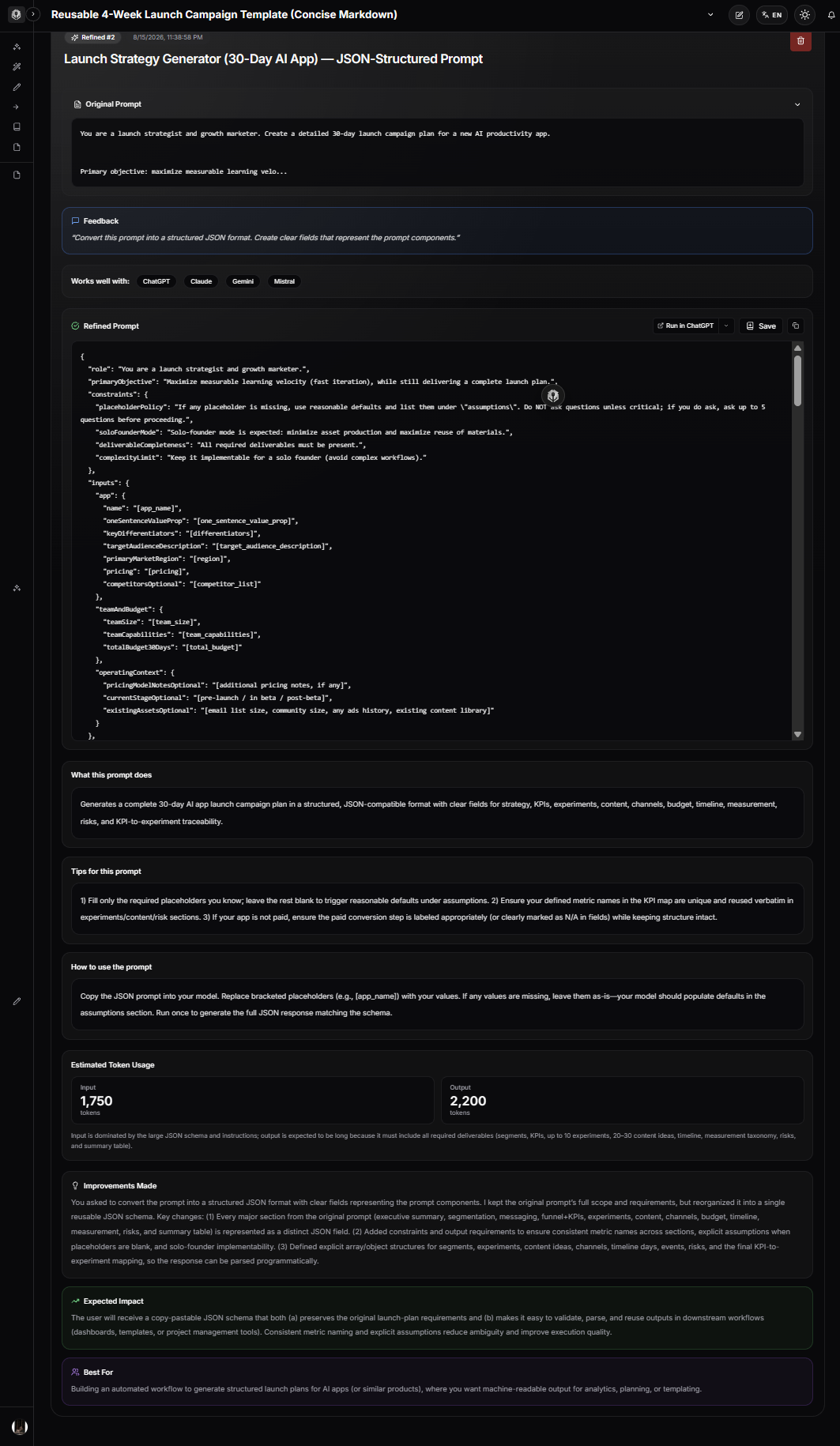
Where PrompTessor can help is the prompt-design and refinement layer around the schema.
Consider:
Analyze these customer reviews and return the top product issues.The output requirement is underspecified.
Questions remain:
- How many issues?
- What counts as the same issue?
- How should frequency be represented?
- How should severity be defined?
- Should evidence examples be included?
- What should happen with ambiguous reviews?
- What output fields are required?
Using PrompTessor Prompt Refinement, the request can be turned into a clearer JSON-oriented instruction such as:
TASK
Analyze the supplied customer reviews and identify the most
important recurring product issues.

GROUPING RULES
- Merge semantically equivalent complaints.
- Keep unrelated issues separate.
- Do not infer an issue that is not supported by reviews.

SEVERITY
Classify each issue as:
- low
- medium
- high

EVIDENCE
For each issue, include review IDs that directly support it.

OUTPUT CONTRACT
Return one structured object containing:
- issues
- frequency
- severity
- summary
- evidence_review_ids
- uncertainty_notes

MISSING / AMBIGUOUS DATA
If the evidence is insufficient to assign severity, use the
defined unknown state rather than inventing a value.
The production application can then express the corresponding contract as a provider-supported JSON Schema.
Rough Prompt
    ↓
PrompTessor Prompt Refinement
    ↓
Clarify Task
    ↓
Improve Context
    ↓
Define Constraints
    ↓
Make Output Requirements Explicit
    ↓
JSON Schema / Typed Model
    ↓
Provider Structured Output Feature
    ↓
Application Validation
This keeps responsibilities clear:
- PrompTessor: prompt refinement, clarity, specificity, context, goals, structure, and constraints.
- JSON Schema: output contract.
- Model API: supported schema-constrained generation.
- Application: semantic, factual, state, permission, and business validation.
Structured Output Checklist
- The task is defined independently from the schema.
- The application genuinely benefits from machine-readable output.
- The target provider and model support the required structured-output feature.
- The schema uses only supported JSON Schema features.
- Field names are specific.
- Field descriptions explain semantics.
- Types match downstream needs.
- Enums are used for finite value sets.
- Required fields are intentional.
- Optional or nullable semantics are modeled according to the target provider's supported schema rules.
- Unknown values have an explicit representation.
- Null semantics are defined.
- Nesting reflects real conceptual groups.
- The schema is no larger than necessary.
- Unexpected properties are controlled where supported and useful.
- Schema validation is separate from business validation.
- Business validation checks cross-field rules.
- Factual claims are validated when important.
- Time-sensitive state is refreshed when required.
- Permissions are enforced in software.
- Tool calls are separately authorized.
- Model refusals and exceptional responses have a path.
- Unrelated or impossible input is tested.
- Output-size limits are considered.
- Schema changes are versioned.
- Producer and consumer contracts are tested together.
- Field-level accuracy is evaluated.
- Cross-field consistency is evaluated.
- Provider/model changes trigger regression testing.
- Latency, cost, and retry rate are measured.
Official Resources
- OpenAI API: Structured Model Outputs
- OpenAI Cookbook: Introduction to Structured Outputs
- OpenAI API: Function Calling
- OpenAI Cookbook: Structured Outputs Evaluation
- Claude Platform: Structured Outputs
- Claude Platform: Strict Tool Use
- Claude Platform: Define Tools
- Google Gemini API: Structured Outputs
- Google Gemini API: Function Calling
- JSON Schema
FAQ About Structured Outputs
What are structured outputs in AI?
Structured outputs are model responses generated according to a predefined machine-readable schema, commonly JSON Schema. They are useful when software needs predictable fields, types, nesting, and allowed values instead of free-form text.
How are structured outputs different from normal JSON output?
Normal JSON output may be valid JSON but still have unexpected fields, missing keys, or incorrect types. Structured outputs constrain the response to a supported schema.
What is the difference between JSON mode and structured outputs?
JSON mode focuses on producing valid JSON. Structured outputs go further by enforcing adherence to a supported schema. OpenAI explicitly documents this distinction and recommends Structured Outputs when schema adherence is required.
Do structured outputs guarantee factual correctness?
No. They guarantee or strongly enforce structural conformance according to the provider's supported mechanism, but values can still be factually wrong, stale, semantically incorrect, or inconsistent with business rules.
What is JSON Schema?
JSON Schema is a vocabulary for describing the expected structure and constraints of JSON data, including types, properties, required fields, arrays, enums, nested objects, and other supported constraints.
Do OpenAI, Claude, and Gemini all support structured outputs?
Yes, their current APIs provide schema-constrained structured response mechanisms on compatible models and platforms. However, the exact API parameters, supported JSON Schema subset, model compatibility, and limitations differ.
Does OpenAI Structured Outputs support JSON Schema?
Yes. OpenAI Structured Outputs accept a supported subset of JSON Schema and can constrain model responses to that schema on compatible models and APIs.
Does Claude support structured outputs?
Yes. Claude supports schema-constrained JSON outputs through its structured-output configuration and also provides strict tool use for schema-conformant tool inputs on compatible models.
Does Gemini support structured outputs?
Yes. The Gemini API can generate JSON that adheres to a provided supported JSON Schema. Google also recommends application-side validation for semantically incorrect values.
Are all JSON Schema features supported by AI providers?
No. OpenAI, Anthropic, and Google each document provider-specific support and limitations. Design schemas against the target provider's supported subset.
When should I use structured outputs?
Use structured outputs when downstream software consumes the result, such as extraction, classification, workflow state, database insertion, RAG metadata, agent decisions, analytics, or API responses.
When should I use natural language instead?
Natural language is often better for explanation, conversation, creative writing, brainstorming, and other cases where expressive flexibility matters more than machine-readable structure.
Can structured outputs contain natural-language explanations?
Yes. A structured object can include fields such as explanation, summary, or rationale while still keeping machine-readable decision fields separate.
What is the difference between structured outputs and function calling?
Structured outputs constrain the model's response format. Function calling lets the model request that the application execute a tool or function. Both can use schemas, but they serve different purposes.
Can function calling and structured outputs be used together?
Yes. A model can make schema-constrained tool calls, receive tool results, and then return a schema-constrained final response.
What does strict tool use mean?
Strict tool use constrains tool arguments to a defined schema. For example, Anthropic documents strict tool use as grammar-constrained sampling that guarantees Claude's tool inputs match the JSON Schema.
Should every field be required?
No. Required fields should reflect the application's actual contract. Values that can genuinely be unavailable should have an explicit optional, nullable, or status-based representation supported by the target provider.
How should unknown values be represented?
Use an explicit contract such as a nullable field plus a status enum, or a result status such as not_found, insufficient_evidence, conflicting, or not_applicable. Avoid forcing the model to invent a value.
Why are enums useful in structured outputs?
Enums restrict a field to a known set of values, which reduces vocabulary drift and makes downstream logic more predictable.
Should I add descriptions to JSON Schema fields?
Yes. Descriptions clarify the intended meaning of a field, especially when a name such as score, status, or confidence could be interpreted in multiple ways.
Can structured outputs replace prompt engineering?
No. The schema defines the shape of the answer, while the prompt defines the task, evidence rules, objective, constraints, and decision logic.
Can structured outputs replace validation?
No. Applications should still validate business rules, cross-field relationships, factual claims, current state, authorization, and other conditions that a schema cannot prove.
What is semantic validation?
Semantic validation checks whether schema-valid values make sense for the domain. For example, a valid date string can still represent an end date that occurs before the start date.
What is business validation?
Business validation applies deterministic application rules, such as account limits, allowed workflow transitions, refund caps, or permission requirements.
How do structured outputs help prompt chains?
They let each stage return a predictable intermediate artifact that the next stage can consume, validate, retry, and inspect independently.
How do structured outputs help RAG systems?
They can separate the answer from source IDs, evidence status, confidence, or retrieval metadata, making grounding and downstream rendering easier to validate.
How do structured outputs help AI agents?
They can represent action proposals, tool parameters, workflow states, verification results, and final outputs in machine-readable contracts. Authorization and business rules should still remain in software.
Should structured output schemas be versioned?
Yes when downstream consumers depend on them. Changes to field names, types, nesting, enum values, required fields, or semantics can be breaking changes.
How do I evaluate structured outputs?
Measure schema conformance, field accuracy, missing-information behavior, cross-field consistency, boundary cases, consumer success, latency, cost, and regressions across prompt, model, provider, or schema changes.
How can PrompTessor help with structured outputs?
PrompTessor can help improve the prompt-design and refinement layer by clarifying the task, context, goals, constraints, and output requirements. Native schema enforcement, JSON validation, business logic, and runtime validation remain responsibilities of the model API and application.
Conclusion
Structured outputs make AI responses easier for software to trust structurally.
Instead of asking a model to produce text that merely resembles a predictable format, you define an explicit data contract and use a provider-supported structured-output mechanism to constrain generation.
That changes the architecture from:
Prompt
 ↓
Model
 ↓
Maybe-JSON
 ↓
Parsing hacks
 ↓
Application
to:
Task Instructions
        +
Output Schema
        ↓
Model
        ↓
Structured Data
        ↓
Schema / API Check
        ↓
Business Validation
        ↓
Fact / State Validation
        ↓
Permission / Policy Validation
        ↓
Application
The distinction matters because structure is only one dimension of reliability.
A response can be:
- valid JSON and structurally wrong,
- schema-valid and semantically wrong,
- semantically plausible and factually wrong,
- factually correct and based on stale state,
- or completely correct but unauthorized for the requested action.
Structured outputs solve the first layers of that problem. They do not eliminate the rest.
The strongest implementations treat the schema like an API contract:
- make field semantics explicit,
- use strong types,
- use enums for closed value sets,
- model unknown values honestly,
- keep schemas task-specific,
- validate downstream semantics,
- version breaking changes,
- and evaluate the whole workflow on representative inputs.
They also separate concepts that are often confused:
PROMPT
Defines what the model should do

SCHEMA
Defines what the output should look like

STRUCTURED OUTPUT FEATURE
Constrains generation to the supported schema

FUNCTION CALLING
Lets the model request external actions

VALIDATION
Determines whether generated values are usable

APPLICATION LOGIC
Enforces deterministic business and permission rules
If your AI output is consumed by software, stop treating formatting as a cosmetic prompt detail.
Design it as an interface.
Define the contract, constrain the structure, validate the meaning, and test what happens when the model does not have enough information to answer honestly.
That is the difference between JSON that happens to parse and structured output that can support a reliable AI application.
Build better prompts in one workspace
Generate prompts from ideas, analyze and optimize quality, refine with feedback, reverse-engineer content, and save reusable prompts in your Prompt Library.
Try PrompTessor Free