15 AI Ad Copy Prompts for Google, Meta, TikTok, and LinkedIn (2026)
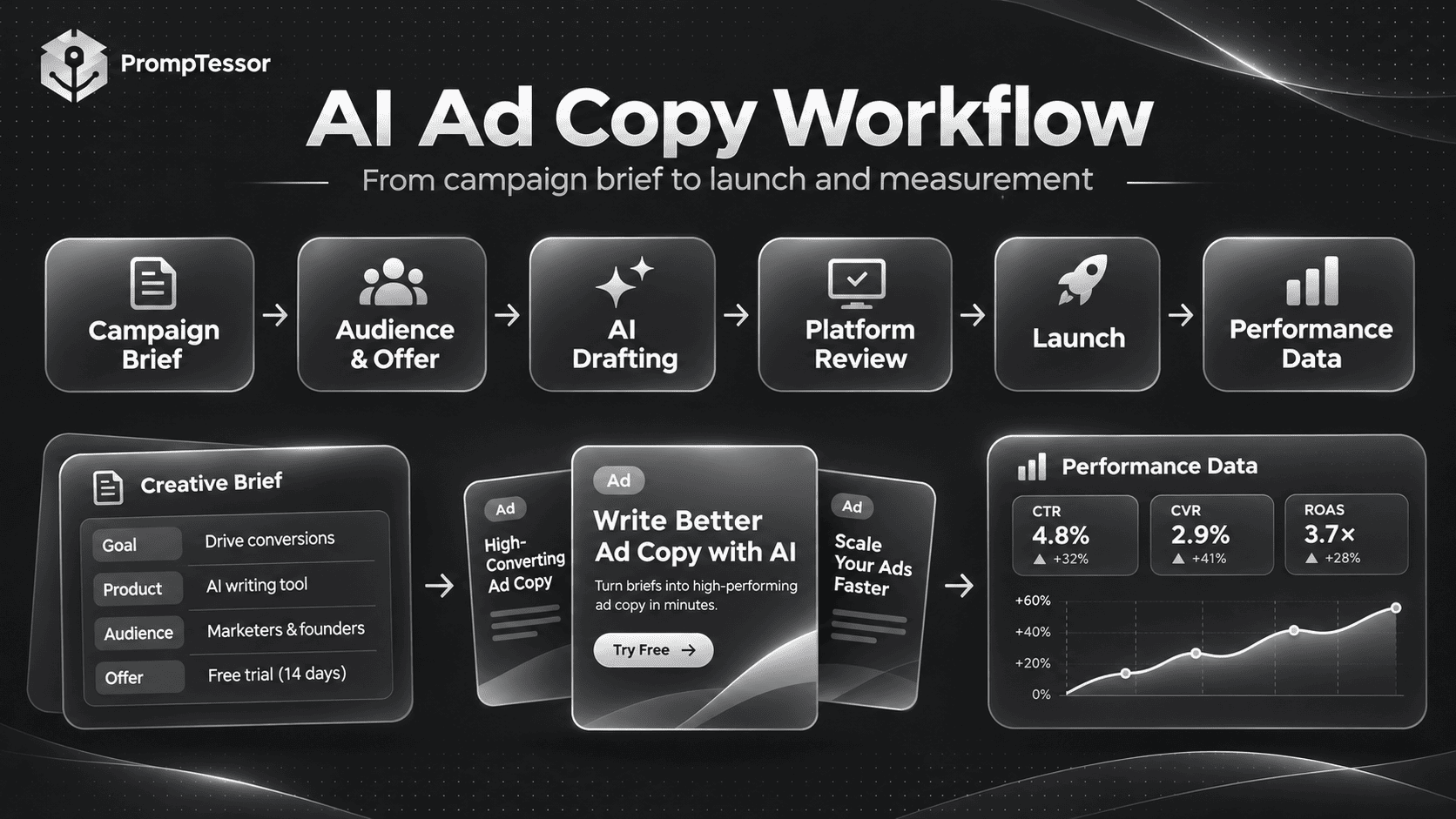
An AI tool can generate 30 ad headlines in seconds. But that does not mean those headlines are ready to run.
A Google Search ad might exceed the character limit. A Facebook ad might promise a discount that does not exist. A TikTok script might sound like a generic commercial instead of a native short-form video. A LinkedIn ad might describe business results that the advertiser has never measured.
Good AI advertising prompts solve a more specific problem: they translate a verified product, a defined audience, and a campaign objective into copy that fits the intended advertising platform.
That means giving AI enough information to understand who the advertisement is for, what the business can truthfully claim, which format the copy must follow, and what action the advertiser wants someone to take.
This guide provides 15 copy-and-paste AI ad copy prompts for Google, Meta, TikTok, and LinkedIn. The templates cover search ad headlines, Facebook and Instagram advertising, short-form video scripts, retargeting, B2B lead generation, A/B testing, and campaign optimization.
You will also find a reusable advertising brief, platform-specific formatting guidelines, practical ad copy examples, and a checklist for reviewing AI-generated ads before publication.
The goal is not to generate more advertisements. It is to create more relevant, testable, and accurate advertising messages.
Quick Answer: What Makes a Good AI Ad Copy Prompt?
A good AI ad copy prompt defines the advertising platform, placement, audience, campaign objective, verified product benefits, approved offer, brand voice, desired action, and technical constraints.
It should also explain which claims are prohibited and how the output should be checked.
For example, "Write a Facebook ad for my software" does not tell the model what the software does, who needs it, what the campaign is promoting, or which claims are supported.
A better prompt includes the available product facts and asks for a specific ad format.
ROLE:
Act as a paid advertising copywriter.

PLATFORM:
{advertising_platform}

PLACEMENT AND FORMAT:
{ad_placement}

CAMPAIGN OBJECTIVE:
{campaign_goal}

TARGET AUDIENCE:
{target_audience}

VERIFIED PRODUCT INFORMATION:
{approved_product_facts}

APPROVED OFFER:
{offer_and_conditions}

LANDING PAGE:
{landing_page_details}

BRAND VOICE:
{tone_and_style}

PRIMARY CTA:
{desired_action}

REQUIREMENTS:
- Follow the current placement specifications.
- Use only verified product and offer claims.
- Do not invent discounts or testimonials.
- Avoid misleading urgency or guarantees.
- Match the landing page's actual offer.
- Distinguish required limits from
  recommended text lengths.
- Flag missing facts before approval.

OUTPUT:
1. Ad copy variants
2. Required ad fields
3. Character counts where relevant
4. Creative direction
5. Claim verification checklist
6. Testing hypothesis
Replace the variables with your campaign information, then adapt the output format to the destination platform. Google Search Ads, Instagram Feed Ads, TikTok video ads, and LinkedIn Sponsored Content have different creative requirements.
Key Takeaways
- AI ad copy prompts work best when they begin with verified product facts and a specific campaign objective.
- Google Responsive Search Ads require headline and description assets that follow strict character limits.
- Meta ad copy should be adapted to the actual Facebook or Instagram placement rather than using one fixed text length everywhere.
- TikTok ad prompts should include the hook, visual action, message, and CTA, not just a caption.
- LinkedIn ads should focus on professional relevance, credible benefits, and a clear next step.
- Do not invent performance statistics, customer testimonials, product capabilities, discounts, deadlines, or scarcity.
- Ad copy and landing pages must communicate consistent information about the advertised offer.
- Retargeting copy should not make intrusive claims about an individual's private behavior.
- Meaningful A/B tests compare distinct hypotheses rather than dozens of nearly identical headlines.
- Campaign optimization requires actual performance data, not predictions generated from the wording alone.
- Every ad should pass a format, accuracy, policy, and destination review before launch.
AI Ad Copy vs. Organic Social Media Copy: What's the Difference?
Paid advertising and organic social content sometimes use similar language, but they serve different purposes.
Organic posts can focus on education, entertainment, community engagement, or general brand awareness. Paid advertisements are distributed through a campaign with defined audiences, placements, objectives, budgets, and measurement.
Advertising copy must work within those constraints.
| Element | Organic Social Content | Paid Advertising |
|---|---|---|
| Primary objective | Inform, engage, entertain, or build community | Support a defined campaign goal |
| Audience | Followers and platform discovery | Selected or algorithmically reached campaign audiences |
| Format | Post, caption, video, or carousel | Specific ad format and placement |
| CTA | Optional or engagement-oriented | Usually aligned with a measurable next action |
| Claim review | Editorial and factual review | Advertising policies, substantiation, and applicable laws |
| Success measurement | Engagement, reach, audience response | Campaign-specific outcomes and efficiency metrics |
For organic content workflows, see 15 AI Social Media Prompts for Posts, Captions, Videos, and Content Calendars.
For producing the actual video assets used in an advertising campaign, see 15 AI Product Video Prompts for Ecommerce, Ads, and Social Media.
This article focuses specifically on the messaging, copy structure, and evaluation of paid advertisements.
Platform-Specific AI Advertising Copy Requirements
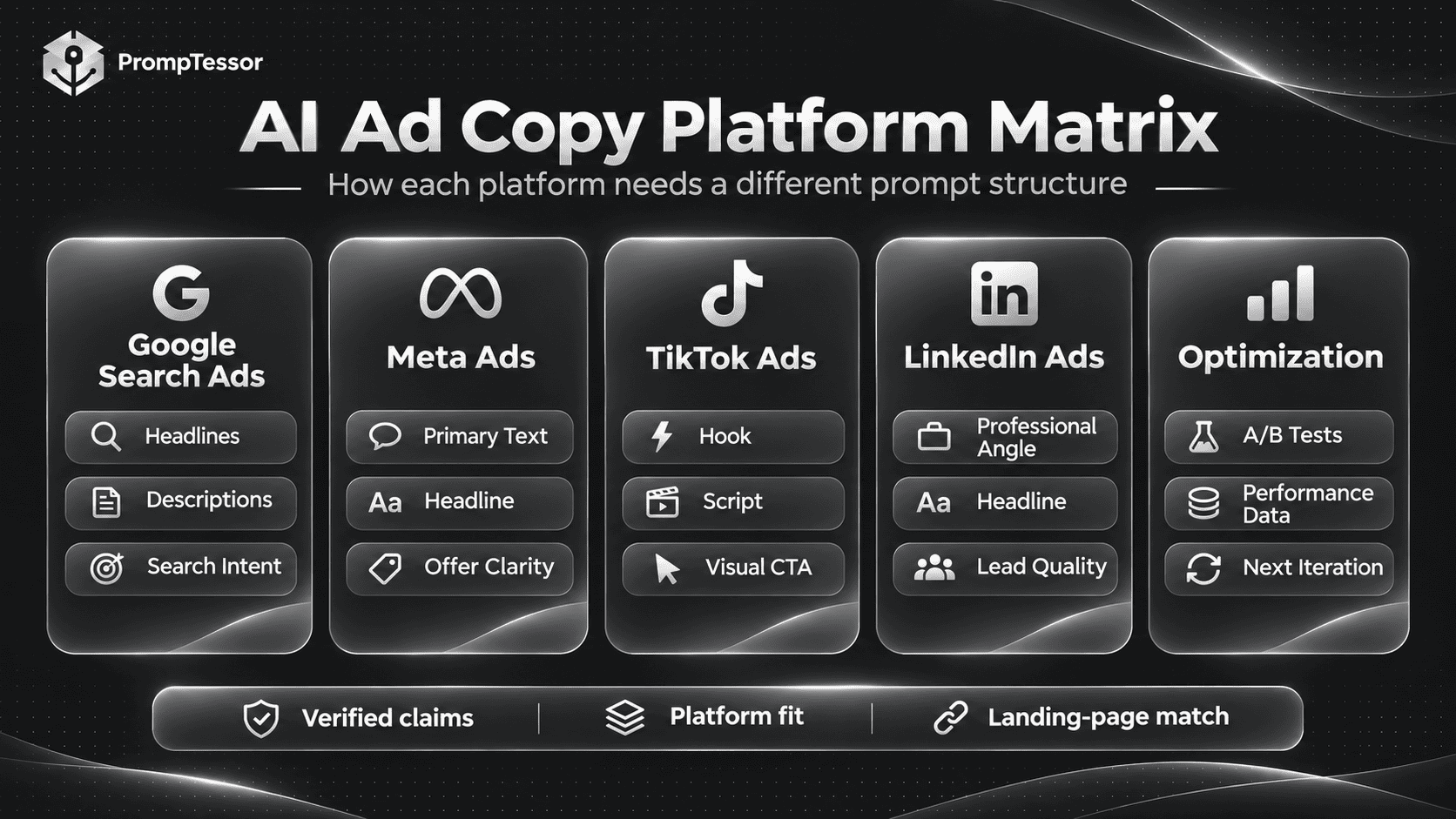
Different platforms require different copy formats. The following overview explains how to instruct an AI model for each major advertising channel.
| Platform / Format | Important Copy Requirements | Prompting Focus |
|---|---|---|
| Google Responsive Search Ads | 3–15 headlines, up to 30 characters each; 2–4 descriptions, up to 90 characters each | Search intent, relevant keywords, distinct assets, accurate offers |
| Facebook Feed Ads | Primary text, headline, and optional description; recommended visible lengths depend on placement | Clear benefit, relevant creative, natural CTA |
| Instagram Ads | Placement-dependent text and creative treatment | Visual-first storytelling, concise supporting copy, message continuity |
| TikTok In-Feed Video Ads | Video creative, captions or ad text, and CTA; detailed restrictions vary by ad format | Opening hook, visual proof, natural script, clear close |
| LinkedIn Single Image Ads | Introductory text and headline, with optional description and CTA | Professional value, credible context, lead quality |
Google Ads: Strict Asset Limits
Google Responsive Search Ads support up to 15 headlines and four descriptions, with at least three headlines and two descriptions required.
Each headline can contain up to 30 characters, and each description can contain up to 90 characters.
Google can combine these assets in different orders, so each headline and description should make sense individually and alongside other assets.
See the official Google Ads responsive search ad specifications.
Meta Ads: Placement-Specific Recommendations
Facebook and Instagram ads include fields such as primary text, headline, and description, depending on the selected format.
Recommended visible text lengths vary across Feed, Stories, Reels, and other placements. These recommendations are not interchangeable with Google Ads' strict headline and description limits.
Longer text may be truncated or displayed differently depending on the placement and device.
When generating Meta ad copy, identify the actual placement and check the current Meta Ads Guide rather than assuming one universal limit.
TikTok Ads: Hook, Body, and Close
TikTok's official creative guidance recommends a structure built around an attention-grabbing opening, relevant product or story content, and a clear closing action.
The platform also emphasizes vertical creative, readable overlays, and content designed for its native viewing experience.
For TikTok, a useful AI prompt should generate a script and shot sequence, not merely an advertising caption.
See TikTok's creative best practices.
LinkedIn Ads: Professional Context and Clear Value
For LinkedIn Single Image Ads, the official specifications recommend keeping introductory text within 150 characters and headlines within 70 characters to reduce truncation, even though longer field maximums are supported.
Description recommendations and display behavior also depend on placement.
A useful LinkedIn prompt should prioritize the business problem, approved product benefit, relevant audience, and appropriate professional CTA.
See the official LinkedIn Single Image Ads specifications.
Important: Advertising specifications and policies can change. The values above reflect reviewed guidance available in November 2026. Always check the current format documentation and final creative preview before publishing.
Before You Start: Build an AI Advertising Brief
Ad copy becomes more useful when the AI receives an actual campaign brief instead of a generic description of the product.
Use the following information before running the prompts.
| Campaign Input | Example | Why It Matters |
|---|---|---|
| Product | Project management software | Defines what is being promoted |
| Audience | Small teams managing several projects | Establishes relevant customer context |
| Campaign objective | Encourage qualified visitors to view the product | Defines the intended action |
| Verified features | Task boards and due-date reminders | Prevents invented product claims |
| Approved offer | No discount or promotional incentive | Prevents fictional pricing |
| Landing page | Product overview describing available features | Aligns the advertisement with its destination |
| Brand voice | Clear, professional, approachable | Keeps messaging consistent |
| Platform | Google Search, Meta, TikTok, or LinkedIn | Determines required output fields |
| Performance data | Actual campaign metrics, if available | Supports measured optimization |
| Restrictions | No invented savings, reviews, or guarantees | Protects factual accuracy |
When an approved offer is unavailable, the AI should create a product-focused message instead of adding a fictional discount or deadline.
One Fictional Product Used Across Platforms
To demonstrate how the same product can be promoted differently, this guide occasionally uses a fictional software product called Northstar Desk.
For the examples, assume that its approved features are task boards and due-date reminders. No pricing, customer results, integrations, or discounts have been established.
These details are illustrative and should not be presented as claims about a real product.
The Reusable AI Ad Copy Prompt Formula
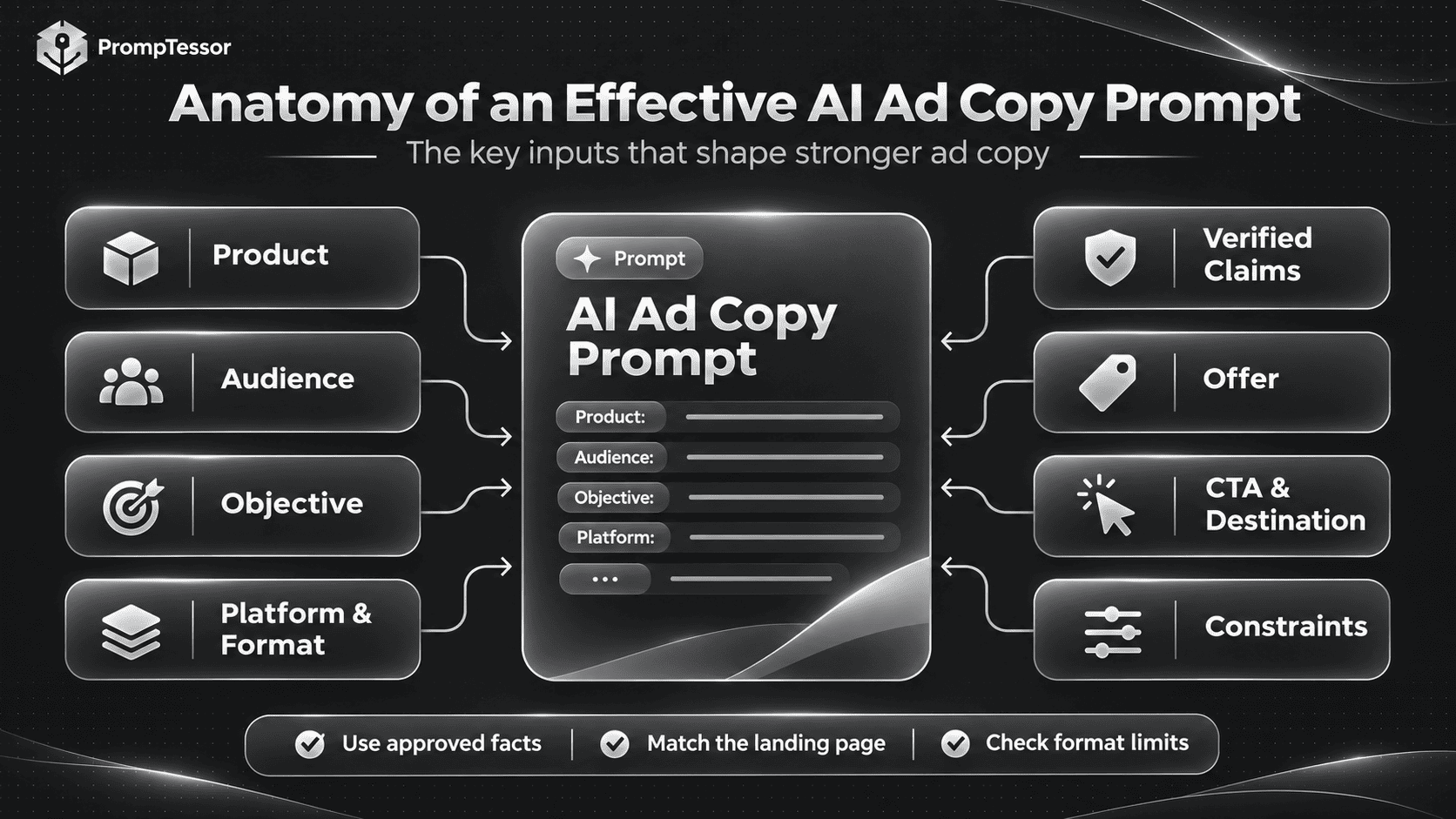
A prompt does not need to be complicated to be effective. It needs to communicate the information that determines the result.
PRODUCT
What is being advertised?

AUDIENCE AND INTENT
Who is the ad for, and why
might they be interested?

OBJECTIVE
What campaign outcome matters?

VERIFIED PROOF
Which product and offer claims
can actually be supported?

PLATFORM AND FORMAT
Where will the ad appear?

MESSAGE ANGLE
Which customer-relevant
benefit should the ad emphasize?

CTA AND DESTINATION
What happens after the click?

CONSTRAINTS
What must not be claimed or invented?

OUTPUT AND VERIFICATION
Which ad fields are required,
and how will they be checked?
Keep this structure stable when comparing multiple ad variations. Change the audience, product facts, creative angle, or platform requirements as appropriate.
For reusable prompting workflows, see Prompt Templates and Variables: How to Build Reusable AI Prompts.
15 Copy-and-Paste AI Ad Copy Prompts
The following templates are organized by advertising platform and campaign task.
Each prompt has a specific objective, editable variables, and a verification step. Use them with compatible text AI tools such as ChatGPT, Claude, Gemini, or another model that can follow structured writing instructions.
For real campaigns, supply approved product facts, offer terms, and a current destination page. These templates do not guarantee ad approval, traffic, conversions, or profitability.
Google Ads Prompts
1. Google Responsive Search Ads Copy Prompt
Best for: Creating Google Responsive Search Ad headline and description assets within the required format.
Example brief: A SaaS company wants to promote a project management tool to people searching for project tracking software.
Customize: {product}, {target_keywords}, {search_intent}, {approved_features}, {landing_page}, {brand_voice}
Act as a Google Search Ads copywriter.

Create Responsive Search Ad assets.

Product:
{product}

Target keywords:
{target_keywords}

User search intent:
{search_intent}

Approved features and benefits:
{approved_features}

Landing page:
{landing_page}

Brand voice:
{brand_voice}

Produce:

1. Fifteen distinct headlines.
   Maximum: 30 characters each.

2. Four distinct descriptions.
   Maximum: 90 characters each.

3. A mapping of headlines to
   relevant keyword themes.

4. One recommended primary CTA.

Requirements:

- Include relevant search terms naturally.
- Make each asset useful independently.
- Avoid headlines that repeat
  nearly identical messages.
- Preserve product and brand accuracy.
- Do not invent discounts, guarantees,
  pricing, rankings, or testimonials.
- Do not use unsupported superlatives.
- Keep claims consistent with
  the actual landing page.
- Account for headline combinations
  that may appear in different orders.

For each asset, include an exact
character count including spaces.

Mark any asset exceeding the limit
as INVALID and rewrite it.

Return:
- Headline asset table
- Description asset table
- Keyword alignment notes
- Final format and claim checklist
Expected output: A set of search ad assets that can be reviewed before being entered into Google Ads.
What to verify: Independently check character counts, keyword relevance, approved claims, and final URL. AI-generated counts can be incorrect.
2. Google Ads Search Intent and Keyword Message Prompt
Best for: Creating different ad messages for distinct keyword themes instead of sending every searcher the same copy.
Example brief: A software company targets users looking for task boards, project planning software, and team workflow tools.
Customize: {keyword_groups}, {audience}, {product_capabilities}, {landing_pages}, {campaign_goal}
Act as a search advertising strategist.

Develop messaging for these
Google Ads keyword groups:

{keyword_groups}

Target audience:
{audience}

Verified product capabilities:
{product_capabilities}

Available landing pages:
{landing_pages}

Campaign goal:
{campaign_goal}

For each keyword group:

1. Identify the likely search intent.
2. Explain the primary user need.
3. Select the most relevant
   verified product benefit.
4. Suggest a message angle.
5. Draft three headlines
   of 30 characters or fewer.
6. Draft two descriptions
   of 90 characters or fewer.
7. Recommend an appropriate
   existing landing page.
8. Identify claims to avoid.

Distinguish:
- Informational searches
- Product comparison searches
- High-intent solution searches

Do not assume that every search
has purchasing intent.

Do not invent available features
or landing page content.

Do not create keyword groups
that cannot be supported by
the actual product or destination.

Return a keyword-to-message matrix,
ad drafts, and validation notes.
Expected output: Distinct messages aligned with different search intents.
What to verify: Check actual keyword research, search terms, campaign structure, and whether each destination page is relevant to the proposed message.
3. Google Ads Sitelink and Callout Assets Prompt
Best for: Drafting additional Google Search ad assets using verified website destinations and product details.
Example brief: A software company wants additional ad assets pointing to its product overview, documentation, and pricing page.
Customize: {business}, {approved_pages}, {verified_features}, {approved_claims}
Act as a Google Ads asset copywriter.

Create candidate sitelink and
callout assets.

Business:
{business}

Approved destination pages:
{approved_pages}

Verified product features:
{verified_features}

Approved business claims:
{approved_claims}

Produce:

A. Sitelink candidates

For each:
- Sitelink text
- Up to two description lines
- Exact destination URL
- Reason the destination is relevant

Use these standard limits:
- Sitelink text: up to 25 characters
- Description lines: up to
  35 characters each

B. Callout candidates

Create eight concise callout ideas
using only verified benefits
or business characteristics.

Use a maximum of 25 characters
per callout as the working limit.

Requirements:
- Do not invent URLs.
- Do not invent support hours,
  guarantees, certifications,
  shipping offers, or pricing.
- Do not link unrelated pages.
- Avoid repeating the same
  information in every asset.
- Calculate character counts
  including spaces.
- Flag any unavailable destination.

Return:
- Sitelink asset table
- Callout asset table
- Source verification checklist
- Final URL testing checklist
Expected output: Candidate assets that make the search advertisement more informative and help users reach relevant pages.
What to verify: Confirm asset eligibility, supported limits, destination URLs, and current Google Ads requirements. The stated limits are working targets for the specified standard text assets, not universal rules for all Google ad extensions.
4. Google Ads Landing Page Message Alignment Prompt
Best for: Checking whether search ad promises match what visitors actually find after clicking.
Example brief: An advertiser wants to know whether a campaign promoting a software feature is accurately represented on the landing page.
Customize: {ad_copy}, {landing_page_content}, {verified_offer_terms}, {campaign_goal}
Act as a paid search message
and landing page reviewer.

Review the alignment between
this Google Search advertisement
and its destination page.

Ad assets:
{ad_copy}

Actual landing page content:
{landing_page_content}

Verified offer terms:
{verified_offer_terms}

Campaign objective:
{campaign_goal}

Evaluate:

1. Product and feature consistency
2. Main headline relevance
3. Offer and pricing consistency
4. CTA alignment
5. Eligibility and disclosures
6. Missing supporting information
7. Claims that cannot be verified
8. Potentially misleading wording

For each issue, provide:
- Exact ad claim
- Relevant landing page evidence
- Problem or discrepancy
- Severity
- Recommended correction

Do not invent content from
an unavailable landing page.

Do not assume a product feature
exists because the ad mentions it.

Do not invent discount conditions
or create unsupported guarantees.

Produce:
- Alignment scorecard
- Evidence table
- Revised ad copy where justified
- Landing page questions
- Human approval checklist

Do not claim formal Google Ads
policy approval or guarantee
that the ad will be accepted.
Expected output: An evidence-based review that helps identify misleading or inconsistent ad messages.
What to verify: Check the live landing page, relevant pricing, policies, destination functionality, and Google Ads' current misrepresentation requirements.
Meta Ads: Facebook and Instagram
5. Facebook Feed Ad Copy Prompt
Best for: Writing single-image Facebook Feed advertisements with concise, benefit-focused copy.
Example brief: An ecommerce retailer introduces a reusable travel mug to an audience interested in everyday drinkware.
Customize: {product}, {audience}, {approved_benefits}, {creative}, {offer}, {cta}
Act as a Meta paid social copywriter.

Create Facebook Feed single-image
ad copy for the following campaign.

Product:
{product}

Audience:
{audience}

Approved product benefits:
{approved_benefits}

Image or creative concept:
{creative}

Verified offer:
{offer}

Primary CTA:
{cta}

Write three distinct ad concepts:

1. Benefit-led
2. Product-use-case-led
3. Direct and conversational

For each concept provide:
- Primary text
- Headline
- Optional description
- CTA recommendation
- Creative-to-copy alignment notes

For this draft, aim for:
- Primary text: approximately
  50 to 150 characters
- Headline: approximately
  27 characters or fewer

Treat these as placement-aware
readability targets, not universal
hard limits.

Do not invent product
performance claims or reviews.

Do not invent discounts
or availability.

Avoid unsupported guarantees,
misleading urgency, and
personal-attribute assumptions.

Return the three complete
ad concepts and a review checklist.
Expected output: Three genuinely different Facebook ad concepts rather than three minor rewrites of the same sentence.
What to verify: Check the selected Facebook placement, actual image creative, readable text preview, current Meta guidance, and destination page.
6. Instagram Carousel Ad Copy Prompt
Best for: Building an advertising carousel where each card explains a different part of the product value proposition.
Example brief: A software company wants to introduce task boards and due-date reminders through an Instagram carousel campaign.
Customize: {product}, {audience}, {approved_features}, {card_count}, {creative_assets}, {destination}
Act as an Instagram advertising
creative strategist.

Create a paid carousel ad
for the following product.

Product:
{product}

Target audience:
{audience}

Verified features:
{approved_features}

Number of cards:
{card_count}

Approved visual assets:
{creative_assets}

Landing page:
{destination}

Campaign goal:
{campaign_goal}

Create a coherent card sequence.

Each card should have:
1. A single communication objective
2. Short on-image headline
3. Supporting visual direction
4. Optional supporting copy
5. Connection to the next card

Also provide:
- Primary ad text
- Carousel concept title
- Appropriate CTA
- Consistent product message
- Final card recommendation

Requirements:
- Avoid repeating the same
  claim on every card.
- Keep on-image text readable.
- Ensure cards work in sequence.
- Do not invent screenshots,
  product interfaces, or features.
- Preserve approved brand assets.
- Use real product evidence
  for screenshots or demonstrations.
- Do not invent testimonials.
- Do not invent performance results.

Return a card-by-card creative brief
and a final claim verification checklist.
Expected output: A usable paid carousel brief with clear narrative progression, copy, and creative instructions.
What to verify: Check final card specifications, image cropping, text legibility, product accuracy, and whether the selected Instagram placement supports the intended format.
7. Meta Retargeting Ad Copy Prompt
Best for: Creating relevant follow-up advertising without explicitly revealing or exaggerating what an individual user did.
Example brief: A software advertiser wants to communicate another product benefit to an eligible audience that previously interacted with the website.
Customize: {product}, {eligible_audience}, {approved_benefits}, {landing_page}, {exclusions}, {cta}
Act as a Meta advertising
retargeting copywriter.

Create retargeting ad concepts.

Product:
{product}

Eligible audience definition:
{eligible_audience}

Approved product benefits:
{approved_benefits}

Landing page:
{landing_page}

Audience exclusions:
{exclusions}

Desired CTA:
{cta}

Produce four ad variations:

1. Product reminder
2. Additional verified benefit
3. Educational explanation
4. Direct next-step invitation

For each provide:
- Primary text
- Headline
- Optional description
- CTA
- Creative concept
- Message angle

Do not say or imply that the brand
personally watched the user's actions.

Avoid statements such as:
"We saw you browsing this product."

Do not infer sensitive
personal characteristics.

Do not invent browsing history,
purchase intent, cart contents,
or account activity.

Do not use fake urgency,
discounts, or scarcity.

Use only audience data collected
and processed for authorized purposes.

Return:
- Four ad concepts
- Audience suitability notes
- Privacy and policy review items
- Landing page checks
Expected output: Retargeting copy based on relevant product messaging rather than intrusive statements about the viewer.
What to verify: Check actual audience eligibility, exclusions, data permissions, campaign settings, and current Meta advertising policies.
8. Meta Ecommerce Offer Ad Prompt
Best for: Promoting an approved ecommerce offer across eligible Meta placements.
Example brief: A store has an authorized discount on a specific collection and wants to advertise it accurately.
Customize: {products}, {verified_discount}, {offer_dates}, {terms}, {landing_page}, {placement}
Act as an ecommerce
advertising copywriter.

Create a Meta ad for an
approved promotional offer.

Products:
{products}

Verified offer:
{verified_discount}

Start and end dates:
{offer_dates}

Conditions and exclusions:
{terms}

Landing page:
{landing_page}

Selected placement:
{placement}

Target audience:
{audience}

Generate three advertising angles:

1. Offer clarity
2. Product value
3. Timely reminder

For each angle return:
- Primary text
- Headline
- Optional description
- CTA
- Suggested visual message

Requirements:
- Use urgency only when
  a real deadline is confirmed.
- Preserve exact discount terms.
- Do not invent stock shortages.
- Do not invent free shipping.
- Do not exaggerate savings.
- Do not imply the promotion
  applies to excluded products.
- Keep landing page and ad
  information consistent.

If offer terms are incomplete,
flag the missing details before
creating publication-ready copy.

Return a final offer validation
and placement review checklist.
Expected output: Promotional advertising copy that emphasizes a real offer without adding fictional incentives.
What to verify: Confirm the start and end times, eligible products, discount calculations, exclusions, relevant disclosures, and actual landing page availability.
TikTok Advertising Prompts
9. TikTok 15-Second UGC-Style Ad Script Prompt
Best for: Planning a short product advertisement that feels natural to TikTok without pretending a fictional testimonial is real.
Example brief: A productivity software company wants a short demonstration of its task boards.
Customize: {product}, {approved_features}, {target_audience}, {visual_assets}, {cta}
Act as a TikTok performance
creative scriptwriter.

Create a 15-second UGC-style
product ad concept.

Product:
{product}

Target audience:
{target_audience}

Verified features:
{approved_features}

Available product footage:
{visual_assets}

Primary CTA:
{cta}

Use a three-part structure:

HOOK:
0 to 3 seconds

BODY:
3 to 12 seconds

CLOSE:
12 to 15 seconds

For each section include:
- Timestamp
- On-screen action
- Voiceover or spoken line
- On-screen text
- Editing direction

Requirements:
- Make the opening relevant
  to the actual product.
- Show one clear use case.
- Use footage or demonstrations
  that can be produced truthfully.
- Keep the script natural.
- Avoid overproduced sales language.
- Do not invent product capabilities.
- Do not create fake testimonials.
- Do not impersonate a real customer.
- Do not invent audience statistics.
- Keep the CTA consistent
  with the landing page.

Return:
- Script table
- Shot list
- On-screen text
- CTA
- Production checklist

Do not claim the ad will
achieve a particular conversion rate.
Expected output: A short video advertising script with production-ready timing and verified product actions.
What to verify: Confirm product demonstrations, footage rights, creator permissions, audio licensing, and the final TikTok placement specifications.
10. TikTok Ad Hook Variations Prompt
Best for: Testing different opening angles without relying on exaggerated claims or clickbait.
Example brief: A product advertiser wants several openings for the same video demonstration.
Customize: {product}, {verified_benefit}, {audience}, {video_concept}, {available_footage}
Act as a short-form video
advertising creative strategist.

Generate 12 distinct TikTok ad
opening hooks.

Product:
{product}

Verified benefit:
{verified_benefit}

Target audience:
{audience}

Video concept:
{video_concept}

Available footage:
{available_footage}

Organize the hooks into:

1. Direct product introduction
2. Problem and solution
3. Visual demonstration
4. Curiosity with a truthful payoff

For each hook provide:
- Opening line
- First visual action
- On-screen text
- Why the angle differs
- Required supporting evidence

Use concise language suitable
for the opening few seconds.

Do not:
- Invent customer problems.
- Use deceptive curiosity.
- Misrepresent product results.
- Fabricate statistics.
- Claim guaranteed outcomes.
- Suggest a visual demonstration
  the product cannot perform.

Select four hooks for testing.

Explain the hypothesis behind
each selected version.

Do not predict a winning hook
without actual campaign data.
Expected output: Twelve opening ideas grouped into different communication strategies, with four candidates for testing.
What to verify: Check that the visual direction can be filmed or generated accurately and that the hook makes a truthful promise fulfilled by the rest of the ad.
11. TikTok Product Storytelling and Spark Ads Prompt
Best for: Adapting an authorized creator video or existing product demonstration into a paid advertising concept.
Example brief: A brand has permission to promote an existing creator demonstration and wants to strengthen the supporting advertising message.
Customize: {product}, {approved_creator_asset}, {usage_rights}, {verified_claims}, {campaign_goal}
Act as a TikTok paid creative
and storytelling strategist.

Develop an ad concept using
an existing authorized video.

Product:
{product}

Available creator or brand content:
{approved_creator_asset}

Verified usage rights:
{usage_rights}

Approved product claims:
{verified_claims}

Campaign objective:
{campaign_goal}

Your tasks:

1. Identify the existing video's
   main story and audience value.
2. Summarize what is directly
   shown in the footage.
3. Suggest two truthful messaging
   angles for paid promotion.
4. Draft concise supporting copy.
5. Recommend an appropriate CTA.
6. Identify whether any new
   production is necessary.
7. List rights and claim checks
   before campaign launch.

Preserve the creator's actual
statements and identity.

Do not invent creator opinions
or endorsements.

Do not imply authorization
when permission is unverified.

Do not fabricate spoken dialogue
or performance metrics.

Do not assume all existing posts
can be promoted as Spark Ads.

Return:
- Creative concept
- Supporting ad copy
- Suggested on-screen text
- Rights and disclosure checklist
- Platform approval requirements
Expected output: A TikTok paid advertising plan built around a genuine, authorized video asset.
What to verify: Confirm Spark Ads eligibility, creator authorization, commercial music rights, paid partnership disclosures, and current TikTok ad policies.
LinkedIn Advertising Prompts
12. LinkedIn Sponsored Content Ad Copy Prompt
Best for: Writing professional single-image LinkedIn Sponsored Content ads for business products or services.
Example brief: A B2B software company wants operations managers to explore a project coordination product.
Customize: {product}, {professional_audience}, {business_problem}, {approved_features}, {landing_page}, {cta}
Act as a LinkedIn B2B
advertising copywriter.

Create three Single Image
Sponsored Content ad concepts.

Product:
{product}

Professional audience:
{professional_audience}

Relevant business problem:
{business_problem}

Verified features and benefits:
{approved_features}

Landing page:
{landing_page}

Primary CTA:
{cta}

Create three angles:

1. Workflow clarity
2. Practical product capability
3. Professional relevance

For each angle provide:
- Introductory text
- Headline
- Optional description
- CTA recommendation
- Supporting visual direction

Aim for:
- Intro text: 150 characters
  or fewer before truncation
- Headline: 70 characters
  or fewer
- Description: around 100
  characters or fewer

Treat these as recommended
visible lengths for the format,
not universal field maximums.

Do not invent ROI, savings,
customer logos, case studies,
or testimonials.

Avoid unsupported claims
about business performance.

Use professional but
natural language.

Include exact character counts
and flag unclear evidence.

Return a final LinkedIn
ad review checklist.
Expected output: Three credible LinkedIn Sponsored Content concepts designed for a professional audience.
What to verify: Confirm actual product capabilities, headline lengths, approved imagery, relevant claims, and the selected LinkedIn campaign objective.
13. LinkedIn B2B Lead Generation Ad Prompt
Best for: Promoting an approved white paper, product demo, guide, or professional resource through a lead generation campaign.
Example brief: A B2B analytics company wants to promote an educational guide using a LinkedIn Lead Gen Form.
Customize: {resource}, {audience}, {verified_contents}, {form_details}, {privacy_notice}, {cta}
Act as a B2B lead generation
advertising strategist.

Create a LinkedIn lead generation
ad for the following resource.

Resource or offer:
{resource}

Professional target audience:
{audience}

Verified resource contents:
{verified_contents}

Approved lead form details:
{form_details}

Privacy notice or policy:
{privacy_notice}

CTA:
{cta}

Create:

1. Three introductory text options
2. Three headline options
3. One value proposition summary
4. Suggested supporting visual
5. Form expectation statement
6. CTA alignment checklist

Explain:
- What the audience will receive
- Why the resource is relevant
- What action the user is taking
- What the landing page or form
  actually provides

Do not invent research findings,
customer results, or download counts.

Do not imply the guide contains
information that is not included.

Do not request excessive
personal information.

Do not invent data handling promises.

Keep the ad and lead form consistent.

Return:
- Ad variants
- Offer alignment notes
- Lead form review checklist
- Missing approval items
Expected output: A B2B lead-generation ad that accurately explains the value of the resource and what happens when someone submits the form.
What to verify: Review the actual downloadable resource, required disclosures, form fields, privacy notice, follow-up process, and applicable LinkedIn lead generation requirements.
Ad Testing and Optimization Prompts
14. AI Ad Copy A/B Testing Prompt
Best for: Designing structured advertising tests that examine meaningful copy differences.
Example brief: A marketer wants to compare a feature-focused ad with a use-case-focused ad.
Customize: {platform}, {campaign}, {current_copy}, {audience}, {hypothesis}, {baseline_data}, {success_metric}
Act as a paid advertising
experimentation strategist.

Design an A/B test for
this campaign.

Platform:
{platform}

Campaign:
{campaign}

Current ad copy:
{current_copy}

Target audience:
{audience}

Test hypothesis:
{hypothesis}

Available baseline performance:
{baseline_data}

Primary success metric:
{success_metric}

Create two clearly differentiated
ad copy variants.

For each variant:
1. Define the message angle.
2. Draft the copy in the
   platform's required format.
3. Identify the tested variable.
4. Explain the expected reader
   interpretation.
5. Identify supporting product facts.
6. Propose relevant guardrail metrics.

Then provide:
- Test hypothesis
- Controlled variables
- Audience assignment considerations
- Required sample-size inputs
- Measurement period considerations
- Decision and interpretation rules

Avoid changing several major
factors at once unless the test
is explicitly designed for that.

Do not invent baseline data.

Do not claim a variant is the
winner before results exist.

Do not fabricate statistical
significance or confidence intervals.

If sample-size planning requires
missing inputs, identify them.

Return a test plan and
two ad-ready draft variants.
Expected output: Two distinct advertising variants accompanied by a measurable testing plan.
What to verify: Confirm that the platform supports the intended testing setup and that the primary metric, audience, allocation, and comparison conditions are appropriate.
15. AI Advertising Performance Analysis and Copy Optimization Prompt
Best for: Analyzing actual advertising performance and planning revisions based on evidence rather than intuition.
Example brief: A marketing team wants to review four weeks of campaign data and identify which ad messages deserve further testing.
Customize: {platform}, {campaign_export}, {reporting_period}, {goals}, {attribution_rules}, {creative_assets}
Act as a paid advertising
performance analyst and copywriter.

Analyze the following
real campaign dataset.

Platform:
{platform}

Campaign export:
{campaign_export}

Reporting period:
{reporting_period}

Business goals:
{goals}

Attribution and measurement rules:
{attribution_rules}

Available ad creatives:
{creative_assets}

Perform these tasks:

1. Validate the available fields.
2. Check reporting dates and units.
3. Compare relevant ad variants.
4. Review metrics including:
   - Impressions
   - Clicks
   - CTR
   - CPC
   - Conversions
   - CPA
   - Conversion value or ROAS
     when available
5. Identify meaningful patterns.
6. Separate observations from
   possible causes.
7. Flag measurement limitations.
8. Identify copy angles worth testing.
9. Propose five prioritized experiments.
10. Draft revised ad copy for
    the two strongest test hypotheses.

Preserve exact source data.

Do not invent missing conversions,
revenue, attribution, or spend.

Do not treat correlation
as proof of causation.

Do not declare statistical
significance without a valid test.

Do not assume a high CTR
means a campaign is profitable.

Return:
- Executive summary
- Comparable performance table
- Findings and limitations
- Proposed copy experiments
- Revised ad variants
- Verification and measurement plan
Expected output: A campaign review that connects measurable observations to specific copywriting experiments.
What to verify: Confirm metric definitions, reporting dates, conversion tracking, attribution windows, data completeness, and actual experiment outcomes.
Which AI Ad Copy Prompt Should You Use?
Choose the prompt based on the campaign task rather than using the same generic copywriting instruction across platforms.
| Advertising Goal | Recommended Prompt | Primary Output |
|---|---|---|
| Create Google Search ad assets | #1 Responsive Search Ads | Headlines and descriptions |
| Match search intent | #2 Keyword Message Mapping | Keyword-to-copy matrix |
| Add search ad assets | #3 Sitelinks and Callouts | Supporting ad assets |
| Check ad promises | #4 Landing Page Alignment | Message consistency audit |
| Create Facebook ads | #5 Facebook Feed Copy | Three ad concepts |
| Plan Instagram paid carousels | #6 Instagram Carousel | Card-by-card copy brief |
| Reach eligible returning audiences | #7 Meta Retargeting | Four message angles |
| Promote an approved offer | #8 Ecommerce Offer | Promotion-ready drafts |
| Script a short TikTok ad | #9 UGC-Style Script | Timed 15-second script |
| Test TikTok opening hooks | #10 Hook Variations | Hook ideas and hypotheses |
| Promote authorized creator content | #11 TikTok Storytelling | Creative and rights review |
| Create professional LinkedIn ads | #12 Sponsored Content | B2B ad concepts |
| Promote a B2B lead magnet | #13 LinkedIn Lead Generation | Ad and form-alignment copy |
| Test two copy angles | #14 A/B Testing | Controlled experiment plan |
| Improve existing campaigns | #15 Performance Analysis | Evidence-based revisions |
Example: Adapting One Product Across Google, Meta, TikTok, and LinkedIn
A useful way to understand platform-specific prompting is to compare the same product across different advertising environments.
Consider the fictional Northstar Desk product introduced earlier.
For this exercise, its approved capabilities are limited to task boards and due-date reminders. Assume its product overview page explains those two features, and no discount is available.
Google Search Ad Example
Search intent: Someone actively looking for project tracking software.
Headline 1:
Task Boards for Teams

Headline 2:
See Project Due Dates

Headline 3:
Explore Northstar Desk

Description 1:
Organize project tasks on boards
and review upcoming due dates.

Description 2:
Explore task boards and reminders
with Northstar Desk.
The Google version focuses on keyword relevance and direct product capabilities. Before publication, the headlines and descriptions must be validated against the actual character limits and supported landing page content.
Facebook Feed Ad Example
Context: A broad but relevant audience encountering the product while browsing.
Primary text:
Keep project tasks visible with
task boards and due-date reminders.
Take a look at Northstar Desk.

Headline:
Explore Northstar Desk

CTA:
Learn More
The Facebook version explains what the product offers without assuming the viewer searched for project management software.
TikTok Video Ad Example
Context: A short visual demonstration.
0-3 seconds:
Show several project tasks on screen.

Voiceover:
"Here's a simple way to see
what your project needs next."

3-11 seconds:
Show the approved task board UI
and due-date reminders.

Voiceover:
"Northstar Desk brings tasks
and due dates into one view."

11-15 seconds:
Display the verified product page.

Voiceover:
"Explore how it works."
The TikTok version prioritizes a visual demonstration. The script must be matched to an actual, authorized product interface before production.
LinkedIn Sponsored Content Example
Audience: Small-team operations managers.
Introductory text:
Give your team a clearer view
of project tasks and due dates.
Explore Northstar Desk.

Headline:
Task Boards and Due Dates

CTA:
Learn More
The LinkedIn version emphasizes professional relevance without claiming that the product improves efficiency by a particular percentage.
What Changes Across Platforms?
| Platform | Message Emphasis | Creative Structure |
|---|---|---|
| Existing search need | Headlines and descriptions | |
| Accessible product benefit | Primary text, visual, headline, CTA | |
| TikTok | Immediate visual understanding | Hook, demonstration, close |
| Professional use case | Concise business context, headline, CTA |
The underlying product facts remain the same. The presentation changes because the audience's context and the advertising format are different.
How to Write Better AI Advertising Prompts
1. Give AI Verified Product Facts
AI models can generate convincing marketing language, but they cannot establish whether a product claim is true without suitable evidence.
Supply approved features, demonstrations, offer terms, prices, or substantiated research. If the necessary information is missing, tell the model to flag the gap rather than inventing it.
2. State the Campaign Objective
A campaign promoting product awareness may need different messaging from one promoting a demo request or a purchase.
Give the AI a specific objective and the action the destination page actually supports.
Do not treat "increase conversions" as sufficient context on its own.
3. Specify Platform and Placement
Writing "create an Instagram ad" is less precise than "write primary text and supporting copy for an Instagram Feed single-image ad."
Different placements may display text differently, crop images, or require different creative formats.
4. Use Different Angles, Not Just Different Words
Ten ads repeating the same benefit with slightly different verbs provide limited creative diversity.
Ask for distinct approaches such as a product demonstration, practical use case, verified offer, educational explanation, or professional problem statement.
Each angle should be tied to evidence rather than invented customer pain points.
5. Keep the CTA Consistent With the Destination
An advertisement asking people to "Download the guide" should lead to a page or form that actually provides that guide.
A product demo ad should not lead to an unrelated blog post unless the campaign and messaging accurately explain the next step.
Review the entire journey from ad impression to landing page, form, checkout, or resource delivery.
6. Avoid Unsupported Persuasion Techniques
Prompts should not encourage fake deadlines, fictional customer reviews, unverifiable guarantees, or misleading claims.
Replace "make this ad impossible to ignore" with a more practical instruction:
Make the benefit clear and relevant
to the intended audience.

Use only verified evidence.

Communicate one primary message.

Avoid exaggerated claims,
fake urgency, and generic hype.

Make the next action obvious.
7. Require Exact Character Validation
For strict limits, such as Google Responsive Search Ads, the output should include a character count.
However, do not rely solely on the AI's self-reported count. Confirm the actual character length using a deterministic counter or the advertising platform's editor.
Character counting may also need attention to punctuation, spaces, and Unicode characters depending on the platform.
8. Separate Copy Generation From Performance Prediction
An AI model may describe one headline as more compelling than another, but that is not proof it will perform better.
Ask it to define testable hypotheses, then use actual campaign metrics to decide what works for your audience.
Advertising Policy and Claim Verification
Advertising policies are not interchangeable across Google, Meta, TikTok, and LinkedIn.
However, truthful product representation and accurate destination information are foundational considerations across major platforms.
Google Ads Misrepresentation
Google's Misrepresentation policy addresses misleading claims, dishonest pricing, unavailable offers, deceptive business representations, and other practices that can prevent users from making informed decisions.
A prompt should not produce copy suggesting that an offer, feature, affiliation, or qualification exists when it does not.
Meta Ad Content and Audience Claims
Meta advertisements should follow the applicable Advertising Standards, including rules about misleading claims and prohibited personal-attribute assertions.
For example, advertisers should not assume or directly assert sensitive characteristics about a viewer in their ad copy.
Personalization and audience eligibility should be managed through approved advertising controls and applicable data practices rather than invented claims about individual users.
TikTok Advertising Claims and Landing Pages
TikTok's Misleading and False Content policy restricts exaggerated product results and inconsistencies between the advertisement and its landing page.
For example, an advertisement should not promote a discount that the destination page does not actually provide.
LinkedIn Advertising and B2B Evidence
LinkedIn advertising still requires accurate representation of products and offers, even when the audience is composed of business professionals.
ROI, productivity gains, customer endorsements, and comparative claims should be supported by appropriate evidence before being included in copy.
Regulated Categories and Special Requirements
Some advertising categories have additional legal, age, targeting, licensing, or platform restrictions.
These may include financial products, housing, employment, healthcare, political advertising, and other regulated categories.
A generic AI copywriting prompt should never be treated as a compliance approval workflow for these categories.
Use the current platform requirements and appropriate legal or compliance review before launching a regulated campaign.
How to Measure AI-Generated Ad Copy Performance
Generating copy faster is useful, but it does not establish whether the advertisement is effective.
Evaluate the copy using business outcomes, supporting metrics, and the quality of the traffic or leads it attracts.
| Metric | What It Measures | Important Limitation |
|---|---|---|
| Impressions | How often the ad was served | Impressions do not equal unique people reached |
| CTR | Clicks divided by impressions | A higher CTR does not prove better lead or purchase quality |
| CPC | Advertising spend divided by clicks | Lower click costs can accompany lower-quality traffic |
| Conversion rate | Conversions relative to a defined denominator | Definitions and attribution must be consistent |
| CPA | Spend per attributed acquisition or conversion | Depends on the conversion event being measured |
| ROAS | Attributed revenue divided by advertising spend | Does not alone account for margins or incrementality |
| Lead quality | Relevance of leads to the business | Requires an agreed qualification process |
| Creative fatigue signals | Performance changes across time and exposure | Changes may also reflect seasonality or audience mix |
The correct primary metric depends on the campaign objective. A lead generation campaign may prioritize qualified leads, while an ecommerce campaign may examine purchases, contribution margin, and attributable revenue.
Do not compare campaigns with incompatible attribution windows or different definitions of conversion without accounting for those differences.
Common AI Ad Copy Prompt Mistakes
1. Using One Prompt for Every Platform
A Google Search ad is not a shortened version of a TikTok script.
Better approach: Adapt the prompt to the intended platform, placement, audience context, and copy fields.
2. Inventing Discounts or Urgency
AI-generated marketing language may introduce sales incentives that are not part of the approved offer.
Better approach: Provide exact terms and explicitly prohibit invented incentives.
3. Writing Generic Benefits Without Evidence
Phrases such as "save hours every day" or "double productivity" imply measurable outcomes.
Better approach: Use actual capabilities or substantiated results rather than unsupported performance claims.
4. Ignoring Character Limits and Placement Display
Copy that looks good in a text editor may be truncated or rejected in an advertising platform.
Better approach: Validate required character limits and preview the actual placement.
5. Overusing Similar Ad Variations
Many generated variations differ only in superficial wording.
Better approach: Test distinct communication angles and record the hypothesis behind each version.
6. Relying on Fictional Testimonials
An AI model may create believable quotes, review counts, or customer outcomes.
Better approach: Supply approved testimonials or use product demonstrations and verified facts instead.
7. Separating Ads From Their Landing Pages
A good headline cannot compensate for a destination that contradicts the advertised message.
Better approach: Review advertisement and landing page together.
8. Asking AI to Predict the Winning Ad
Models can suggest reasonable hypotheses but cannot determine real audience performance without data.
Better approach: Design controlled tests and evaluate results using the appropriate campaign metrics.
9. Ignoring Creative Asset Accuracy
Correct copy can still be paired with misleading generated images or product videos.
Better approach: Verify product identity, branding, visual demonstrations, and all on-screen claims.
10. Publishing Without Policy Review
Advertising policies differ by platform, category, region, and sometimes account or placement.
Better approach: Review the current applicable rules and required disclosures before publishing.
How to Improve AI Ad Copy Prompts With PrompTessor
Creating useful advertising prompts is a repeatable process: define the campaign, generate instructions, review the copy, identify weaknesses, and improve the prompt based on actual results.
PrompTessor supports the prompt-design and refinement parts of that workflow.
Start With the AI Prompt Generator
Use the PrompTessor AI Prompt Generator to turn a rough campaign idea into a structured copywriting instruction.
For example, you can describe the advertising platform, product, target audience, verified benefits, required fields, and restrictions.
The resulting prompt can be copied into a compatible AI tool for content generation.
Analyze and Optimize the Prompt
If the output feels generic or inconsistent, use the AI Prompt Optimizer to improve the prompt's clarity, specificity, context, structure, and constraints.
For advertising, common improvements include defining the placement, adding factual boundaries, requiring real claim evidence, specifying character limits, and separating creative variants.
Build Reusable Ad Prompt Templates
When a prompt works well for a repeated task, save the stable instruction and replace dynamic values for future campaigns.
A reusable template might contain:
PLATFORM:
{platform}

PRODUCT:
{product}

AUDIENCE:
{audience}

OBJECTIVE:
{objective}

APPROVED BENEFITS:
{benefits}

OFFER:
{offer}

FORMAT:
{ad_format}

CTA:
{cta}

CLAIM RULES:
{claim_rules}

OUTPUT:
{required_ad_fields}
You can reuse the structure for different campaigns without rebuilding the instructions each time.
Evaluate Copy in the Actual Ad Platform
Prompt optimization is not the same as advertising campaign optimization.
PrompTessor helps improve the instructions you give to AI models. The final advertising system remains responsible for campaign execution, targeting, budgets, ad approval, measurement, and reporting.
Use actual performance data to inform subsequent prompt revisions.
For campaigns involving email follow-ups after lead generation, the 15 AI Email Marketing Prompts guide provides related templates for newsletters, welcome sequences, and lifecycle communication.
AI Ad Copy Quality Checklist Before Publishing
Use the following checklist to review an AI-generated advertisement before submitting it to an advertising platform.
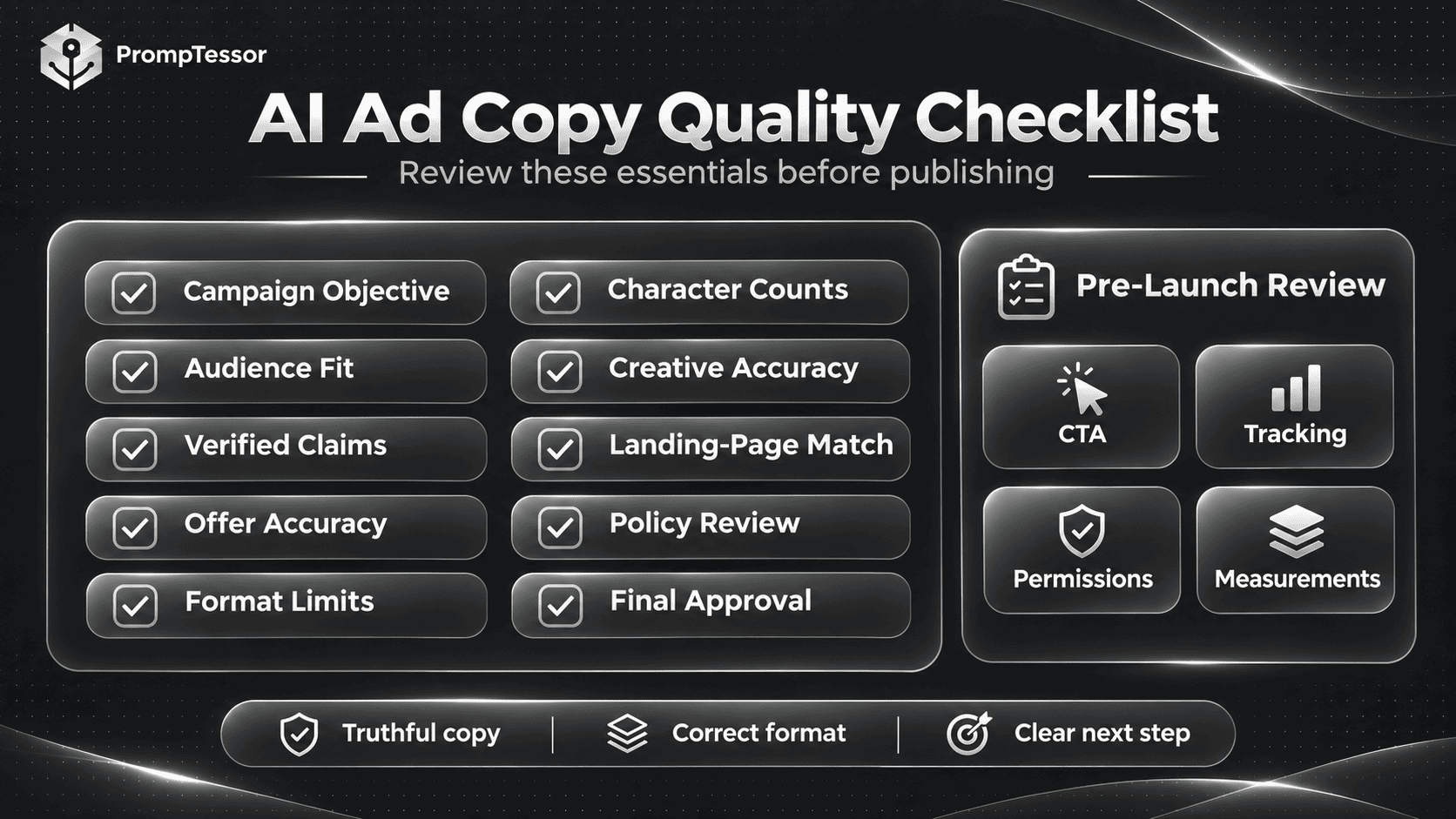
- Campaign objective: The advertisement supports one clearly defined goal.
- Audience relevance: The message matches an appropriate audience need or search intent.
- Verified product facts: All features, benefits, and product descriptions are accurate.
- Offer accuracy: Discounts, deadlines, eligibility, and pricing are confirmed.
- Platform format: Required ad fields and technical limits are satisfied.
- Character counts: Strict limits have been checked independently.
- Creative consistency: Images, videos, and voiceovers accurately represent the product.
- Brand identity: Logos and other official brand assets are used correctly.
- Landing page: The destination provides what the ad promises.
- CTA: The next action is clear and supported by the destination.
- Policies and disclosures: Relevant advertising requirements have been reviewed.
- Rights and permissions: Creative assets, endorsements, and music are authorized for advertising use.
- Tracking: Conversion events and relevant measurement settings are configured.
- Testing plan: The creative has an appropriate evaluation or experiment plan.
- Final review: A responsible reviewer has approved the complete advertisement.
Frequently Asked Questions About AI Ad Copy Prompts
What are AI ad copy prompts?
AI ad copy prompts are instructions that guide an AI model in creating or analyzing advertising content. They specify the product, audience, campaign objective, platform, approved claims, writing requirements, CTA, and desired output format.
What is the best ChatGPT prompt for ad copy?
The most useful prompt identifies the advertising platform and format, defines the intended audience and campaign goal, provides verified product facts, and requests specific ad fields with appropriate limits. There is no single best prompt for every advertising channel.
Can ChatGPT write Google Ads?
Yes. ChatGPT can draft Responsive Search Ad headlines, descriptions, and other copy assets. Final outputs should be checked against the current Google Ads requirements, advertising policies, and actual landing page information before use.
How many characters can a Google Search ad headline have?
Google Responsive Search Ad headlines support up to 30 characters each. Descriptions support up to 90 characters each. Advertisers can provide between three and 15 headlines and between two and four descriptions per responsive search ad.
Can AI write Facebook and Instagram ads?
Yes. AI models can create Facebook and Instagram primary text, headlines, carousel concepts, and creative briefs. The output should be adapted to the selected placement, and product claims and destination information must be verified.
What is a good TikTok advertising prompt?
A useful TikTok ad prompt specifies the audience, verified product benefit, video duration, opening hook, visual actions, script, on-screen text, and CTA. It should also include creative accuracy and production requirements.
Can AI generate TikTok UGC ad scripts?
Yes. AI can draft scripts that use natural creator-style storytelling. However, fictional testimonials should not be presented as real customer experiences, and creator content must have the appropriate usage rights and disclosures.
Can ChatGPT write LinkedIn B2B advertisements?
Yes. ChatGPT can help draft Sponsored Content, lead-generation messaging, headlines, and professional ad concepts. Effective prompts should focus on verified business benefits and specific professional use cases rather than fabricated ROI claims.
Can AI optimize advertising copy for conversions?
AI can help generate hypotheses, evaluate copy against a campaign brief, and propose revisions using real performance data. It cannot guarantee conversion improvements or identify a winning ad without appropriate testing and measurement.
How can I use AI for advertising A/B testing?
Provide the current ad, audience, primary metric, and test objective. Ask the model to create meaningfully different variants and explain the hypothesis behind each one. Run the test through the advertising platform and interpret actual results.
How do I prevent AI from inventing advertising claims?
Provide approved product facts and supporting evidence. Explicitly prohibit invented discounts, deadlines, testimonials, guarantees, and performance statistics. Require the model to identify missing information and verify the final copy manually.
Are AI-generated ads automatically compliant with advertising policies?
No. AI-generated ads must still satisfy the relevant platform policies, applicable laws, and industry-specific requirements. Human review and appropriate organizational approval remain necessary.
What is the difference between AI ad copy and AI social media content?
AI ad copy is developed for paid campaign objectives, ad placements, targeting, and measurable outcomes. Organic social content may focus more broadly on education, community engagement, entertainment, or brand storytelling.
Can PrompTessor help create better ad copy prompts?
Yes. PrompTessor can help generate, analyze, optimize, refine, save, and reuse prompts for advertising tasks. The final ads are produced and evaluated through compatible AI tools and advertising platforms, with independent policy and factual review.
Final Thoughts: Better Ad Copy Starts With Better Instructions
AI makes it easier to generate advertising ideas, headlines, scripts, and creative variations. But more output is not necessarily better output.
Effective advertising still depends on understanding the audience, choosing the right platform, communicating a genuine product benefit, and giving people a clear next step.
The 15 AI ad copy prompts in this guide provide practical starting points for Google Search Ads, Facebook and Instagram advertising, TikTok videos, LinkedIn Sponsored Content, and campaign optimization.
Start with the prompt that matches your campaign, supply verified business information, review the resulting copy, and test it using actual campaign data.
For repeated work, save the prompt structure and improve it based on measurable results.
If you want to develop more precise, reusable advertising instructions, try the PrompTessor AI Prompt Generator and refine the output around your own products, audiences, and campaign requirements.
Good advertising copy does not need bigger promises. It needs a clearer message, credible evidence, and a reason for the right audience to act.
Official Sources and Further Reading
- Google Ads — Creating Responsive Search Ads
- Google Ads — About Responsive Search Ads
- Google Ads — Misrepresentation Policy
- Meta — Ads Guide
- Meta — Advertising Standards
- TikTok for Business — Creative Best Practices
- TikTok — Misleading and False Content Advertising Policy
- LinkedIn — Single Image Ad Specifications
Build better prompts in one workspace
Generate prompts from ideas, analyze and optimize quality, refine with feedback, reverse-engineer content, and save reusable prompts in your Prompt Library.
Try PrompTessor Free