15 AI Email Marketing Prompts for Campaigns, Sequences, and Better Results (2026)
An AI tool can draft an email campaign in seconds. It can also write a message that sounds polished but gives subscribers no compelling reason to read, click, or buy. A subject line might promise an exciting offer that does not exist. A welcome sequence might repeat the same pitch three times. A personalized email might reference customer behavior that was never actually recorded.
The difference usually starts with the prompt.
Effective AI email marketing prompts define the audience, campaign objective, offer, verified customer data, brand voice, message structure, and desired action. They also tell the AI what it cannot assume, from promotional discounts and customer testimonials to campaign performance and subscriber preferences.
This guide provides 15 copy-and-paste AI email marketing prompts for planning campaigns, writing newsletters, building automated sequences, improving subject lines, personalizing messages, and analyzing actual results. The templates work with compatible text AI tools, including ChatGPT, Claude, and Gemini, and can be adapted for different email marketing platforms.
The goal is not simply to generate more emails. It is to create messages that are relevant, trustworthy, and worth receiving.
Better email marketing starts with the right message for the right audience, supported by real information.
Quick Answer: What Makes a Good AI Email Marketing Prompt?
A good AI email marketing prompt specifies the campaign goal, intended audience, subscriber context, verified offer details, brand voice, email format, call to action, and constraints. It also defines what the AI should produce and what must be checked before sending.
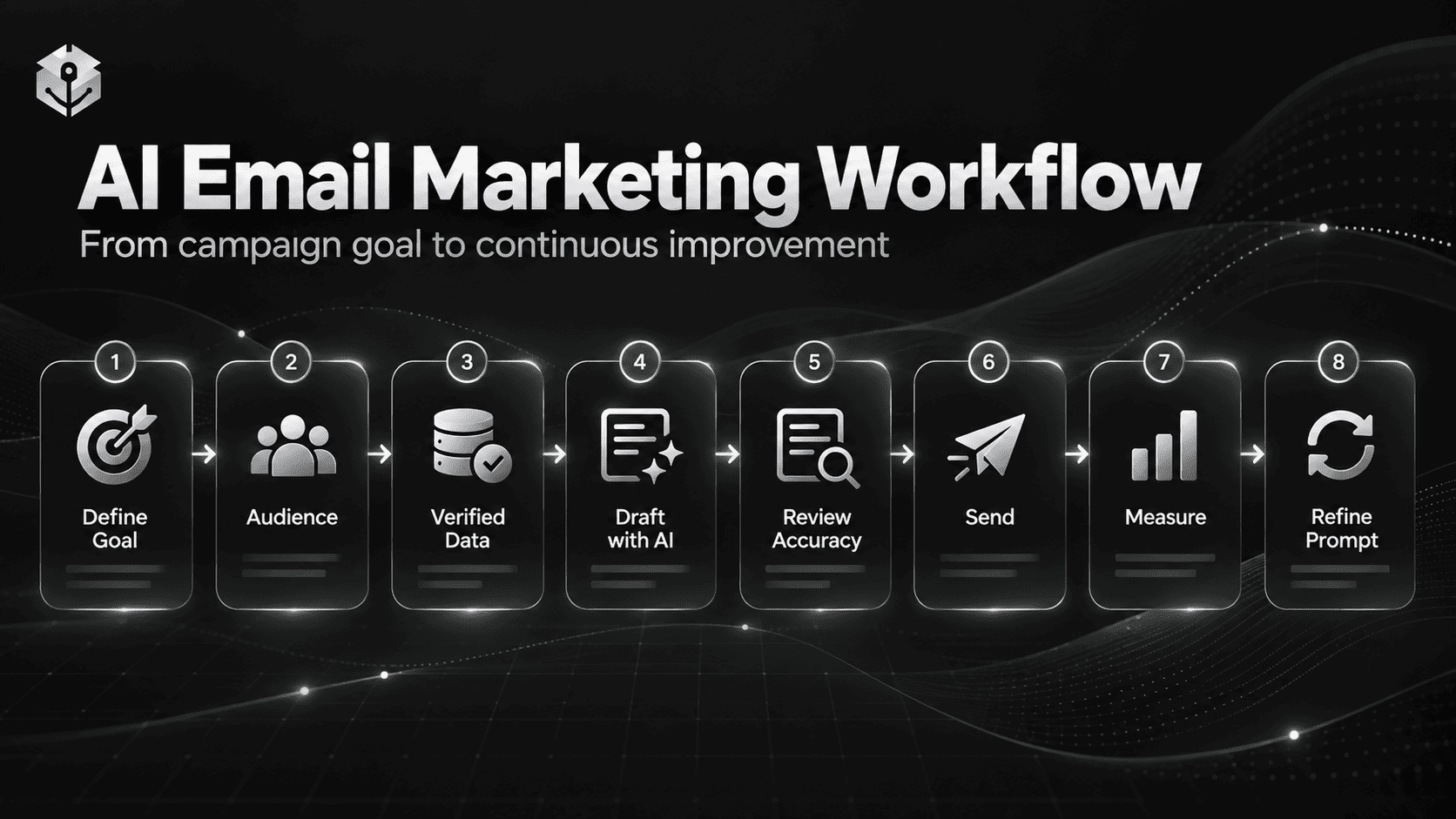
CAMPAIGN OBJECTIVE + AUDIENCE
              |
       SUBSCRIBER CONTEXT
              |
     VERIFIED OFFER + FACTS
              |
     MESSAGE + BRAND VOICE
              |
     SUBJECT + BODY + CTA
              |
  ACCURACY + CONSENT REVIEW
              |
      SEND + MEASURE
              |
        REFINE PROMPT
For example, "Write an email promoting my product" leaves important decisions to the model. A stronger prompt identifies the product, target customer, reason for sending, approved claims, actual offer, desired action, and expected output.
If important information is missing, the AI should flag the gap rather than inventing details to make the email appear complete.
Key Takeaways
- Start with one clear campaign goal before requesting copy.
- Provide verified product information, offer terms, and audience context.
- Use separate prompts for newsletters, promotional campaigns, lifecycle sequences, and performance analysis.
- Personalize using available, appropriate customer data rather than invented details or inferred sensitive attributes.
- Ask for subject lines, preview text, body copy, and CTAs that communicate the same promise.
- Build automated sequences around the subscriber journey instead of repeating the same sales message.
- Never invent discounts, deadlines, testimonials, scarcity, performance statistics, or customer behavior.
- Review consent, unsubscribe requirements, sender authentication, and other applicable email rules before launching.
- Evaluate campaigns using real data, including clicks, conversions, unsubscribes, and complaints, rather than relying on open rates alone.
- Save successful prompts as reusable templates and improve them through measured experimentation.
Before You Start: Build an Email Campaign Brief
Before copying any of the prompts below, prepare a short campaign brief. This gives the AI enough information to draft an email without guessing about your business or subscribers.
| Input | Example | Why It Matters |
|---|---|---|
| Business | Independent coffee retailer | Defines the product and business context. |
| Audience | Subscribed home coffee enthusiasts | Helps match the content to reader interests. |
| Campaign goal | Introduce a new coffee product | Gives the email a measurable purpose. |
| Verified details | Product name, origin, roast level, price | Prevents fictional product claims. |
| Brand voice | Friendly, informative, straightforward | Keeps messages consistent. |
| Offer | Product announcement without a discount | Prevents the AI from inventing incentives. |
| CTA | View the new coffee | Clarifies the next action. |
| Constraints | No fake reviews, deadlines, or guarantees | Protects accuracy and trust. |
A simple brief like this can be reused across campaigns. Change the audience, product, objective, or content format while keeping the underlying instructions consistent.
The Reusable AI Email Marketing Prompt Formula
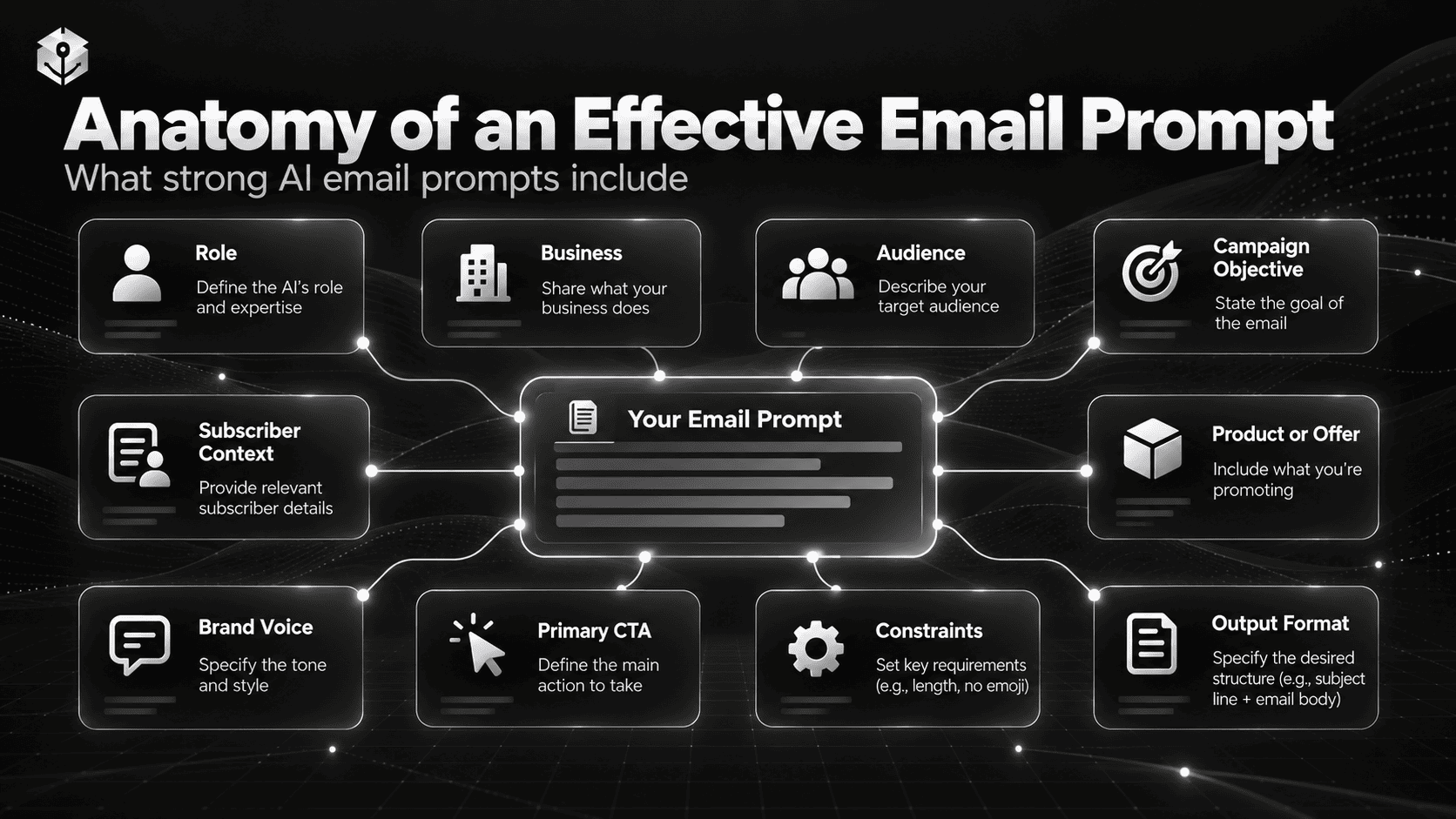
You do not need an extremely long instruction for every email. A reusable structure makes it easier to communicate the essential information and compare the quality of different outputs.
ROLE:
Act as an experienced email marketing strategist
and copywriter.

BUSINESS:
{business_description}

AUDIENCE:
{target_audience}

CAMPAIGN OBJECTIVE:
{campaign_goal}

SUBSCRIBER CONTEXT:
{verified_audience_data}

PRODUCT OR OFFER:
{approved_product_and_offer_details}

BRAND VOICE:
{tone_and_style}

EMAIL TYPE:
{newsletter | promotion | welcome | lifecycle}

PRIMARY CTA:
{desired_action}

CONSTRAINTS:
- Use only verified facts.
- Do not invent discounts or deadlines.
- Do not fabricate customer behavior.
- Avoid misleading subject lines.
- Identify missing information.

OUTPUT:
- Subject line options
- Preview text
- Email body
- CTA
- Personalization recommendations
- Pre-send verification checklist
Replace each variable with relevant information before using the prompt. For repeated campaigns, keep the structure stable and update only the information that changes.
For more advanced reusable workflows, see the PrompTessor guide to prompt templates and variables.
15 Copy-and-Paste AI Email Marketing Prompts
The following prompts are designed for different parts of the email marketing process. Each includes a practical use case, variables to customize, and a review step.
Examples are illustrative. They do not represent verified results from real campaigns. When using customer information, provide only data that your organization is authorized to process and use for the intended purpose.
Email Strategy and Audience Planning
1. AI Email Marketing Campaign Strategy Prompt
Best for: Developing a coordinated email marketing strategy instead of sending unrelated campaigns.
Customize: {business}, {audience}, {business_goal}, {products}, {email_frequency}, {available_data}, {resources}
Example brief: A small ecommerce business wants to build a monthly email strategy for existing subscribers.
Act as a senior email marketing strategist.

Develop a practical email marketing strategy
for {business}.

Target audience:
{audience}

Primary business objective:
{business_goal}

Products or services:
{products}

Existing email frequency:
{email_frequency}

Available audience and campaign data:
{available_data}

Team resources and constraints:
{resources}

Your tasks:

1. Identify the most relevant subscriber needs,
   motivations, and likely objections based on
   the information provided.

2. Define three measurable email marketing goals.

3. Recommend a realistic campaign mix across
   educational content, product information,
   promotional campaigns, and retention.

4. Create a four-week email calendar.

5. For each proposed email, include:
   - Audience segment
   - Campaign objective
   - Email topic
   - Main message
   - Recommended CTA
   - Required supporting information
   - Primary success metric

6. Identify opportunities for automated sequences.

7. Suggest three experiments worth prioritizing.

Do not invent customer research, industry
benchmarks, conversion rates, or historical
campaign performance.

Do not recommend contacting subscribers who
lack the required permission.

Distinguish established facts from assumptions.

Return:
- Strategy summary
- Four-week campaign calendar
- Automation opportunities
- Experiment backlog
- Missing information checklist
What to verify: Make sure the strategy matches actual subscriber interests, operational capacity, and available data. The recommended frequency should be treated as a starting hypothesis, not a universal best practice.
2. AI Audience Segmentation Prompt
Best for: Creating more relevant campaigns for distinct customer groups without relying on broad demographic assumptions.
Customize: {business}, {audience_data}, {customer_events}, {existing_segments}, {marketing_goal}
Example brief: An online clothing store has opted-in subscribers with different purchase histories and product interests.
Act as an email lifecycle marketing specialist.

Help develop an audience segmentation strategy
for {business}.

Available audience information:
{audience_data}

Recorded customer events:
{customer_events}

Existing segments:
{existing_segments}

Marketing objective:
{marketing_goal}

Create up to six actionable email segments.

For each segment, provide:

1. Segment name and purpose.
2. Exact eligibility conditions using only
   fields and events that exist in the data.
3. Required marketing consent condition.
4. Relevant subscriber need or context.
5. Appropriate campaign or sequence idea.
6. Suggested message angle.
7. Primary CTA.
8. Metric to evaluate effectiveness.
9. Important data limitations.

Prioritize meaningful differences in customer
behavior and explicitly recorded preferences.

Do not infer sensitive personal characteristics,
invent purchase history, or assume that appearing
in a database means someone consented to
marketing emails.

If a proposed segment requires unavailable data,
identify that dependency instead of pretending
the segment can already be created.

Output a segmentation table, implementation
checklist, and prioritized recommendations.
What to verify: Confirm that segment conditions exist in your email platform and that marketing permission is checked independently of segment membership.
Segmentation is useful because different customers may need different information, but more segments do not automatically mean better results. Start with meaningful differences that your data can support.
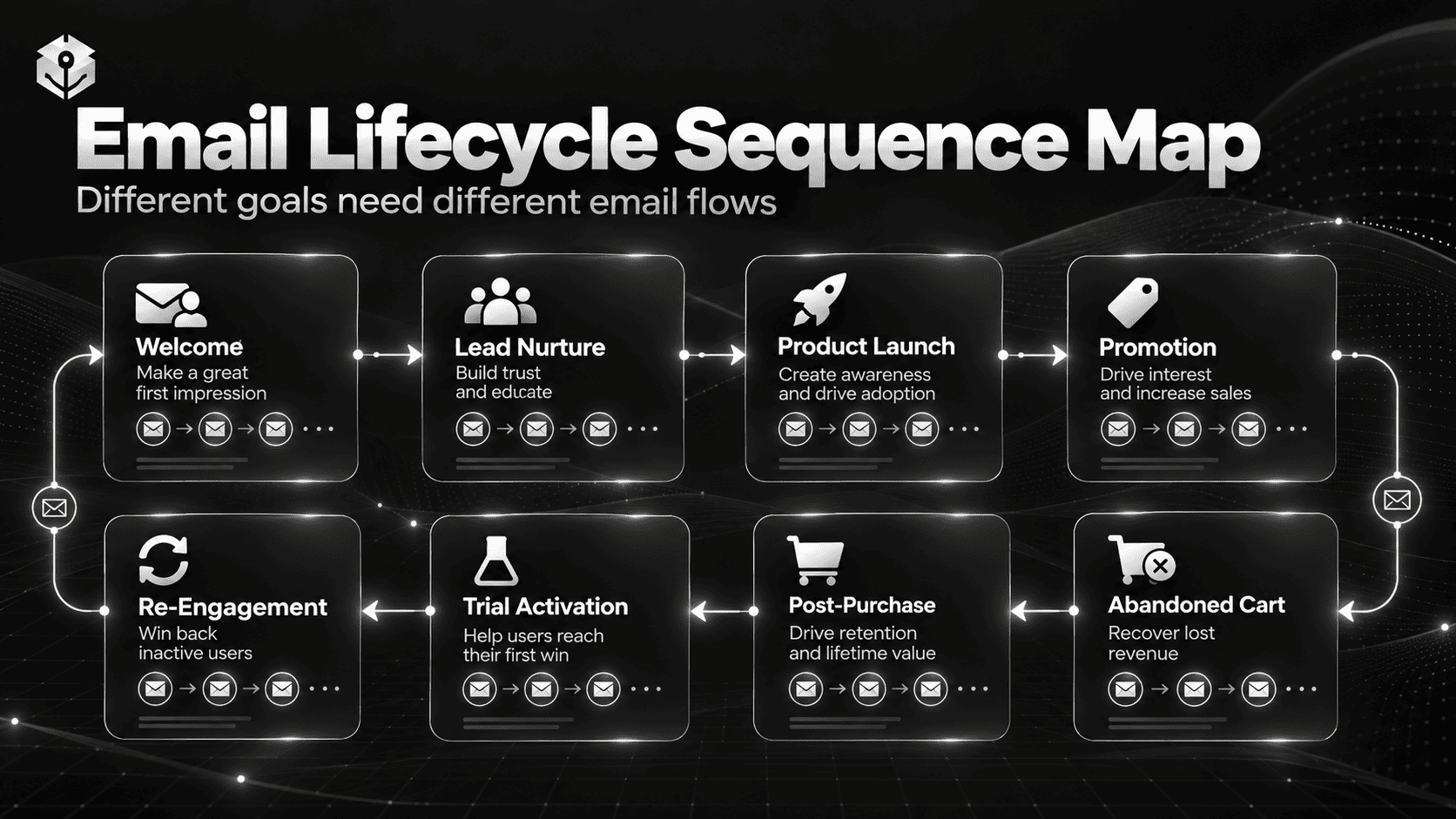
3. AI Welcome Email Sequence Prompt
Best for: Introducing a brand to new subscribers and giving them a useful reason to remain engaged.
Customize: {brand}, {signup_source}, {subscriber_expectations}, {product}, {brand_story}, {approved_incentive}
Example brief: A productivity software company wants to welcome new newsletter subscribers over their first week.
Act as an email lifecycle copywriter.

Create a three-email welcome sequence for
{brand}.

Signup source:
{signup_source}

What subscribers were promised:
{subscriber_expectations}

Product or service:
{product}

Verified brand story and benefits:
{brand_story}

Approved signup incentive, if any:
{approved_incentive}

Sequence objectives:

Email 1:
Welcome subscribers, fulfill the signup promise,
and explain what they can expect.

Email 2:
Provide useful educational content that helps
subscribers solve a relevant problem.

Email 3:
Introduce a relevant product or next step
without applying unnecessary pressure.

For each email, provide:
- Purpose
- Suggested timing after signup
- Three subject line options
- Preview text
- Email body
- Primary CTA
- Recommended personalization
- Information requiring verification

Keep the tone {brand_voice}.

Use one primary CTA per email.

Avoid repeating the same sales pitch.

Do not invent testimonials, user counts,
discounts, exclusive benefits, or results.

If signup expectations are unclear, flag them
before producing send-ready copy.

Finish with a sequence consistency checklist.
What to verify: Check that the first email delivers what the subscriber actually signed up for and that the subsequent messages match those expectations.
Email Copy and Campaign Creation
4. AI Email Subject Line and Preview Text Prompt
Best for: Generating focused subject line alternatives that accurately represent the email content.
Customize: {campaign_summary}, {audience}, {primary_benefit}, {brand_voice}, {approved_offer}
Example brief: A coffee retailer is announcing a new medium-roast coffee to existing subscribers.
Act as an email copywriting specialist.

Create 12 subject line and preview text pairs
for the following campaign.

Campaign summary:
{campaign_summary}

Audience:
{audience}

Primary benefit or announcement:
{primary_benefit}

Brand voice:
{brand_voice}

Verified offer details:
{approved_offer}

Organize the subject lines into four groups:

1. Clear and informative
2. Benefit-focused
3. Curiosity-driven
4. Direct and conversational

Requirements:

- Keep most subject lines under 50 characters
  where the meaning remains clear.
- Write preview text that complements rather
  than repeats the subject.
- Do not use fake urgency or misleading claims.
- Avoid excessive capitalization and punctuation.
- Do not invent discounts or exclusive access.
- Ensure every subject accurately reflects
  the actual email content.

For each pair, explain the communication angle.

Select three candidates worth testing and
explain what each test would teach.

Do not predict open-rate improvements or claim
that any candidate is guaranteed to perform best.
What to verify: Check subject-line accuracy, clarity, mobile rendering, and consistency with the email body. Character limits are editorial guidelines, not guarantees of display length across inboxes.
5. AI Email Newsletter Writing Prompt
Best for: Turning a collection of approved updates and useful information into a coherent newsletter.
Customize: {audience}, {newsletter_goal}, {source_material}, {brand_voice}, {primary_link}
Example brief: A business software company sends a monthly newsletter with product updates and educational resources.
Act as an editorial email newsletter writer.

Create a newsletter for {audience}.

Newsletter objective:
{newsletter_goal}

Approved information and source material:
{source_material}

Brand voice:
{brand_voice}

Primary destination link:
{primary_link}

Write a concise newsletter with:

1. A relevant subject line.
2. Complementary preview text.
3. A short opening that gives readers context.
4. One clearly identified lead story.
5. Two supporting updates or practical tips,
   but only if the source material supports them.
6. A clear CTA pointing to the primary resource.
7. A natural closing.

Prioritize the information readers will find
most useful rather than promoting everything
equally.

Preserve exact dates, prices, feature names,
source claims, and availability information.

Do not invent announcements, statistics,
customer stories, partnerships, or quotes.

If there are not enough approved updates,
produce a shorter newsletter instead of
manufacturing additional sections.

Return:
- Three subject line options
- Preview text
- Final newsletter
- Link verification list
- Factual review checklist
What to verify: Confirm that all announcements, features, links, and dates are accurate. The newsletter should deliver useful information even when a subscriber does not click through.
6. AI Product Launch Email Campaign Prompt
Best for: Announcing a new product, feature, or service with a coordinated email sequence.
Customize: {product}, {audience}, {launch_date}, {approved_features}, {availability}, {landing_page}
Example brief: A software company is introducing a new reporting feature to existing customers.
Act as a product launch email strategist.

Create a three-stage product launch
email campaign.

Product or feature:
{product}

Target audience:
{audience}

Verified launch date:
{launch_date}

Approved features and benefits:
{approved_features}

Availability and eligibility:
{availability}

Official landing page:
{landing_page}

Create these emails:

1. Announcement
   Introduce what is launching and why
   the audience should care.

2. Product explanation
   Show the main use cases and explain
   the verified benefits.

3. Follow-up
   Address likely questions and help
   interested readers take the next step.

For each email, provide:
- Goal
- Subject and preview text
- Main message
- Email body
- CTA
- Required supporting material
- Verification notes

Ensure the three emails add distinct value.

Use only confirmed launch information.

Do not promise access, compatibility,
pricing, results, or features not included
in the approved product details.

Do not invent customer testimonials
or adoption statistics.

If an important launch detail is missing,
flag it instead of filling the gap.
What to verify: Make sure access requirements, launch timing, and feature claims match the live product and landing page.
7. AI Promotional Email Copy Prompt
Best for: Writing a focused promotion using verified discounts, bundles, or limited-time offers.
Customize: {offer}, {eligible_audience}, {discount}, {start_date}, {end_date}, {terms}, {landing_page}
Example brief: A retail store has approved a weekend promotion on a specific product collection.
Act as a direct-response email copywriter.

Create a promotional marketing email for
the following confirmed offer.

Offer:
{offer}

Eligible audience:
{eligible_audience}

Approved discount or incentive:
{discount}

Start date and time:
{start_date}

End date and time:
{end_date}

Terms and exclusions:
{terms}

Landing page:
{landing_page}

Brand voice:
{brand_voice}

Write:

1. Three truthful subject line options.
2. Preview text.
3. A concise opening.
4. A clear explanation of the offer.
5. Two or three benefits supported
   by approved product information.
6. One primary CTA.
7. Necessary eligibility or offer details.

Use urgency only when a genuine deadline
has been confirmed.

Do not invent stock limitations,
countdown timers, hidden bonuses,
discount amounts, or savings claims.

Do not describe an offer as exclusive
unless eligibility genuinely supports
that description.

Check that the email matches the
actual landing page and offer conditions.

Finish with an offer-accuracy checklist.
What to verify: Confirm offer eligibility, calculation of savings, applicable dates and time zones, exclusions, and landing-page consistency before sending.
Email Automation and Customer Retention
8. AI Abandoned Cart Email Sequence Prompt
Best for: Helping eligible shoppers complete a purchase without using manipulative pressure.
Customize: {store}, {cart_data}, {products}, {shipping_information}, {approved_offer}, {consent_rules}
Example brief: An online accessories store wants to draft cart recovery emails for customers it is permitted to contact.
Act as an ecommerce lifecycle
email marketing specialist.

Create a two-email abandoned cart
recovery sequence.

Store:
{store}

Available cart information:
{cart_data}

Verified product details:
{products}

Shipping and return information:
{shipping_information}

Approved recovery offer:
{approved_offer}

Applicable contact permission rules:
{consent_rules}

Email 1:
Provide a straightforward cart reminder
and an easy way to return to checkout.

Email 2:
Address common purchasing questions
using only verified store information.

For each email, include:
- Goal
- Suggested timing for testing
- Subject line options
- Preview text
- Email body
- CTA
- Conditional content requirements

Use only actual cart details and
available customer information.

Do not invent checkout problems,
cart expiration deadlines, discounts,
inventory shortages, customer reviews,
or product benefits.

If the shopper is not eligible to receive
the message, the automation must not send it.

Include suppression rules for purchases,
unsubscribes, and other relevant events.

Return a sequence map, email drafts,
and implementation checklist.
What to verify: Confirm the customer is eligible to receive cart recovery marketing in the relevant jurisdiction. Test cart restoration links, purchase-based suppression, and the automation exit conditions.
9. AI Post-Purchase Email Sequence Prompt
Best for: Supporting new customers after a purchase and building a useful relationship beyond checkout.
Customize: {product}, {customer_context}, {usage_instructions}, {support_resources}, {review_policy}
Example brief: A home organization brand wants to help customers get value from a newly purchased storage product.
Act as a customer lifecycle
email marketing specialist.

Develop a post-purchase email sequence
for {product}.

Customer context:
{customer_context}

Verified product usage instructions:
{usage_instructions}

Available support resources:
{support_resources}

Approved review request policy:
{review_policy}

Create three distinct messages:

1. Product guidance
   Help customers use or prepare
   their new purchase.

2. Helpful follow-up
   Address common questions and
   share approved care or usage tips.

3. Feedback invitation
   Invite an honest review or relevant
   feedback when appropriate.

For each message include:
- Purpose
- Proposed trigger
- Subject and preview text
- Draft body
- CTA
- Required data
- Exit or suppression conditions

Separate essential transactional messages
from optional marketing communications.

Do not make marketing consent assumptions
based solely on a completed purchase.

Do not invent delivery confirmation,
product usage outcomes, testimonials,
warranty terms, or support promises.

Avoid incentives for positive reviews
or requests that imply only satisfied
customers should provide feedback.

Return a practical sequence plan
and review checklist.
What to verify: Keep order confirmations, delivery notices, and other necessary transactional communications distinct from promotional follow-ups. Check message classification and applicable permission requirements.
10. AI Customer Re-Engagement Email Prompt
Best for: Reconnecting with previously engaged subscribers whose recent activity has declined.
Customize: {brand}, {inactivity_definition}, {subscriber_data}, {approved_content}, {preferences_options}
Example brief: An educational newsletter wants to reconnect with subscribers who have not recently clicked its content.
Act as an email retention strategist.

Create a respectful re-engagement
campaign for {brand}.

Definition of inactive subscribers:
{inactivity_definition}

Available subscriber history:
{subscriber_data}

New or useful approved content:
{approved_content}

Available preference options:
{preferences_options}

Develop up to two emails.

Email 1:
Reintroduce useful content and give
subscribers a clear reason to engage.

Email 2:
Invite subscribers to update their
preferences or decide whether
they still want these emails.

For each email include:
- Objective
- Subject line
- Preview text
- Main copy
- Primary CTA
- Suppression considerations

Use a helpful, non-accusatory tone.

Do not pretend to know why someone
stopped engaging.

Do not say a subscriber ignored
specific emails unless reliable
data supports the statement.

Do not rely solely on opens as proof
of actual human engagement.

Include a recommendation for handling
subscribers who remain unengaged.

Return campaign copy and a measurement
plan covering clicks, preferences,
unsubscribes, and complaints.
What to verify: Confirm engagement criteria, unsubscribe handling, and the impact of privacy-related email tracking limitations before evaluating results.
11. AI Educational Lead Nurture Sequence Prompt
Best for: Helping interested subscribers understand a problem, evaluate options, and decide whether a product fits their needs.
Customize: {audience}, {problem}, {educational_resources}, {product}, {approved_proof}, {desired_action}
Example brief: A B2B productivity company is nurturing subscribers who downloaded an educational guide.
Act as a B2B content and email
nurture strategist.

Create a four-email educational
nurture sequence for {audience}.

Audience problem:
{problem}

Signup context:
{signup_context}

Available educational resources:
{educational_resources}

Relevant product or service:
{product}

Approved proof and product claims:
{approved_proof}

Desired next action:
{desired_action}

Build a logical progression:

Email 1:
Help the reader understand the problem.

Email 2:
Share a practical framework or useful
method supported by available sources.

Email 3:
Explain the available solution options
and meaningful tradeoffs.

Email 4:
Show where the product fits and invite
an appropriate next step.

For each email provide:
- Learning objective
- Main takeaway
- Subject and preview text
- Email copy
- Resource link placement
- CTA
- Missing evidence notes

Prioritize education over repetitive
product promotion.

Use only approved case studies,
statistics, and product capabilities.

Do not fabricate ROI calculations,
testimonials, customer outcomes,
or product comparisons.

Keep each email useful as a
standalone message.
What to verify: Make sure the educational resources genuinely support the message and the sales CTA matches the reader's stage of consideration.
12. AI Personalized Email Recommendation Prompt
Best for: Adapting approved product or content recommendations to explicit preferences and verified subscriber activity.
Customize: {subscriber_segment}, {verified_preferences}, {approved_catalog}, {recent_interactions}, {recommendation_goal}
Example brief: A bookstore wants to recommend titles based on genres subscribers explicitly selected.
Act as an email personalization
and recommendation copywriter.

Create a personalized email draft
for the following subscriber segment.

Segment:
{subscriber_segment}

Verified subscriber preferences:
{verified_preferences}

Available products or content:
{approved_catalog}

Recorded interactions:
{recent_interactions}

Recommendation goal:
{recommendation_goal}

Choose up to three relevant
recommendations from the approved catalog.

For each recommendation:
- Explain why it matches the supplied
  preferences or behavior.
- Identify the supporting data.
- Provide accurate product information.
- Include the approved destination link.

Then write:
1. Two subject line options.
2. Preview text.
3. Brief personalized introduction.
4. Recommendation sections.
5. Primary CTA.

Do not invent purchases, browsing events,
individual preferences, or stock status.

Do not infer sensitive personal attributes.

Avoid wording that reveals more customer
tracking information than is necessary
or appropriate.

If the available data cannot support a
recommendation, use a general
interest-based version instead.

Return the email and a data provenance
checklist for all personalized claims.
What to verify: Check that every recommendation exists in the approved catalog and that the personalization is permitted, accurate, and appropriate for the recipient.
13. AI SaaS Trial Activation Email Sequence Prompt
Best for: Helping trial users discover relevant features and reach a meaningful first outcome.
Customize: {software}, {trial_details}, {activation_goal}, {verified_features}, {observed_events}, {support_resources}
Example brief: A project management SaaS product wants to help trial users complete their first project setup.
Act as a SaaS lifecycle and
product onboarding strategist.

Design a three-email trial
activation sequence.

Product:
{software}

Verified trial details:
{trial_details}

Desired activation milestone:
{activation_goal}

Available product features:
{verified_features}

Recorded user events:
{observed_events}

Official tutorials and support:
{support_resources}

Create:

Email 1:
Introduce the most useful first step.

Email 2:
Explain one practical workflow
that leads toward activation.

Email 3:
Offer relevant guidance based on
an actual recorded event or a
general onboarding fallback.

For each email include:
- Trigger conditions
- Purpose
- Subject and preview text
- Body copy
- CTA
- Required personalization data
- Exit conditions
- Verification notes

Do not invent trial expiration
dates, pricing, usage activity,
product capabilities, or support options.

Do not claim a user failed to
complete an action without
reliable event data.

Distinguish necessary account
communications from promotional
messages and apply the correct
permissions and preferences.

Finish with an activation funnel
and measurement proposal.
What to verify: Confirm actual trial terms, event instrumentation, feature availability, and whether each message should be classified as transactional or marketing.
Testing and Campaign Optimization
14. AI Email A/B Testing Strategy Prompt
Best for: Designing a meaningful experiment instead of changing several email elements at once.
Customize: {campaign}, {hypothesis}, {audience_size}, {baseline_metrics}, {test_variable}, {business_goal}
Example brief: An ecommerce brand wants to compare a benefit-focused subject line with a direct announcement.
Act as an email experimentation
and conversion optimization specialist.

Design an A/B test for this campaign:

Campaign:
{campaign}

Test hypothesis:
{hypothesis}

Eligible audience size:
{audience_size}

Actual historical metrics:
{baseline_metrics}

Variable to test:
{test_variable}

Business objective:
{business_goal}

Your tasks:

1. Define the hypothesis clearly.
2. Propose two test variants.
3. Keep all other meaningful
   campaign elements consistent.
4. Choose a primary success metric
   aligned with the business goal.
5. Identify secondary and guardrail metrics.
6. Describe random assignment
   and audience eligibility.
7. Explain how sample size,
   expected effect, and variance
   affect the test design.
8. Recommend a measurement
   and interpretation framework.
9. Identify potential sources of bias.
10. Define what results would justify
    further investigation or rollout.

Do not invent baseline performance
or declare a statistically meaningful
winner without actual test data.

If the information is insufficient
for sample-size planning, identify
the missing inputs and avoid
unsupported numerical claims.

Return a test plan, variant copy,
measurement framework, and
decision checklist.
What to verify: Ensure that the test isolates a meaningful variable, uses a suitable primary metric, and accounts for sample size and measurement limitations.
A subject-line test may use opens as a directional diagnostic, but privacy-related tracking can distort that signal. When appropriate and measurable, downstream clicks and conversions provide additional evidence.
15. AI Email Campaign Performance Audit Prompt
Best for: Reviewing actual campaign performance and identifying realistic opportunities for improvement.
Customize: {campaign_data}, {date_range}, {goals}, {segments}, {attribution_rules}, {limitations}
Example brief: A marketing team wants to review the previous eight weeks of email campaigns using exported campaign metrics.
Act as an email marketing
performance analyst.

Analyze the following actual
email campaign data.

Campaign export:
{campaign_data}

Analysis period:
{date_range}

Business goals:
{goals}

Audience segments:
{segments}

Attribution and measurement rules:
{attribution_rules}

Known data limitations:
{limitations}

Perform these tasks:

1. Validate the available fields,
   dates, and metric definitions.

2. Summarize campaign performance
   using comparable metrics.

3. Compare relevant campaigns
   and audience segments.

4. Examine:
   - Delivery and bounce indicators
   - Click performance
   - Conversions when available
   - Revenue when attributable
   - Unsubscribes
   - Spam complaints
   - Engagement trends

5. Separate observations
   from possible explanations.

6. Identify campaigns that
   deserve closer inspection.

7. Propose five prioritized
   improvements or experiments.

8. Define metrics and a timeline
   for evaluating those changes.

Do not invent missing measurements.

Do not treat correlation as causation.

Do not compare rates with different
denominators as if they were equivalent.

Do not treat privacy-inflated opens
as reliable proof of human reading.

If the dataset cannot answer a question,
state that limitation explicitly.

Return:
- Executive summary
- Metric comparison table
- Observed patterns
- Data limitations
- Prioritized experiments
- Next measurement plan
What to verify: Check metric definitions, reporting periods, segment overlap, attribution windows, and whether apparent improvements reflect genuine behavior rather than tracking changes.
Example: Turning a Basic Request Into an Effective Email Prompt
The difference between a vague request and a structured prompt becomes clearer with a simple example.
Weak Prompt
Write a marketing email for my coffee store
that will make more people buy my products.
This leaves the model guessing about the product, audience, message, offer, tone, and desired action. It also encourages unsupported assumptions about what might increase sales.
Improved Prompt
Act as an email marketing copywriter.

Write a product announcement email for
an independent online coffee retailer.

Audience:
Existing subscribers interested in
brewing specialty coffee at home.

Product:
A newly available medium-roast
whole-bean coffee.

Verified details:
- Medium roast
- Whole beans
- Available through the online store
- No promotional discount

Goal:
Introduce the product and encourage
subscribers to view its product page.

Tone:
Friendly, informative, and concise.
Avoid exaggerated sales language.

Output:
- Three subject lines
- One preview text option
- Email body under 180 words
- One primary CTA

Do not invent origin, tasting notes,
certifications, pricing, stock levels,
customer reviews, or other details
not provided.

If essential product information
is missing, flag it before publication.
Example Email Output
Subject: Meet the new medium roast
Preview text: A new whole-bean coffee is ready to explore.
Hi there,
There's something new in the coffee collection.
The latest addition is a medium-roast whole-bean coffee, ready for anyone looking to explore another option for their home brewing routine.
Take a look at the product details and see whether it's the right fit for your next cup.
Explore the new coffee
The second prompt produces a more focused starting point because it defines the product and restricts the claims. The output still needs a real product link, an approved email template, and final checks before sending.
How to Choose the Right AI Prompt for Each Email Marketing Goal
Not every email should be written with the same objective. A new subscriber may need an introduction, while an existing customer may need help using a purchased product. A promotional message may be appropriate for one segment and irrelevant to another.
| Marketing Goal | Recommended Prompt | What to Measure |
|---|---|---|
| Plan upcoming campaigns | Campaign Strategy (#1) | Execution quality and goal-aligned campaign metrics |
| Improve message relevance | Audience Segmentation (#2) | Segment-level clicks, conversions, and complaints |
| Introduce new subscribers | Welcome Sequence (#3) | Useful engagement and downstream actions |
| Test different opening angles | Subject Lines (#4) | Appropriate test metrics and guardrails |
| Share educational updates | Newsletter (#5) | Qualified clicks and meaningful engagement |
| Announce a product or feature | Product Launch (#6) | Product-page visits and relevant conversions |
| Promote a verified offer | Promotional Copy (#7) | Conversions and attributed revenue |
| Recover eligible abandoned carts | Cart Recovery (#8) | Completed purchases and incremental outcomes where measurable |
| Improve customer experience | Post-Purchase (#9) | Useful actions, feedback, and support signals |
| Reconnect with subscribers | Re-Engagement (#10) | Clicks, preferences, unsubscribes, and complaints |
| Educate interested prospects | Lead Nurture (#11) | Resource engagement and qualified next steps |
| Recommend relevant products | Personalization (#12) | Recommendation clicks and conversions |
| Help trial users activate | SaaS Activation (#13) | Verified product activation events |
| Test messaging improvements | A/B Testing (#14) | Prespecified primary metric and guardrails |
| Evaluate existing campaigns | Performance Audit (#15) | Comparable actual campaign metrics |
The most useful prompt is not always the one that produces the longest email. Choose the instruction that matches the customer journey and the decision you want the reader to make.
How to Write Better AI Email Marketing Prompts
1. Define One Primary Objective
An email that tries to announce a product, educate customers, promote a discount, and request a review simultaneously may become unfocused.
Tell the AI the primary purpose of the email. Supporting information should reinforce that purpose rather than competing with it.
2. Supply Verified Information
Give the model approved product information, prices, offers, real customer research, and supporting source material. When necessary, provide the exact words that must remain unchanged.
A well-written email containing fictional product benefits or inaccurate offer terms is not ready to send.
3. Include Brand Voice and Examples
Instructions such as "make it engaging" are subjective. More useful guidance might be "use short conversational sentences, explain the benefit before the feature, avoid exaggerated claims, and do not use unnecessary exclamation marks."
If possible, provide two or three approved emails as examples of the desired tone. Clarify that these examples guide style rather than supply new claims for the current campaign.
4. Personalize With Real Subscriber Context
Personalization should reflect information that the business actually possesses and is permitted to use.
Relevant examples include explicitly selected interests, confirmed subscription preferences, or eligible purchase history. Avoid asking a model to guess private characteristics or fabricate past interactions.
When useful personalization data is unavailable, a genuinely relevant general message is better than a fictional personal reference.
5. Specify the Output Structure
Instead of asking for "a good email," request a specific format:
Return:
1. Three subject line options
2. One preview text
3. Email body (120-180 words)
4. One primary CTA
5. Personalization opportunities
6. Missing information
7. Verification checklist
The word count is an editorial starting point. It should be adjusted based on the complexity of the message, subscriber expectations, and the role of the email.
6. Separate Drafting From Approval
AI-generated copy should be treated as a draft. A human or approved operational workflow still needs to confirm factual accuracy, links, consent, technical settings, and campaign readiness.
This separation matters especially when an email contains pricing, legal terms, product availability, customer information, or regulated claims.
Email Marketing Compliance and Deliverability in 2026
Good copy alone does not ensure that an email reaches the inbox or satisfies legal requirements.
For commercial email in the United States, the Federal Trade Commission explains that the CAN-SPAM Act requires accurate sender information, truthful subject lines, a valid postal address, a clear opt-out mechanism, and timely handling of unsubscribe requests. The rules can apply to business-to-business commercial email as well as consumer marketing.
Under the FTC's guidance, recipients' opt-out requests must be honored within 10 business days. Other countries and regions may impose additional or different rules, including consent and privacy requirements.
Read the FTC CAN-SPAM compliance guide for the applicable details.
Email providers also impose technical sending requirements. Google's sender guidelines describe authentication, spam-rate management, and unsubscribe expectations, including additional requirements for bulk senders. For relevant promotional messages, Gmail's one-click unsubscribe requirement depends on properly configured email headers; an ordinary unsubscribe link in the email body alone does not satisfy that specific technical requirement.
See the Google email sender guidelines FAQ for current details.
These requirements cannot be implemented merely by adding text to an AI prompt. Your email sending infrastructure, subscription records, authentication settings, and automation platform must enforce them.
What to Check Before Sending
- Recipient eligibility and applicable marketing permission requirements.
- Accurate sender identity and email authentication settings.
- Correct unsubscribe functionality and suppression handling.
- Truthful subject lines and advertising claims.
- Valid business address and required disclosures where applicable.
- Product, price, promotion, and landing-page accuracy.
- Appropriate frequency and audience segmentation.
- Actual test deliveries across relevant inbox environments.
This checklist is operational guidance, not a substitute for jurisdiction-specific legal review.
How to Measure AI-Assisted Email Campaign Performance
Generating email copy faster is useful, but output speed alone does not establish campaign effectiveness.
To evaluate whether AI-assisted drafting improves results, compare relevant campaigns and actual subscriber outcomes.
| Metric | What It Shows | Important Limitation |
|---|---|---|
| Delivery and bounce indicators | Whether messages are accepted or rejected by receiving systems | Acceptance does not prove inbox placement. |
| Open rate | Reported email opens | Privacy features can inflate or otherwise distort opens. |
| Click rate | Recipients interacting with tracked links | Definitions and automated link activity can affect measurement. |
| Conversion rate | Recipients completing the intended action | Results depend on the denominator and attribution setup. |
| Revenue per delivered email | Attributed revenue relative to delivered volume | Attribution does not automatically demonstrate incremental revenue. |
| Unsubscribe rate | Recipients choosing to stop marketing emails | Interpret alongside relevance, frequency, and audience changes. |
| Spam complaint rate | Reported unwanted messages | Coverage and calculation depend on provider and data source. |
Open rates deserve particular caution because privacy features, including Apple Mail Privacy Protection, can affect tracking. Klaviyo's campaign engagement guidance recommends evaluating clicks, conversions, bounces, unsubscribes, and other indicators alongside reported opens.
When analyzing a campaign export with AI, include the reporting period, metric definitions, and known measurement limitations. A model cannot responsibly conclude that a subject line caused better performance simply because its campaign recorded a higher conversion rate.
Common AI Email Marketing Prompt Mistakes
1. Asking AI to Make an Email More Persuasive Without Context
The instruction "make this email convert better" does not explain who the audience is, why the current message underperforms, or which improvements are permitted.
Instead, provide the original email, approved offer details, intended reader, goal, and any actual performance information.
2. Generating Too Many Similar Variations
Twenty subject lines that all communicate the same generic benefit offer little strategic value.
Ask for variations that test distinct, truthful communication angles and explain why each version differs.
3. Inventing Customer Personalization
AI may produce convincing statements about past purchases, preferences, or browsing activity that were never supplied.
Provide actual approved data fields and require generic fallback copy when relevant values are unavailable.
4. Using Fake Scarcity or Urgency
Phrases such as "only three left" or "offer ends tonight" should never be generated without reliable supporting information.
Use actual inventory limits and verified campaign deadlines where appropriate, or omit urgency entirely.
5. Ignoring Email Automation Conditions
Writing a cart recovery email does not mean the automation is correctly configured.
Check triggers, delays, purchase suppression, permission requirements, and the events that should stop the sequence.
6. Treating AI Predictions as Campaign Results
An AI model may describe one subject line as likely to outperform another. Without a suitable experiment, that remains a hypothesis.
Use actual experiments and appropriately interpreted campaign metrics to evaluate results.
7. Publishing Without Reviewing the Full Journey
A compelling email can still fail when the CTA leads to a broken page, an expired promotion, or content that contradicts the email.
Review the entire reader experience, not just the copy.
How PrompTessor Fits Into an AI Email Marketing Workflow
Creating email campaigns involves several related tasks: planning, writing, checking instructions, reviewing output, and learning from results.
PrompTessor supports the prompt-design part of that workflow.
Use the AI Prompt Generator to turn a rough campaign idea into a structured prompt with clear audience context, constraints, and output requirements.
When an existing prompt produces generic or inconsistent results, use the AI Prompt Analyzer to inspect the instruction and the AI Prompt Optimizer to improve its clarity and structure.
PrompTessor can also help refine prompts based on feedback and organize reusable instructions for future campaigns.
A practical workflow looks like this:
CAMPAIGN IDEA
      |
      v
DEFINE GOAL + AUDIENCE + VERIFIED DATA
      |
      v
GENERATE OR SELECT A PROMPT
      |
      v
ANALYZE + OPTIMIZE INSTRUCTIONS
      |
      v
DRAFT COPY USING A COMPATIBLE AI TOOL
      |
      v
REVIEW ACCURACY + CONSENT + LINKS
      |
      v
SEND THROUGH AN EMAIL PLATFORM
      |
      v
MEASURE ACTUAL RESULTS
      |
      v
REFINE AND REUSE THE PROMPT
PrompTessor does not replace an email service provider, subscriber management platform, deliverability infrastructure, or campaign analytics system. Those systems remain responsible for sending, automation execution, permissions, and measurement.
If your campaign also needs consistent messaging across social platforms, see the 15 AI Social Media Prompts guide. For ecommerce campaigns where the source copy needs improvement, the AI Product Description Prompts guide can help structure accurate product information before adapting it into email copy.
AI Email Marketing Quality Checklist Before Sending
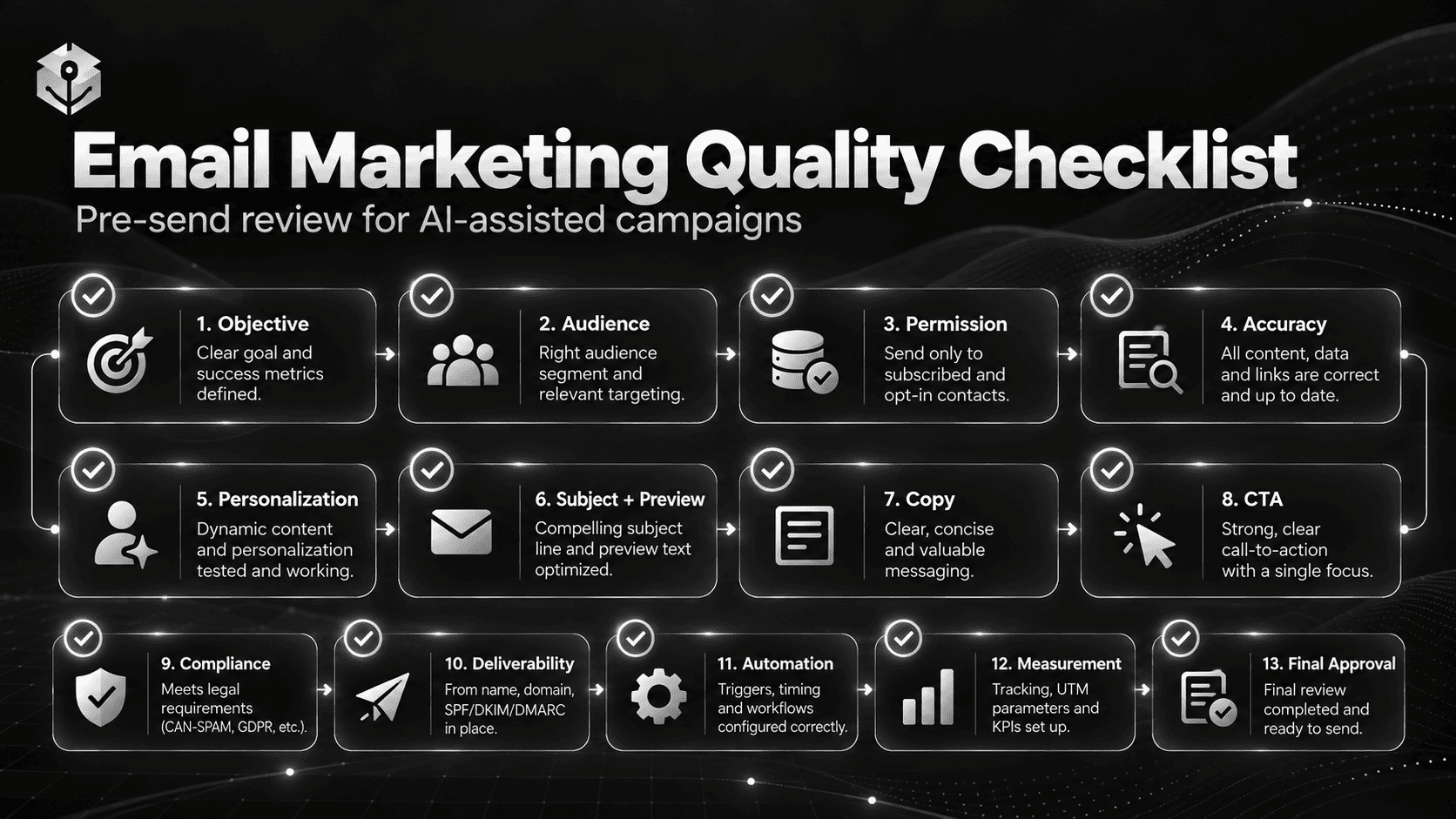
- Objective: The email has one clear purpose and a relevant next action.
- Audience: The message matches the needs of its intended subscriber segment.
- Permission: Recipient eligibility and required consent or other applicable permission are verified.
- Accuracy: Every product claim, price, deadline, and promotional condition is supported.
- Personalization: Dynamic fields are available, appropriate, and tested with fallback values.
- Subject and preview: The opening accurately reflects the content.
- Copy: The message is readable, useful, and consistent with the brand voice.
- CTA: The primary action is clear and links to the correct destination.
- Accessibility: The email remains understandable with images disabled and supports readable text, descriptive links, and appropriate text alternatives.
- Compliance: Required identification, address, opt-out, and other disclosures are present.
- Deliverability: Authentication, sending reputation, suppression lists, and technical unsubscribe requirements are reviewed.
- Automation: Triggers, delays, conditions, and exits are tested against realistic scenarios.
- Measurement: The campaign has a clearly defined success metric and a suitable reporting method.
- Final approval: A responsible reviewer has checked the email and its destination experience.
Frequently Asked Questions About AI Email Marketing Prompts
What are AI email marketing prompts?
AI email marketing prompts are instructions that guide an AI model in creating or analyzing email marketing content. They can specify the audience, objective, product or offer, brand voice, email format, CTA, and rules for accuracy and output.
Can ChatGPT write email marketing campaigns?
Yes. ChatGPT can help draft subject lines, newsletters, promotional messages, welcome sequences, educational emails, and other campaign content. The quality depends heavily on the supplied context and the model's capabilities. All outputs should be reviewed before sending.
What is the best ChatGPT prompt for email marketing?
The most useful prompt describes a specific campaign goal, audience, verified information, email type, brand voice, desired action, and output format. There is no single best prompt for every campaign. A product launch email requires different information from an abandoned cart reminder or a newsletter.
Can AI generate personalized marketing emails?
Yes, when given appropriate verified customer data and clear personalization rules. AI should not invent customer activity, assume private preferences, or make unsupported claims about individual recipients. Email systems must still manage personalization fields and permissions correctly.
How do I prompt AI to write a welcome email sequence?
Explain why subscribers joined, what they were promised, what the brand offers, and what each email should achieve. Ask for a progression that welcomes subscribers, provides useful information, and introduces a relevant next step. Include timing suggestions, accurate CTAs, and exit conditions for the automation.
Can AI improve email open rates and conversions?
AI can help generate messaging alternatives, improve clarity, and design experiments. However, it cannot guarantee improved results. Performance depends on audience relevance, deliverability, offers, timing, creative quality, and many other factors. Use real campaign data and suitable tests to evaluate improvements.
Should I use the same email prompts for ecommerce and SaaS?
You can reuse the underlying structure, but the campaign context should change. Ecommerce may focus on product discovery, cart recovery, and post-purchase care. SaaS campaigns may emphasize onboarding, feature adoption, activation, and retention. Each requires different events, proof, and success metrics.
How many emails should be in a welcome sequence?
There is no universally optimal number. A short three-email sequence can be a useful starting point, but the right length depends on what subscribers expect, the product's complexity, engagement, and business goals. Test the sequence and adjust it using actual results.
Are AI-generated marketing emails compliant with CAN-SPAM?
AI-generated text is not automatically compliant. Businesses must confirm that commercial messages meet applicable requirements, including accurate sender and subject information, appropriate disclosures, a valid postal address, and an effective opt-out mechanism. Other privacy and marketing rules may apply depending on recipients and jurisdictions.
Can AI automatically send and manage email campaigns?
Some email marketing platforms offer AI-assisted automation, but text generation alone does not execute a campaign. Sending, scheduling, subscriber management, permission enforcement, performance tracking, and unsubscribe processing require suitable systems and configurations.
How can I improve a generic AI-generated marketing email?
Provide a more specific audience description, verified product information, concrete campaign objectives, and examples of the desired brand voice. Ask the model to identify unsupported statements, remove vague claims, strengthen the reader benefit, and explain the purpose of the CTA. Then review and test the revised output.
How does PrompTessor help with email marketing prompts?
PrompTessor helps create, analyze, optimize, refine, and organize prompts. Marketers can use it to structure campaign instructions and develop reusable templates before using a compatible AI model to draft or analyze email content. Final approval, sending, and performance measurement remain separate responsibilities.
Final Thoughts: Better Emails Start With Better Instructions
AI can accelerate email marketing tasks, from drafting a newsletter to building a lifecycle sequence or reviewing campaign data. But speed is not the same as effectiveness.
Useful emails still depend on understanding subscribers, communicating a meaningful message, respecting their preferences, and supporting every claim with accurate information.
The 15 AI email marketing prompts in this guide provide structured starting points for different campaign goals. Use the one that matches your audience and objective, replace its variables with real information, and review the result carefully.
Then measure what happens. Save prompts that prove useful, improve those that create unclear output, and let actual customer behavior guide future campaigns.
If you want to develop more consistent and reusable campaign instructions, start with the PrompTessor AI Prompt Generator and refine the result around your own audience, messaging, and quality requirements.
Official Resources and Further Reading
Build better prompts in one workspace
Generate prompts from ideas, analyze and optimize quality, refine with feedback, reverse-engineer content, and save reusable prompts in your Prompt Library.
Try PrompTessor Free