15 AI Product Description Prompts for Ecommerce, SEO, and Sales 2026
An AI-generated product description can sound convincing while saying almost nothing useful. A draft might call a water bottle “durable and premium,” but omit its capacity, lid type, dimensions, or what the buyer actually receives. Worse, a language model may invent a warranty, a certification, or a compatibility claim that the merchant never approved.
Strong AI product description prompts do more than ask for persuasive writing. They define the real product, who the customer is, where the copy will appear, which benefits can be supported, how it should be structured, and what must be checked before publishing. An online store product page, a marketplace listing, and a Google Shopping feed need related but different outputs.
This guide includes 15 copy-and-paste prompts for ecommerce descriptions, product titles, SEO, buyer objections, variant listings, technical products, and bulk catalog work. Each template is tool-agnostic: use it with a compatible text AI, supply the approved product details, then review the results. The examples are illustrative briefs, not claims about actual products.
Write from product evidence first. Make the language persuasive second.
Quick Answer: What Makes a Good AI Product Description Prompt?
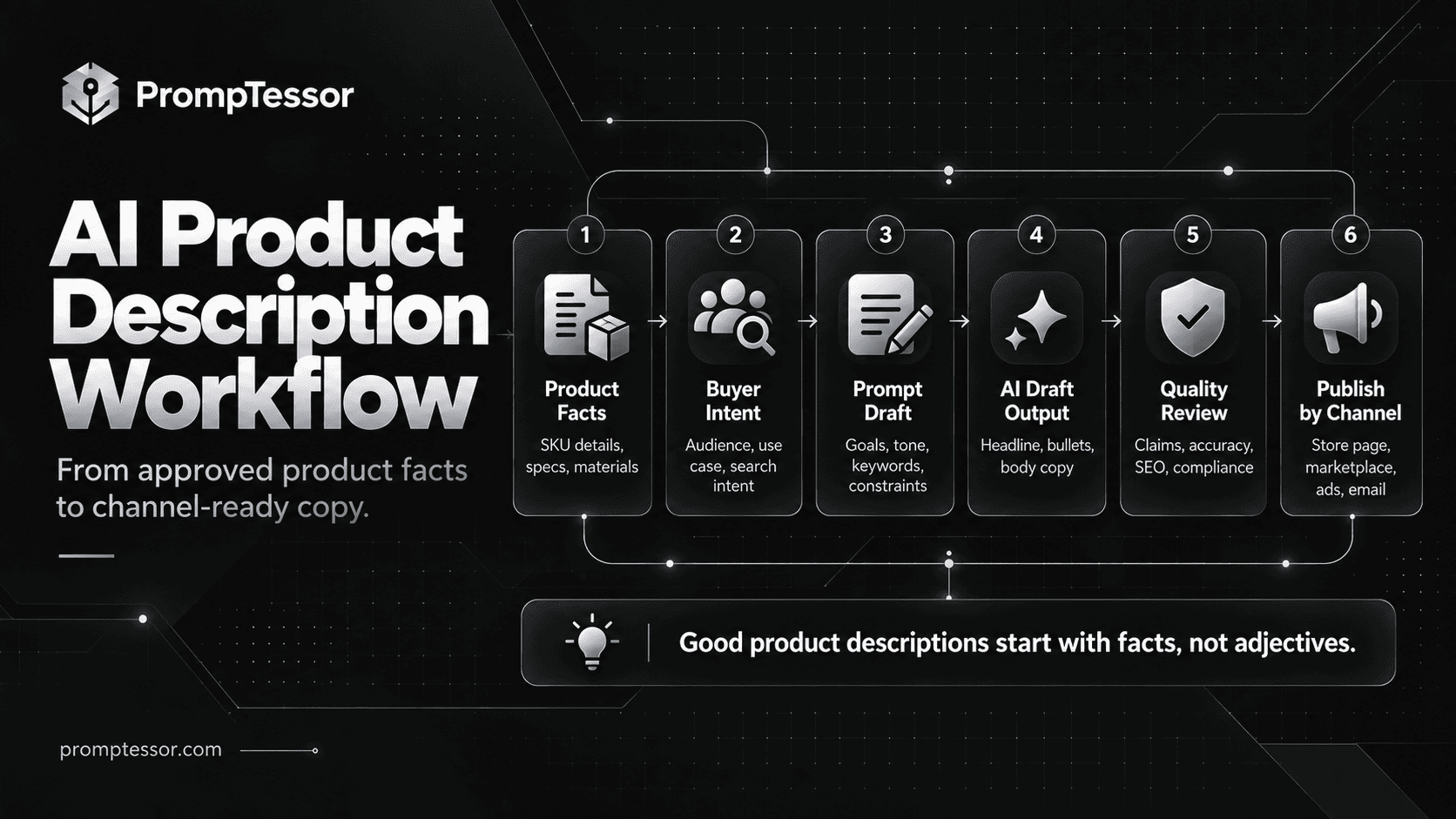
A useful prompt combines verified SKU facts + buyer intent + channel + benefit hierarchy + brand voice + output format + exclusions + approval checks. Ask the model to flag missing information instead of guessing. For multiple products, keep each SKU record separate and require a traceable output.
VERIFIED SKU RECORD + SOURCE OF TRUTH
                 ↓
AUDIENCE + BUYER QUESTIONS + SEARCH INTENT
                 ↓
CHANNEL / FIELD + TONE + LENGTH
                 ↓
FEATURES → SUPPORTED BENEFITS → USEFUL COPY
                 ↓
CLAIM CHECK → SEO / FEED CHECK → HUMAN APPROVAL
                 ↓
PUBLISH + MEASURE + IMPROVE
Key Takeaways
- Build a product truth sheet before generating copy; never let the model invent SKU attributes.
- Keep product-page descriptions, marketplace copy, and Google Merchant Center feed fields distinct.
- Explain features in terms of useful, supportable benefits instead of empty adjectives.
- Make short mobile copy scannable while keeping critical details easy to find.
- Use relevant queries naturally, without turning descriptions into keyword lists.
- Treat specifications, warranties, compatibility, health claims, and certifications as high-risk facts.
- For multiple SKUs, validate row-level inputs and never spread one variant’s attributes across others.
- Review the final copy against the real item, platform policy, and actual shopper questions.
Table of Contents
- Why Generic AI Product Descriptions Fail
- Before You Start: Build a Product Truth Sheet
- The Reusable Product Description Prompt Formula
- 15 Copy-and-Paste Product Description Prompts
- 1. Product Information Brief and Fact Sheet
- 2. Features-to-Benefits Product Description
- 3. Short Mobile-Friendly Product Description
- 4. SEO-Optimized Product Page Description
- 5. Long-Tail Search Intent Product Copy
- 6. Product Title and Meta Description
- 7. Marketplace Product Listing Description
- 8. Google Merchant Center Product Feed Description
- 9. Product Variants and SKU-Specific Descriptions
- 10. Consistent Brand Voice Across Product Pages
- 11. Answer Buyer Objections With Evidence
- 12. Premium Product Storytelling
- 13. Technical Specification-Led Product Description
- 14. Bulk Product Description Generation From a Catalog
- 15. Product Copy Audit and Prioritized Rewrite
- Before and After: Weak vs. Evidence-Based Product Copy
- Product Page vs. Marketplace vs. Google Shopping Copy
- Google Merchant Center and AI-Generated Descriptions
- SEO Checks That Actually Matter
- A Safe Bulk Description Production Workflow
- Build Better Copywriting Prompts With PrompTessor
- Product Description Quality Checklist
- Frequently Asked Questions
Why Generic AI Product Descriptions Fail
A vague instruction such as “write a high-converting product description” encourages an AI model to fill in missing context. It may default to filler (“elevate your everyday”), overpromise a benefit, or produce identical copy for dozens of SKUs. The problem is not only style. Incorrect dimensions, fabricated compatibility, or unsupported claims can create returns, complaints, and compliance risks.
An accurate description should answer what the product is, what is included, how a buyer might use it, which specifications matter, and whether it fits their needs. Shopify Help Center: Writing engaging product descriptions recommends highlighting customer-relevant benefits alongside materials, dimensions, functions, and other factual details. Persuasion should make those facts easier to understand—not replace them.
Search engines also do not need a separate layer of invented enthusiasm. Google Search Central: Helpful, reliable, people-first content emphasizes useful, reliable content made primarily for people. A description can use search language naturally and still be straightforward about limitations.
Before You Start: Build a Product Truth Sheet
Collect an authoritative record for every SKU before drafting copy. The product team’s approved record, manufacturer manual, specifications, package, and policy documents should determine what may be claimed. Marketing notes or customer reviews may reveal useful questions, but they do not automatically prove a technical property.
| Field | Example input | Review rule |
|---|---|---|
| SKU and product name | ACME-TRAY-01, Three-Compartment Desk Tray | Match catalog ID exactly |
| Materials | Powder-coated steel (if verified) | Do not assume composition from images |
| Size and quantity | 30 × 12 × 4 cm; 1 tray | Preserve units and contents |
| Variants | Charcoal or sand | Use only attributes valid for that SKU |
| Approved benefits | Three sections separate small items | Trace to real features |
| Unverified statements | Scratch-proof, lifetime warranty | Exclude until substantiated |
The sample tray and measurements above are fictional for demonstration. In a real workflow, label the approved document and revision date. If a supplier sheet and a store page disagree, do not silently choose whichever detail sounds better—resolve the difference before writing.
The Reusable AI Product Description Prompt Formula
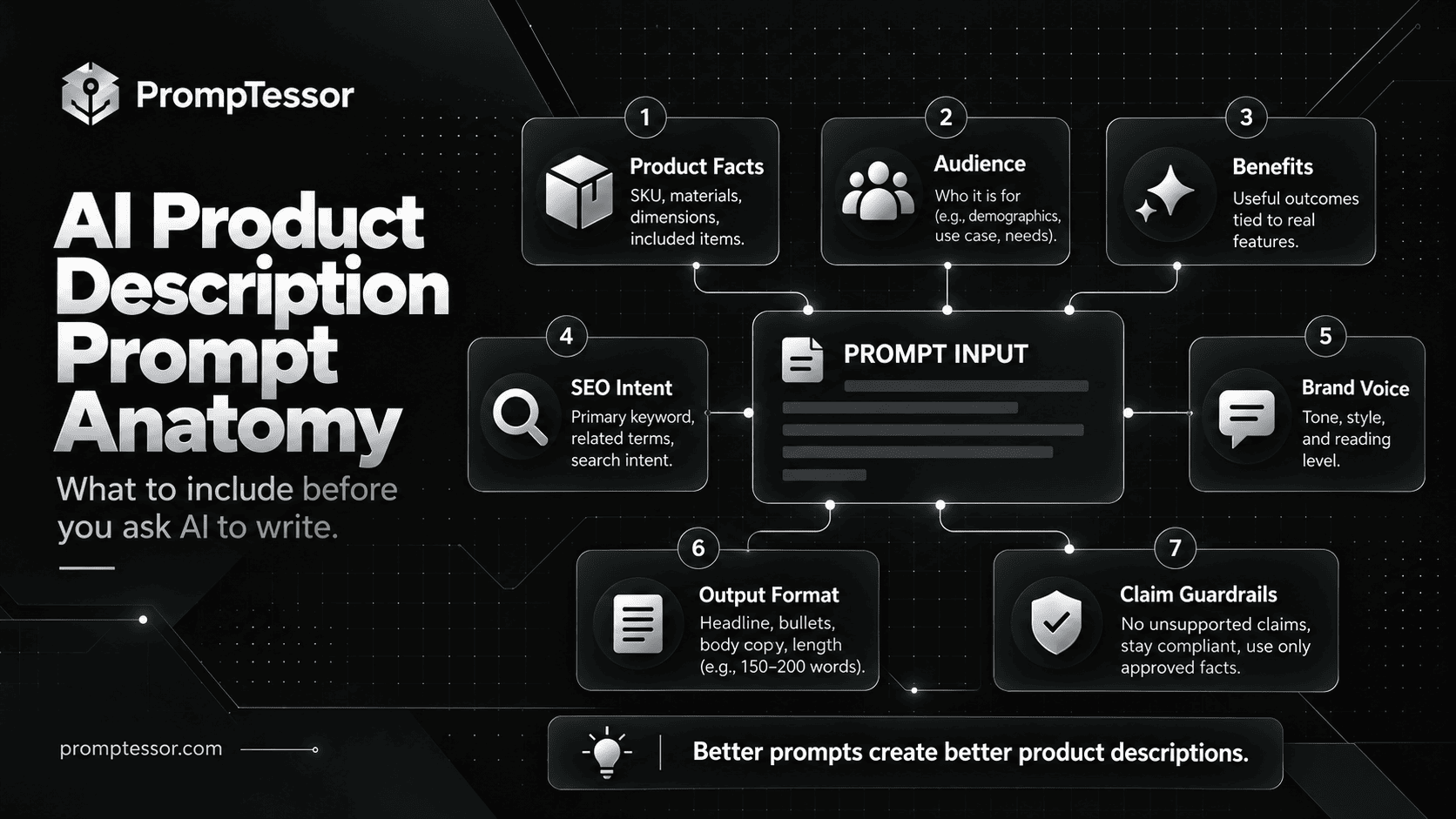
This general template is useful for most products. Replace variables with actual catalog data, not creative guesses. If the product needs a required disclosure, warranty restriction, or specialized compliance review, include that in the inputs and ask the model to preserve it.
TASK: {draft | rewrite | audit | localize}
PRODUCT / SKU: {exact identifier}
APPROVED FACTS: {materials, dimensions, variants, included items}
SOURCE DOCUMENTS: {approved records / revision dates}
AUDIENCE: {who is buying and why}
BUYER QUESTIONS: {fit, benefits, compatibility, use, care}
DESTINATION: {PDP | marketplace | feed | email}
SEARCH INTENT: {only truly relevant query terms}
BRAND VOICE: {tone, terms to use or avoid}
OUTPUT: {word count, fields, bullets, table, format}
DO NOT INVENT: {claims, reviews, ratings, warranty, results}
MISSING DATA: flag, do not fill
APPROVAL: {fact-check, policy-check, human sign-off}
As a safeguard, request a short claim-to-source table after each draft. If a line cannot be linked to an approved record, revise or remove it. A disclaimer telling the model not to hallucinate helps clarify the task, but it does not replace a source check.
15 Copy-and-Paste AI Product Description Prompts
The templates below are intentionally specific to ecommerce product copy. They are not prompts for inventing a brand, researching unknown product properties, or publishing directly to a commerce platform. When the underlying AI tool cannot access the authoritative product data, paste the relevant data into the prompt first.
Foundation & Benefits
1. Product Information Brief and Fact Sheet
Best for: Start with messy catalog data or an incomplete supplier brief.
Customize: {sku}, {verified_specs}, {supplier_notes}, {approved_claims}, {missing_fields}
Example brief: A 20 oz stainless-steel water bottle with a screw cap and two verified colors.
You are preparing an approved source-of-truth brief for product {sku}. Use only the supplied {verified_specs}, {supplier_notes}, and {approved_claims}. Do not write persuasive sales copy yet.
Create a structured product fact sheet with: exact product name/SKU, category, included items, size and units, materials, colors and variants, functional features, approved care or use instructions, supported customer benefits, approved brand terminology, and restricted claims. Classify each entry as VERIFIED, NEEDS CONFIRMATION, or NOT PROVIDED, and show the exact source field for every verified attribute. Do not infer performance, safety, certifications, sustainability, compatibility, or warranties from product category or appearance.
Return (1) facts table, (2) claims/evidence ledger, (3) customer questions the facts answer, (4) missing data that blocks publication, and (5) a normalized input record for later prompts. Do not fill {missing_fields} with guesses.
What to verify: Compare the fact sheet against the source catalog, package, and approved SKU sheet; reject invented features or unapproved claims.
Practical tip: Treat this brief as the authoritative input for every later writing prompt—not as a replacement for maintaining structured product records.
2. Features-to-Benefits Product Description
Best for: Turn raw specifications into buyer-relevant language.
Customize: {product}, {audience}, {verified_features}, {approved_use_cases}, {voice}
Example brief: A canvas laptop sleeve with a documented padded lining and zip closure.
Act as an ecommerce copywriter. Write a product description for {product} aimed at {audience}, using only {verified_features} and {approved_use_cases}. Voice: {voice}.
For each feature, explain the practical benefit that logically follows from that feature; distinguish direct fact from reasonable interpretation. Never turn a feature into a guaranteed outcome. Avoid invented customer reviews, protection ratings, claims such as "indestructible," or competitor comparisons without evidence.
Output: (1) a one-sentence positioning line, (2) a 75–110 word product description, (3) four scannable feature-to-benefit bullets, and (4) a two-column traceability table linking each claim to its supplied feature or use case. If the evidence is insufficient for a benefit, write "benefit requires confirmation" instead.
What to verify: Every benefit should connect to a supplied feature; edit or delete claims that the product cannot substantiate.
Practical tip: For complex products, keep a short technical specification block below the benefit-led copy.
Product Pages & SEO
3. Short Mobile-Friendly Product Description
Best for: Create immediately scannable copy near the purchase button.
Customize: {product}, {top_3_facts}, {buyer}, {tone}, {character_limit}
Example brief: A ceramic mug with a 12 oz capacity and dishwasher-safe care instructions, if documented.
Write compact ecommerce copy for {product} intended to appear near the add-to-cart button on a mobile product page. Reader: {buyer}; tone: {tone}. Approved facts: {top_3_facts}.
Lead with the most useful differentiating fact and why a shopper would care. Write one natural product description of 45–65 words, followed by three brief bullets. Keep each bullet focused on a distinct verified attribute. Respect {character_limit} for the designated short field when provided. Do not pad with generic phrases like "premium quality" or "must-have." Do not repeat the title verbatim.
Return the finished short copy, three bullets, a missing-facts list, and a note explaining what belongs in a separate details/specifications accordion rather than the first-screen summary.
What to verify: Check the mobile layout, bullets, factual accuracy, and whether customers can understand what is included at a glance.
Practical tip: Do not remove critical variant, safety, size, or material details merely to shorten the text.
4. SEO-Optimized Product Page Description
Best for: Support a specific product page and its search intent without keyword stuffing.
Customize: {product}, {primary_query}, {related_terms}, {buyer_intent}, {verified_facts}, {related_urls}
Example brief: An adjustable monitor stand with documented dimensions and supported weight limit.
Optimize a unique ecommerce product page description for {product}. Primary search query: {primary_query}. Relevant related terms: {related_terms}. Buyer intent: {buyer_intent}. Verified product facts: {verified_facts}. Related site pages: {related_urls}.
Write an informative 140–210 word description that answers the shopper's main questions and naturally uses terminology only where accurate. Structure it with a clear opening, benefit-led explanation, and scannable specifics. Add a short specifications block, two genuinely helpful buyer FAQs (only where supported), and 2–3 contextual internal-link suggestions with appropriate anchor text.
Avoid keyword repetition, vague boilerplate, fabricated claims, and copy copied unchanged across near-identical product pages. Return an SEO rationale, any unresolved evidence gaps, and the draft. Do not promise search rankings.
What to verify: Confirm the query truly describes the SKU; inspect overlap with category pages and other product variants.
Practical tip: Optimization begins with product usefulness; the keyword must not distort an accurate description.
5. Long-Tail Search Intent Product Copy
Best for: Match a specific buyer need such as material, size, compatibility, or purpose.
Customize: {product}, {long_tail_queries}, {allowed_facts}, {customer_questions}, {restrictions}
Example brief: A 30-inch-wide storage shelf, without inventing a room-fit or weight claim.
You are editing a product page for {product}. Search phrases under consideration: {long_tail_queries}. Approved facts: {allowed_facts}. Real customer questions: {customer_questions}. Restrictions: {restrictions}.
Identify which phrases are factually supported by this exact item and which are not. Select at most three relevant intents, then revise the existing description or draft a 100–170 word version that explains the appropriate use case, important specifications, and limitations. Include a plain-English sentence answering the most relevant customer question. Do not imply fit, performance, or compatibility unless verified.
Output an intent-to-evidence table first, then final copy and suggested on-page location for supporting specs or FAQs. Exclude irrelevant keywords even if they appear attractive for search volume.
What to verify: Reject any phrase that implies unsupported compatibility, fit, certification, or durability.
Practical tip: Long-tail relevance is an evidence-matching problem, not an exercise in inserting more keywords.
6. Product Title and Meta Description
Best for: Write useful page metadata and a clear ecommerce product name.
Customize: {product_name}, {brand}, {sku_attributes}, {primary_query}, {page_benefit}
Example brief: A cotton canvas tote, with its real size and color where useful.
Create search-result and on-page copy for {product_name}. Brand: {brand}. Verified variant attributes: {sku_attributes}. Main search query: {primary_query}. Main page benefit: {page_benefit}.
Provide: (1) a factual, readable product page H1; (2) an SEO title candidate with sensible length and clear product identification; (3) a concise meta description that helps a shopper decide whether to click; and (4) an optional marketplace title variant, clearly labeled as a different field. Preserve the actual product name, type, and variant attributes. Avoid duplicate titles across different SKUs, invented superlatives, keyword strings, price or shipping promises that may go stale, and characters that make the text harder to read.
Return character counts and a short justification for each candidate. Mark the output as DRAFT until checked against the live page and catalog.
What to verify: Review title/H1 consistency, uniqueness, SKU accuracy, and how the snippet actually appears in search.
Practical tip: Google may construct snippets from page text rather than using your submitted meta description.
Marketplace & Catalogs
7. Marketplace Product Listing Description
Best for: Adapt approved copy to a specific sales channel without assuming all marketplaces have identical rules.
Customize: {product}, {marketplace}, {rules}, {approved_facts}, {format}
Example brief: A rechargeable book light; verify its included cable and charging port from the actual SKU.
Adapt the verified product description for {product} to {marketplace}. Approved facts: {approved_facts}. Current platform rules supplied: {rules}. Required field format: {format}.
Create a shopper-friendly marketplace listing with a short opening, accurate feature bullets, and any required specifications. Prioritize what a buyer can confirm about the actual product: contents, materials, dimensions, variation, and use. Remove website-only CTA language, links, external seller references, invented ratings, and promotional material disallowed by the destination.
If {rules} is absent or outdated, do not claim marketplace compliance. Instead provide a format-neutral draft, a list of rule checks needed on the platform, and an approval status of NEEDS PLATFORM REVIEW. Return a field-by-field output table and a source trace for all claims.
What to verify: Check the actual marketplace specification, prohibited copy patterns, allowed field lengths, and whether bullets describe the purchased variant.
Practical tip: A text field accepted by one marketplace is not automatically compliant with another.
8. Google Merchant Center Product Feed Description
Best for: Create accurate shopping feed text while correctly handling AI-generated descriptions.
Customize: {product_id}, {feed_facts}, {landing_page_copy}, {attributes}, {ai_disclosure_workflow}
Example brief: A laptop sleeve whose dimensions and supported device sizes are documented.
Prepare a Google Merchant Center product-description draft for product ID {product_id} using only {feed_facts}. Cross-check wording against {landing_page_copy} and the current item data {attributes}. This task generates draft copy, not a feed upload or compliance certification.
Write a concise, factual feed description about the item itself: important product type, material, size, actual compatibility where verified, color, and key attributes. Exclude free-shipping text, prices, promotional slogans, external links, other product mentions, and unsupported claims. Identify any disagreement between feed facts and the landing page.
Because this text is generated with AI, label the output for the current Google Merchant Center {ai_disclosure_workflow}: structured_description with digital_source_type set to trained_algorithmic_media and content as the approved description. Return plain-text content separately from feed mapping, plus a human-review checklist. Do not present a normal description field as the sole AI-disclosure solution.
What to verify: Verify current Merchant Center documentation, chosen feed/API integration, landing-page consistency, and the structured_description mapping.
Practical tip: Google publishes the current syntax and maximum length; follow the official specification, not a generic product listing prompt.
9. Product Variants and SKU-Specific Descriptions
Best for: Keep similar products distinguishable while avoiding copy drift.
Customize: {parent_product}, {sku_table}, {shared_facts}, {variant_attributes}, {output_fields}
Example brief: The same backpack in charcoal and olive, plus two verified capacities.
Build product copy for variants of {parent_product} using {sku_table}. Shared verified facts: {shared_facts}. Variant-specific facts: {variant_attributes}. Required output fields: {output_fields}.
First separate invariants that apply to every SKU from attributes that differ by SKU. For each variant write a unique, accurate title, a compact 60–100 word description, and up to three factual bullets. Mention a difference only when it applies to that exact row. Do not copy a color, dimension, material, included accessory, or feature from a neighboring SKU. Never invent a missing variant attribute.
Return one row per SKU with the original SKU identifier, copy fields, proof-source references, and QA status. Flag any SKU that lacks enough data instead of creating copy that implies the missing attribute.
What to verify: Spot-check smallest/largest sizes, different materials, discontinued colors, and any SKU with incomplete data.
Practical tip: Product identity should be stable within a SKU and genuinely different across meaningful variants.
10. Consistent Brand Voice Across Product Pages
Best for: Make many descriptions feel like one brand without making them repetitive.
Customize: {brand_voice_rules}, {approved_examples}, {product_facts}, {avoid_phrases}, {audience}
Example brief: A minimalist homewares brand writing about lamps, planters, and desk accessories.
Act as a brand editor for {audience}. Apply these approved voice rules: {brand_voice_rules}. Reference these examples for style only, not factual claims: {approved_examples}. Product facts: {product_facts}. Never use: {avoid_phrases}.
Create a short style guide with five writing rules, preferred sentence length, tone, allowed terminology, and examples of helpful product-specific specificity. Then rewrite the supplied draft(s) to match the voice while preserving every approved feature, warning, limitation, and SKU attribute. Avoid boilerplate openers and the same adjective across an entire catalog.
Return before/after excerpts, final copy, a change log distinguishing stylistic edits from factual edits, and unresolved issues. Do not infer that stylistic examples prove attributes of the current product.
What to verify: Confirm the rewrite did not delete material details, introduce exclusivity claims, or make distinct items sound interchangeable.
Practical tip: Separate reusable voice guidelines from per-product factual data.
Persuasion & Trust
11. Answer Buyer Objections With Evidence
Best for: Reduce uncertainty without inventing reviews or guarantees.
Customize: {product}, {buyer_objections}, {approved_evidence}, {returns_policy}, {audience}
Example brief: A dining chair with approved seat dimensions and cleaning instructions.
Review the product {product} for {audience}. Common buyer uncertainties: {buyer_objections}. Approved factual evidence: {approved_evidence}. Actual return policy: {returns_policy}.
For each objection, identify the specific product detail that can answer it, or say the evidence is missing. Draft a trust-building product description of 100–150 words and an optional four-item FAQ covering only supported topics such as size, setup, care, compatibility, materials, or included items. Make limitations easy to understand. Do not invent buyer testimonials, customer counts, test certifications, warranty terms, shipping policies, or guaranteed results.
Return an objection/evidence/copy table, the final draft, and an unresolved-information list. Where a claim requires confirmation, write a question for the product team instead of persuasive copy.
What to verify: Compare the FAQ against manuals and policies; important limitations should not be hidden in marketing language.
Practical tip: Trust grows from answering real questions, not stacking reassuring adjectives.
12. Premium Product Storytelling
Best for: Create elevated language while keeping product substance intact.
Customize: {product}, {materials}, {craft_details}, {approved_origin}, {brand_tone}, {buyer_context}
Example brief: A handcrafted ceramic serving bowl with documented glaze and dimensions.
Write refined product storytelling for {product}, intended for {buyer_context}. Verified materials: {materials}; documented craft details: {craft_details}; verified origin information: {approved_origin}; brand tone: {brand_tone}.
Create an elegant 120–170 word description with a concrete opening, tactile material and design details, one real use-case, and a grounded close. Keep claims tied to supplied facts. Do not make up artisan names, handmade processes, national origin, limited-edition quantities, environmental credentials, exclusivity, or endorsements. If craft or provenance information is unavailable, build the story around the visible and documented product qualities rather than fictional backstory.
Provide one primary version, one restrained alternative, and an evidence table listing each factual claim and its source. Avoid hyperbole that could mislead.
What to verify: Review origin/craft claims especially closely and ensure the product still sounds useful, not only atmospheric.
Practical tip: A premium tone is a writing style, not permission to invent a premium heritage.
13. Technical Specification-Led Product Description
Best for: Write accurate copy when buyers compare measurements, ports, and compatibility.
Customize: {product}, {spec_sheet}, {compatibility_matrix}, {use_cases}, {buyer_level}
Example brief: A USB-C hub with a verified port list and tested power limits.
Write a technical ecommerce product description for {product} using {spec_sheet}, {compatibility_matrix}, and {use_cases}. Target reader: {buyer_level}.
Begin with a one-paragraph plain-English explanation of what the product does. Follow with a structured technical specification table containing only provided values and measurement units. Summarize verified compatibility and important limitations clearly; distinguish tested support from assumptions based on connector type. Define specialist terms briefly when needed, without flattening useful accuracy.
Produce a 100–160 word summary, a specifications section, a compatibility/limitations note, and a fact verification table. Do not invent transfer speeds, wattage, device compatibility, safety marks, product certifications, or test results. If any technical value conflicts across sources, flag the conflict and require resolution before publication.
What to verify: Reconcile every number and compatibility claim against the latest approved manual or engineering sheet.
Practical tip: Technical clarity can improve conversions by reducing avoidable mismatch and returns.
Scale & Optimization
14. Bulk Product Description Generation From a Catalog
Best for: Create structured drafts for many SKUs with human review built in.
Customize: {catalog_rows}, {approved_style_guide}, {field_map}, {language}, {batch_size}
Example brief: A spreadsheet with 40 stationery SKUs, each with its own materials, dimensions, and pack count.
You are generating DRAFT ecommerce product copy from structured {catalog_rows}. Use {approved_style_guide}, {field_map}, and {language}. Process at most {batch_size} rows at a time.
Preserve each source SKU and all supplied numeric attributes exactly. Generate unique but consistent title, short_description, long_description, three key_features, missing_facts, source_field_references, and status. Do not guess data from adjacent products, fill empty fields by analogy, or reuse variant attributes. If a product lacks essential information, set status to NEEDS_FACTS and leave affected claims out; do not silently invent them.
Return machine-readable rows in the requested schema (CSV or JSON), then a batch QA report counting records, missing fields, duplicate-like titles, possible unsupported claims, and outliers. Never claim the drafts were published or synchronized with a storefront; exporting, validation, and publishing happen outside this writing task.
What to verify: Validate row counts, SKU integrity, fields, escaped delimiters, duplicates, character limits, and random high-risk samples.
Practical tip: Use a versioned template with validated inputs for production-scale catalog workflows.
15. Product Copy Audit and Prioritized Rewrite
Best for: Improve an existing listing based on observable problems.
Customize: {current_description}, {product_truth_sheet}, {target_queries}, {observed_issues}, {performance_data}
Example brief: A product page with vague features, poor readability, and outdated compatibility details.
Audit {current_description} against {product_truth_sheet}. Intended search queries: {target_queries}. Observed shopper issues: {observed_issues}. Actual performance data, if available: {performance_data}.
Score the draft qualitatively on factual accuracy, unique value, benefits, clarity, scanability, SEO relevance, objection coverage, brand voice, and unsupported claims. Identify factual errors as BLOCKERS, material buyer confusion as HIGH PRIORITY, and purely stylistic edits as LOWER PRIORITY. Do not infer that a high score proves conversion performance.
Return (1) findings with quoted evidence from the draft, (2) prioritized fixes, (3) a fully rewritten version using approved facts only, (4) a before/after change summary, and (5) a measurement plan for monitoring product-page behavior. Flag anything that still requires manual or legal approval before publication.
What to verify: Read the revision against the real product record, then check page behavior and metrics after shipping the approved copy.
Practical tip: A convincing rewrite is only a draft until its claims and real-world performance have been verified.
Before and After: Weak vs. Evidence-Based Product Copy
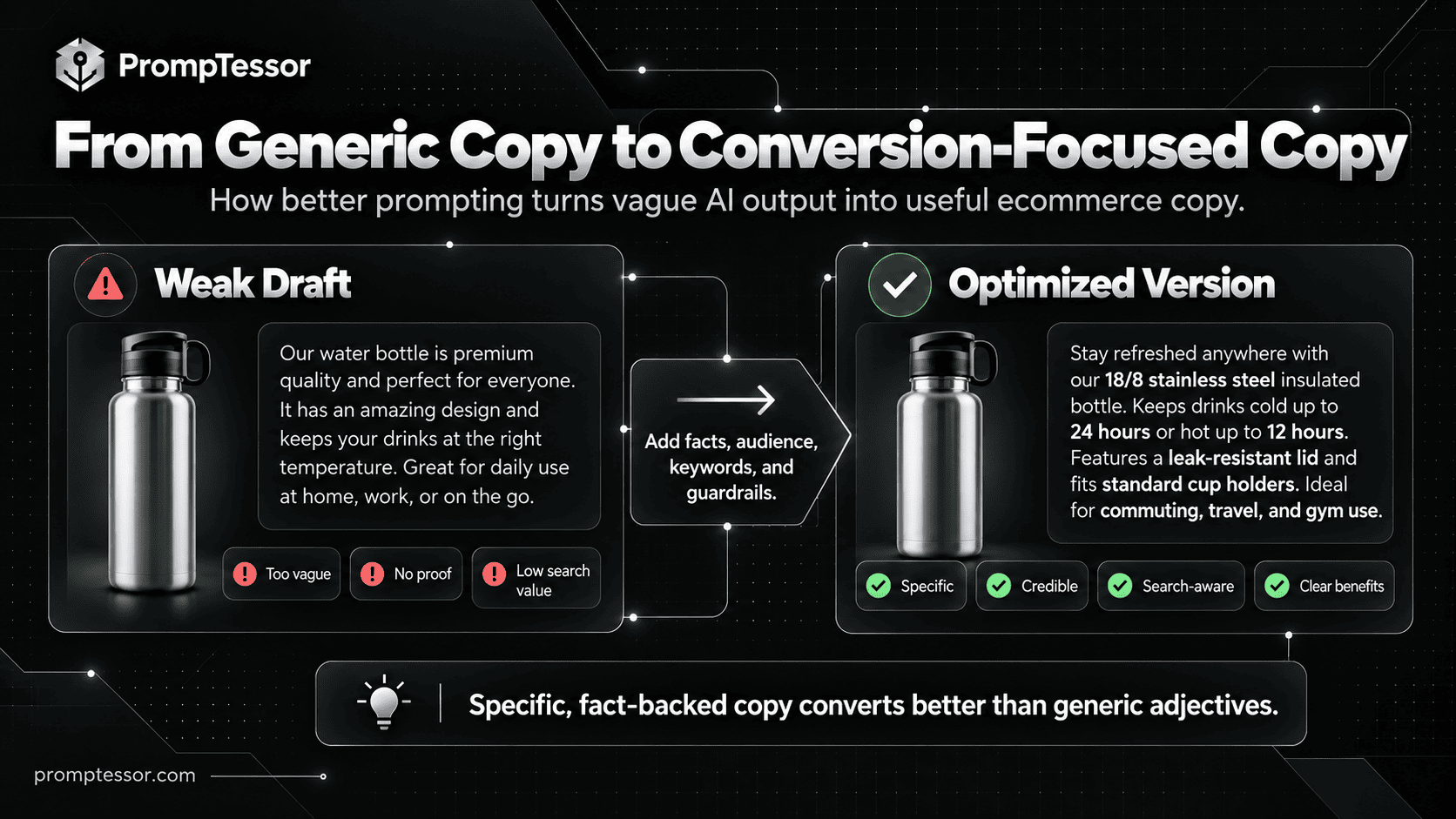
Consider this fictional product record: a desk tray with three compartments, powder-coated steel construction, dimensions of 30 × 12 × 4 cm, and a charcoal color option. No scratch-resistance testing, environmental certification, or warranty information has been supplied.
| Weak generic AI copy | Revised evidence-based copy |
|---|---|
| “Upgrade your workspace with the ultimate premium organizer. Built to last forever, this scratch-proof tray is perfect for every desk.” | “Keep small desk essentials in one place with this three-compartment steel tray. Its powder-coated finish and 30 × 12 × 4 cm dimensions make it easy to compare against your available desk space. Available in charcoal.” |
The revised version uses facts a shopper can evaluate. It does not claim the tray is guaranteed to resist scratches, fit every desk, or last indefinitely. “Better” copy is not necessarily longer or more emotional; it is more informative, specific, and defensible.
Product Page vs. Marketplace vs. Google Shopping Copy
These destinations may describe the same SKU, but they serve different reading contexts and have different constraints. The central facts should not change, even when field lengths, formatting, and persuasive emphasis do.
| Destination | Primary goal | What to prioritize | Common mistake |
|---|---|---|---|
| Product detail page | Help a visitor understand and purchase | Benefits, full specs, care, FAQs, variant selection | Generic copy that omits buyer questions |
| Marketplace listing | Accurate product discovery and comparison | Approved attributes, format rules, scannable details | Assuming every marketplace permits the same style |
| Google Merchant Center feed | Represent the exact item in Shopping data | Factual item description, policy, AI-generated text disclosure | Adding sales promises or ignoring structured_description |
| Paid ad copy | Explain a supported reason to engage | One relevant value proposition and compliant claim | Inventing dramatic performance results |
When buyers can purchase directly from your site, accurate Product and Offer structured data may support eligibility for richer shopping surfaces. That is a website markup consideration—not a reason to add fictitious ratings or a Product schema to an editorial article. See Google Search Central: Merchant listing structured data.
Google Merchant Center: AI-Generated Descriptions Need the Right Field
If you create title or description text with generative AI for Shopping product data, do not treat it exactly like manually authored feed text. Google Merchant Center: AI-generated content explains the required AI-content identification and directs generative-AI-created descriptions to structured_description rather than relying only on the ordinary description field.
The structured description consists of a digital source type and the generated text content. The documented source type for generative-AI text is trained_algorithmic_media. Your feed export method—Content API replacement, Merchant API, file feed, or platform integration—determines the precise serialization. The conceptual mapping is:
structured_description
  digital_source_type = trained_algorithmic_media
  content             = {approved_ai_generated_product_description}
This illustrates the fields, not a universally uploadable CSV or XML row. Always check Google Merchant Center: Product data specification for current formatting rules and attribute limits; the product description text has a documented 5,000-character maximum. Google instructs merchants to match the feed description to the landing page and to exclude irrelevant promotional text such as shipping offers.
A human editor should still check accuracy, product-feed mapping, and the merchant’s current integration. If a platform handles AI provenance for you, verify what it actually sends. Do not assume editing AI output automatically removes disclosure obligations; follow the current Google classification rules for the content and workflow being submitted.
SEO Checks That Actually Matter for Product Descriptions
- Answer the shopper first. Include core attributes, realistic use cases, what is included, and material limitations.
- Differentiate the exact SKU. Variants need correct attributes; do not copy size, compatibility, or finish from neighboring items.
- Match intent rather than keyword volume alone. Only target queries that describe what the item actually is.
- Use descriptive, unique titles. Avoid producing the same title for dozens of products when meaningful distinctions exist.
- Write accurate metadata. Google Search Central: Meta descriptions and snippets notes that snippets can draw from page content rather than always showing the submitted meta description.
- Keep details accessible on mobile. Present an at-a-glance description and scannable facts, with deeper specifications available below.
- Link intentionally. Contextual links to useful care guides or compatible accessories should help buyers without misrepresenting what is included.
- Measure rather than assume. Watch search impressions and clicks, product-page conversion, returns, and support questions when enough data exists.
SEO is not a reason to repeat “best” and “top quality.” The most persuasive sentence may simply resolve the buyer’s main doubt. If a product is hard to describe because its approved specs are missing, gather better inputs rather than forcing the model to be more creative.
A Safe Workflow for Generating Descriptions at Catalog Scale
Bulk generation amplifies both productivity and mistakes. A spreadsheet with 500 SKUs is not 500 blank creative-writing assignments: it is 500 records with different materials, sizes, variants, accessories, and approval states. Treat generation as a controlled drafting step in a broader data process.
- Normalize source data. Keep canonical SKU IDs, attribute units, source documents, and blank fields in a clean table.
- Segment product families. Use a common style template while keeping category-specific constraints for electronics, apparel, homewares, and other types.
- Draft in small batches. Request explicit output columns for facts, copy, source references, missing data, and status.
- Apply deterministic validation. Use software or a spreadsheet to check row count, valid SKUs, required fields, character limits, and duplicate records.
- Review risky claims. Check technical specifications, certification, compatibility, health or environmental language, and high-return product categories.
- Prepare channel-specific outputs. Separate storefront copy, marketplace listings, and Shopping feed fields.
- Approve before publishing. Keep a reviewer, timestamp, source revision, and rollback path for each generated record.
- Monitor results. Compare search visibility, product page engagement, conversion signals, complaints, and returns where measurable.
The Prompt Templates and Variables guide explains why reusable prompt structures, validated variables, versioning, and test fixtures become increasingly valuable in recurring production workflows. The storefront or catalog system remains responsible for data integrity and publication.
Build Better Product Copywriting Prompts With PrompTessor
PrompTessor helps improve the instructions you send to AI—not replace your product-information system or automatically sync approved descriptions to a store. Its AI Prompt Generator can turn a rough goal such as “write descriptions for a minimalist home decor collection” into a more structured, reusable prompt with context, constraints, and output rules.
If your existing copywriting prompt produces generic results, use the AI Prompt Optimizer to improve clarity around audience, SKU accuracy, length, evidence, and format. The AI Prompt Analyzer can help inspect a prompt’s specificity and structure before you use it in a larger workflow. The AI writing model you choose still needs the actual approved product facts, and a person or validated publishing process must check the result.
You can also connect the content workflow to other practical creative tasks. The AI Product Photography Prompts guide covers truthful product visuals, while the AI Image Prompt Generator can help structure prompts for product images. Keep visual and textual claims consistent with the item being sold.
Example workflow: create the SKU truth sheet → adapt one of the 15 prompts → produce copy in a compatible AI model → compare claims with the record → optimize the prompt where it fails → export the approved content through your ecommerce platform.
AI Product Description Quality and SEO Checklist
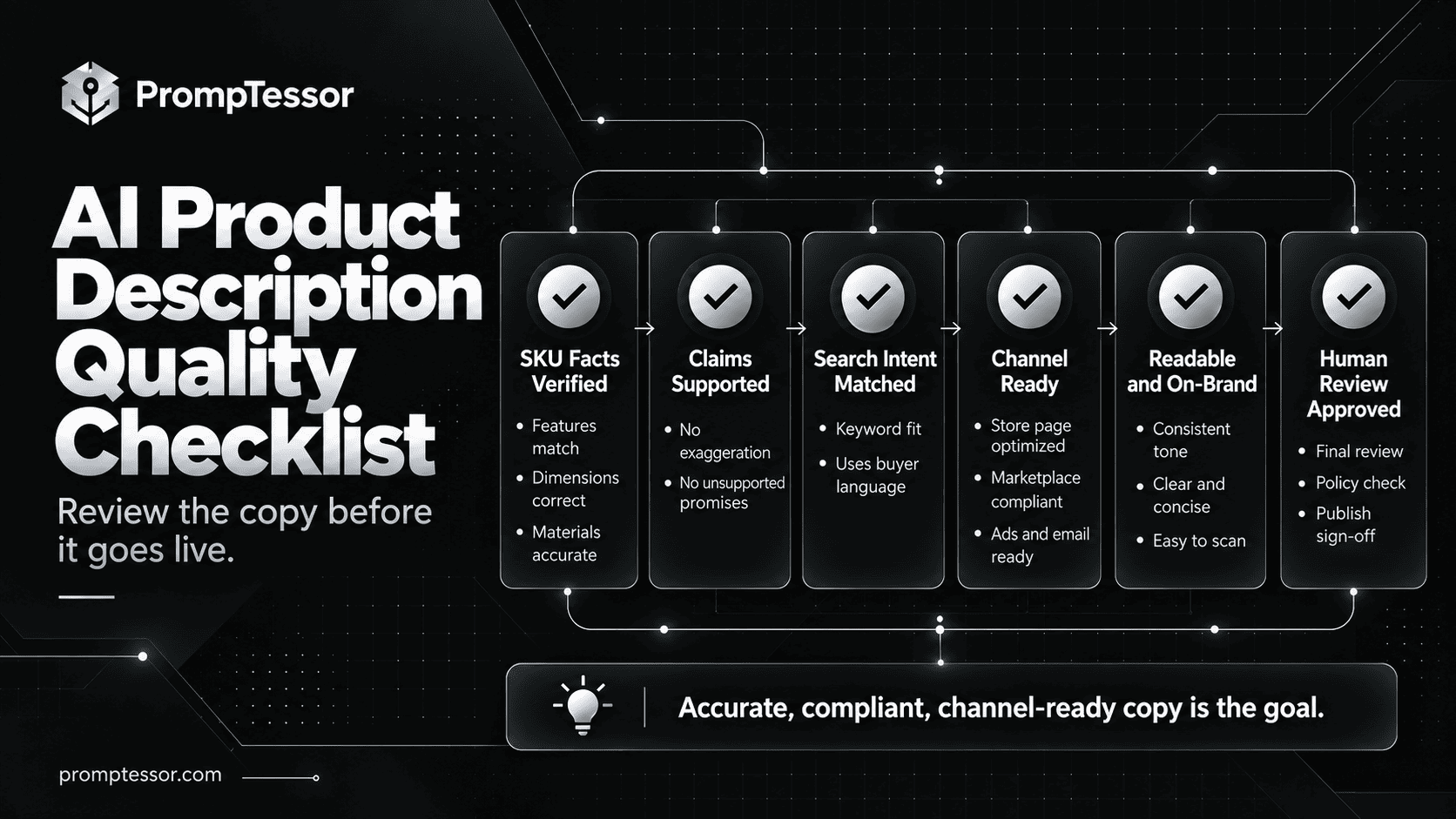
- Product identity: Name, SKU, pack quantity, options, materials, and dimensions match the exact item.
- Benefits and claims: Any feature-to-benefit wording can be supported; no invented warranties, awards, reviews, test results, or certifications.
- Readability: The opening is useful; key facts are scannable on mobile; important limitations remain visible.
- SEO and uniqueness: Query intent matches the item, titles are descriptive, and descriptions avoid duplicate boilerplate.
- Variants: Each SKU has correct size, color, compatibility, included items, and separate approval status.
- Marketplace rules: The copy conforms to the current destination format and attribute requirements.
- AI feed disclosure: Google Merchant Center AI-generated fields are mapped according to its current
structured_descriptionrules where applicable. - Advertising accuracy: FTC: Advertising and marketing basics requires advertising claims to be truthful, nondeceptive, and evidence-based.
- Human review: Missing facts are resolved, source revisions recorded, and publishing approval documented.
- Post-publish validation: Check rendered pages, feeds, variant displays, and performance after changes go live.
If you can only do one improvement today, replace vague promotional adjectives with two or three verified, decision-relevant attributes. Then make sure the headline, body copy, product photos, and variant selection all describe the same item.
Frequently Asked Questions About AI Product Description Prompts
What is an AI product description prompt?
It is a reusable set of instructions that tells an AI writing model which product facts, audience needs, channel, tone, constraints, and output format to use when drafting ecommerce copy. It should explicitly prohibit invented attributes and request human verification.
What is the best prompt for product descriptions?
The best prompt includes a verified SKU fact sheet, the intended customer, the page or marketplace destination, what benefits can be supported, brand voice, length, and a review checklist. A generic “write a compelling description” instruction is usually too vague.
Can I use AI-generated product descriptions on my ecommerce store?
You can use AI to draft product copy, but publication still requires product-accuracy and policy review. Confirm materials, sizes, included items, certifications, compatibility, and promotional claims against your approved information before publishing.
Are AI-written product descriptions good for SEO?
They can be useful when they are genuinely helpful, specific to the product, and accurate. AI alone does not create a ranking advantage, and duplicative or thin descriptions can disappoint shoppers. Focus on satisfying search intent and keeping the product page useful.
How long should an ecommerce product description be?
There is no universal ideal length. Put essential buyer information close to the purchase decision, use readable bullets for important specifications, and provide more detail below when the product or buying decision requires it.
How do I stop AI from inventing product features?
Provide an approved product fact sheet; tell the model to use only those facts; require a claim-to-source table; flag missing values; and compare the output with actual SKU records. Do not rely on “do not hallucinate” without a review step.
Should product pages and Google Shopping feeds use the same description?
They should describe the same real product consistently, but the format and field requirements differ. Google Merchant Center feed descriptions exclude certain promotional information; AI-generated feed descriptions must follow Google’s current structured-description disclosure rules.
Does Google Merchant Center require disclosure for AI-generated product descriptions?
Google’s documented Merchant Center rules require generative-AI-created product descriptions to use the structured_description attribute with the appropriate digital source type and content. Confirm the current product-data specification and your feed implementation before submission.
Can I write descriptions for hundreds of SKUs with one prompt?
Yes, a reusable template can create drafts in batches, but the inputs must be SKU-specific and validated. Add missing-data flags, structured output, duplicate checks, and human QA rather than blindly publishing every generated row.
Can PrompTessor directly edit my store listings?
PrompTessor helps you generate, analyze, and optimize AI prompts. It does not automatically become your product catalog manager or publish descriptions to an ecommerce store. Use its prompt tools alongside your chosen AI writing model and storefront workflow.
Final Thoughts: Useful Product Copy Starts With Reliable Inputs
AI can speed up first drafts, produce useful variations, and help teams maintain a more consistent writing process. But a product description only earns a place on a live store when its claims are accurate, its language answers real buyer questions, and its format suits the destination.
Use the 15 templates as starting points, not guarantees. Give the model trustworthy SKU data, tell it where the copy will appear, require a visible check of unsupported statements, and let the final description be specific enough that a customer understands what they are buying.
Build better prompts in one workspace
Generate prompts from ideas, analyze and optimize quality, refine with feedback, reverse-engineer content, and save reusable prompts in your Prompt Library.
Try PrompTessor Free