AI Prompt Analysis How to Identify Weaknesses in Your Prompts
Before you optimize a prompt, you need to understand what is wrong with it.
Many AI prompts do not fail because the idea is bad. They fail because the instruction is unclear, the context is missing, the output format is undefined, or the constraints are too weak.
This is where AI prompt analysis becomes useful.
AI prompt analysis is the process of reviewing a prompt to identify its strengths, weaknesses, missing details, and improvement opportunities. Instead of guessing why an AI output is poor, prompt analysis helps you understand what the prompt needs before you optimize or refine it.
A strong analysis can show whether your prompt has a clear task, useful context, specific audience, proper structure, output format, constraints, examples, and success criteria.
In this guide, you will learn what AI prompt analysis is, why it matters, how to analyze prompts step by step, what metrics to look at, and how prompt analysis fits into a complete AI prompt workflow.
Quick Answer
AI prompt analysis is the process of evaluating a prompt to identify weaknesses such as unclear tasks, missing context, vague goals, poor structure, weak constraints, undefined output format, and lack of success criteria. It helps users understand what needs to be improved before optimizing, refining, or reusing a prompt.
Key Takeaways
- AI prompt analysis helps you diagnose why a prompt may produce weak, generic, or inconsistent AI outputs.
- A good prompt analysis checks clarity, specificity, context, goal alignment, structure, constraints, and output format.
- Prompt analysis should usually happen before prompt optimization or prompt refinement.
- Analyzing prompts helps you improve AI outputs with more control instead of relying on trial and error.
- PrompTessor helps users analyze prompt quality, identify weaknesses, optimize prompts, refine versions, and save reusable prompts.
Table of Contents
- What Is AI Prompt Analysis?
- Why Prompt Analysis Matters Before Optimization
- Common Weaknesses Found in AI Prompts
- How to Analyze an AI Prompt Step by Step
- AI Prompt Analysis Metrics
- Prompt Analysis vs Prompt Optimization
- Prompt Analysis vs Prompt Refinement
- Prompt Analysis Examples
- How Prompt Analysis Fits Into an AI Prompt Workflow
- Common Prompt Analysis Mistakes
- How PrompTessor Helps With AI Prompt Analysis
- FAQ About AI Prompt Analysis
- Start Analyzing Your Prompts Before Optimizing Them
What Is AI Prompt Analysis?
AI prompt analysis is the process of reviewing an AI prompt to understand how well it communicates the task, context, goal, format, constraints, and expected result.
The goal is to identify what is working and what needs improvement.
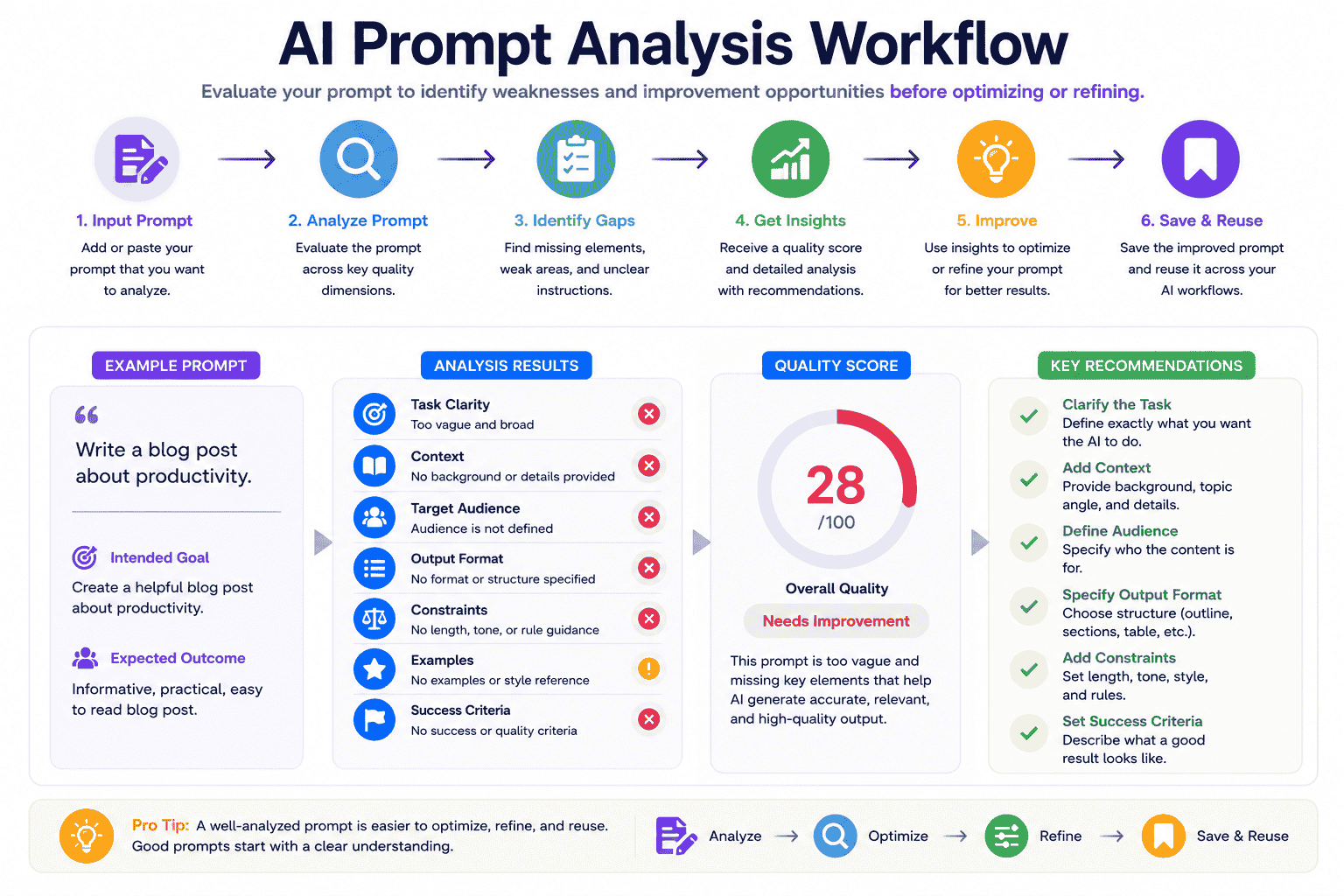
For example, this prompt is very weak:
Write something about productivity.
The prompt is not completely unusable, but it gives the AI very little direction.
A prompt analysis may identify several problems:
- The task is vague
- The topic is too broad
- The target audience is missing
- The output format is undefined
- The tone is unclear
- There are no constraints
- There is no success criteria
After analyzing the prompt, it becomes easier to improve it.
Instead of randomly rewriting the prompt, you can fix the specific problems that make it weak.
Why Prompt Analysis Matters Before Optimization
Prompt optimization is easier when you know what needs to be optimized.
Without prompt analysis, you may only guess what is wrong. You may make the prompt longer, add more details, or rewrite everything, but those changes do not always solve the real problem.
For example, a prompt may not need more length. It may only need a clearer output format.
Another prompt may not need more examples. It may need stronger constraints.
Another prompt may already have good context, but it may be missing a target audience.
Prompt analysis helps you diagnose the issue first.
A practical AI prompt workflow often looks like this:
- Write or generate a prompt.
- Analyze the prompt quality.
- Identify weak or missing elements.
- Optimize the prompt based on the analysis.
- Refine the prompt with feedback.
- Test the output.
- Save the best version for reuse.
In this workflow, analysis acts as the diagnosis step.
It helps you understand the prompt before making changes.
Common Weaknesses Found in AI Prompts
Most weak prompts share similar problems.
Here are the most common issues found during AI prompt analysis.
1. Unclear Task
The AI needs to know exactly what action to perform.
Weak prompt:
Help me with marketing.
This is unclear because “help” could mean many things. It could mean writing copy, creating a strategy, reviewing a campaign, finding ideas, or building a content calendar.
Better task clarity:
Create a 30-day content marketing plan for a SaaS product targeting solo founders.
2. Missing Context
Context explains the background behind the task.
Without context, the AI may produce generic answers.
Useful context may include:
- Product details
- Target audience
- Business goal
- Current problem
- Brand voice
- Source material
- Available resources
- Important limitations
3. No Target Audience
The same topic can be explained differently depending on the audience.
A prompt for beginners should not produce the same result as a prompt for experts.
A prompt for founders should not sound the same as a prompt for students, developers, marketers, designers, or executives.
Prompt analysis should check whether the audience is defined clearly.
4. Undefined Output Format
If the output format is missing, the AI may return the answer in a structure that is hard to use.
Examples of output formats include:
- Table
- Checklist
- Outline
- Email draft
- Markdown
- JSON
- Step-by-step plan
- Comparison matrix
- Content brief
5. Weak Constraints
Constraints help control the output.
A prompt without constraints may produce responses that are too long, too broad, too vague, or misaligned with the user’s goal.
Examples of useful constraints:
- Keep the answer under 700 words
- Use simple English
- Avoid unsupported claims
- Return only valid JSON
- Include practical examples
- Do not use hype language
- Focus only on beginner-friendly advice
6. Poor Structure
A prompt can include good information but still feel messy.
Prompt analysis should check whether the prompt is organized in a way that is easy for the AI to follow.
A structured prompt often separates:
- Role
- Task
- Context
- Audience
- Output format
- Constraints
- Success criteria
7. No Success Criteria
Success criteria explain what a good output should achieve.
Example:
The final answer should be practical, specific, easy to execute, and useful for a solo founder with limited time.
This helps the AI understand what “good” means for the task.
How to Analyze an AI Prompt Step by Step
You can analyze a prompt manually by reviewing each important prompt element.
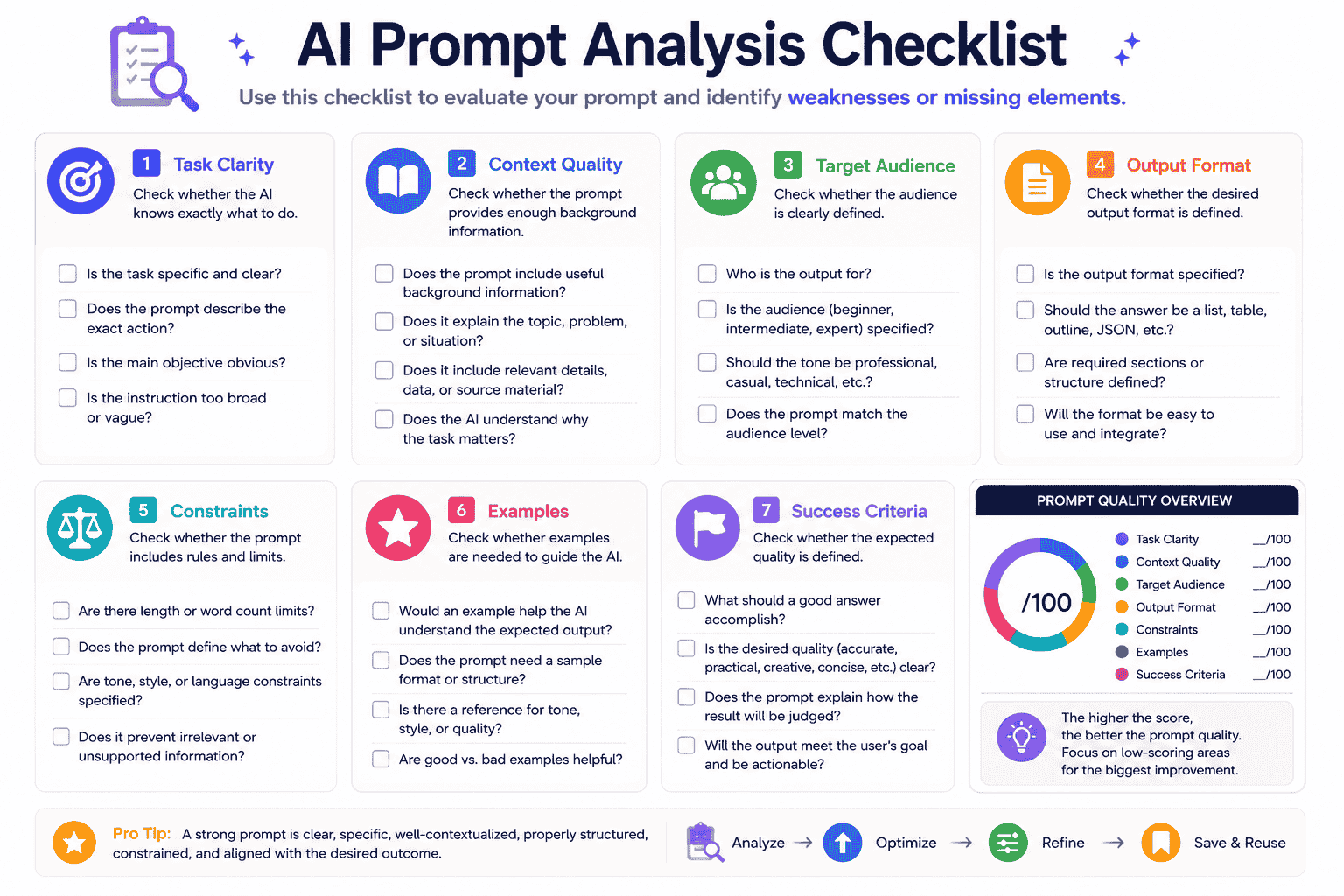
Step 1 Check Task Clarity
Ask whether the AI knows exactly what to do.
Questions to ask:
- Is the task specific?
- Does the prompt describe the expected action?
- Can the AI understand the main objective?
- Is the instruction too broad?
A clear task reduces guessing.
Step 2 Review Context Quality
Context helps the AI understand the situation.
Questions to ask:
- Does the prompt include enough background information?
- Does it explain the product, topic, problem, or goal?
- Does it include relevant source material?
- Does the AI know why the task matters?
Good context makes the output more relevant.
Step 3 Identify the Target Audience
Audience affects tone, depth, examples, and structure.
Questions to ask:
- Who is the output for?
- Is the audience beginner, intermediate, or advanced?
- Should the response be technical or simple?
- Should the tone be casual, professional, persuasive, or educational?
Step 4 Evaluate the Output Format
Format determines how usable the response will be.
Questions to ask:
- Does the prompt specify the output format?
- Should the answer be a table, list, outline, JSON, or draft?
- Does the prompt include required sections?
- Is the desired structure clear?
Step 5 Check Constraints
Constraints guide the AI away from unwanted outputs.
Questions to ask:
- Does the prompt include length limits?
- Does it mention what to avoid?
- Does it set tone, style, or content boundaries?
- Does it prevent unsupported or irrelevant information?
Step 6 Look for Missing Examples
Examples are not always required, but they can be useful when style, format, or quality level matters.
Questions to ask:
- Would an example help the AI understand the expected output?
- Does the prompt need a sample format?
- Does the task require a specific tone or pattern?
Step 7 Define Success Criteria
Success criteria make the expected quality clearer.
Questions to ask:
- What should a good answer accomplish?
- How should the final output be judged?
- Should it be practical, detailed, concise, persuasive, accurate, or reusable?
AI Prompt Analysis Metrics
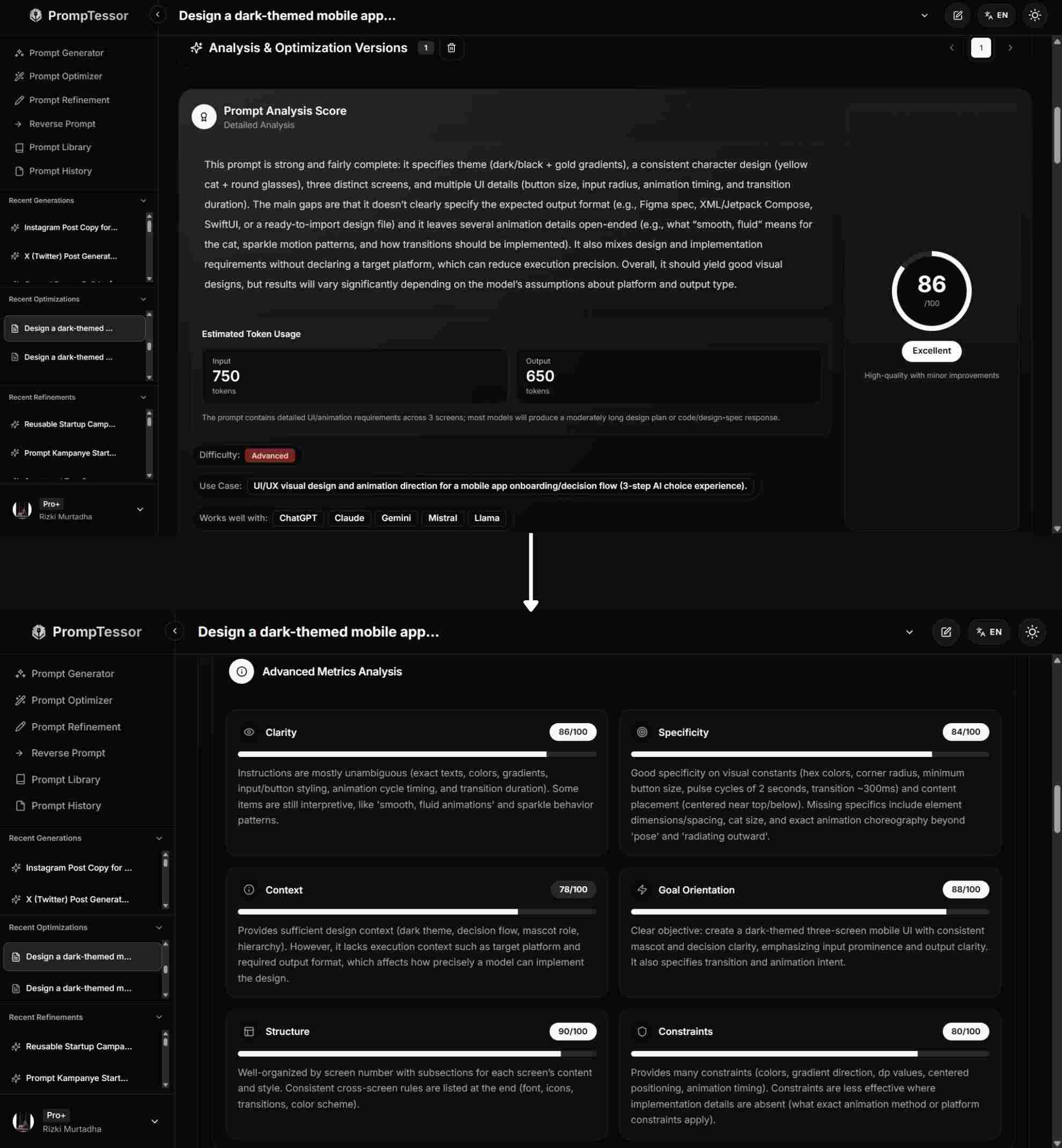
A strong prompt analysis can use specific metrics to evaluate prompt quality.
Here are useful metrics to review.
| Metric | What It Measures | Why It Matters |
|---|---|---|
| Clarity | How easy the prompt is to understand | Clear prompts reduce confusion and guessing |
| Specificity | How detailed and focused the instruction is | Specific prompts usually produce more relevant answers |
| Context | How much useful background information is included | Context helps the AI understand the situation |
| Goal Alignment | How well the prompt matches the desired outcome | Aligned prompts produce outputs that are closer to the user’s intent |
| Structure | How well the prompt is organized | Structured prompts are easier for AI models to follow |
| Constraints | How clearly the prompt defines limits and rules | Constraints help control length, tone, format, and quality |
| Output Format | How clearly the prompt defines the response structure | Format instructions make outputs easier to use |
| Reusability | How easily the prompt can be reused or adapted | Reusable prompts save time and support repeatable workflows |
These metrics help turn prompt review into a structured process.
Instead of simply saying a prompt is “good” or “bad,” you can identify exactly where it is strong and where it needs improvement.
Prompt Analysis vs Prompt Optimization
Prompt analysis and prompt optimization are connected, but they are not the same.
Prompt analysis identifies what is wrong or missing in a prompt.
Prompt optimization improves the prompt based on those findings.
| Concept | Main Purpose | Example |
|---|---|---|
| Prompt Analysis | Evaluate prompt quality and identify weaknesses | The prompt lacks context, audience, format, and constraints |
| Prompt Optimization | Improve the prompt so it produces better results | Add context, define the audience, set format, and include constraints |
A simple way to think about it:
- Analysis tells you what is weak.
- Optimization improves what is weak.
For a deeper guide, read AI Prompt Optimization How to Improve Weak Prompts for Better AI Results.
Prompt Analysis vs Prompt Refinement
Prompt analysis is also different from prompt refinement.
Prompt analysis reviews the prompt and identifies quality issues.
Prompt refinement changes an existing prompt based on specific feedback.
| Concept | Main Purpose | Example |
|---|---|---|
| Prompt Analysis | Diagnose prompt strengths and weaknesses | The prompt is clear but needs a better output format |
| Prompt Refinement | Apply feedback to improve an existing prompt version | Make the prompt shorter, more structured, or more suitable for beginners |
A practical workflow may use all three steps:
- Analyze the prompt.
- Optimize the weak areas.
- Refine the improved version with feedback.
For more detail, read Prompt Refinement How to Improve AI Prompts Through Feedback and Iteration.
Prompt Analysis Examples
Here are a few examples of how AI prompt analysis works across different tasks.
Example 1 Weak Content Prompt
Prompt:
Write a blog post about AI.
Analysis:
- The topic is too broad
- The audience is missing
- The word count is undefined
- The structure is unclear
- The goal is missing
- The tone is not specified
Improvement direction:
Define the audience, topic angle, word count, structure, tone, and expected outcome.
Example 2 Weak Marketing Prompt
Prompt:
Give me marketing ideas for my app.
Analysis:
- The app is not described
- The target users are missing
- The marketing goal is unclear
- The budget is undefined
- The preferred channels are not mentioned
- The output format is missing
Improvement direction:
Add product context, target audience, campaign goal, budget, channels, and a table format with effort and impact.
Example 3 Weak Coding Prompt
Prompt:
Fix this code.
Analysis:
- The bug is not described
- The programming language may be unclear
- The expected behavior is missing
- The current error message is missing
- The user does not specify whether they want explanation, corrected code, or debugging steps
Improvement direction:
Include the language, error message, expected behavior, actual behavior, relevant code, and desired response format.
Example 4 Weak Research Prompt
Prompt:
Summarize this.
Analysis:
- The desired summary style is unclear
- The audience is missing
- The level of detail is undefined
- The output format is missing
- The prompt does not say whether to include key findings, limitations, quotes, or action items
Improvement direction:
Define the audience, summary length, structure, focus areas, and whether the answer should include takeaways or limitations.
How Prompt Analysis Fits Into an AI Prompt Workflow
Prompt analysis is most useful when it is part of a larger prompt workflow.
A complete AI prompt workflow may include:
- Generate a prompt from an idea, task, or goal.
- Analyze the prompt for weaknesses.
- Optimize the prompt based on the analysis.
- Refine the prompt with feedback.
- Test the prompt in an AI model.
- Save the best version in a Prompt Library.
- Reuse the prompt across future workflows.
This process turns prompting into a repeatable system.
Instead of writing one-off prompts and hoping they work, you can build prompts that are tested, improved, saved, and reused.
For a broader explanation of this workflow, read What Is an AI Prompt Workspace?.
Common Prompt Analysis Mistakes
Prompt analysis is useful, but it can become less effective if the review is too shallow.
1. Only Checking Grammar
A prompt can be grammatically correct but still weak.
Prompt analysis should look beyond grammar and review clarity, context, structure, constraints, and goal alignment.
2. Assuming Longer Prompts Are Better
A longer prompt is not always stronger.
The goal is not to add more words. The goal is to add useful direction.
3. Ignoring the Output Format
Many prompts fail because the response format is not defined.
If you need a table, checklist, JSON object, outline, or draft, the prompt should say that clearly.
4. Not Checking the Audience
A prompt without an audience often produces generic output.
Audience affects tone, examples, explanation depth, and vocabulary.
5. Not Reviewing Constraints
Constraints are important for controlling the AI response.
A prompt analysis should check whether the prompt defines limits, rules, and things to avoid.
6. Skipping Success Criteria
Without success criteria, the AI may not know what quality standard to aim for.
A strong prompt explains what a useful result should look like.
How PrompTessor Helps With AI Prompt Analysis
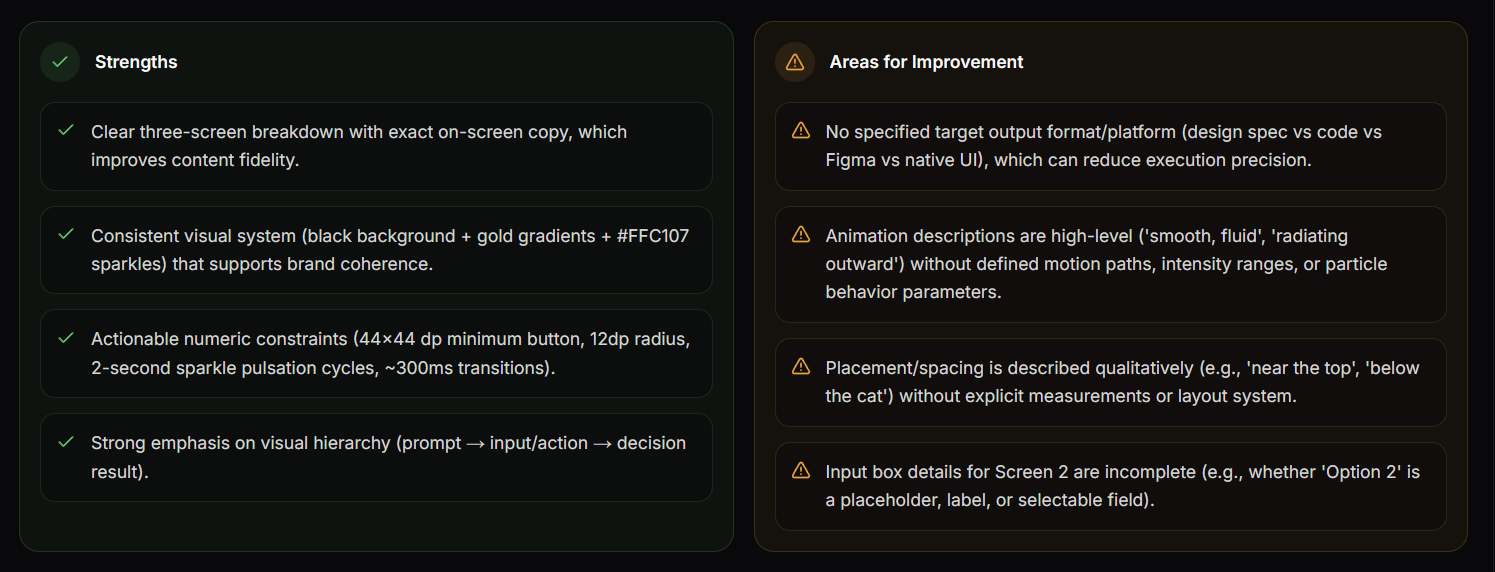
PrompTessor helps users analyze prompts as part of a complete AI prompt workspace.
Instead of manually guessing why a prompt is weak, users can review prompt quality, identify missing elements, and understand what needs to be improved before moving into optimization or refinement.
PrompTessor helps with AI prompt analysis by reviewing important prompt elements such as:
- Clarity
- Specificity
- Context
- Goal alignment
- Structure
- Constraints
- Output format
- Improvement opportunities
After analysis, users can optimize weak prompts, refine prompts with feedback, create better versions, and save useful prompts to a Prompt Library for future workflows.
This makes PrompTessor useful for creators, marketers, developers, founders, researchers, students, writers, prompt engineers, and everyday AI users who want more consistent results from AI tools.
FAQ About AI Prompt Analysis
What is AI prompt analysis?
AI prompt analysis is the process of evaluating a prompt to identify weaknesses, missing context, unclear tasks, poor structure, weak constraints, undefined output format, and improvement opportunities.
Why is prompt analysis important?
Prompt analysis is important because it helps you understand why a prompt may produce weak, generic, or inconsistent AI outputs. It helps identify what should be improved before optimization or refinement.
How do you analyze an AI prompt?
To analyze an AI prompt, review the task clarity, context, target audience, output format, constraints, examples, structure, and success criteria. Then identify what is missing or unclear.
What makes a prompt weak?
A prompt is weak when it is vague, too broad, missing context, lacking audience guidance, missing output format, lacking constraints, poorly structured, or unclear about the desired result.
What is the difference between prompt analysis and prompt optimization?
Prompt analysis identifies what is wrong or missing in a prompt. Prompt optimization improves the prompt based on those findings.
What is the difference between prompt analysis and prompt refinement?
Prompt analysis evaluates the prompt and identifies weaknesses. Prompt refinement applies specific feedback to improve an existing prompt version.
Can AI prompt analysis improve ChatGPT prompts?
Yes. AI prompt analysis can improve ChatGPT prompts by identifying unclear instructions, missing context, weak constraints, and undefined output format before the prompt is optimized or refined.
Does prompt analysis work for Claude and Gemini?
Yes. Prompt analysis can be used for Claude, Gemini, and other AI models because clear tasks, useful context, structure, constraints, and output format are helpful across many AI tools.
Can PrompTessor analyze AI prompts?
Yes. PrompTessor helps users analyze prompt quality, identify weaknesses, optimize prompts, refine prompt versions, and save useful prompts for reuse.
Start Analyzing Your Prompts Before Optimizing Them
Better prompts start with better understanding.
If an AI output is weak, the first step is not always to rewrite the prompt immediately. The better first step is to analyze the prompt and find out what is missing.
AI prompt analysis helps you identify unclear tasks, missing context, weak structure, undefined output format, poor constraints, and unclear success criteria.
Once you understand the weaknesses, optimization and refinement become much easier.
PrompTessor helps users analyze, optimize, refine, save, and reuse prompts inside one AI prompt workspace.
Before you optimize your next prompt, analyze it first.
Build better prompts in one workspace
Generate prompts from ideas, analyze and optimize quality, refine with feedback, reverse-engineer content, and save reusable prompts in your Prompt Library.
Try PrompTessor Free