What Is an AI Prompt Workspace? How to Generate, Optimize, and Save Prompts in a Library
AI tools are becoming part of everyday work. People use AI for writing, coding, marketing, research, product planning, visual content, learning, automation, and business workflows.
But even as AI models become more powerful, one thing still decides how useful the output will be:
The prompt.
A prompt is not only a question or instruction. It is the way you explain your goal, context, expected output, tone, structure, and constraints to an AI system.
When your prompt is vague, the output often becomes vague. When your prompt is structured, specific, and reusable, the AI has a better chance of producing a useful result.
That is why AI users are moving beyond simple prompt writing and basic prompt generators.
They need a better way to create, improve, organize, and reuse prompts across different AI tools.
This is where an AI prompt workspace becomes useful.
An AI prompt workspace helps users manage the full prompt workflow, from generating a prompt idea to optimizing it, refining it, reverse-engineering existing content, saving the best version, and reusing it later from a prompt library.
In this guide, you will learn what an AI prompt workspace is, why prompt workflows matter, what features a good prompt workspace should include, and how tools like PrompTessor help users build better prompts for ChatGPT, Claude, Gemini, and other AI models.
Quick Answer
An AI prompt workspace is a tool or platform that helps users generate, analyze, optimize, refine, reverse-engineer, save, organize, and reuse prompts. Instead of only creating one prompt at a time, an AI prompt workspace supports the full prompt workflow, including prompt generation, prompt optimization, prompt refinement, prompt library management, and prompt history.
Key Takeaways
- An AI prompt workspace helps users create, improve, organize, and reuse prompts in one place.
- It is different from a basic prompt generator because it supports the full workflow, not only prompt creation.
- A strong prompt workspace usually includes prompt generation, analysis, optimization, refinement, reverse prompting, prompt library, and prompt history.
- Prompt libraries help users save their best prompts and reuse them across projects, tools, and workflows.
- PrompTessor is an AI prompt workspace for generating, analyzing, optimizing, refining, reverse-engineering, saving, and reusing prompts.
Table of Contents
- What Is an AI Prompt Workspace?
- Why AI Prompt Workflows Matter
- AI Prompt Workspace vs Basic Prompt Generator
- AI Prompt Workspace vs Prompt Optimizer
- Core Parts of an AI Prompt Workspace
- How an AI Prompt Workspace Helps You Create Better Prompts
- Common Use Cases for an AI Prompt Workspace
- AI Prompt Workspace for ChatGPT, Claude, Gemini, and Other AI Models
- How PrompTessor Works as an AI Prompt Workspace
- FAQ About AI Prompt Workspaces
- Build Better Prompt Workflows With PrompTessor
What Is an AI Prompt Workspace?
An AI prompt workspace is a place where users can create, improve, organize, and reuse prompts for AI tools.
Instead of treating prompts as one-time messages, an AI prompt workspace treats prompts as reusable assets.
This matters because prompts are often used repeatedly across similar tasks. A marketer may reuse prompts for campaign planning. A developer may reuse prompts for code review. A writer may reuse prompts for outlines, editing, and content briefs. A founder may reuse prompts for customer research, product strategy, and launch planning.
A basic AI prompt might look like this:
Write a marketing plan for my product.
This prompt may produce a response, but it is broad. It does not explain the product, audience, channels, tone, budget, timeline, or expected output format.
A stronger reusable prompt might look like this:
You are a senior SaaS marketing strategist. Create a 30-day launch plan for {product_name}, an AI tool for {target_audience}. Include positioning, audience segments, channel strategy, content ideas, launch timeline, KPI targets, and a weekly execution plan. Use a practical tone and format the output as a structured campaign playbook.
The second prompt is more useful because it includes role, task, variables, context, audience, structure, and expected output.
An AI prompt workspace helps users create prompts like this, improve them, save them, and reuse them later.
Why AI Prompt Workflows Matter
Many AI users think prompting is only about writing one good instruction.
But in real workflows, prompting is usually a process.
You may start with a rough idea. Then you generate a prompt. Then you test it. Then you notice the output is too broad, too long, too generic, or not structured correctly. Then you revise the prompt, add context, change the format, adjust the tone, and test again.
This process can become messy if everything happens manually across chat windows, notes, documents, spreadsheets, and different AI tools.
An AI prompt workspace makes this process more organized.
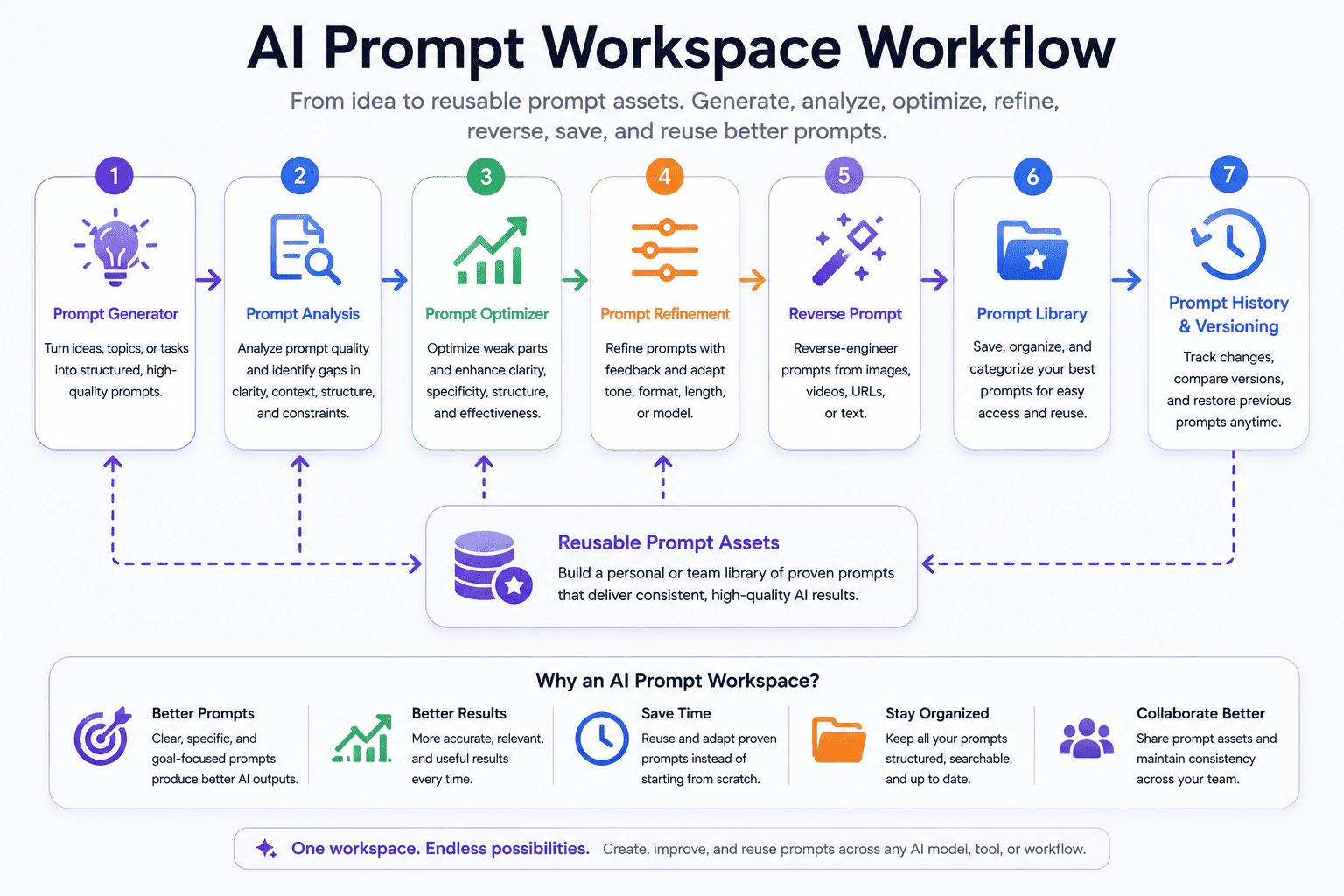
Instead of losing prompt versions or rewriting the same instruction again, you can build a repeatable workflow:
- Start with a goal or rough idea
- Generate a structured prompt
- Analyze prompt quality
- Optimize weak parts
- Refine the prompt with feedback
- Reverse-engineer prompts from existing content
- Save the best prompt in a library
- Reuse or adapt the prompt for future work
This is important because better prompt workflows can help users save time, improve output quality, reduce repeated work, and make AI results more consistent.
If you want to understand the foundation behind prompt quality, you can also read this guide on what prompt engineering is and how to write better AI prompts.
AI Prompt Workspace vs Basic Prompt Generator
A basic prompt generator helps users create prompts from a topic, keyword, task, or short instruction.
That can be useful, especially when you do not want to start from a blank page.
However, a basic prompt generator often stops after generating one prompt.
An AI prompt workspace goes further.
It does not only help you create a prompt. It also helps you analyze, optimize, refine, save, organize, and reuse that prompt.
| Feature | Basic Prompt Generator | AI Prompt Workspace |
|---|---|---|
| Create prompts from ideas | Yes | Yes |
| Analyze prompt quality | Usually limited | Yes |
| Optimize weak prompts | Sometimes | Yes |
| Refine prompts with feedback | Usually limited | Yes |
| Reverse-engineer prompts from content | Usually no | Yes, if supported |
| Save prompts in a library | Usually no | Yes |
| Track prompt history and versions | Usually no | Yes |
So the difference is simple:
A prompt generator helps you create a prompt. An AI prompt workspace helps you manage the full prompt lifecycle.
For a deeper guide on prompt generation, read AI Prompt Generator for Any AI Model.
AI Prompt Workspace vs Prompt Optimizer
A prompt optimizer helps improve an existing prompt.
For example, if your prompt is vague, a prompt optimizer may rewrite it with clearer instructions, better structure, more context, and stronger constraints.
This is useful because many prompts are not strong enough on the first attempt.
But prompt optimization is only one part of the larger workflow.
An AI prompt workspace includes prompt optimization, but it also supports other steps such as prompt generation, prompt refinement, reverse prompting, prompt library management, and prompt history.
This means a prompt optimizer helps with improvement, while an AI prompt workspace helps with the full system around prompt creation and reuse.
For example, a user might use an AI prompt workspace to:
- Generate a new prompt from a rough idea
- Analyze whether the prompt is clear and specific enough
- Optimize the prompt into stronger versions
- Refine the prompt for a specific use case
- Save the final prompt in a library
- Reuse the prompt later for another project
This is why the workspace concept is important. It connects the steps instead of treating each prompt task as separate.
Core Parts of an AI Prompt Workspace
A good AI prompt workspace should help users move from rough ideas to reusable prompts.
Here are the core parts that make an AI prompt workspace useful.
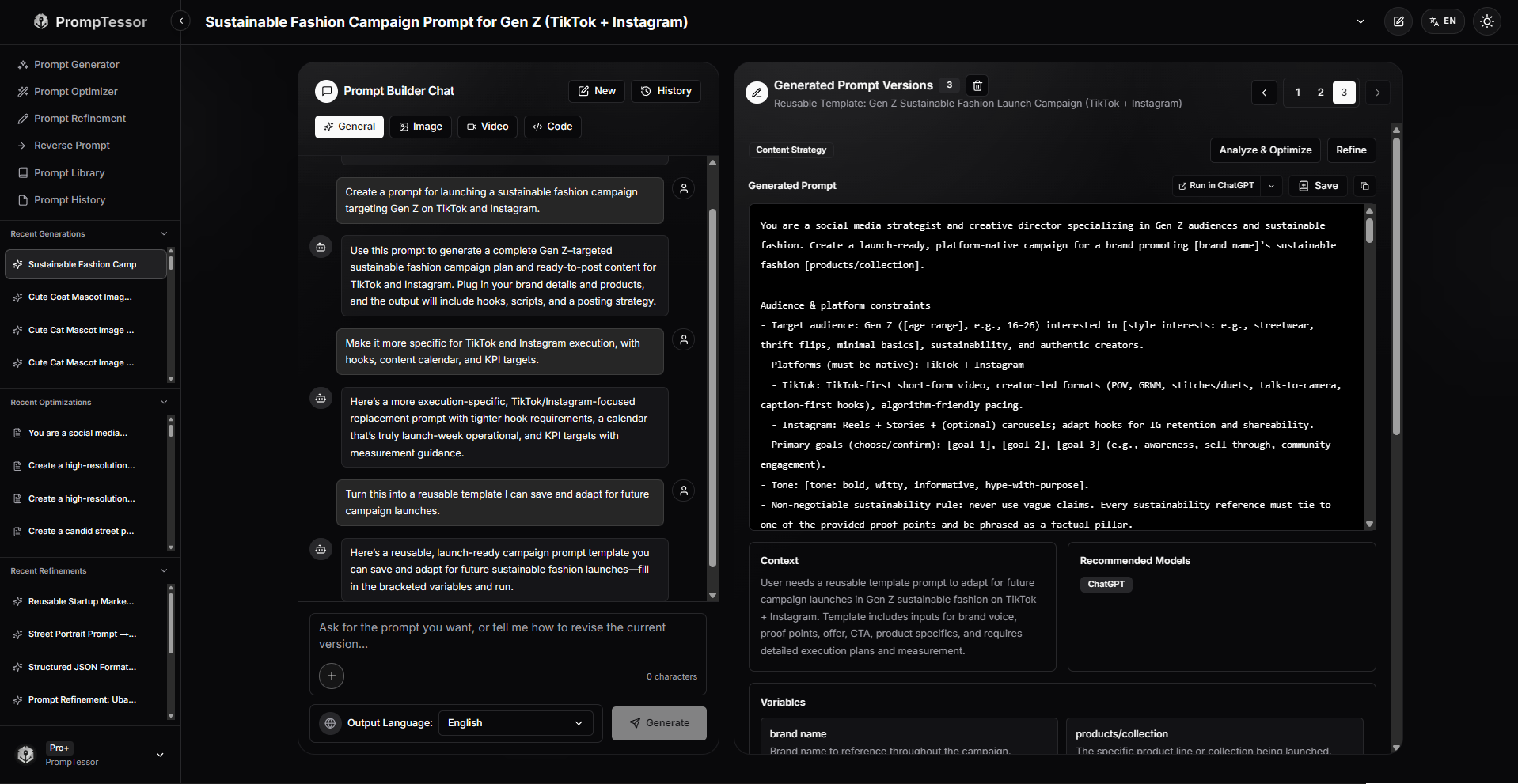
1. Prompt Generator
A prompt generator helps users create prompts from goals, ideas, tasks, workflows, or reference materials.
This is useful when you know what you want to achieve but do not know how to write the prompt clearly.
For example, instead of typing:
Create a prompt for content marketing.
A prompt generator can help create a more structured prompt with audience, goal, content type, tone, output format, and constraints.
2. Prompt Analysis
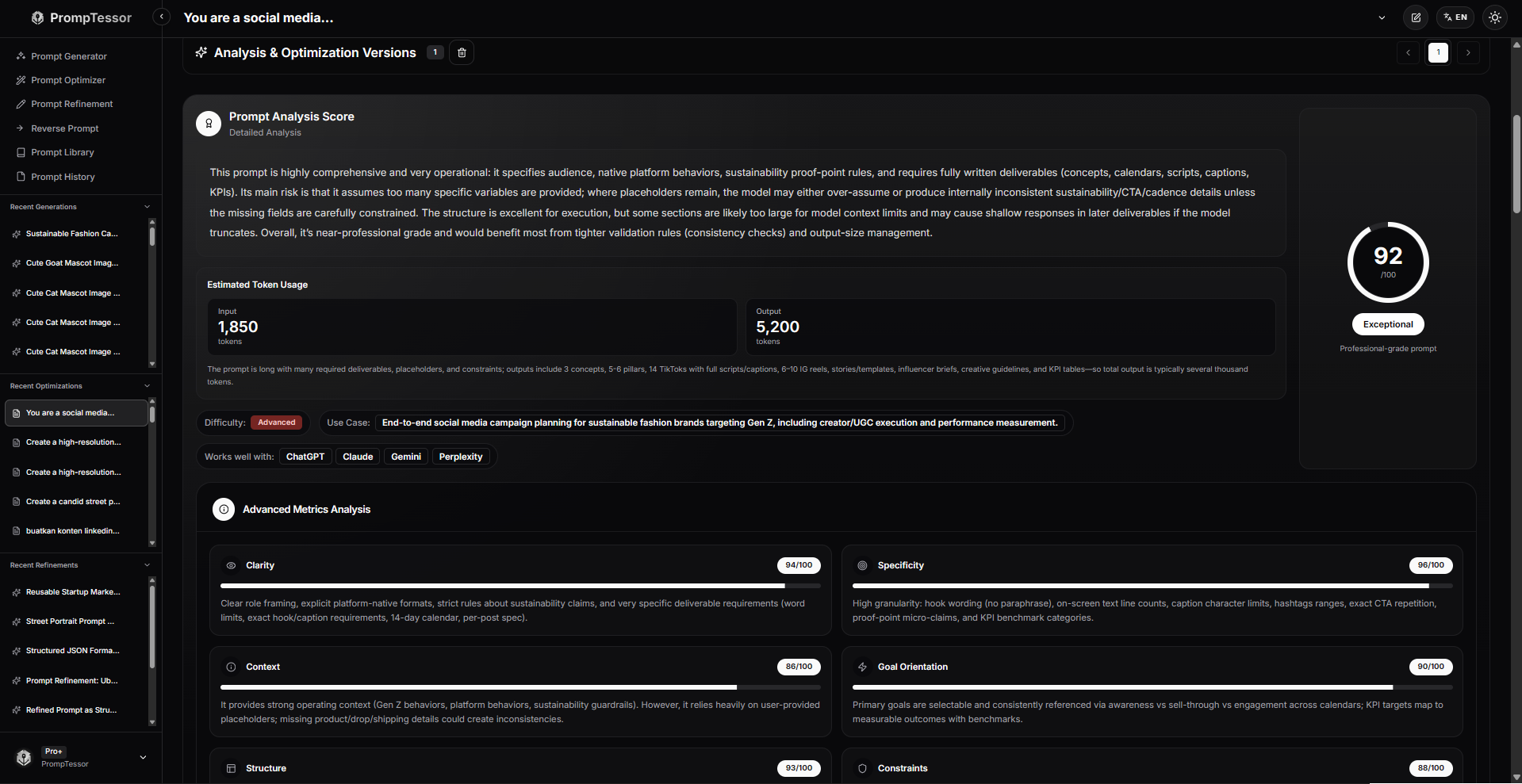
Prompt analysis helps users understand the quality of a prompt before using it in an AI model.
A prompt may look good at first, but it may still be missing important details such as context, audience, output format, success criteria, or constraints.
Prompt analysis can help identify issues such as:
- Unclear task instructions
- Missing context
- Weak structure
- Unclear output format
- Missing constraints
- Low specificity
This helps users understand why an AI response may not be useful and what can be improved.
3. Prompt Optimizer
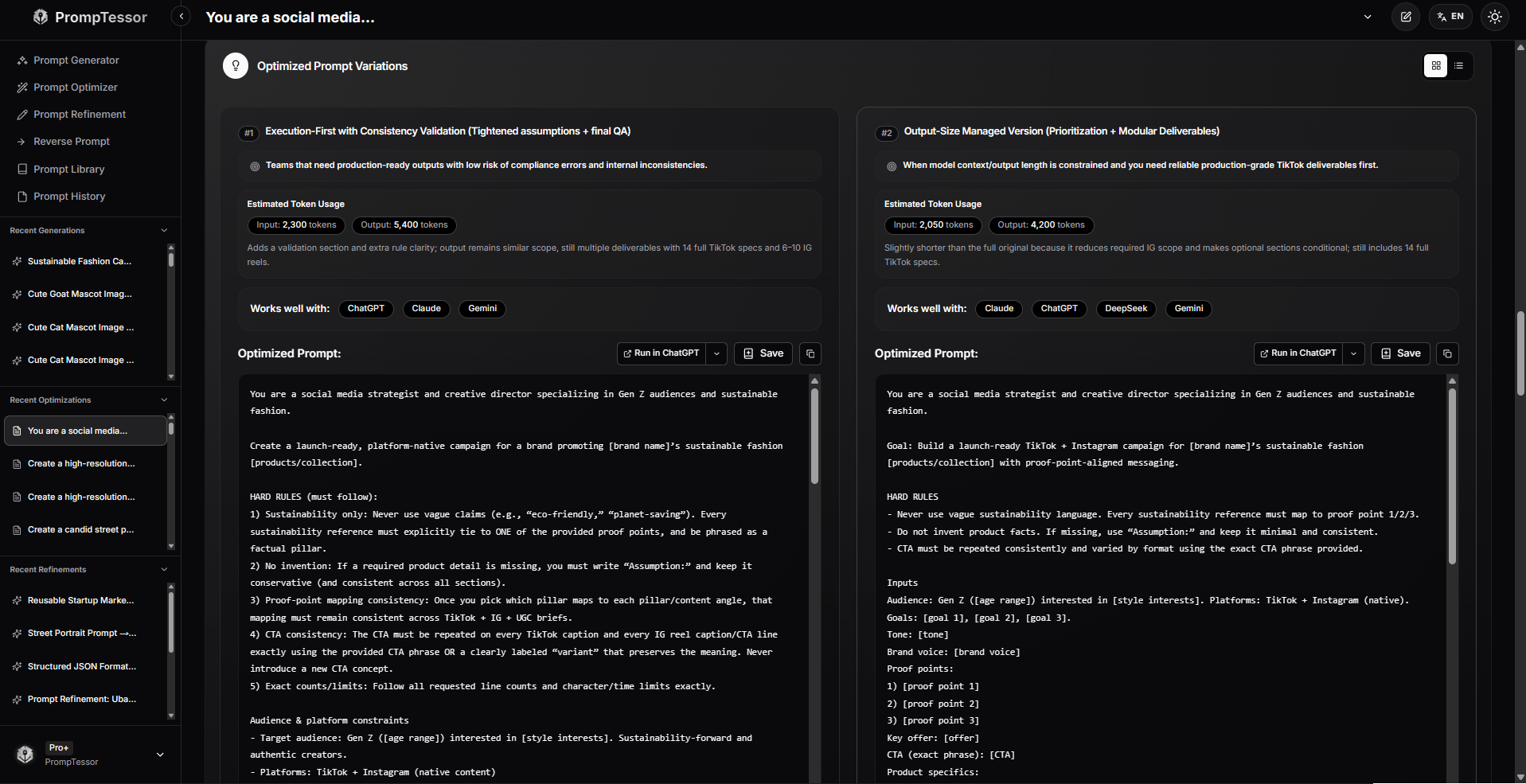
A prompt optimizer turns weak or incomplete prompts into stronger versions.
It can help improve clarity, structure, specificity, context, formatting, and output direction.
For example, a rough prompt like:
Write a product launch email.
can be optimized into a prompt that includes product details, audience, offer, tone, subject line options, email structure, CTA, and constraints.
This helps AI models produce more useful and consistent results.
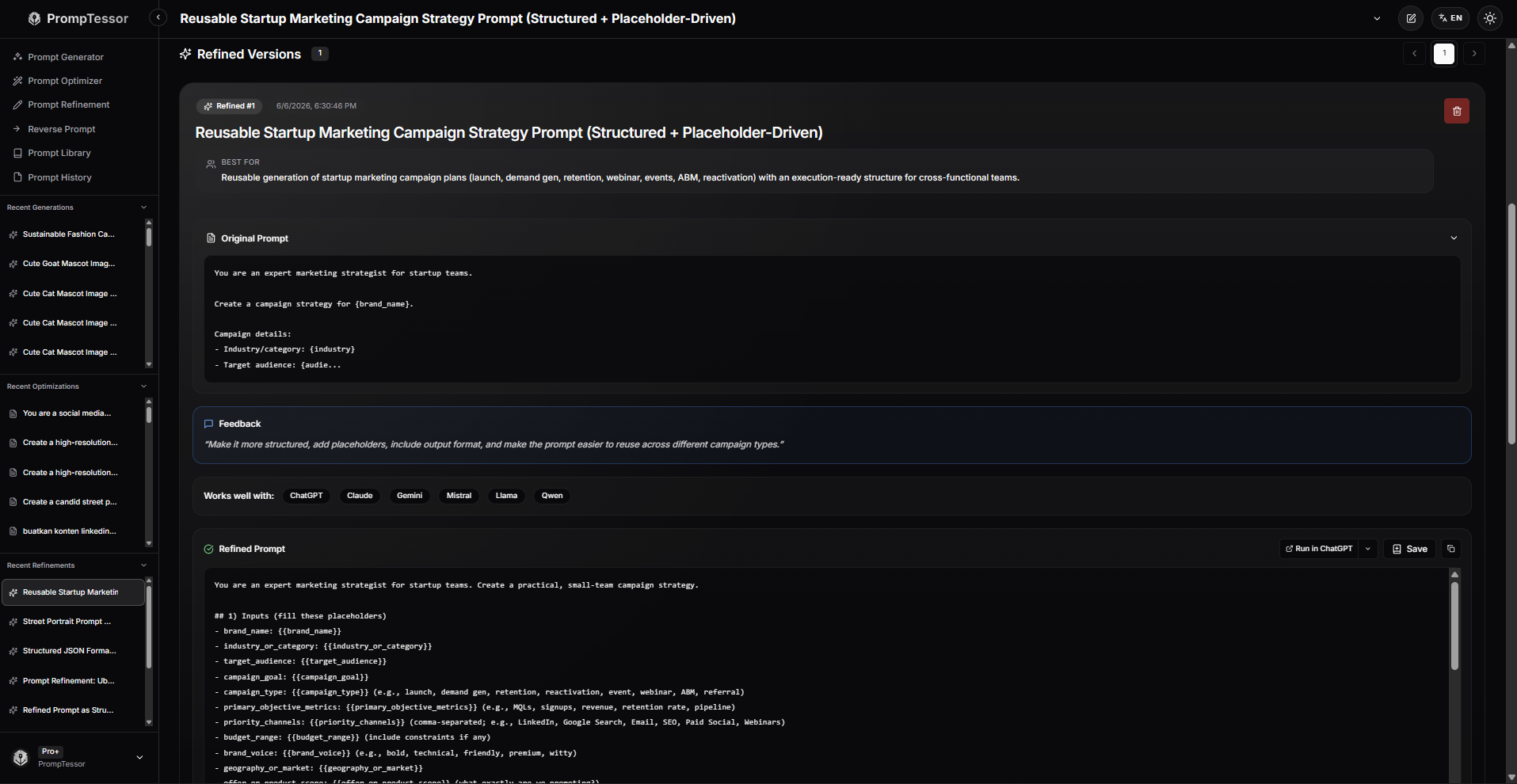
4. Prompt Refinement
Prompt refinement helps users improve an existing prompt through feedback and iteration.
Sometimes the optimized prompt is good, but you still need it to be shorter, more detailed, more technical, more creative, more professional, or more suitable for a specific AI model.
Prompt refinement gives users more control over the final version.
For example, you may refine a prompt by asking it to:
- Make the output more concise
- Add more examples
- Change the tone
- Adapt the prompt for ChatGPT, Claude, or Gemini
- Return the response as JSON
- Add stronger constraints
- Turn the prompt into a reusable template
5. Reverse Prompt
Reverse prompting helps users recreate or infer prompts from existing content.
For example, if you see an image, video, landing page, article, social post, or AI-generated output and want to understand how something similar could be created, reverse prompting can help turn that content into a reusable prompt.
This is useful for creators, designers, marketers, and AI users who want to learn from examples and turn inspiration into prompt workflows.

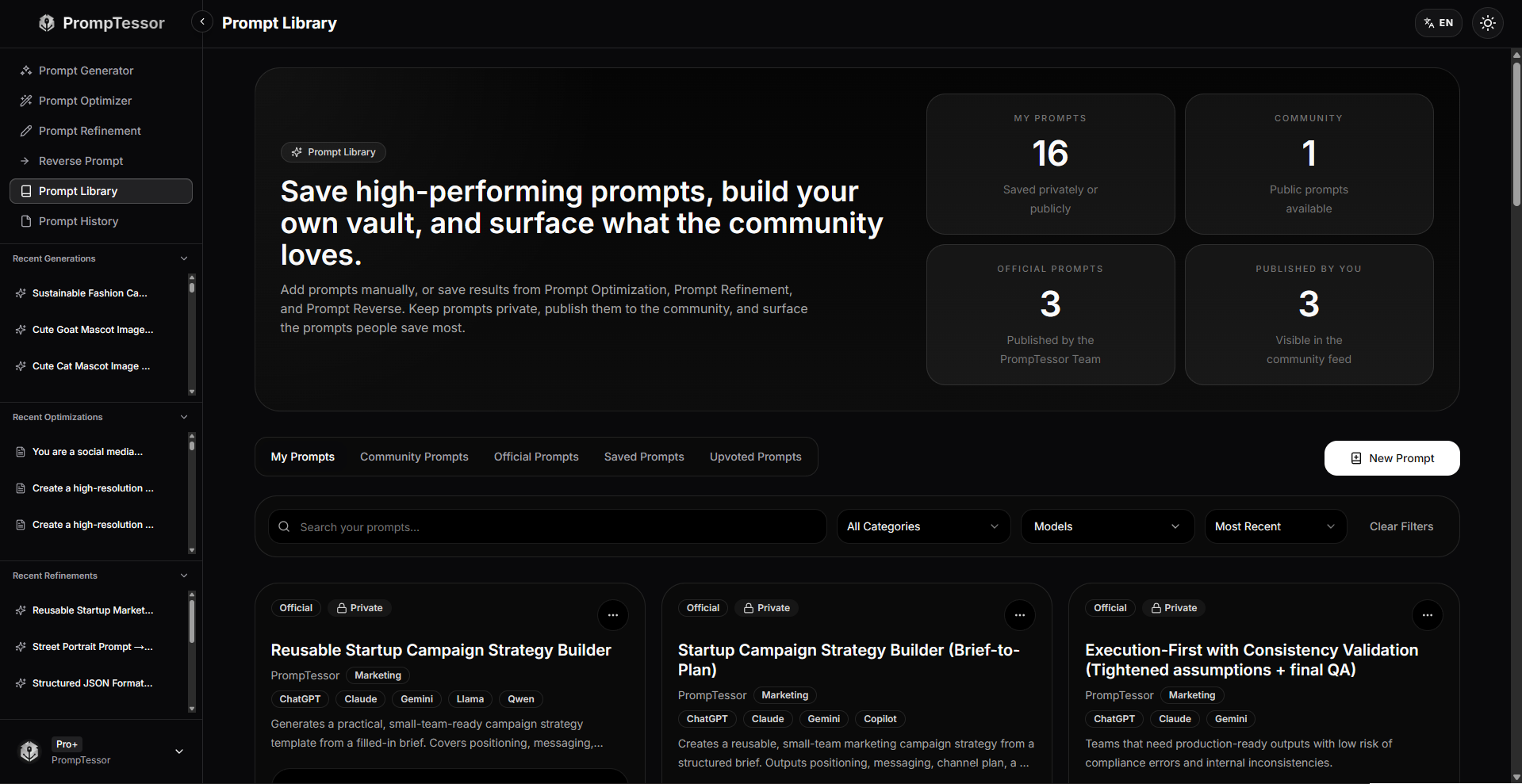
6. Prompt Library
A prompt library helps users save, organize, and reuse their best prompts.
This is one of the most important parts of an AI prompt workspace.
Without a prompt library, users often lose good prompts inside chat history, notes, documents, or scattered files.
With a prompt library, successful prompts can become reusable assets.
A good prompt library can help users organize prompts by category, use case, project, model, workflow, visibility, or team need.
For example, a prompt library may include prompts for:
- Blog outlines
- SEO briefs
- Landing page copy
- Email campaigns
- Code review
- Product research
- Meeting summaries
- Image generation
- Video storyboards
- Customer research
7. Prompt History and Versioning
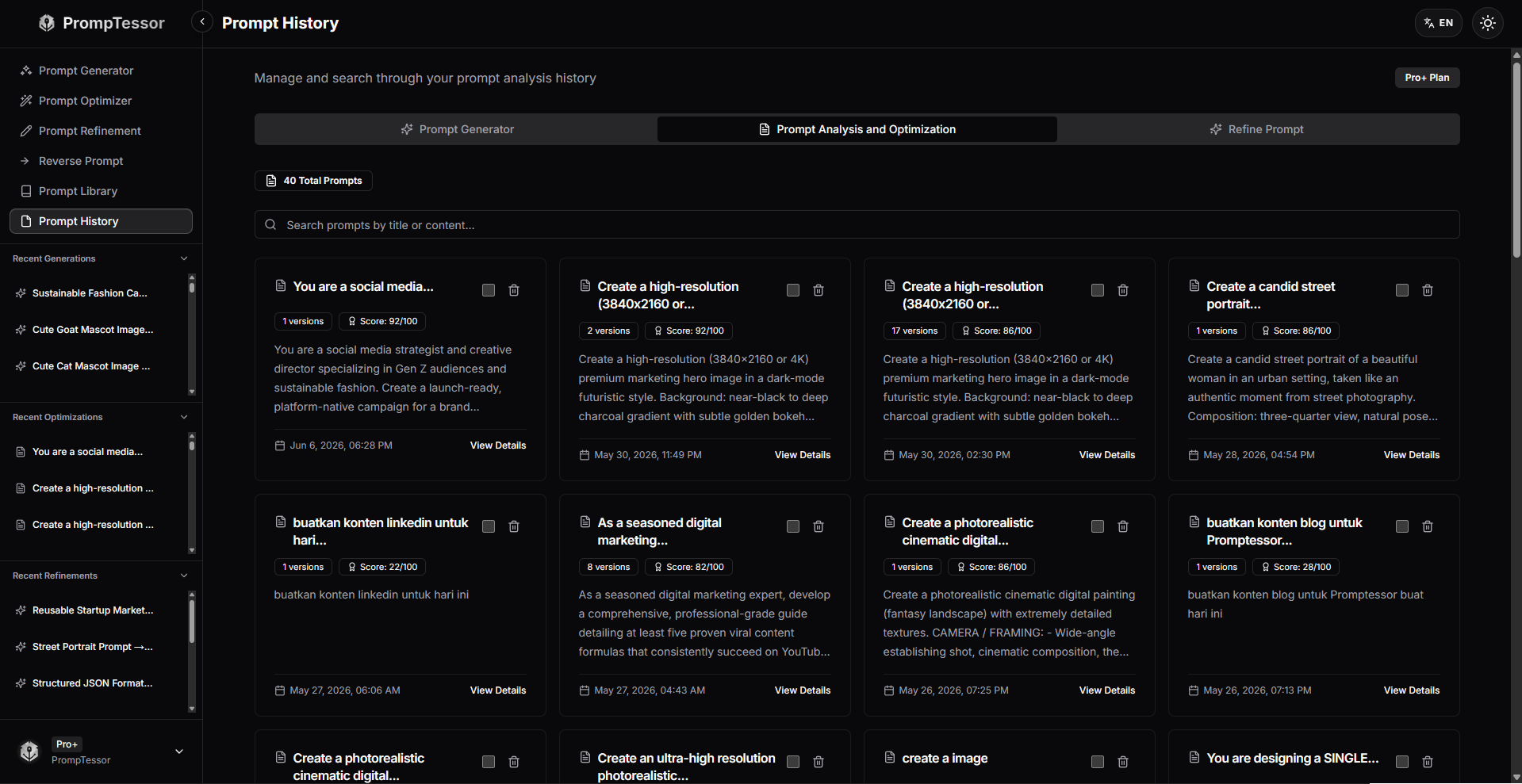
Prompt history and versioning help users track how prompts change over time.
This is useful because prompt creation is often iterative.
You may generate version one, optimize version two, refine version three, and then save the final version to your prompt library.
Prompt history helps you revisit previous versions, compare improvements, continue editing, and understand how a prompt evolved.
How an AI Prompt Workspace Helps You Create Better Prompts
An AI prompt workspace helps users improve the entire process of creating prompts.
Instead of treating prompt writing as a guessing game, it gives users a more structured workflow.
Step 1: Start With a Rough Idea
You do not need to begin with a perfect prompt.
You can start with a rough idea, goal, or task.
Create a prompt for planning a YouTube video campaign.
Step 2: Generate a Structured Prompt
The workspace can help turn the rough idea into a structured prompt with role, task, audience, context, format, and constraints.
Step 3: Analyze the Prompt Quality
Before using the prompt, you can analyze whether it is clear, specific, and complete enough.
Step 4: Optimize Weak Parts
If the prompt is missing context, structure, or constraints, optimization can help improve it.
Step 5: Refine the Prompt
You can refine the prompt further based on your own needs, such as tone, format, model, length, or output style.
Step 6: Save the Final Prompt in a Library
Once the prompt works well, you can save it in a prompt library so it can be reused later.
Step 7: Reuse and Improve Over Time
The best prompts can be adapted for new projects, new campaigns, new models, and new workflows.
This process turns prompt writing into a repeatable system.
Common Use Cases for an AI Prompt Workspace
An AI prompt workspace can be useful across many types of work.
Content Creation
Writers and creators can use an AI prompt workspace to generate and save prompts for blog posts, newsletters, captions, scripts, outlines, editing, repurposing, and content briefs.
Marketing
Marketers can use prompt workspaces for campaign strategy, ad copy, landing pages, email sequences, audience research, SEO content, product positioning, and social media planning.
Product and Business Work
Founders and product teams can use prompt workspaces for customer research, feature prioritization, product briefs, competitor analysis, meeting summaries, documentation, and launch planning.
Developer Workflows
Developers can use prompt workspaces to create reusable prompts for debugging, code review, architecture planning, documentation, test planning, and technical explanations.
Research and Learning
Students, researchers, and professionals can use prompt workspaces for summaries, explanations, literature reviews, study plans, research questions, and structured analysis.
Visual Content Production
Designers and visual creators can use prompt workspaces for image prompts, video prompts, creative direction, thumbnails, product photography prompts, storyboard prompts, and visual references.
Team Prompt Operations
Teams can use prompt workspaces to organize approved prompts, share reusable prompt templates, improve consistency, and reduce repeated prompt writing across workflows.
AI Prompt Workspace for ChatGPT, Claude, Gemini, and Other AI Models
A good AI prompt workspace should not only work for one AI model.
Many users work across different AI tools. One person may use ChatGPT for writing, Claude for long-form analysis, Gemini for multimodal tasks, and other AI models for image generation, video generation, coding, or automation.
This is why model-agnostic prompt workflows matter.
A strong prompt workspace helps users create prompts that can be adapted across different AI systems.
Core prompt elements such as role, task, context, audience, format, constraints, examples, and success criteria are useful across many AI models.
However, different models may respond differently. That is why prompt refinement and versioning are useful. They help users adjust prompts for specific models, formats, and use cases without losing the original prompt workflow.
An AI prompt workspace can help users prepare prompts for:
- ChatGPT
- Claude
- Gemini
- Image generation tools
- Video generation tools
- Coding assistants
- Writing assistants
- Research tools
- Automation workflows
How PrompTessor Works as an AI Prompt Workspace
PrompTessor is an AI prompt workspace designed to help users generate, analyze, optimize, refine, reverse-engineer, save, and reuse prompts.
Instead of only helping users rewrite prompts, PrompTessor supports the broader prompt workflow.
Users can start with a rough idea and create a structured prompt with Prompt Generator. Then they can analyze and optimize the prompt to improve clarity, specificity, context, structure, constraints, and output quality.
After that, users can refine the prompt with feedback, adapt it for a specific model or format, save it in a prompt library, and track prompt versions through prompt history.
PrompTessor also includes Reverse Prompt, which helps users turn existing content such as images, videos, URLs, or text into reusable prompts.
This makes PrompTessor useful for people who want to build better prompt workflows instead of managing prompts manually across different tools.
For a broader product overview, you can read Understanding PrompTessor: AI Prompt Optimization Tool and Prompt Workspace.
FAQ About AI Prompt Workspaces
What is an AI prompt workspace?
An AI prompt workspace is a tool or platform that helps users generate, analyze, optimize, refine, reverse-engineer, save, organize, and reuse prompts for AI tools.
How is an AI prompt workspace different from a prompt generator?
A prompt generator mainly helps users create prompts. An AI prompt workspace goes further by supporting prompt analysis, optimization, refinement, reverse prompting, prompt library management, and prompt history.
How is an AI prompt workspace different from a prompt optimizer?
A prompt optimizer improves an existing prompt. An AI prompt workspace includes optimization, but also helps users generate prompts, refine them, save them, organize them, and reuse them across workflows.
Why do I need a prompt library?
A prompt library helps users save, organize, and reuse their best prompts. This prevents useful prompts from getting lost in chat history, notes, documents, or scattered files.
Can an AI prompt workspace help with ChatGPT prompts?
Yes. An AI prompt workspace can help users create better prompts for ChatGPT by improving task clarity, context, output format, constraints, and prompt structure.
Can an AI prompt workspace work with Claude and Gemini?
Yes. Many prompt workflows can be adapted for Claude, Gemini, and other AI models. A prompt workspace can help users refine prompts for specific models, formats, and use cases.
What features should an AI prompt workspace include?
A good AI prompt workspace should include prompt generation, prompt analysis, prompt optimization, prompt refinement, reverse prompt, prompt library, and prompt history or versioning.
Can PrompTessor save prompts in a library?
Yes. PrompTessor includes a Prompt Library where users can save, organize, and reuse prompts across projects and workflows.
Is PrompTessor an AI prompt workspace?
Yes. PrompTessor is an AI prompt workspace for generating, analyzing, optimizing, refining, reverse-engineering, saving, and reusing prompts.
Build Better Prompt Workflows With PrompTessor
AI prompts are becoming more important because they shape how users interact with AI systems.
But better prompting is not only about writing one good instruction.
It is about building a workflow that helps you create, improve, save, and reuse prompts over time.
An AI prompt workspace helps make that process easier.
Instead of starting from scratch every time, you can generate prompts from ideas, analyze prompt quality, optimize weak prompts, refine them with feedback, reverse-engineer prompts from content, and save the best versions in a prompt library.
PrompTessor brings these steps together in one workspace.
Whether you use ChatGPT, Claude, Gemini, image generation tools, video generation tools, coding assistants, or other AI systems, PrompTessor helps you build clearer and more reusable prompts.
Better prompts lead to better AI results. An AI prompt workspace helps you build them consistently.
Build better prompts in one workspace
Generate prompts from ideas, analyze and optimize quality, refine with feedback, reverse-engineer content, and save reusable prompts in your Prompt Library.
Try PrompTessor Free