Best AI Coding Prompts for Software Development, Debugging, Testing, and Code Review in 2026
AI coding assistants can generate functions, explain unfamiliar code, debug errors, write tests, review pull requests, refactor legacy code, document APIs, and help plan software architecture.
However, a request such as “fix this code” or “build an authentication system” gives the AI very little information about the actual project.
It does not explain the programming language, framework, repository structure, current behavior, expected behavior, architectural patterns, security requirements, testing tools, or definition of done.
The result may look convincing while still being incomplete, incompatible with the codebase, difficult to test, or unsafe to deploy.
A stronger coding prompt gives the AI enough technical context to understand the task while clearly defining what it may change, what it must preserve, and how the result should be verified.
This guide contains reusable AI coding prompts for code generation, debugging, code explanation, code review, refactoring, unit testing, integration testing, frontend development, backend development, APIs, databases, performance, security, documentation, Git, architecture, legacy systems, migrations, and repository-level tasks.
The prompts are model-independent. You can adapt them for ChatGPT, Claude, Gemini, GitHub Copilot, Codex, IDE assistants, terminal-based coding agents, and other AI development tools.
Quick Answer
The best AI coding prompts define the task, technical environment, relevant files, current behavior, expected behavior, constraints, acceptance criteria, testing requirements, and desired output format.
Instead of asking an AI to simply “write the code,” explain how the new code should fit into the existing system and require the AI to verify its solution through tests, type checking, linting, static analysis, or another appropriate validation process.
Key Takeaways
- Describe the development task as a specific, testable outcome.
- Include the language, framework, runtime, database, and important dependencies.
- Provide only the files and code that are relevant to the task.
- Explain the current behavior before describing the expected behavior.
- Define which files the AI may modify and which areas must remain unchanged.
- Use acceptance criteria to make the result objectively verifiable.
- Ask for tests that cover normal behavior, errors, boundaries, and regressions.
- Require the AI to explain assumptions instead of silently inventing project details.
- Review AI-generated code for correctness, security, dependencies, and architectural fit.
- Never place secrets, production credentials, private keys, or sensitive customer data inside a prompt.
- Break large tasks into planning, implementation, testing, and review stages.
- Save successful coding prompts as reusable templates for similar workflows.
Table of Contents
- What Are AI Coding Prompts?
- Why Generic Coding Prompts Produce Weak Code
- What Makes a Good AI Coding Prompt?
- AI Coding Prompt Structure
- How to Write Better AI Coding Prompts
- AI Coding Prompts for Code Generation
- AI Coding Prompts for Debugging
- AI Coding Prompts for Explaining Code
- AI Coding Prompts for Code Review
- AI Coding Prompts for Refactoring
- AI Coding Prompts for Unit Tests
- AI Coding Prompts for Integration and End-to-End Tests
- AI Coding Prompts for Frontend Development
- AI Coding Prompts for Backend Development
- AI Coding Prompts for APIs
- AI Coding Prompts for Databases and SQL
- AI Coding Prompts for Performance Optimization
- AI Coding Prompts for Security Reviews
- AI Coding Prompts for Documentation
- AI Coding Prompts for Git and Pull Requests
- AI Coding Prompts for Architecture and System Design
- AI Coding Prompts for Legacy Code and Migrations
- AI Coding Prompts for Repository-Level Tasks
- How to Provide Codebase Context
- How to Define Acceptance Criteria
- How to Request Production-Ready Code
- How to Verify AI-Generated Code
- Weak vs Strong AI Coding Prompts
- Common AI Coding Prompt Mistakes
- How PrompTessor Helps With AI Coding Prompts
- Official AI Coding Resources
- FAQ About AI Coding Prompts
What Are AI Coding Prompts?
AI coding prompts are instructions that guide an AI assistant through software development tasks.
They may ask an AI to:
- Generate new code
- Modify an existing feature
- Find the cause of a bug
- Explain unfamiliar code
- Review a pull request
- Refactor a module
- Write automated tests
- Design an API
- Optimize a database query
- Review security-sensitive code
- Plan an architecture
- Document a repository
- Perform a migration
A coding prompt can be a single question, a code comment, an IDE instruction, a terminal command, a repository task, or a detailed specification containing files, requirements, and acceptance criteria.
For example, this is technically an AI coding prompt:
Create a login endpoint.
But it leaves many decisions undefined:
- Which language and framework should be used?
- Does the application use sessions, tokens, or an external identity provider?
- Where are users stored?
- How are passwords verified?
- What response format does the API use?
- What validation rules already exist?
- What errors should be returned?
- Which tests must pass?
A stronger prompt makes those expectations explicit.
Implement a POST /api/auth/login endpoint in the existing Node.js and Express application. Use the current User repository and password verification utility instead of introducing new authentication dependencies. Validate the email and password, return the project’s existing error-response format, create a session using the current session service, and avoid exposing whether an account exists. Add unit and integration tests for successful login, invalid input, unknown users, incorrect passwords, disabled accounts, and session-service failures. Preserve all existing public interfaces.
The second prompt gives the AI a specific implementation target and boundaries for its solution.
Why Generic Coding Prompts Produce Weak Code
A generic coding prompt forces the AI to make assumptions.
Some assumptions may be harmless, but others can create code that does not fit the application.
The AI Does Not Automatically Know Your Architecture
Two projects using the same language may follow completely different patterns.
One application may use:
- Controllers, services, and repositories
- Server actions
- Event-driven handlers
- Domain-driven architecture
- Functional modules
- A monorepo with shared packages
Without context, the AI may introduce a new pattern that conflicts with the existing repository.
The AI May Choose the Wrong Dependency
A broad request can cause an AI to recommend or import a library the project does not use.
The dependency might be:
- Incompatible with the runtime
- Unmaintained
- Unnecessary
- Already replaced by an internal utility
- Disallowed by the project
The AI May Solve the Wrong Problem
An error message is evidence, but it is not always the root cause.
Asking the AI to immediately change the failing line may hide a deeper state-management, data, concurrency, configuration, or architectural issue.
The Output May Be Difficult to Verify
If the prompt contains no acceptance criteria, tests, or expected behavior, there is no objective definition of success.
The Code May Ignore Edge Cases
Generic prompts often produce the most obvious happy-path implementation while missing:
- Empty input
- Invalid input
- Permission failures
- Timeouts
- Concurrency
- Retries
- Duplicate requests
- Large datasets
- Partial failures
- Backward compatibility
Confident Output Does Not Prove Correctness
Code can compile and still be logically incorrect.
It can also pass a limited test suite while introducing a security, performance, or compatibility problem elsewhere.
AI-generated code should therefore be treated as a proposed implementation that still requires verification.
What Makes a Good AI Coding Prompt?
1. A Specific Task
Start with a clear action and outcome.
Weak:
Improve this component.
Stronger:
Refactor this component so data fetching is separated from presentation logic without changing its public props or rendered behavior.
2. Technical Context
Include information that affects implementation decisions:
- Programming language
- Framework
- Runtime version
- Package manager
- Database
- Testing framework
- Deployment environment
- Architectural pattern
3. Relevant Code and Files
Provide or reference the smallest useful set of files.
This may include:
- The failing function
- The caller
- Related interfaces or types
- Existing tests
- Configuration
- The database schema
- A similar implementation elsewhere in the repository
4. Current Behavior
Explain what currently happens.
Current behavior:
Submitting the form twice quickly creates two orders with the same payment reference.
5. Expected Behavior
Explain what should happen instead.
Expected behavior:
Repeated requests with the same idempotency key must return the original order without creating another database record or payment request.
6. Reproduction Steps
For debugging, provide a reliable way to reproduce the issue.
Reproduction:
1. Sign in as a standard user.
2. Open /checkout.
3. Enter valid payment information.
4. Double-click the Submit Order button.
5. Observe two order records with the same payment reference.
7. Constraints
Constraints define the boundaries of acceptable implementation.
Examples:
- Do not add new dependencies.
- Preserve the existing public API.
- Support the current runtime version.
- Do not modify the database schema.
- Follow the existing repository pattern.
- Keep the operation backward compatible.
- Do not change files outside the specified directory.
8. Non-Goals
Non-goals prevent the task from expanding unnecessarily.
Non-goals:
- Redesigning the checkout page
- Replacing the payment provider
- Migrating the order database
- Changing unrelated validation logic
9. Acceptance Criteria
Acceptance criteria turn a broad request into a verifiable task.
Acceptance criteria:
- Duplicate requests do not create additional orders
- The same idempotency key returns the same order ID
- Different keys can create separate orders
- Existing checkout tests still pass
- New tests cover simultaneous requests
- No new production dependency is added
10. Testing Requirements
Tell the AI which tests should be written or executed.
Examples:
- Unit tests
- Integration tests
- End-to-end tests
- Contract tests
- Regression tests
- Property-based tests
- Performance tests
- Security tests
11. Output Format
Specify what you want the AI to return.
Possible formats include:
- A diagnosis before any code
- A step-by-step implementation plan
- A unified diff
- Complete replacement files
- Only changed functions
- A review report grouped by severity
- A test matrix
- A migration plan with rollback steps
12. Verification Instructions
Explain how the proposed work should be checked.
Verification:
- Run the affected unit tests
- Run the integration test suite
- Run type checking
- Run linting
- Explain any remaining warning or failing test
- Do not claim completion if a command was not executed
13. Assumption Handling
Do not let missing context remain invisible.
If required information is missing, list the missing information and your assumptions before proposing changes. Do not invent repository APIs, database fields, or dependencies.AI Coding Prompt Structure
A reusable AI coding prompt can follow this structure:
Task:
{specific_task_and_desired_outcome}

Technical environment:
- Language: {language_and_version}
- Framework: {framework_and_version}
- Runtime: {runtime}
- Database: {database}
- Testing: {test_framework}
- Package manager: {package_manager}

Relevant context:
{architecture_repository_patterns_and_business_rules}

Relevant files:
{files_code_interfaces_schema_logs_or_tests}

Current behavior:
{what_happens_now}

Expected behavior:
{what_should_happen}

Constraints:
- {constraint_one}
- {constraint_two}
- {constraint_three}

Non-goals:
- {non_goal_one}
- {non_goal_two}

Acceptance criteria:
- {criterion_one}
- {criterion_two}
- {criterion_three}

Testing requirements:
{tests_and_edge_cases}

Output format:
{plan_diff_files_review_or_explanation}

Verification:
{commands_or_checks_to_run}

Before making changes:
1. Inspect the relevant implementation and tests.
2. Explain the likely approach.
3. List assumptions or missing context.
4. Do not change unrelated code.
Compact AI Coding Prompt Template
In the existing {language_and_framework} project, {task}.

Relevant context:
{context}

Current behavior:
{current_behavior}

Expected behavior:
{expected_behavior}

Constraints:
{constraints}

Acceptance criteria:
{acceptance_criteria}

Add or update tests for:
{test_cases}

Return:
{output_format}

Explain assumptions and verify the solution using {verification_commands}.
Example Complete Prompt
In the existing TypeScript and Express application, add idempotency protection to the POST /api/orders endpoint.

Technical context:
- Node.js
- TypeScript with strict mode
- Express
- PostgreSQL
- Vitest for unit tests
- Supertest for API integration tests
- The project uses controller, service, and repository layers

Relevant files:
- src/orders/order.controller.ts
- src/orders/order.service.ts
- src/orders/order.repository.ts
- src/orders/order.types.ts
- tests/orders/create-order.test.ts
- db/schema.sql

Current behavior:
Two requests with the same payment reference can create duplicate orders when submitted almost simultaneously.

Expected behavior:
Requests containing the same Idempotency-Key header must return the original order and must not create a second order or payment attempt.

Constraints:
- Do not add a new production dependency
- Preserve the existing response format
- Follow the current repository transaction pattern
- Do not change unrelated endpoints
- Keep existing API clients compatible

Acceptance criteria:
- The first valid request creates an order
- A repeated request with the same key returns the same order ID
- Concurrent duplicate requests create only one order
- Different keys can create separate orders
- Invalid or missing keys follow the defined validation behavior
- Existing order tests continue to pass

Testing requirements:
Add unit and integration tests for repeated requests, concurrent requests, repository failures, and different idempotency keys.

Before editing:
Explain the likely race condition and propose an implementation plan.

After editing:
Run the affected tests, type checking, and linting. Report exactly which commands were run and any unresolved failures.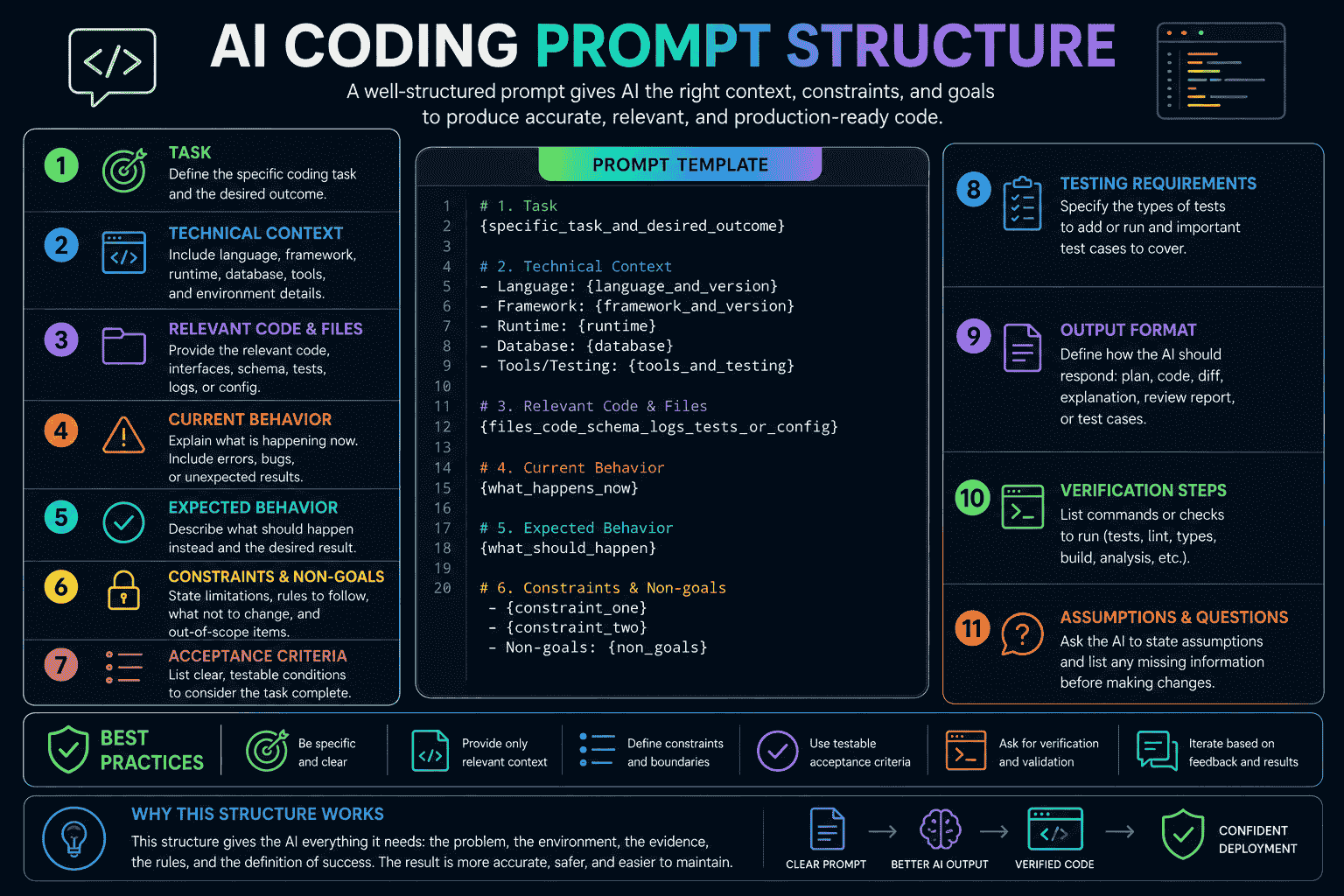
How to Write Better AI Coding Prompts
Step 1 Define the Development Outcome
Describe what must be true when the task is complete.
Instead of:
Add search.
Use:
Add server-side product search by name and SKU with pagination, case-insensitive matching, and a maximum page size of 50.
Step 2 Identify the Smallest Relevant Scope
Do not provide an entire repository when the task involves one isolated function.
Do not provide only one function when the bug depends on its caller, schema, and transaction boundaries.
The goal is useful context, not maximum context.
Step 3 Describe the Existing Pattern
Point to an implementation the AI should follow.
Use the same validation, error handling, dependency injection, and test structure as the existing createCustomer workflow in src/customers.Step 4 Separate Facts From Assumptions
Facts:
- The endpoint currently returns a 500 error.
- The failure occurs only when the cache is empty.
- The application uses Redis.
Assumption:
- The cache read may return a different value type than the service expects.
Ask the AI to verify the assumption rather than treating it as established truth.
Step 5 Include Evidence
Useful debugging evidence includes:
- Exact error messages
- Stack traces
- Logs
- Request and response examples
- Failing tests
- Database records
- Recent code changes
- Environment differences
Remove secrets, credentials, personal data, and sensitive production information before sharing evidence.
Step 6 Define Boundaries
Tell the AI what it can change.
Allowed changes:
- src/invoices/invoice.service.ts
- src/invoices/invoice.repository.ts
- tests/invoices/

Do not modify:
- Public API response types
- Database schema
- Authentication middleware
- Other billing modules
Step 7 Request a Plan Before a Large Change
For a multi-file or architecture-sensitive task, separate planning from implementation.
First inspect the relevant files and return:
1. Your understanding of the current flow
2. The likely root cause
3. The files that need modification
4. The proposed implementation
5. Risks and edge cases
6. The tests you would add

Do not edit code until the plan is reviewed.
Step 8 Require Verification
An implementation is not complete merely because code was generated.
Request evidence such as:
- Compilation result
- Test results
- Type-checking result
- Linting result
- Static-analysis result
- Migration validation
- Performance measurements
Step 9 Review the Result
Check whether the solution:
- Solves the stated problem
- Matches the architecture
- Preserves public behavior
- Handles failure paths
- Uses trustworthy dependencies
- Introduces security risks
- Includes meaningful tests
- Changes only the intended scope
Step 10 Refine One Issue at a Time
Instead of asking for a complete rewrite after the first output, use focused refinement instructions.
Examples:
- Keep the implementation, but remove the new dependency.
- Add a transaction around the read-and-write operations.
- Preserve the existing public type.
- Add a regression test for empty input.
- Reduce duplication between these two handlers.
- Explain why this query still performs a full table scan.
AI Coding Prompts for Code Generation
1. Generate a New Function
Implement a {function_name} function in {language}.

Purpose:
{what_the_function_should_do}

Inputs:
{input_types_and_examples}

Expected output:
{output_type_and_examples}

Rules:
- {business_rule_one}
- {business_rule_two}
- {business_rule_three}

Edge cases:
- Empty input
- Invalid input
- Duplicate values
- Boundary values
- Dependency failure

Constraints:
- Follow the style of {reference_file_or_function}
- Do not add external dependencies
- Preserve strict typing
- Do not mutate the input

Return:
1. The implementation
2. Unit tests
3. A short complexity analysis
4. Any assumptions
2. Implement a Feature in an Existing Repository
Implement {feature} in the existing repository.

First inspect:
{relevant_files_and_directories}

Project conventions:
{architecture_and_patterns}

Functional requirements:
- {requirement_one}
- {requirement_two}
- {requirement_three}

Non-functional requirements:
- {performance_security_accessibility_or_compatibility_requirements}

Constraints:
- Modify only {allowed_scope}
- Do not add dependencies without explaining why
- Preserve existing public interfaces
- Follow current error handling and logging patterns

Acceptance criteria:
{acceptance_criteria}

Testing:
Add tests for the happy path, invalid input, permission failure, dependency failure, and regression behavior.

Before implementing, summarize the current flow and propose a concise plan.
AI Coding Prompts for Debugging
3. Root-Cause Debugging Prompt
Investigate the following bug and identify the root cause before proposing a fix.

Technical environment:
{language_framework_runtime_database}

Observed behavior:
{observed_behavior}

Expected behavior:
{expected_behavior}

Reproduction steps:
{steps}

Error message or stack trace:
{error}

Relevant code:
{code_or_files}

Recent changes:
{recent_changes}

Return:
1. A concise description of the failure
2. The most likely root-cause hypotheses, ranked by likelihood
3. Evidence supporting or contradicting each hypothesis
4. Additional logging or tests needed to confirm the cause
5. The smallest safe fix
6. A regression test

Do not recommend a code change until you have explained the likely cause.
4. Debug a Failing Test
Explain why this test fails and determine whether the problem is in the implementation, the test, the fixture, or the environment.

Failing test:
{test_code}

Failure output:
{failure_output}

Implementation under test:
{implementation}

Related setup:
{fixtures_mocks_configuration}

Analyze:
- The intended behavior
- The actual execution path
- Incorrect assumptions in the test
- Mock or fixture inconsistencies
- Timing, state, or environment dependencies

Then propose the smallest correction and explain why it is correct. Preserve the intended product behavior instead of changing production code merely to satisfy a flawed test.
5. Debug an Intermittent Failure
Investigate an intermittent failure in {component_or_service}.

Frequency:
{frequency}

Environments affected:
{environments}

Symptoms:
{symptoms}

Relevant logs and timestamps:
{logs}

Concurrency or timing details:
{details}

Recent changes:
{changes}

Focus on:
- Race conditions
- Shared mutable state
- Unawaited asynchronous work
- Retry behavior
- Timeouts
- Clock dependencies
- Test isolation
- Connection-pool exhaustion
- Event ordering

Return a hypothesis table with probability, supporting evidence, confirmation method, and potential fix. Do not present an unverified hypothesis as the confirmed root cause.
AI Coding Prompts for Explaining Code
6. Explain an Unfamiliar Module
Explain how the following module works for a developer who is new to this repository.

Module:
{code_or_files}

Include:
1. Its responsibility
2. Main inputs and outputs
3. Control flow
4. Important dependencies
5. State changes
6. Error paths
7. External side effects
8. Important business rules
9. Tests that document its behavior
10. Risks or confusing areas

Use the terminology already used in the codebase. Do not invent behavior that is not supported by the provided code.
7. Trace a Request Through the Codebase
Trace how {request_or_event} moves through this repository.

Starting point:
{endpoint_handler_event_or_command}

Follow the execution through:
- Routing
- Middleware
- Validation
- Authorization
- Service logic
- Repository or external API calls
- Database changes
- Response creation
- Error handling

For every step, identify the relevant file and function.

End with:
1. A sequence summary
2. The main business rules
3. Possible failure points
4. The tests that cover the flow
5. Areas where the code behavior remains unclear
AI Coding Prompts for Code Review
8. Comprehensive Code Review Prompt
Review the following change as if it were a pull request.

Change:
{diff_or_files}

Task requirements:
{requirements}

Repository conventions:
{conventions}

Review for:
- Functional correctness
- Missing edge cases
- Error handling
- Security vulnerabilities
- Authorization boundaries
- Data consistency
- Concurrency risks
- Performance
- Maintainability
- Architecture consistency
- Backward compatibility
- Test quality
- Documentation

Group findings as:
1. Critical issues
2. Important issues
3. Suggestions
4. Good practices

For every issue include:
- File and location
- Explanation
- Realistic failure scenario
- Recommended correction
- Whether the issue should block merging

Do not invent issues solely to fill every category.
9. Review a Pull Request Against Requirements
Compare this pull request with the original requirements.

Requirements:
{requirements}

Pull request description:
{description}

Diff:
{diff}

Tests:
{tests}

Determine:
- Which requirements are fully implemented
- Which requirements are partially implemented
- Which requirements are missing
- Whether any unrelated behavior changed
- Whether acceptance criteria are covered by tests
- Whether the PR introduces compatibility or migration risks

Return a requirements traceability table followed by prioritized review comments.
AI Coding Prompts for Refactoring
10. Behavior-Preserving Refactor
Refactor the following code without changing its observable behavior.

Code:
{code}

Goals:
- Improve readability
- Reduce duplication
- Separate responsibilities
- Improve naming
- Make the code easier to test

Must preserve:
- Public interfaces
- Return values
- Error types
- Side effects
- Logging behavior
- Existing test expectations

Constraints:
- Do not add dependencies
- Avoid introducing abstractions used only once
- Keep the refactor within {scope}

First identify the main maintainability problems. Then provide the refactored version and explain how behavior preservation is verified.
11. Reduce a Large Function
Refactor this large function into smaller units with clear responsibilities.

Function:
{function}

Existing callers:
{callers}

Tests:
{tests}

Requirements:
- Preserve the public signature
- Preserve execution order and side effects
- Keep domain rules visible
- Avoid excessive helper functions
- Improve testability
- Maintain current performance characteristics

Return:
1. A responsibility breakdown
2. The proposed function boundaries
3. Refactored code
4. Updated tests
5. Any behavior that could not be confidently preserved
AI Coding Prompts for Unit Tests
12. Generate Unit Tests
Write unit tests for the following function using {testing_framework}.

Function:
{code}

Expected behavior:
{behavior}

Dependencies:
{dependencies}

Cover:
- Standard valid input
- Minimum and maximum boundary values
- Empty values
- Invalid values
- Dependency failures
- Duplicate or repeated calls
- State changes
- Regression case: {regression}

Testing constraints:
- Follow the existing test style in {reference_test}
- Test observable behavior rather than implementation details
- Avoid unnecessary snapshots
- Use descriptive test names
- Do not mock pure internal logic unnecessarily

Return the test code and a test-case matrix explaining what each test protects.
13. Identify Missing Test Cases
Review the implementation and its current tests to identify meaningful missing coverage.

Implementation:
{implementation}

Current tests:
{tests}

Requirements:
{requirements}

Look for missing coverage involving:
- Branches
- Boundaries
- Invalid input
- Permissions
- Errors
- State transitions
- Concurrency
- Retries
- Time-dependent behavior
- Regression risks

Do not recommend tests merely to increase coverage percentage. Prioritize cases that could reveal realistic defects.
AI Coding Prompts for Integration and End-to-End Tests
14. Integration Test Prompt
Create integration tests for {workflow}.

System components:
{components}

Test environment:
{database_services_test_framework}

Workflow:
{workflow_steps}

Cover:
- Successful execution
- Invalid request
- Authentication failure
- Authorization failure
- Database constraint failure
- External dependency timeout
- Retry or idempotency behavior
- Transaction rollback
- Response schema

Use the project’s existing test setup and fixtures. Keep external services stubbed only where the current testing strategy requires it. Explain which boundaries remain untested.
15. End-to-End Test Plan
Create an end-to-end test plan for {user_journey}.

User roles:
{roles}

Supported platforms:
{browsers_devices_or_clients}

Critical flow:
{flow}

Include:
- Preconditions
- Test data
- Main path
- Validation errors
- Permission boundaries
- Network failures
- Recovery behavior
- Accessibility checks
- Mobile or responsive behavior
- Cleanup strategy

Prioritize the smallest set of stable tests that protects the most important business behavior. Avoid tests that depend on fragile visual details unless those details are requirements.
AI Coding Prompts for Frontend Development
16. Build a Frontend Component
Implement a {component_name} component in the existing {frontend_framework} application.

Purpose:
{purpose}

Props or inputs:
{inputs}

States:
- Loading
- Empty
- Success
- Validation error
- Request error
- Disabled
- Permission restricted

Interaction requirements:
{interactions}

Accessibility requirements:
- Keyboard operable
- Visible focus
- Correct semantic elements
- Accessible labels
- Screen-reader-friendly errors

Design constraints:
{design_system_or_existing_components}

Technical constraints:
- Follow the existing state-management pattern
- Do not add a UI dependency
- Preserve server-rendering compatibility
- Avoid unnecessary client-side state

Add component tests for important states and interactions.
17. Fix a Frontend State Bug
Investigate the following frontend state bug.

Component:
{component}

Current behavior:
{current_behavior}

Expected behavior:
{expected_behavior}

Reproduction:
{steps}

Relevant state:
{state_hooks_store_or_queries}

Network behavior:
{requests_and_responses}

Analyze possible:
- Stale state
- Incorrect dependency arrays
- Race conditions
- Duplicate requests
- Cache invalidation
- Derived-state errors
- Uncontrolled and controlled input conflicts
- Component unmount behavior

Explain the root cause before proposing the smallest fix. Add a regression test that fails with the current implementation.
AI Coding Prompts for Backend Development
18. Implement a Backend Service
Implement {service_or_use_case} in the existing backend.

Architecture:
{architecture}

Relevant domain rules:
{rules}

Inputs:
{inputs}

Outputs:
{outputs}

Dependencies:
{repositories_services_or_clients}

Failure cases:
{failure_cases}

Requirements:
- Validate inputs at the correct boundary
- Preserve transactional consistency
- Use the existing error types
- Avoid leaking internal errors
- Use structured logging without sensitive data
- Preserve idempotency where applicable
- Keep business logic outside transport handlers

Add unit tests for domain behavior and integration tests for the main persistence boundary.
19. Background Job Prompt
Implement a background job for {job_purpose}.

Trigger:
{schedule_event_or_queue}

Input payload:
{payload}

Processing steps:
{steps}

Requirements:
- The job must be idempotent
- Failed items must be retryable
- Permanent failures must be recorded
- Duplicate delivery must not duplicate side effects
- Logs must include a correlation ID
- Sensitive values must not be logged
- Processing must respect {rate_limit_or_batch_size}
- Shutdown must not leave items in an ambiguous state

Define the retry strategy, failure categories, observability, and tests before writing the implementation.
AI Coding Prompts for APIs
20. Design a REST API Endpoint
Design and implement a REST endpoint for {operation}.

Method and path:
{method_and_path}

Authentication:
{authentication}

Authorization:
{authorization_rules}

Request:
{request_schema}

Response:
{response_schema}

Business rules:
{rules}

Errors:
{error_cases_and_status_codes}

Requirements:
- Validate all external input
- Follow existing API naming and error conventions
- Avoid exposing sensitive internal details
- Preserve idempotency where required
- Support pagination or limits where applicable
- Add rate-limit considerations
- Document the endpoint
- Add unit and integration tests

Return the API contract, implementation plan, code changes, and test cases.
21. Review an API Contract
Review this API contract before implementation.

Contract:
{openapi_schema_or_description}

Consumers:
{clients}

Review for:
- Clear resource naming
- HTTP method and status-code semantics
- Request validation
- Response consistency
- Pagination
- Filtering and sorting
- Idempotency
- Error format
- Authentication and authorization
- Versioning
- Backward compatibility
- Rate limiting
- Sensitive-data exposure

Return blocking issues, compatibility risks, and a revised contract where necessary.
AI Coding Prompts for Databases and SQL
22. Optimize a SQL Query
Analyze and optimize this SQL query.

Database:
{database_and_version}

Query:
{query}

Schema:
{relevant_schema}

Indexes:
{indexes}

Approximate table sizes:
{row_counts}

Execution plan:
{explain_output}

Performance target:
{target}

Preserve:
- Exact result semantics
- Current transaction isolation assumptions
- Required ordering
- Null behavior

Identify:
1. The main bottleneck
2. Unnecessary scans, joins, sorting, or repeated work
3. Index opportunities and their write-cost tradeoffs
4. A revised query
5. How to benchmark the change
6. Risks to other workloads

Do not recommend an index without explaining why the query planner can use it.
23. Plan a Database Migration
Plan a safe migration for {schema_change}.

Database:
{database}

Current schema:
{current_schema}

Target schema:
{target_schema}

Application behavior:
{behavior}

Data volume:
{volume}

Availability requirements:
{requirements}

Include:
- Forward migration
- Data backfill
- Compatibility phase
- Deployment order
- Validation queries
- Monitoring
- Rollback strategy
- Locking and performance risks
- Cleanup phase

The application must remain compatible during a rolling deployment. Separate schema expansion, application changes, data migration, and schema cleanup where necessary.
AI Coding Prompts for Performance Optimization
24. Performance Investigation Prompt
Investigate the performance problem in {system_or_endpoint}.

Observed metric:
{latency_memory_cpu_throughput}

Baseline:
{baseline}

Target:
{target}

Workload:
{workload}

Profiling data:
{profiles_traces_or_query_plans}

Relevant code:
{code}

Analyze:
- Algorithmic complexity
- Repeated computation
- I/O
- Database access
- Network calls
- Serialization
- Caching
- Memory allocation
- Concurrency
- Lock contention

Return:
1. Evidence-based bottlenecks
2. Recommended measurements
3. Optimizations ranked by expected impact and risk
4. The smallest useful change
5. A benchmark plan

Do not optimize solely from code appearance when profiling evidence is available.
AI Coding Prompts for Security Reviews
25. Security-Focused Code Review
Perform a defensive security review of the following code.

Code:
{code_or_diff}

Application context:
{context}

Trust boundaries:
{external_inputs_users_services_and_databases}

Sensitive assets:
{credentials_personal_data_payments_or_permissions}

Review for:
- Input validation
- Injection risks
- Authentication
- Authorization
- Session handling
- Sensitive-data exposure
- Secret handling
- Cryptographic misuse
- Path or file access
- Server-side request risks
- Unsafe deserialization
- Race conditions
- Dependency risk
- Error and logging exposure
- Abuse and rate-limit concerns

For every finding include:
- Severity
- Affected location
- Attack or failure scenario
- Required preconditions
- Secure remediation
- A test or verification method

Do not claim the code is secure merely because no issue was identified. Clearly state the limits of the review.
26. Review an Authentication Flow
Review this authentication flow for correctness and security.

Flow:
{code_and_description}

Authentication method:
{method}

Session or token lifecycle:
{lifecycle}

User states:
{active_disabled_unverified_or_locked}

Analyze:
- Credential validation
- Account enumeration
- Brute-force protection
- Session fixation
- Token storage
- Expiration and revocation
- Password reset
- Multi-factor behavior
- Cross-site request protections
- Authorization after authentication
- Logging and audit requirements

Return prioritized findings and secure design recommendations. Do not replace established security libraries with custom cryptographic code.
AI Coding Prompts for Documentation
27. Document a Module
Create developer documentation for the following module.

Code:
{files}

Audience:
{audience}

Include:
- Purpose
- Responsibilities
- Public interfaces
- Data flow
- Dependencies
- Configuration
- Examples
- Error behavior
- Testing
- Operational considerations
- Known limitations

Base every statement on the provided code and existing documentation. Mark behavior that cannot be confirmed instead of inventing it.
28. Generate API Documentation
Create API documentation for {endpoint_or_service}.

Source:
{implementation_schema_and_tests}

Include:
- Purpose
- Authentication
- Authorization
- Request fields
- Response fields
- Validation
- Status codes
- Error examples
- Pagination or limits
- Idempotency
- Example requests and responses
- Compatibility notes

Use the actual implementation and tests as the source of truth. Highlight any mismatch between documentation, schema, and runtime behavior.
AI Coding Prompts for Git and Pull Requests
29. Write a Pull Request Description
Create a pull request description from the following issue, commits, and diff.

Issue:
{issue}

Commits:
{commits}

Diff:
{diff}

Use this structure:
- Summary
- Problem
- Solution
- Key implementation details
- Files or systems affected
- Testing performed
- Screenshots or evidence needed
- Deployment or migration notes
- Risks
- Rollback plan
- Checklist

Do not claim tests were executed unless the provided information confirms they were executed.
30. Generate a Commit Plan
Divide this implementation into a small sequence of logical commits.

Task:
{task}

Planned changes:
{changes}

Requirements:
- Every commit should have one clear purpose
- Tests should be committed with the behavior they protect
- Avoid mixing formatting with functional changes
- Keep intermediate commits buildable when practical
- Identify dependencies between commits

Return the proposed commit order with a concise commit message and the files included in each commit.
AI Coding Prompts for Architecture and System Design
31. Architecture Decision Prompt
Evaluate architecture options for {system_or_feature}.

Business requirements:
{requirements}

Current system:
{current_architecture}

Expected scale:
{traffic_data_volume_users}

Reliability requirements:
{requirements}

Security and compliance:
{requirements}

Team constraints:
{team_skills_timeline_and_operations}

Options to evaluate:
{options}

Compare:
- Complexity
- Scalability
- Reliability
- Data consistency
- Security
- Operability
- Observability
- Cost
- Migration effort
- Vendor lock-in
- Failure modes

Return:
1. Assumptions
2. Decision criteria
3. Comparison table
4. Recommended option
5. Tradeoffs
6. Migration stages
7. Risks
8. Conditions that would change the recommendation
32. Design a New Service
Design a service for {service_purpose}.

Inputs:
{inputs}

Outputs:
{outputs}

Upstream systems:
{upstream}

Downstream systems:
{downstream}

Data ownership:
{data}

Requirements:
- {functional_requirements}
- {reliability_requirements}
- {security_requirements}
- {performance_requirements}

Include:
- Service boundaries
- API or event contracts
- Data model
- Consistency model
- Failure handling
- Retries and idempotency
- Observability
- Deployment
- Testing strategy
- Rollout and rollback

Identify which parts should remain inside the existing system instead of creating a new service.
AI Coding Prompts for Legacy Code and Migrations
33. Understand Legacy Code Before Changing It
Analyze this legacy module before proposing changes.

Code:
{files}

Known behavior:
{behavior}

Existing tests:
{tests}

Production dependencies:
{dependencies}

Return:
1. The module’s apparent responsibilities
2. Public and implicit interfaces
3. Side effects
4. Hidden coupling
5. Important business rules
6. Areas not covered by tests
7. Risks of modification
8. Characterization tests to add before refactoring

Do not modernize the code yet. The first objective is to preserve and document existing behavior.
34. Framework Migration Prompt
Create an incremental migration plan from {current_framework_or_version} to {target_framework_or_version}.

Repository context:
{context}

Constraints:
- Production must remain available
- Features will continue to be developed during migration
- Public behavior must remain compatible
- The migration must be reversible in early stages

Include:
- Compatibility assessment
- Deprecated APIs
- Dependency changes
- Build and tooling changes
- Test updates
- Incremental migration boundaries
- Dual-running or adapter strategy
- Rollout stages
- Monitoring
- Rollback
- Final cleanup

Separate mandatory migration work from optional refactoring.
AI Coding Prompts for Repository-Level Tasks
35. Repository Analysis Prompt
Analyze this repository and create an onboarding guide for a developer who will work on {area}.

Inspect:
- Repository structure
- Entry points
- Build scripts
- Configuration
- Main domain modules
- Data access
- Tests
- Deployment files
- Documentation

Return:
1. Repository overview
2. How to run it locally
3. Main request or event flows
4. Important conventions
5. Relevant files for {area}
6. Common development commands
7. Testing strategy
8. Known risks or unclear areas

Base the guide on repository evidence. Clearly label assumptions.
36. Repository-Wide Change Prompt
Plan a repository-wide change for {change}.

Before modifying code:
1. Search for every affected interface and usage
2. Identify generated files and files that should not be manually edited
3. Identify compatibility boundaries
4. Find the relevant tests and documentation
5. Propose the implementation order

Constraints:
{constraints}

Acceptance criteria:
{criteria}

Return a file-by-file plan with dependencies, risks, tests, and rollback considerations. Do not apply broad automated replacements without checking semantic differences.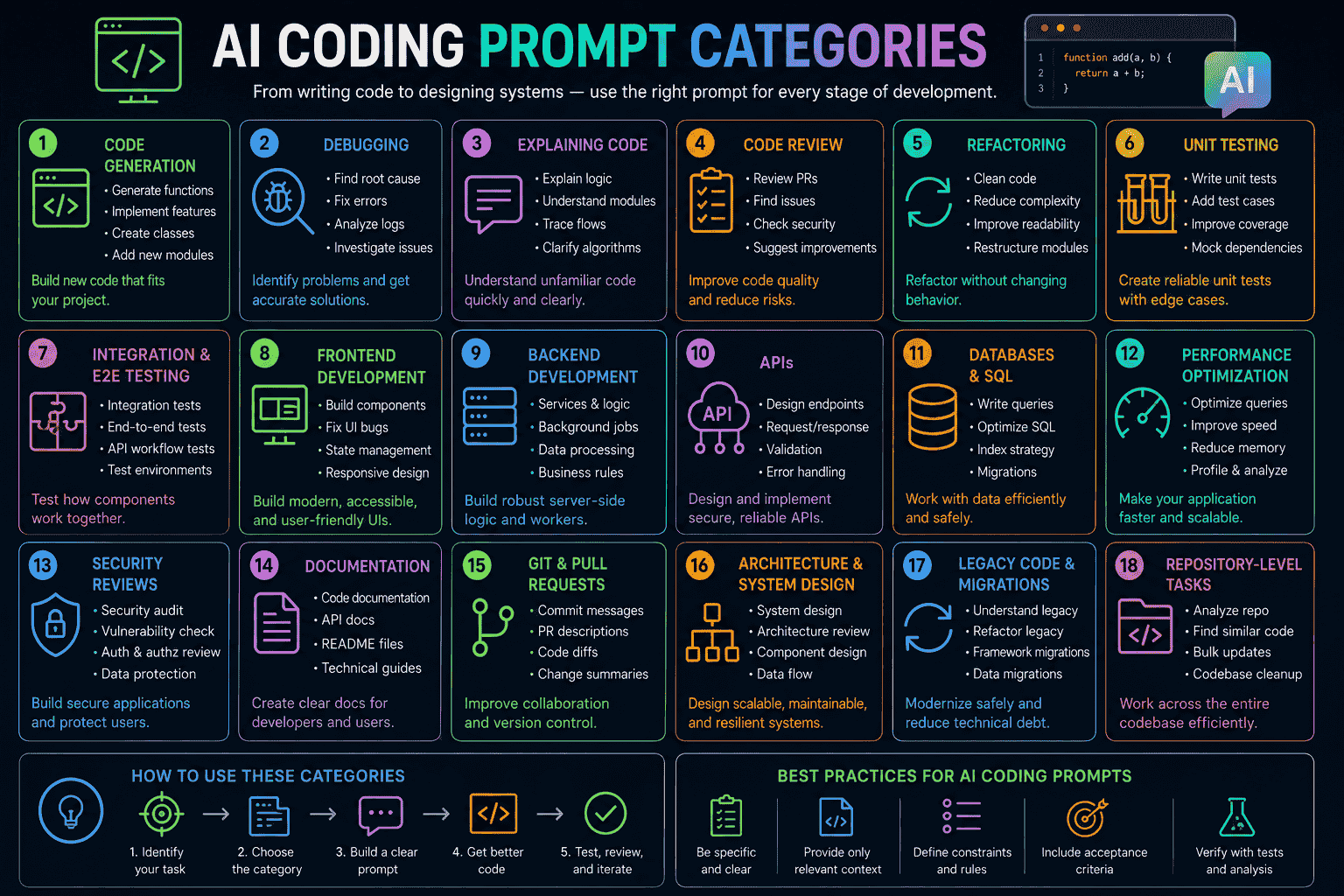
How to Provide Codebase Context
Context helps an AI produce code that fits the project rather than an isolated example.
Provide the Repository Structure
Relevant structure:
src/
  auth/
    auth.controller.ts
    auth.service.ts
    auth.repository.ts
    auth.types.ts
tests/
  auth/
db/
  schema.sql
Reference Existing Patterns
Follow the same controller, service, repository, validation, error handling, and testing pattern used in src/customers.Include Interfaces Before Implementations
Types, interfaces, schemas, and contracts often contain more important context than one implementation file.
Include Tests
Tests reveal expected behavior, naming conventions, fixtures, and edge cases.
Include Configuration Only When Relevant
Configuration may be needed for:
- Build errors
- Runtime differences
- Environment variables
- Database connections
- Module resolution
- Deployment issues
Exclude Sensitive Information
Do not include:
- API keys
- Database passwords
- Private keys
- Session tokens
- Production credentials
- Sensitive customer records
- Unnecessary proprietary code
State the Source of Truth
Use the implementation and tests as the source of truth. The README may be outdated. Highlight any inconsistency you find.Keep Context Relevant
Old conversation history and unrelated files can distract the AI.
Start a new task or reduce context when the assistant begins relying on irrelevant earlier assumptions.
How to Define Acceptance Criteria
Acceptance criteria describe observable conditions that must be satisfied.
Weak Acceptance Criterion
The page should work well.
Stronger Acceptance Criteria
Acceptance criteria:
- Results are filtered on the server
- Search is case insensitive
- Results are paginated
- Page size cannot exceed 50
- Empty queries return the default product list
- Invalid page values return a validation error
- Search terms are safely parameterized
- The URL preserves the active query
- Loading, empty, and error states are displayed
- Existing product-list behavior remains unchanged
Use Behavior That Can Be Tested
Prefer:
The operation returns within 500 milliseconds for the supplied benchmark dataset.
Instead of:
The operation should be fast.
Include Failure Behavior
Define what should happen when:
- Input is invalid
- A dependency is unavailable
- A permission check fails
- A database operation conflicts
- A retry is exhausted
Include Compatibility
Existing API consumers must continue receiving the same response fields and status codes.Include Verification
All existing tests and the new regression tests must pass. Type checking and linting must complete without new errors.How to Request Production-Ready Code
The phrase “production-ready” is not enough by itself.
It should be translated into concrete requirements.
Implement this as production-quality code for the existing repository.

Requirements:
- Follow current architecture and naming conventions
- Validate every external input
- Handle dependency failures explicitly
- Preserve authorization boundaries
- Avoid exposing secrets or internal errors
- Use structured logging without sensitive values
- Preserve idempotency where appropriate
- Use database transactions where consistency requires them
- Avoid introducing unnecessary dependencies
- Include unit and integration tests
- Document non-obvious behavior
- Preserve backward compatibility
- Include migration and rollback steps if data changes
- Run type checking, linting, tests, and relevant static analysis
- Report any command that could not be run
- Clearly state remaining risks and assumptions
Even with these instructions, the output still requires review.
No prompt can guarantee that generated code is correct, secure, performant, or compatible with every production condition.
How to Verify AI-Generated Code
1. Confirm It Solves the Correct Problem
Compare the implementation with the original requirement and acceptance criteria.
2. Read the Code
Do not approve code only because the AI explains it confidently.
3. Compile or Build the Project
Compilation can detect syntax, type, and dependency problems.
4. Run Automated Tests
Run:
- Affected unit tests
- Integration tests
- Regression tests
- End-to-end tests where appropriate
5. Run Static Analysis
Use the repository’s existing tools for:
- Linting
- Type checking
- Security scanning
- Dependency scanning
- Code quality
6. Inspect Dependencies
Check whether the generated code:
- Adds a dependency unnecessarily
- Uses a nonexistent package or API
- Uses a package incompatible with the runtime
- Introduces licensing or maintenance concerns
7. Review Security Boundaries
Pay special attention to:
- Authentication
- Authorization
- Input validation
- Database queries
- File access
- External requests
- Secrets
- Logging
- Cryptography
8. Check Failure Paths
Test how the code behaves when dependencies return errors, time out, or return unexpected values.
9. Review the Diff Scope
Make sure unrelated files or behavior were not changed.
10. Use Human Review
AI review can support a developer, but it should not automatically replace responsible human approval for important changes.
Reusable Verification Prompt
Verify the proposed change against the original task.

Original requirements:
{requirements}

Implementation:
{diff}

Tests:
{tests}

Review:
- Requirement coverage
- Correctness
- Edge cases
- Error handling
- Security
- Performance
- Architecture consistency
- Backward compatibility
- Test quality
- Dependency changes
- Documentation

Identify what is proven by the provided tests and what remains unverified. Do not claim the implementation is correct or secure without supporting evidence.
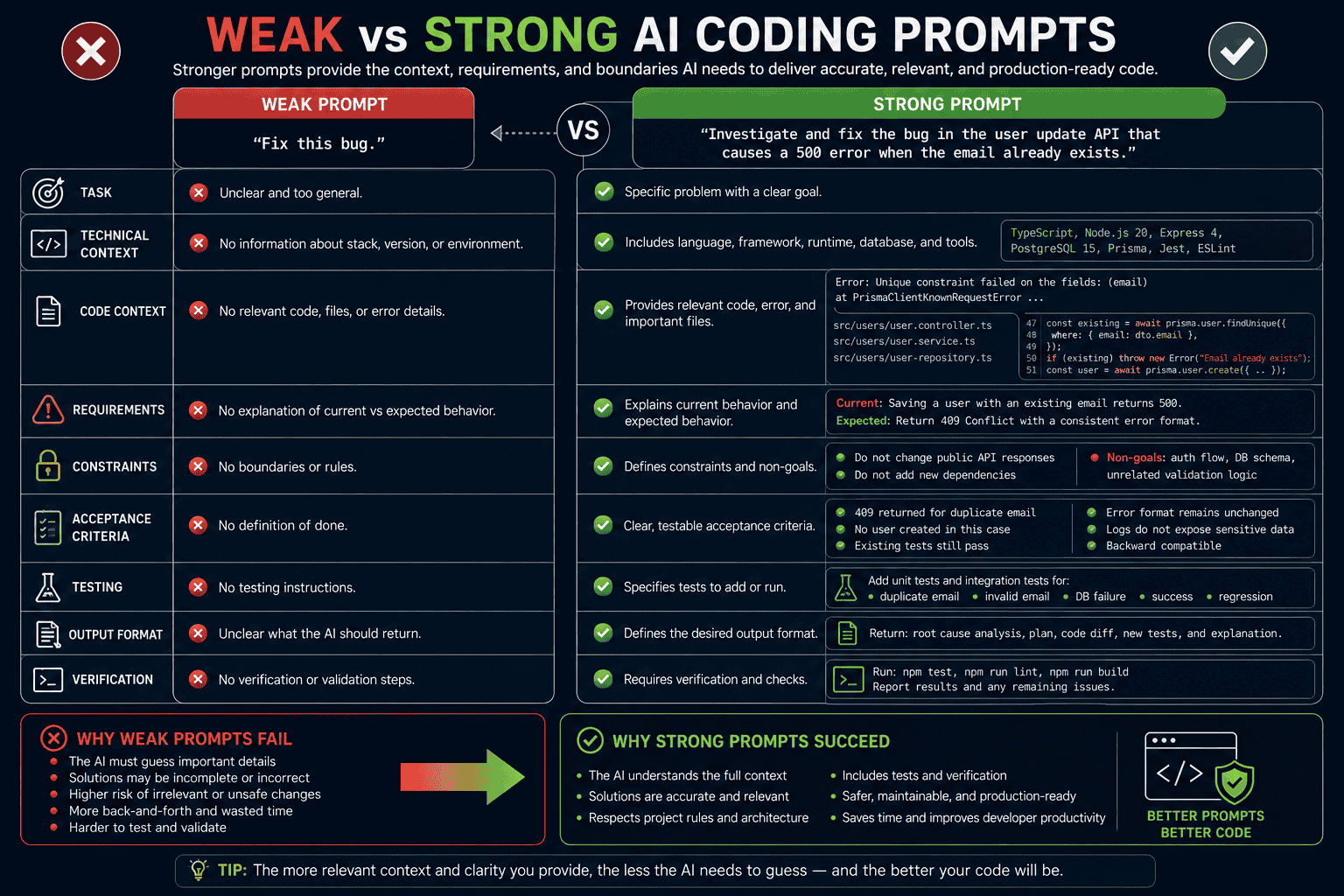
Weak vs Strong AI Coding Prompts
Example 1 Code Generation
Weak prompt:
Create a payment endpoint.
What is missing:
- Framework
- Payment provider
- Authentication
- Request and response schemas
- Idempotency
- Error handling
- Tests
- Security boundaries
Stronger prompt:
Implement POST /api/payments in the existing TypeScript and Express application. The endpoint must require the current authenticated user, validate the order ID and payment method token, confirm that the order belongs to the user, and call the existing PaymentProvider interface. Require an Idempotency-Key header and ensure repeated or concurrent requests cannot create duplicate charges. Preserve the current API error format and do not log payment tokens. Add integration tests for successful payment, invalid input, unauthorized access, duplicate keys, provider decline, provider timeout, and repository failure.
Example 2 Debugging
Weak prompt:
Why does this crash?
Stronger prompt:
Investigate why the worker crashes when processing an empty CSV file. The application uses Python 3.12, FastAPI, Celery, and pandas. The crash occurs after file validation but before the job status is updated. Review the stack trace, parser function, task handler, and current tests below. Rank the possible root causes, identify evidence for each, and propose the smallest safe fix. Add a regression test for an empty file and verify that failed jobs receive the expected status.
Example 3 Code Review
Weak prompt:
Review this code.
Stronger prompt:
Review this pull request for functional correctness, authorization errors, database consistency, concurrency risks, performance regressions, backward compatibility, and missing tests. Compare the implementation with the attached issue and acceptance criteria. Group findings by severity, provide exact locations and realistic failure scenarios, and do not invent findings simply to fill every category.
Example 4 Testing
Weak prompt:
Write tests for this function.
Stronger prompt:
Write Vitest unit tests for this invoice-total function. Cover standard items, an empty invoice, fractional quantities, percentage discounts, fixed discounts, tax rounding, negative values, maximum supported values, and the previous regression where discounts were applied after tax. Follow the structure in invoice-total.test.ts and test observable output rather than private helper functions.
Common AI Coding Prompt Mistakes
1. Asking for Code Without Explaining the Project
A standalone implementation may not fit the repository.
2. Providing Too Little Relevant Code
The visible function may depend on types, callers, schema, configuration, and tests.
3. Providing the Entire Repository Without Scope
More context is not automatically better when most of it is unrelated.
4. Omitting Current Behavior
The AI cannot reliably diagnose a difference it cannot see.
5. Omitting Expected Behavior
An error message alone does not define the intended product behavior.
6. Not Defining Acceptance Criteria
Without a definition of done, the AI may stop after producing plausible code.
7. Asking for Several Large Changes at Once
Separate planning, implementation, testing, review, and deployment.
8. Allowing Unnecessary Dependencies
Ask the AI to prefer existing utilities and explain any new dependency.
9. Trusting Generated APIs or Package Names
Verify that libraries, methods, configuration fields, and versions actually exist.
10. Asking the AI to Change Production Code to Pass a Bad Test
Determine whether the implementation or test is wrong before changing either.
11. Testing Only the Happy Path
Include boundaries, invalid input, permission failures, dependency failures, and regressions.
12. Ignoring Security
Authentication, authorization, input, secrets, and data access require deliberate review.
13. Sharing Sensitive Data
Remove credentials, keys, personal data, and unnecessary proprietary information.
14. Asking for “Production-Ready” Code Without Defining It
Translate that phrase into concrete quality, testing, security, and operational requirements.
15. Letting the AI Make Silent Assumptions
Require assumptions and missing context to be listed explicitly.
16. Accepting a Large Diff Without Review
Review every changed file and verify that the scope remains intentional.
17. Treating AI Review as Final Approval
AI feedback can miss defects or report false positives. Important changes still require human judgment.
How PrompTessor Helps With AI Coding Prompts
PrompTessor helps developers generate, analyze, optimize, refine, save, and reuse prompts for coding and software development workflows.
You can begin with a rough instruction such as:
Fix this API bug.
Prompt Generator can help transform the idea into a structured coding prompt containing:
- A specific development task
- Technical context
- Relevant files
- Current and expected behavior
- Constraints
- Non-goals
- Acceptance criteria
- Testing requirements
- Output format
- Verification steps
Prompt Analysis can help identify missing information such as:
- Undefined framework or runtime
- Missing codebase context
- Unclear expected behavior
- No reproduction steps
- Missing constraints
- No test requirements
- Undefined output format
- No acceptance criteria
Prompt Optimizer can improve a weak coding request by making the task clearer, more specific, and easier for an AI coding assistant to interpret.
Prompt Refinement can apply focused feedback such as:
- Preserve the existing public interface
- Do not add new dependencies
- Ask for a plan before implementation
- Add unit and integration tests
- Include security review requirements
- Limit changes to specific files
- Require a unified diff
- Add verification commands
- Turn the result into a reusable repository template
Developers can save effective prompts in the Prompt Library and reuse them for debugging, code review, testing, migrations, documentation, architecture, and other recurring development tasks.
For model-specific workflows, read Best ChatGPT Prompts for Work Writing Marketing and Coding in 2026 and Best Claude Prompts for Writing Coding Research and Business in 2026.
Official AI Coding Resources
These official resources provide additional guidance for AI-assisted software development:
- GitHub Copilot Prompt Engineering
- GitHub Guide to Reviewing AI-Generated Code
- OWASP Guidance for Reviewing AI-Assisted Code
- OpenAI Codex and Repository Instructions
- Gemini Code Assist Codebase Context
FAQ About AI Coding Prompts
What are AI coding prompts?
AI coding prompts are instructions that guide an AI assistant through software development tasks such as code generation, debugging, code review, testing, refactoring, documentation, architecture, and repository changes.
What makes a good AI coding prompt?
A good AI coding prompt defines the task, technical environment, relevant code, current behavior, expected behavior, constraints, acceptance criteria, testing requirements, output format, and verification process.
How detailed should an AI coding prompt be?
It should contain enough relevant information to reduce important ambiguity without including unrelated code or unnecessary history. More detail is useful only when it affects the implementation.
Should I include the programming language and framework?
Yes. Include the language, framework, runtime, database, testing tools, and other dependencies when they affect how the task should be implemented.
Should I paste my entire codebase into the prompt?
Usually not. Provide the relevant files, interfaces, tests, schemas, configuration, and examples needed to understand the task. Repository-aware coding agents may inspect additional files when permitted.
How do I write a debugging prompt?
Include the observed behavior, expected behavior, reproduction steps, exact errors, relevant code, logs, environment, and recent changes. Ask the AI to identify and verify the root cause before proposing a fix.
How do I ask AI to review code?
Provide the requirements, diff, relevant repository conventions, and review priorities. Ask for findings grouped by severity with exact locations, realistic failure scenarios, and recommended fixes.
Can AI write unit tests?
AI can help generate unit tests, but the prompt should define the expected behavior, test framework, important boundaries, errors, regressions, and existing test conventions. Developers should still review whether the tests are meaningful.
Can AI-generated code be trusted?
AI-generated code should be treated as a proposed implementation. It should be reviewed, compiled, tested, scanned, and evaluated against the project requirements before use.
How do I prevent AI from changing unrelated code?
Define the allowed files, prohibited areas, public interfaces that must remain unchanged, and non-goals. Review the resulting diff before accepting it.
How do I ask for production-ready code?
Define what production-ready means for the project, including validation, error handling, security, logging, transactions, compatibility, testing, documentation, deployment, observability, and rollback requirements.
Should I ask AI to plan before coding?
Planning first is useful for large, multi-file, security-sensitive, or architecture-sensitive tasks. Ask the AI to inspect the relevant code, explain the current flow, list assumptions, identify affected files, and propose tests before editing.
Can the same coding prompt work with ChatGPT, Claude, Gemini, Copilot, and Codex?
The same core structure can be adapted across tools. However, chat assistants, IDE assistants, and repository agents may receive context differently and may have different abilities to inspect files, execute commands, or modify code.
Can PrompTessor create AI coding prompts?
PrompTessor helps users generate, analyze, optimize, refine, save, and reuse structured prompts for code generation, debugging, code review, testing, refactoring, architecture, documentation, and other development workflows.
Build Better Software With Clearer Coding Prompts
A useful AI coding prompt does not simply ask for code.
It defines the problem, explains the environment, provides relevant evidence, establishes boundaries, and describes how success will be verified.
Start with one specific development outcome.
Provide the relevant files, current behavior, expected behavior, constraints, acceptance criteria, and testing requirements.
For larger tasks, ask the AI to inspect and plan before editing. For debugging, require evidence before accepting a root-cause explanation. For code review, request realistic findings rather than generic best-practice comments.
After the AI produces an implementation, review the code, run the tests, inspect dependencies, use static analysis, check security boundaries, and confirm that the change fits the existing architecture.
Once a prompt works well, turn it into a reusable template for similar features, bugs, pull requests, tests, migrations, and repository workflows.
Better AI-generated code begins with a clearer technical task and ends with responsible verification.
Build better prompts in one workspace
Generate prompts from ideas, analyze and optimize quality, refine with feedback, reverse-engineer content, and save reusable prompts in your Prompt Library.
Try PrompTessor Free