How to Prompt Claude Mythos 5.2: Best Practices for Security Research, Coding, and Examples
Claude Mythos 5.2 is not simply another AI model for writing, coding, and answering technical questions. It is designed to support demanding research tasks, including advanced cybersecurity engineering and specialized scientific work, for users with appropriate access.
That distinction matters when designing prompts.
A general coding prompt might ask an AI to fix a failing test. A security research prompt needs more information: which systems are authorized, what evidence is available, what actions are permitted, how findings should be verified, and what must happen before changes reach production.
Without those boundaries, a model can produce conclusions that look authoritative but lack supporting evidence. It may classify a hypothetical security issue as confirmed, recommend a patch without considering compatibility, or confuse a suspicious log entry with proof of an intrusion.
Advanced model capabilities do not eliminate those risks. They make accurate scope definition and verification even more important.
Anthropic released Claude Mythos 5.2 on November 9, 2026, alongside Claude Fable 5.2. The two share the same underlying model, but differ in safeguards and access requirements.
Mythos is intended for verified organizations and researchers working in areas such as cybersecurity and life sciences. Its availability is governed by Anthropic's verification programs, and the permitted activities depend on the organization's approved access.
This guide explains how to prompt Claude Mythos 5.2 for authorized security research, secure coding, vulnerability triage, threat modeling, remediation, incident response, and evidence-based research.
It includes 12 practical prompt templates, model specifications, prompting best practices, effort calibration, API configuration, migration guidance, and a checklist for evaluating the results.
The templates are illustrative. They have not been independently benchmarked by PrompTessor on Claude Mythos 5.2, and they do not grant permission to access systems or perform activities outside an approved research scope.
Quick Answer: How Should You Prompt Claude Mythos 5.2?
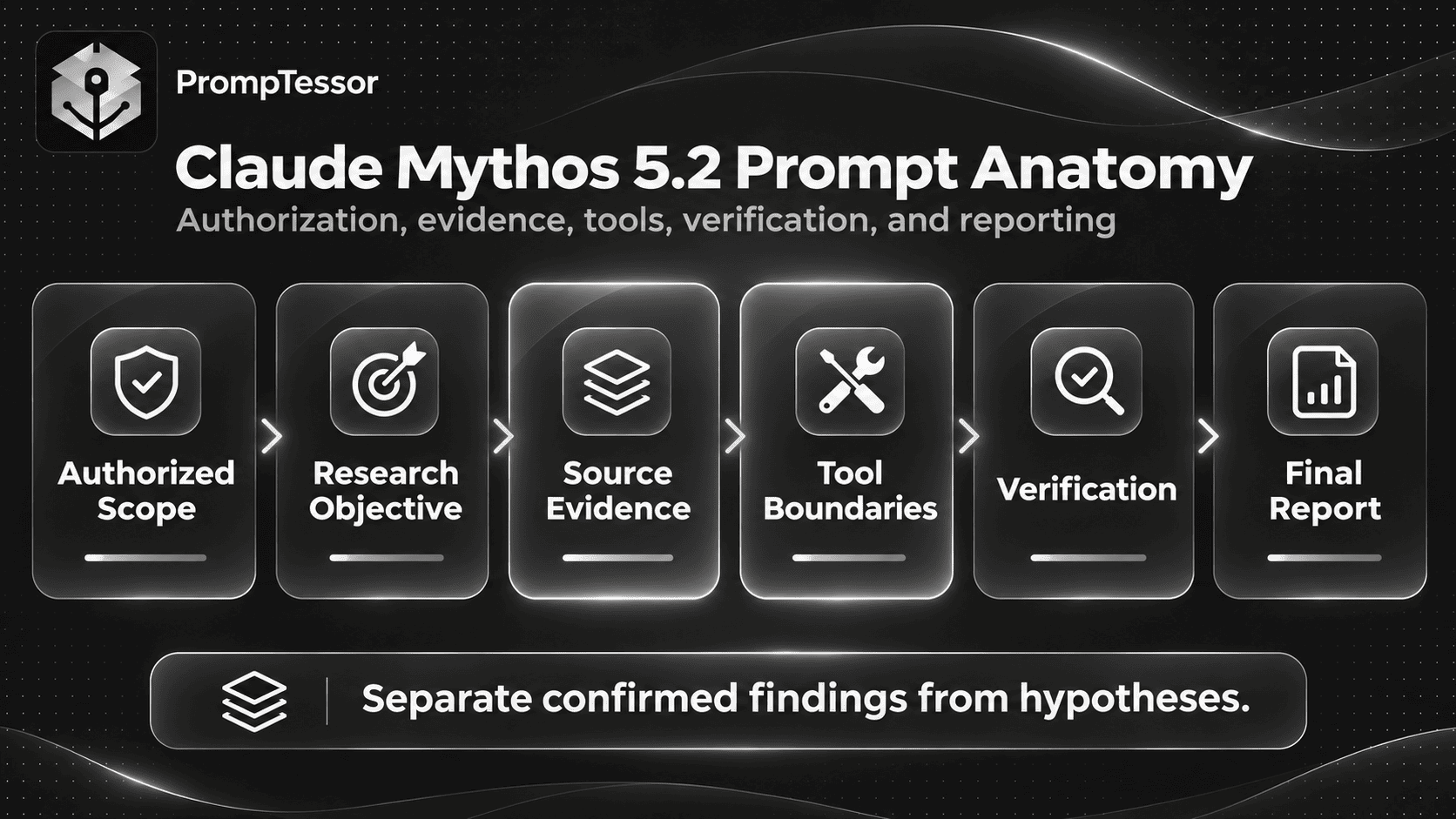
A strong Claude Mythos 5.2 prompt should define the research objective, authorized scope, available evidence, permitted tools, expected findings, verification method, and reporting requirements.
For cybersecurity tasks, the prompt should also distinguish a suspected weakness from a confirmed vulnerability, preserve original evidence, and specify which actions require human approval.
Here is a reusable starting structure:
ROLE:
Act as a defensive security
research and engineering assistant.

OBJECTIVE:
{specific_security_research_goal}

AUTHORIZED ASSETS:
{systems_repositories_or_documents}

APPROVED ACCESS:
{verification_tier_and_permissions}

SCOPE:
{included_and_excluded_work}

AVAILABLE EVIDENCE:
{source_code_logs_reports_or_advisories}

TOOLS:
{approved_read_only_or_test_tools}

ACTION BOUNDARIES:
{permitted_actions_and_approval_rules}

TASK:
Analyze the supplied evidence
and identify findings relevant
to the research objective.

REQUIREMENTS:
- Keep all work within scope.
- Do not invent vulnerabilities.
- Separate facts from hypotheses.
- Cite evidence for each finding.
- Do not claim tests were executed
  unless their results are available.
- Do not modify production systems
  without explicit authorization.
- Do not expose secrets or
  unnecessary personal information.
- Respect the approved access tier.

OUTPUT:
1. Executive summary
2. Evidence-backed observations
3. Potential security findings
4. Confidence and limitations
5. Defensive recommendations
6. Verification requirements
7. Final review checklist

COMPLETION:
The authorized analysis is complete
when findings are documented,
uncertainties are explicit,
and any remaining review actions
are clearly identified.
This is a prompt framework, not an authorization mechanism. The application must independently enforce access permissions, tool restrictions, and approval requirements.
Key Takeaways
- Claude Mythos 5.2 was released on November 9, 2026, and uses the same underlying model as Claude Fable 5.2.
- Mythos 5.2 requires verification through an applicable Anthropic program.
- Cyber Verification Program permissions differ by access tier and do not authorize unrestricted security activity.
- Its Claude API model ID is
claude-mythos-5-2. - It supports a 1 million-token context window, 128,000 maximum output tokens, and always-on adaptive thinking.
- The default effort setting is
high. Higher settings should be evaluated rather than selected automatically. - Security prompts should include target authorization, scope, action boundaries, evidence requirements, and completion criteria.
- A potential vulnerability is not a confirmed vulnerability until appropriate evidence supports that conclusion.
- Defensive code analysis should consider exploitability uncertainty, false positives, compensating controls, and operational context.
- Remediation prompts should identify intended fixes, affected components, compatibility concerns, and verification tests.
- Scientific research prompts should preserve source provenance, distinguish observations from interpretations, and respect applicable oversight.
- Long-running agents should separate progress updates from actual completion.
- Human review and technical validation remain necessary for consequential findings and production changes.
What Is Claude Mythos 5.2?
Claude Mythos 5.2 is an Anthropic frontier model available to verified users and organizations for specialized research and engineering workflows.
According to Anthropic, Mythos 5.2 and Fable 5.2 use the same underlying model. The important difference is that Fable includes stronger safeguards restricting certain cybersecurity and biology activities, while Mythos provides adjusted access for appropriately verified work.
That does not mean Mythos operates without rules or restrictions. Anthropic's Usage Policy, access conditions, verification tiers, and other safeguards continue to apply.
Claude Mythos 5.2 Specifications
| Specification | Claude Mythos 5.2 |
|---|---|
| Release date | November 9, 2026 |
| Claude API model ID | claude-mythos-5-2 |
| Context window | 1 million tokens |
| Maximum output | 128,000 tokens |
| Input and output | Text and images to text |
| Thinking | Adaptive, always on |
| Default effort | high |
| Supported effort levels | low, medium, high, xhigh, max |
| Standard input pricing | $8 per million tokens |
| Standard output pricing | $40 per million tokens |
| Reliable knowledge cutoff | June 2026 |
| Availability | Verification required |
These specifications are from the official Claude Mythos 5.2 model reference.
A large context window allows substantial research material to be included, but it does not make the material authoritative or automatically ensure that relevant details are correctly interpreted.
Claude Mythos 5.2 vs. Claude Fable 5.2
Because both models use the same underlying model, their general prompting techniques overlap.
Both support adaptive thinking, effort calibration, tool-based workflows, complex coding, and long-running tasks.
The important differences are access and safeguards.
| Area | Fable 5.2 | Mythos 5.2 |
|---|---|---|
| Underlying model | Shared | Shared |
| Availability | Generally available | Requires verification |
| Context window | 1M tokens | 1M tokens |
| Maximum output | 128K tokens | 128K tokens |
| Standard API price | $8 input / $40 output per million tokens | Same |
| Thinking | Always-on adaptive | Always-on adaptive |
| Default effort | High | High |
| Cybersecurity safeguards | Stronger restrictions on higher-risk activities | Adjusted according to verified access |
| Research access | Broad general-purpose work | Approved specialized workflows |
A developer writing ordinary application code or reviewing an authentication implementation may not need Mythos access. Anthropic states that generally available models can support everyday secure coding, known-issue remediation, and security alert triage.
Mythos becomes more relevant when an appropriately verified security team requires capabilities for work covered by its specific authorization.
For general prompting guidance, see How to Prompt Claude Fable 5.1 and How to Prompt Claude Opus 5.5.
How to Get Access to Claude Mythos 5.2
Claude Mythos 5.2 is not available merely by selecting a model name or adding a special phrase to a prompt.
Access depends on Anthropic's verification programs, the user's organization, the requested work, and applicable platform support.
Cyber Verification Program
Anthropic's Cyber Verification Program provides approved security professionals with access to advanced capabilities under different verification tiers.
| Tier | General Scope | Who Can Apply |
|---|---|---|
| Defense Access | Security operations, defensive research, incident response, detection engineering, vulnerability triage | Qualifying individuals and organizations |
| Red Team Access | Approved professional red-team and penetration-testing activities | Organizations |
| Specialized Access | Higher-risk authorized security work under additional restrictions | Qualifying organizations |
These descriptions are summaries, not grants of permission. Exact eligibility, activities, and restrictions come from Anthropic's current program terms.
Approval for one tier does not automatically authorize activities reserved for another tier.
The program also distinguishes internal use from externally provided security services, which may require separate approval.
Security testing must additionally be authorized by the owner of the relevant systems. Access to a capable model is not authorization to examine unrelated infrastructure.
Life Sciences Verification Program
Anthropic's Life Sciences Verification Program provides verified organizations with access to specialized research capabilities under approved conditions.
The program covers areas such as research biology, drug discovery, clinical development, manufacturing, and related scientific workflows. Some categories require additional review and more restrictive access.
Program approval, research credentials, institutional oversight, and applicable policies still determine which activities can be performed.
Claude Security and Enterprise Access
Anthropic also describes Claude Security, which can use its advanced models, including Mythos 5.2, for codebase security analysis.
Enterprise access to a managed security feature is not necessarily equivalent to direct, unrestricted Mythos API access. Developers should check which model capabilities and tools are actually available through their approved product or workspace.
What to Do If You Do Not Have Mythos Access
You can still use the general structure of many defensive prompts in this article with an appropriately available AI model.
However, do not claim that an output was generated or tested with Mythos unless the relevant model was actually used.
Do not attempt to bypass Anthropic's verification systems, safety classifiers, or account permissions.
How Mythos 5.2 Prompting Is Different From General Claude Prompting
The underlying model does not require an entirely separate prompt language.
The difference lies in the information that specialized workflows need.
A normal coding prompt may identify the files to change. A security prompt should additionally identify the authorized environment, threat model, available evidence, acceptable validation techniques, impact boundaries, and responsible disclosure requirements.
Five Essential Layers of a Security Research Prompt
| Layer | What to Define |
|---|---|
| Authorization | Which assets, systems, and research activities are approved |
| Evidence | What source code, logs, reports, and authoritative documentation are available |
| Analysis | Which security question or defensive outcome the model must investigate |
| Validation | How findings can be checked safely and whether additional access is required |
| Reporting | How to document observations, limitations, fixes, and disclosure decisions |
These layers help prevent two common problems: overstating unverified findings and confusing permission to analyze a document with permission to interact with a live system.
12 Practical Claude Mythos 5.2 Prompt Examples
The following examples focus on defensive research and analysis. Each template can be adapted to the approved systems, documents, and research tools available to the user.
They do not assume that the model has access to a repository, can execute security tools, or has permission to test a live environment.
Replace the variables in braces with actual information. Do not add sensitive secrets or unnecessary personal data.
Security Scope and Threat Modeling
1. Authorized Security Research Scope Prompt
Best for: Establishing the boundaries of a security research task before analysis begins.
Required input: Written authorization, asset inventory, permitted methods, exclusions, and approval contacts.
ROLE:
Act as a defensive security
research planning assistant.

RESEARCH OBJECTIVE:
{security_objective}

ASSET OWNER:
{authorized_owner}

IN-SCOPE ASSETS:
{approved_assets}

EXCLUDED ASSETS:
{excluded_assets}

APPROVED RESEARCH METHODS:
{permitted_methods}

AVAILABLE ACCESS:
{accounts_and_permissions}

APPROVAL CONTACT:
{responsible_reviewer}

TASK:
Create a security research plan
using only the supplied authorization.

Include:
1. Research objective
2. Scope boundaries
3. Evidence requirements
4. Approved tools
5. Activities needing confirmation
6. Risk controls
7. Reporting requirements
8. Completion criteria

Do not expand the scope.

Do not interpret missing
permission as authorization.

If an activity is not clearly
covered, mark it as
APPROVAL_REQUIRED.

Do not access or test any asset.

Return a plan for review.
Expected output: A research scope document that clarifies what the security team may investigate and which actions remain blocked pending approval.
Verification: Compare the plan against the original authorization and the organization's applicable security policies.
2. Application Threat Modeling Prompt
Best for: Identifying plausible security threats to an application using documented architecture and trust boundaries.
Required input: Architecture diagram, components, data flows, user roles, and existing controls.
Act as an application
security threat modeling analyst.

SYSTEM:
{application_description}

ARCHITECTURE:
{verified_architecture}

DATA FLOWS:
{data_flow_description}

TRUST BOUNDARIES:
{trust_boundaries}

SENSITIVE ASSETS:
{protected_data_and_functions}

EXISTING CONTROLS:
{implemented_controls}

TASK:
Build a structured threat model.

For each component identify:
- Security assumptions
- Relevant trust boundaries
- Plausible threat categories
- Existing mitigations
- Missing evidence
- Defensive design recommendations

Use an appropriate framework
such as STRIDE when useful.

Separate:
CONFIRMED DESIGN FACT
POTENTIAL THREAT
UNVERIFIED CONTROL

Do not invent implementation details.

Do not assume a missing control
in the diagram is absent
from the actual system.

Do not provide instructions
for attacking live targets.

OUTPUT:
1. Asset and boundary map
2. Threat assessment table
3. Defensive control review
4. Prioritized questions
5. Verification checklist
Expected output: A threat model that links system components and trust boundaries to possible security concerns.
Verification: Review with engineers who understand the actual architecture, configuration, and deployed controls.
Secure Code Review and Vulnerability Triage
3. Defensive Secure Code Review Prompt
Best for: Reviewing authorized source code for potential security weaknesses and identifying appropriate defensive improvements.
Required input: Relevant source code, framework details, configurations, and existing tests.
ROLE:
Act as a senior application
security code reviewer.

AUTHORIZED REPOSITORY:
{repository_scope}

LANGUAGE AND FRAMEWORK:
{technology_stack}

CODE UNDER REVIEW:
{source_files}

KNOWN SECURITY REQUIREMENTS:
{security_requirements}

RELEVANT CONFIGURATION:
{configuration}

TASK:
Review the supplied code
for potential security weaknesses.

Focus on:
- Authentication and authorization
- Input handling and validation
- Sensitive data exposure
- Access control boundaries
- Error handling
- Unsafe defaults
- Security-relevant dependencies

For each finding provide:
1. Affected file and location
2. Observed code behavior
3. Potential security consequence
4. Evidence supporting the concern
5. Confidence level
6. Defensive remediation
7. Appropriate verification tests

Do not invent code paths.

Do not claim exploitability
has been demonstrated
without supporting evidence.

Do not generate attack payloads
or execute tests against live systems.

Return a code review report
for human validation.
Expected output: A source-backed security review with proposed fixes and a clear distinction between potential and confirmed issues.
Verification: Confirm findings against the full execution context and the actual deployed configuration. A suspicious pattern does not always imply a practically exploitable weakness.
4. Vulnerability Report Triage Prompt
Best for: Evaluating an existing vulnerability report or scanner finding before remediation prioritization.
Required input: Report text, asset information, affected versions, evidence, and known controls.
ROLE:
Act as a defensive vulnerability
triage analyst.

FINDING:
{reported_issue}

AFFECTED ASSET:
{authorized_asset}

SOURCE OF REPORT:
{scanner_advisory_or_researcher}

AVAILABLE EVIDENCE:
{supporting_records}

PRODUCT VERSION:
{verified_version}

EXISTING CONTROLS:
{mitigations}

TASK:
Assess the report's
evidence and remediation priority.

Classify findings as:
CONFIRMED
PLAUSIBLE
INSUFFICIENT_EVIDENCE
NOT_APPLICABLE

For each finding explain:
- Technical basis
- Affected component
- Evidence quality
- Potential business impact
- Relevant exposure conditions
- Uncertainty
- Recommended defensive action
- Verification needed

Do not assume a scanner
finding is automatically correct.

Do not invent a CVE identifier.

Do not assign a precise
CVSS score without sufficient
information and methodology.

Do not perform live exploitation.

OUTPUT:
- Triage table
- Evidence assessment
- Priority rationale
- Remediation recommendations
- Open questions
Expected output: A vulnerability triage report that identifies which issues need immediate attention and which require further evidence.
Verification: Confirm versions, affected components, environmental conditions, and any official vendor advisories before changing production systems.
5. Dependency Security Advisory Analysis Prompt
Best for: Understanding whether published dependency vulnerabilities affect a particular authorized application.
Required input: Dependency inventory, lockfiles, vendor advisories, and implementation context.
ROLE:
Act as a software supply
chain security analyst.

APPLICATION:
{application}

DEPENDENCY INVENTORY:
{sbom_or_lockfile}

SECURITY ADVISORIES:
{official_advisories}

DEPLOYED VERSIONS:
{version_inventory}

RELEVANT USAGE:
{dependency_usage_context}

TASK:
Evaluate the supplied advisories
against the actual dependencies.

For each advisory:
1. Identify the affected package.
2. Check the installed version.
3. Compare advisory version ranges.
4. Identify whether the package
   is present in the relevant build.
5. Explain uncertainty about
   application exposure.
6. Identify available vendor fixes.
7. Recommend upgrade validation.

Do not invent CVE IDs,
affected versions, or patches.

Do not equate package presence
with confirmed exploitability.

Do not change dependencies
without explicit authorization.

OUTPUT:
- Dependency risk table
- Version compatibility notes
- Patch recommendations
- Verification checklist
- Outstanding unknowns
Expected output: A dependency risk assessment grounded in actual package versions and advisory information.
Verification: Cross-check original vendor advisories, package manifests, and compatibility tests. Do not rely on a model's remembered vulnerability information for current security decisions.
Remediation and Secure Development
6. Security Root-Cause Analysis Prompt
Best for: Explaining why a confirmed security defect occurred and what changes could prevent recurrence.
Required input: Confirmed finding, relevant code, incident or test evidence, and system architecture.
ROLE:
Act as a secure software
engineering analyst.

CONFIRMED SECURITY ISSUE:
{finding}

SUPPORTING EVIDENCE:
{verified_evidence}

AFFECTED COMPONENT:
{component}

RELEVANT SOURCE:
{source_code}

EXPECTED SECURITY INVARIANT:
{required_behavior}

TASK:
Analyze the root cause
and propose defensive corrections.

Address:
1. The violated security invariant
2. The relevant implementation behavior
3. Contributing design assumptions
4. Possible affected code paths
5. Suitable remediation approaches
6. Regression prevention
7. Additional evidence needed

Separate the confirmed root cause
from plausible contributing factors.

Do not invent historical events.

Do not claim unrelated modules
are affected without evidence.

Do not create exploit instructions.

OUTPUT:
- Root cause analysis
- Evidence references
- Proposed corrections
- Regression test plan
- Remaining uncertainty
Expected output: A technical root-cause analysis that supports engineering decisions and future prevention.
Verification: Validate the conclusions with maintainers who understand the affected code and deployment environment.
7. Secure Code Remediation Prompt
Best for: Preparing a focused patch for an established security issue in an authorized repository.
Required input: Confirmed defect, source code, desired secure behavior, tests, and allowed change scope.
ROLE:
Act as a senior software engineer
responsible for an approved
security remediation.

OBJECTIVE:
Fix {confirmed_security_issue}.

AUTHORIZED CODEBASE:
{repository}

RELEVANT FILES:
{source_files}

EXPECTED SECURE BEHAVIOR:
{acceptance_criteria}

APPROVED CHANGE SCOPE:
{scope}

TEST ENVIRONMENT:
{authorized_test_environment}

TASK:
1. Inspect the affected logic.
2. Explain the confirmed cause.
3. Propose a minimal correction.
4. Implement approved changes
   when appropriate tools exist.
5. Update relevant regression tests.
6. Review compatibility and side effects.

RULES:
- Preserve unrelated behavior.
- Avoid unnecessary refactors.
- Do not weaken security controls.
- Do not modify production data.
- Do not deploy without approval.
- Do not invent test results.

VERIFICATION:
Run available authorized tests.
Inspect the final diff.
Document any unavailable checks.

FINAL OUTPUT:
- Root cause
- Patch summary
- Files changed
- Test evidence
- Remaining risks
Expected output: A reviewable defensive code change or patch proposal with traceable verification.
Verification: Run the appropriate test suite and perform human review before merging or deploying. A model-generated patch is not a substitute for testing.
8. Security Regression Test Design Prompt
Best for: Designing tests that verify a known security fix without constructing an operational attack procedure.
Required input: Security invariant, patch details, affected interfaces, and authorized test environment.
ROLE:
Act as a software security
quality assurance specialist.

SECURITY REQUIREMENT:
{required_property}

CONFIRMED DEFECT:
{defect_description}

PROPOSED FIX:
{patch_description}

AFFECTED INTERFACE:
{interface}

AUTHORIZED TEST ENVIRONMENT:
{test_environment}

TASK:
Design defensive regression
tests for the security requirement.

Include:
1. Valid authorized behavior
2. Rejected unauthorized behavior
3. Boundary and error handling
4. Relevant role or permission checks
5. Logging and monitoring expectations
6. Compatibility requirements

For each test describe:
- Purpose
- Test inputs as safe abstract cases
- Expected result
- Evidence of passing behavior
- Required environment
- Dependencies

Do not test production systems.

Do not generate reusable
attack payloads or stealth techniques.

Do not claim tests have passed
unless actual results are provided.

OUTPUT:
- Test matrix
- Suggested test structure
- Coverage gaps
- Execution checklist
Expected output: A test plan that allows engineers to confirm the intended security behavior and reduce regressions.
Verification: Run tests in an approved environment and compare results against the defined security requirements.
Security Operations and Incident Analysis
9. Security Alert and Log Triage Prompt
Best for: Analyzing authorized security telemetry without assuming that unusual activity proves compromise.
Required input: Security alerts, sanitized logs, known baselines, and asset context.
ROLE:
Act as a security operations
alert triage assistant.

ALERT DETAILS:
{alerts}

LOG RECORDS:
{sanitized_logs}

TIME PERIOD:
{time_window}

ASSET CONTEXT:
{affected_assets}

KNOWN BASELINE:
{expected_activity}

AVAILABLE INCIDENT HISTORY:
{related_records}

TASK:
Identify observations that
may require analyst attention.

For each alert explain:
1. What the records show
2. Relevant timestamps
3. Supporting log references
4. Possible benign explanations
5. Potential security implications
6. Confidence and uncertainty
7. Additional evidence needed
8. Recommended defensive review

RULES:
- Do not invent log events.
- Do not equate anomalies
  with confirmed compromise.
- Do not expose credentials.
- Do not attribute an attack
  to a named actor without evidence.
- Do not execute response actions
  without authorization.

OUTPUT:
- Alert triage table
- Timeline of observed events
- Evidence and limitations
- Recommended next investigations
- Escalation criteria
Expected output: A prioritized analyst review that preserves the distinction between suspicious observations and verified incidents.
Verification: Confirm timestamps, log completeness, ingestion delays, environmental baselines, and related events before escalating conclusions.
10. Defensive Detection Engineering Prompt
Best for: Designing monitoring requirements and detection hypotheses for a known security concern.
Required input: Threat model, telemetry capabilities, existing alerts, and authorized monitoring scope.
ROLE:
Act as a defensive
detection engineering advisor.

SECURITY OBJECTIVE:
{detection_goal}

APPROVED ENVIRONMENT:
{environment}

KNOWN THREAT SCENARIO:
{documented_scenario}

AVAILABLE TELEMETRY:
{log_sources}

EXISTING DETECTIONS:
{current_rules}

OPERATIONAL CONSTRAINTS:
{constraints}

TASK:
Design a defensive
detection improvement plan.

Include:
1. Detection hypothesis
2. Required observable events
3. Relevant data sources
4. Expected normal behavior
5. Potential false positives
6. Coverage limitations
7. Safe test requirements
8. Analyst response guidance

Do not assume telemetry
exists when it is not provided.

Do not generate evasion methods.

Do not invent detection accuracy
or false-positive rates.

Do not deploy monitoring changes
without approval.

OUTPUT:
- Detection design
- Evidence requirements
- Test plan
- Quality metrics
- Deployment review checklist
Expected output: A detection design brief suitable for defensive engineering and subsequent testing.
Verification: Confirm that the relevant events are actually collected and evaluate performance using authorized, representative test data.
11. Security Incident Postmortem Prompt
Best for: Preparing an accurate incident review after a confirmed security event.
Required input: Approved timeline, incident records, response notes, impact assessment, and recovery actions.
ROLE:
Act as a security incident
postmortem editor.

INCIDENT SUMMARY:
{confirmed_incident}

VERIFIED EVENT TIMELINE:
{event_records}

AFFECTED SYSTEMS:
{systems}

CONFIRMED IMPACT:
{impact}

RESPONSE ACTIONS:
{completed_actions}

AVAILABLE EVIDENCE:
{records}

TASK:
Prepare a factual,
blameless incident review.

Include:
1. Executive summary
2. Confirmed timeline
3. Detection and escalation
4. Scope and impact
5. Contributing technical factors
6. Response effectiveness
7. Recovery verification
8. Preventive improvements
9. Owners and follow-up actions
10. Unresolved questions

Do not invent incident events.

Do not invent root causes.

Do not assign blame without
supporting evidence.

Distinguish confirmed impact
from possible exposure.

Protect sensitive information.

OUTPUT:
- Postmortem report
- Corrective action tracker
- Evidence gaps
- Review checklist
Expected output: A structured postmortem that documents what happened, what was learned, and which improvements remain necessary.
Verification: Review the chronology and impact statements with incident owners, technical teams, and appropriate legal or compliance personnel.
Advanced Scientific Research
12. Scientific Literature and Research Evidence Prompt
Best for: Synthesizing authorized scientific research without presenting unsupported mechanisms or conclusions as established facts.
Required input: Published papers, research question, methodological information, and relevant institutional guidance.
ROLE:
Act as a scientific
literature research assistant.

RESEARCH DOMAIN:
{scientific_field}

RESEARCH QUESTION:
{question}

AUTHORIZED SOURCE MATERIAL:
{papers_and_reports}

RESEARCH CONTEXT:
{approved_project_scope}

SOURCE PRIORITY:
{source_hierarchy}

TASK:
Synthesize the supplied
scientific evidence.

For each relevant study report:
1. Research objective
2. Methodology summary
3. Reported findings
4. Sample or evidence limitations
5. Conflicting results
6. Reproducibility considerations
7. Open research questions

Separate:
REPORTED RESULT
RESEARCHER INTERPRETATION
UNTESTED HYPOTHESIS

Do not invent citations,
experimental results,
or scientific consensus.

Do not recommend unapproved
high-risk experimental procedures.

Do not claim research oversight
or authorization is unnecessary.

OUTPUT:
- Evidence review
- Study comparison table
- Limitations
- Research gaps
- Questions for expert review
Expected output: A structured research synthesis with traceable source material and clearly defined uncertainty.
Verification: Compare every material claim with the original publications and follow applicable institutional and scientific oversight requirements.
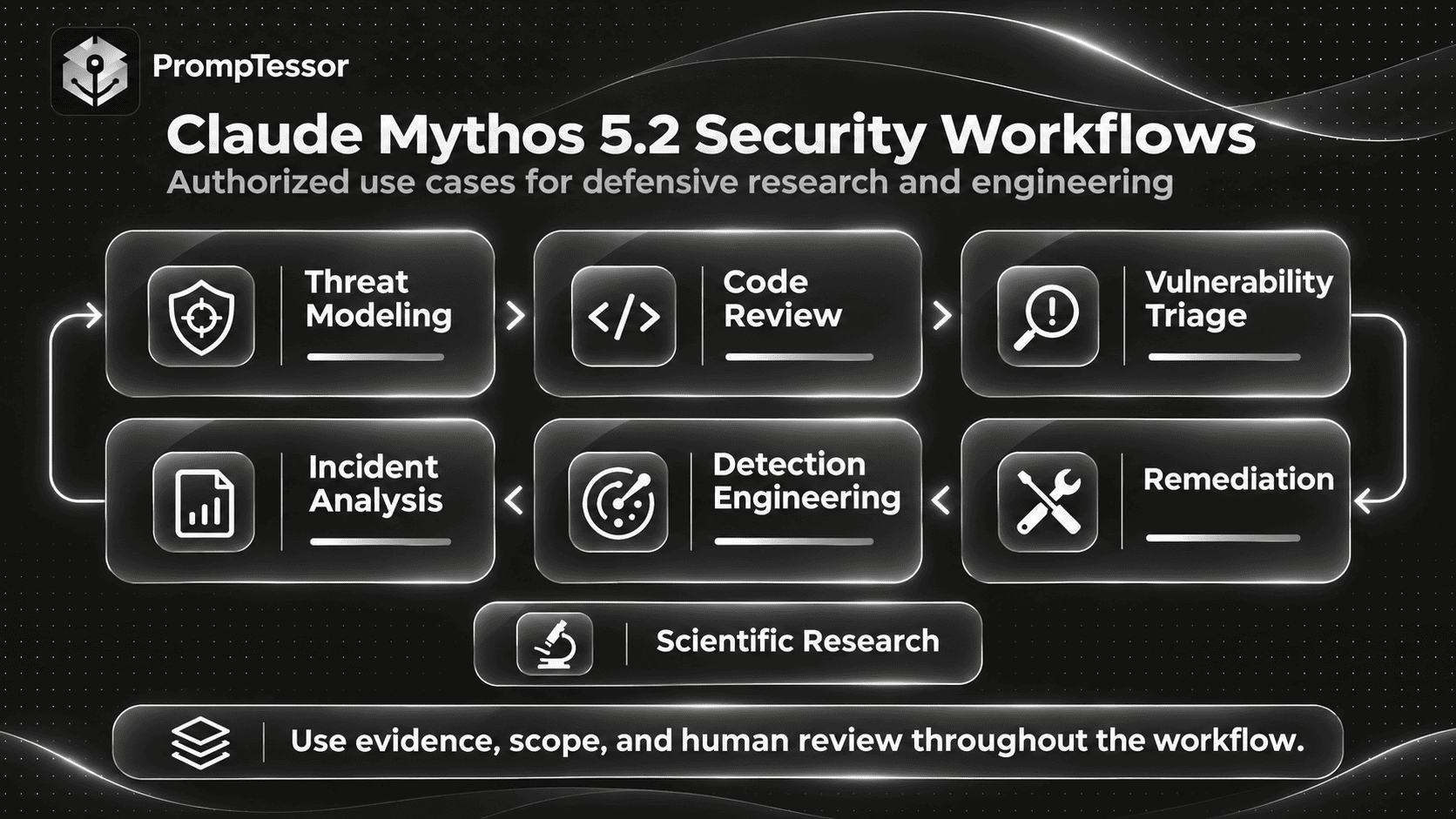
Which Claude Mythos 5.2 Prompt Should You Use?
| Goal | Recommended Prompt | Output |
|---|---|---|
| Define an approved research task | #1 Security Scope | Authorization and research plan |
| Analyze system security design | #2 Threat Modeling | Threat assessment |
| Review source code | #3 Secure Code Review | Security findings |
| Assess an existing report | #4 Vulnerability Triage | Evidence-based triage |
| Examine dependency advisories | #5 Dependency Analysis | Dependency risk assessment |
| Understand a confirmed defect | #6 Root-Cause Analysis | Cause and remediation plan |
| Prepare a secure code fix | #7 Remediation | Patch or patch proposal |
| Prevent security regressions | #8 Regression Testing | Test design |
| Investigate security alerts | #9 Alert Triage | Analyst findings |
| Improve defensive monitoring | #10 Detection Engineering | Detection design |
| Document a confirmed incident | #11 Incident Postmortem | Incident review |
| Review scientific evidence | #12 Literature Review | Research synthesis |
Practical Example: Reviewing Authentication Code With Mythos 5.2
Consider a fictional SaaS application called Northstar Desk.
Its development team wants to review the authorization logic used when users request project data.
For this demonstration, assume the team owns the repository and has approved a read-only code review. No production testing or external security activity is authorized.
Step 1: Define the Security Question
The central question is whether the application's current implementation consistently verifies that a user is permitted to access the requested project's resources.
This is an authorization review, not an instruction to bypass the application's access controls.
Step 2: Provide Relevant Context
The review should include the relevant route handlers, authorization middleware, database access logic, identity information, and tests.
If any of these are unavailable, the model should identify the missing evidence instead of assuming how they work.
Step 3: Use a Focused Prompt
OBJECTIVE:
Review the supplied project
authorization implementation.

AUTHORIZED SCOPE:
Read-only analysis of
the provided repository files.

SECURITY REQUIREMENT:
A user may access project data
only when the server has
confirmed the required permission.

SOURCE MATERIAL:
{route_handlers}
{authorization_middleware}
{database_access_logic}
{relevant_tests}

TASK:
Trace the authorization decision
through the relevant code paths.

Identify whether each path
has sufficient supporting evidence
for the required security property.

Classify observations as:
VERIFIED
POTENTIAL_ISSUE
INSUFFICIENT_EVIDENCE

Do not assume omitted files
contain or lack controls.

Do not execute code
or modify files.

Return:
- Authorization flow summary
- Code references
- Potential gaps
- Required verification
- Defensive recommendations
Step 4: Review the Findings
A useful output might identify that the available code delegates authorization to middleware, but that the middleware implementation was not included in the supplied material.
That is a research gap, not proof of a vulnerability.
Alternatively, the reviewer may identify an observable missing permission check along a specific code path. The finding should then be checked against the complete application context before being classified as confirmed.
Step 5: Prepare a Remediation Plan
After a defect is verified, use Prompt #7 to prepare an appropriate correction and Prompt #8 to design regression tests.
Keep the work in a controlled development environment and require review before release.
Step 6: Document the Result
The final report should state which files were reviewed, what was observed, which conclusions were confirmed, and what could not be established.
This creates a traceable workflow from code inspection to responsible remediation.
How to Prevent False Positives in AI Security Research
A common mistake in AI-assisted security research is presenting a possible weakness as a confirmed exploitable vulnerability.
Security findings require careful terminology because severity and exploitability depend on real system conditions.
Use a Consistent Finding Classification
CONFIRMED:
The supplied evidence
supports the stated finding.

POTENTIAL:
A plausible weakness exists,
but further validation is needed.

INSUFFICIENT EVIDENCE:
The available information
cannot establish the claim.

NOT APPLICABLE:
The concern does not apply
under the verified system context.

REMEDIATED:
A fix has been implemented
and the required verification
has been completed.
Do not use REMEDIATED simply because the model generated a patch. The relevant tests and review must actually have occurred.
Separate Severity From Confidence
A potentially severe issue may still have limited supporting evidence.
For each finding, report both the possible impact and the confidence in the evidence.
When assigning standardized severity scores, use the relevant scoring methodology and available environmental information. Do not fabricate precision.
Preserve Evidence References
Include relevant source file locations, report identifiers, advisory dates, or log references.
Do not fabricate CVE numbers, tool results, or quotations.
Account for Compensating Controls
The application may have controls outside the supplied code fragment, such as authentication middleware, network restrictions, or service-level authorization.
Ask for missing context when it materially affects the conclusion.
Claude Mythos 5.2 Effort Levels and Research Depth
Claude Mythos 5.2 supports the same effort controls as Claude Fable 5.2.
Anthropic recommends starting with high and evaluating alternative levels against the intended workload.
| Effort | Possible Research Use | Consideration |
|---|---|---|
low | Simple report formatting and routine extraction | Lower cost, but may omit important analysis |
medium | Structured evidence summaries and ordinary review | Balanced effort for suitable tasks |
high | Complex security reviews and multistep investigations | Recommended starting point |
xhigh | Difficult, evidence-intensive work that benefits in testing | Higher latency and token consumption |
max | Exceptional research workloads with measured benefits | Highest resource demands |
Do not assume that maximum effort produces more accurate security findings.
The best setting is the lowest level that reliably meets the workflow's quality threshold.
Example: Security Research Evaluation Prompt
OBJECTIVE:
Compare prompt performance
on approved defensive
security review tasks.

TEST DATA:
{authorized_evaluation_cases}

METRICS:
- Correct findings
- False positives
- Missed known issues
- Evidence attribution
- Scope adherence
- Report completeness
- Task completion
- Latency
- Token cost

EVALUATION:
Run the same prompt and
test cases at selected
effort levels.

Use verified reference answers
or expert-reviewed results.

Do not use real unauthorized
systems as test targets.

Return a comparison report
and explain any tradeoffs.
The different effort configurations must be executed through the actual model runtime. A text prompt alone cannot run a controlled multi-setting evaluation.
Tool Use, Approvals, and Agent Boundaries
Advanced security workflows may involve code repositories, scanners, issue trackers, log systems, or cloud environments.
Each tool has different access rights and operational consequences.
A read-only repository search is not equivalent to changing a production firewall or executing a security test against an external service.
Example: Defensive Agent Action Policy
PERMITTED WITHOUT NEW APPROVAL:
- Read approved repository files.
- Analyze supplied reports.
- Inspect approved documentation.
- Run specifically authorized
  non-destructive checks.
- Draft remediation plans.
- Prepare test designs.

APPROVAL REQUIRED:
- Change production configuration.
- Deploy code.
- Modify access permissions.
- Run tests outside approved scope.
- Delete records.
- Send external disclosures.
- Execute irreversible operations.

BLOCKED:
- Work against unauthorized assets.
- Bypass access restrictions.
- Exfiltrate secrets.
- Suppress audit evidence.
- Ignore applicable policy limits.

IF UNCERTAIN:
Stop the affected action,
document the reason,
and request authorization.

Continue independent,
permitted analysis where possible.
The agent's permissions should be enforced by the surrounding application. Prompt wording is not a substitute for technical controls.
Long-Running Mythos Agents and Task Completion
Security investigations can span many files, tools, and evidence sources.
Anthropic's prompting guidance identifies several behaviors worth controlling in long-running Fable and Mythos workflows, including early stopping, unnecessary approvals, excessive subagent use, and unclear progress reporting.
Use a defined completion condition instead of telling the model to continue indefinitely.
Example: Evidence-Based Completion Policy
OBJECTIVE:
Complete the approved
defensive security review.

COMPLETION REQUIRES:
- In-scope components reviewed
- Findings linked to evidence
- Uncertainties recorded
- Remediation options proposed
- Verification gaps documented
- Final report prepared

CONTINUATION:
Continue authorized,
reversible analysis when
ordinary tool obstacles occur.

Do not bypass protections.

Do not request unnecessary
approval for read-only work
already authorized.

PROGRESS:
Report meaningful milestones
without claiming completion.

STOP:
Finish when the review contract
is satisfied or a genuine
blocker prevents further
authorized work.

FINAL REPORT:
Distinguish completed checks,
proposed actions, and
unresolved limitations.
For complex multi-agent workflows, delegate independent tasks only when the benefits justify the additional coordination and token costs.
Claude Mythos 5.2 API: Model ID and Python Example
Developers with approved access can use Claude Mythos 5.2 through supported Anthropic platforms.
The Claude API model ID is:
claude-mythos-5-2The following example prepares a defensive analysis of supplied source code. It does not execute tests, access external systems, or verify the existence of a vulnerability.
Python SDK Example
import anthropic

client = anthropic.Anthropic()

review_prompt = """
Review the supplied source code
for potential security weaknesses.

Authorized scope:
Read-only analysis of the input.

Requirements:
- Cite code evidence.
- Separate findings from hypotheses.
- Do not invent vulnerabilities.
- Do not assume omitted controls
  are absent from the application.
- Recommend defensive fixes.
- Do not execute security tests.

Return:
1. Observations
2. Potential findings
3. Confidence and limitations
4. Defensive recommendations
5. Verification checklist
"""

source_code = """
PASTE_AUTHORIZED_SOURCE_CODE_HERE
"""

response = client.messages.create(
    model="claude-mythos-5-2",
    max_tokens=8192,
    output_config={
        "effort": "high"
    },
    messages=[
        {
            "role": "user",
            "content": (
                review_prompt
                + "\n\nSOURCE CODE:\n"
                + source_code
            )
        }
    ]
)

for block in response.content:
    if block.type == "text":
        print(block.text)

print("Stop reason:", response.stop_reason)
Requirements: This example assumes an approved Mythos-enabled account, a configured API key, and a compatible Anthropic Python SDK.
The code is illustrative and has not been executed against a Mythos account as part of this guide.
If the organization does not have access, changing the model ID or rewriting the prompt will not enable the service.
Important Runtime Considerations
- Adaptive thinking is always on. Use the supported
effortsetting to control depth. - Manual thinking budgets and disabling thinking are not supported in this model.
- Unsupported sampling parameters such as
temperature,top_p, andtop_kshould be omitted. - Forced tool choice using
anyor a specific named tool is not supported. Use approved automatic tool selection patterns. - Applications should handle refusal responses and their associated metadata instead of assuming that every response contains successful analysis.
- Model context and output limits do not replace application-level safeguards or source verification.
See Anthropic's Fable 5.2 and Mythos 5.2 migration guide for compatibility details.
Claude Mythos 5.2 API Pricing
Anthropic's published standard API pricing for Claude Mythos 5.2 is:
| Usage | Price |
|---|---|
| Standard input | $8 per million tokens |
| Standard output | $40 per million tokens |
| 5-minute cache write | $10 per million tokens |
| 1-hour cache write | $16 per million tokens |
| Cache read | $0.20 per million tokens |
| Batch API | 50% discount on standard input and output rates |
Anthropic also offers an optional fast mode for eligible access, with published pricing of $16 per million input tokens and $80 per million output tokens.
Actual billing can depend on token usage, caching, deployment configuration, and available premium modes.
Illustrative Cost Example
Suppose a research request uses 25,000 standard input tokens and 15,000 billed output tokens, without cache adjustments or other charges.
Input cost:
25,000 / 1,000,000 x $8
= $0.20

Output cost:
15,000 / 1,000,000 x $40
= $0.60

Illustrative total:
$0.80
This is a hypothetical calculation, not a prediction of typical security research costs.
Long research agents may require multiple calls, extensive context, tool operations, and additional output tokens.
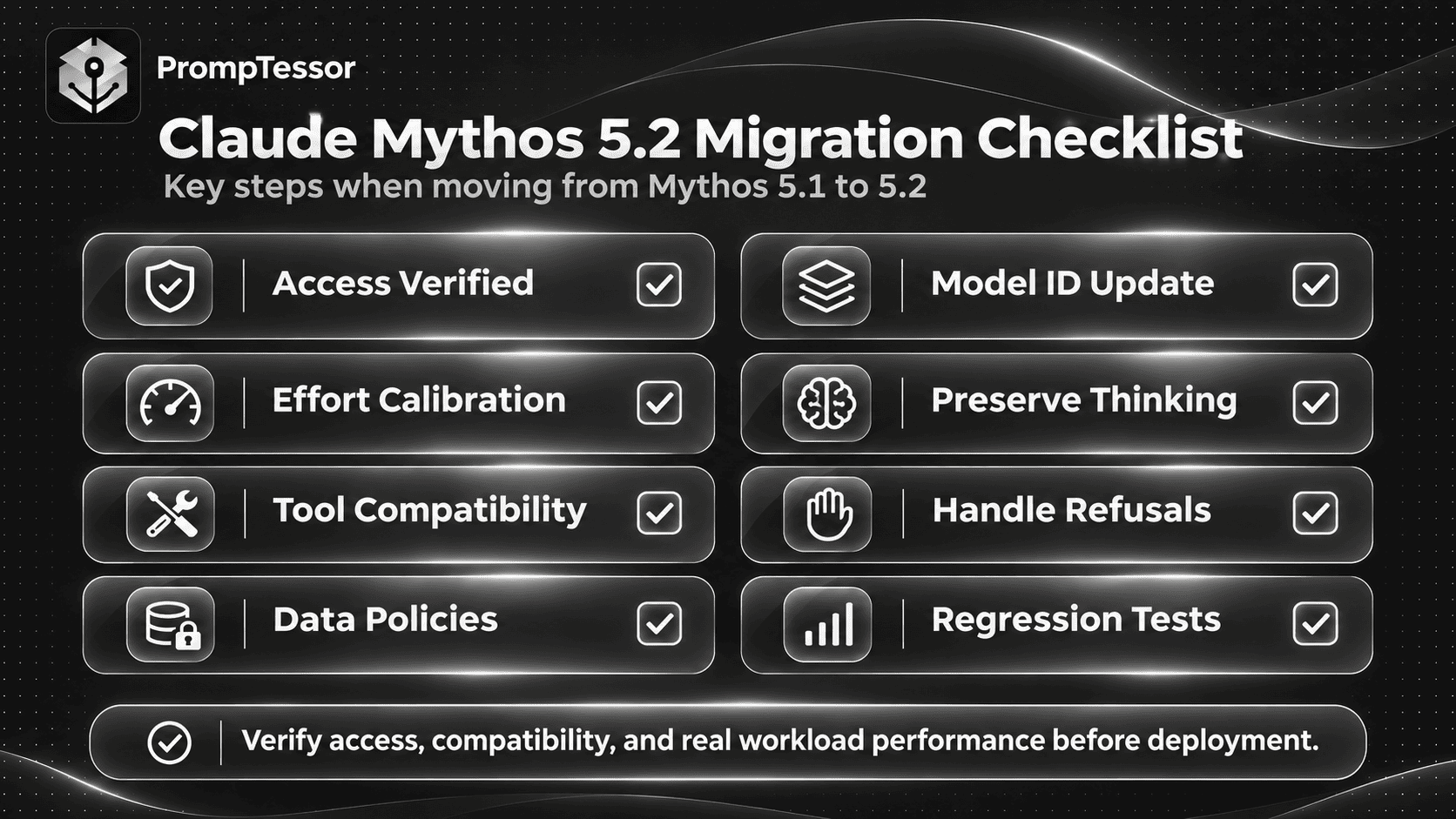
Migrating From Claude Mythos 5.1 to Mythos 5.2
Developers upgrading an existing verified Mythos workflow should evaluate both model behavior and integration compatibility.
1. Confirm Access
Ensure the account or organization has approval for Claude Mythos 5.2 and that its intended use remains within the applicable verification tier.
2. Update the Model ID
BEFORE:
claude-mythos-5-1

AFTER:
claude-mythos-5-2
3. Recalibrate Effort
Test the new model using representative workloads at appropriate effort levels. Do not assume the same setting has identical latency or analysis behavior across versions.
4. Preserve Thinking Blocks and Conversation History
Mythos 5.2 enforces preserved-thinking conversation-prefix integrity. Applications that modify earlier system instructions, tool definitions, or previous messages while replaying thinking blocks can encounter API errors.
Keep conversation history append-only and follow the documented state-handling rules.
5. Update Computer Use Integrations
The older computer_20251124 tool definition is not supported by Mythos 5.2. Migrate to the documented computer_toolset_20260801 toolset where computer use is required.
6. Review Tool Choice and Advisor Compatibility
Forced tool selection is not supported for Mythos 5.2. Applications using Anthropic's advisor tool should also check the compatible advisor model requirements.
7. Handle Refusals Correctly
Check response metadata such as stop_reason before treating an output as a successful completion.
A refusal is not a tool execution error and should not be treated as permission to circumvent safeguards.
8. Recheck Data Handling Requirements
Anthropic documents model-specific retention requirements for Fable 5.2 and Mythos 5.2, with exceptions requiring explicit authorization.
Organizations handling sensitive customer information or regulated research data should review their approved contractual and security arrangements before migration.
9. Run Security and Prompt Regression Tests
Compare evidence accuracy, false positives, task completion, scope adherence, latency, and cost using a controlled evaluation set.
Do not change the model, prompt, tools, and effort simultaneously if the goal is to isolate which change affected performance.
Common Claude Mythos 5.2 Prompting Mistakes
1. Assuming Model Access Means Security Authorization
Approved model access does not authorize analysis or testing of unrelated infrastructure.
Better approach: Document both the Anthropic access tier and the target asset owner's permission.
2. Requesting Live Testing Without Scope Definitions
Vague instructions do not identify which operations are permitted or safe.
Better approach: Define in-scope assets, approved methods, exclusions, and approval requirements before execution.
3. Calling Every Suspected Weakness a Vulnerability
AI can identify plausible patterns that require additional context.
Better approach: Use evidence-based finding states and distinguish hypotheses from confirmed issues.
4. Inventing CVE or CVSS Information
Security identifiers and severity scores require factual support and appropriate methodology.
Better approach: Verify official advisories and document the evidence behind any severity assessment.
5. Ignoring Deployment Context
A concerning code pattern may be mitigated by controls outside the supplied snippet.
Better approach: Include architecture and configuration information, and report unknowns explicitly.
6. Treating a Generated Patch as Verified Remediation
Draft code can contain errors or unexpected compatibility changes.
Better approach: Run relevant tests, review the diff, and obtain required approval before deployment.
7. Maximizing Effort for Every Task
Higher effort can increase token cost and latency without improving routine analysis.
Better approach: Evaluate effort levels using actual workloads.
8. Confusing Agent Progress With Completion
A progress summary does not demonstrate that every authorized review step has finished.
Better approach: Define observable completion criteria and require a final verification report.
9. Creating Unnecessary Subagents
Delegation may increase coordination work and token usage.
Better approach: Delegate only sufficiently independent analysis tasks that justify the overhead.
10. Using Outdated Vulnerability Information
The model's internal knowledge does not replace current advisories or updated dependency information.
Better approach: Retrieve and verify current official sources before making security decisions.
11. Exposing Sensitive Research Data
Security material may contain secrets, confidential architecture, or customer information.
Better approach: Apply data minimization, access controls, and organizational retention policies.
12. Reusing an Old Prompt Without Compatibility Testing
Behavior and API requirements may change between Mythos versions.
Better approach: Test model migration, prompt behavior, tools, conversation handling, and security boundaries together through a controlled release process.
How to Improve Claude Mythos 5.2 Prompts With PrompTessor
PrompTessor can help developers create clearer instructions for complex technical tasks, including authorized security analysis and research.
It operates at the prompt-design layer. It does not provide Mythos verification, authorize security testing, or replace the execution and approval mechanisms of the target application.
1. Generate a Structured Prompt
Use the PrompTessor AI Prompt Generator to develop a prompt with a clearly defined objective, context, scope, and output structure.
For example, instead of requesting "find every vulnerability," define the approved codebase, available evidence, type of review, security requirements, and findings format.
2. Optimize Evidence and Verification Rules
Use the AI Prompt Optimizer to improve instructions that produce unsupported conclusions or inconsistent outputs.
Consider this example:
ORIGINAL:
Find security problems in my code.

IMPROVED:
Review the supplied authorized
source code for potential
authentication and authorization
weaknesses.

Use only provided files.

Reference exact code locations.

Separate confirmed observations
from hypotheses.

Identify missing context.

Recommend defensive corrections.

Do not invent findings or tests.

Return a structured review
with confidence and limitations.
The improved version makes the expected behavior more specific and the resulting analysis easier to review.
3. Build Reusable Research Templates
For repeated security reviews, keep stable instructions separate from variable inputs.
OBJECTIVE:
{security_task}

AUTHORIZED SCOPE:
{assets_and_permissions}

RESEARCH EVIDENCE:
{sources}

ENVIRONMENT:
{technology_context}

TOOLS:
{approved_tools}

ANALYSIS REQUIREMENTS:
{review_criteria}

ACTION BOUNDARIES:
{approval_rules}

OUTPUT:
{report_format}

VERIFICATION:
{acceptance_checks}

COMPLETION:
{done_definition}
4. Evaluate and Refine
When a prompt causes false positives, unsupported severity claims, or unnecessary scope expansion, revise the instructions and evaluate the result on representative approved cases.
Keep prompt comparisons separate from changes to effort, tool permissions, and runtime behavior.
For a structured approach, read AI Prompt Evaluation: How to Test, Compare, and Improve Prompts.
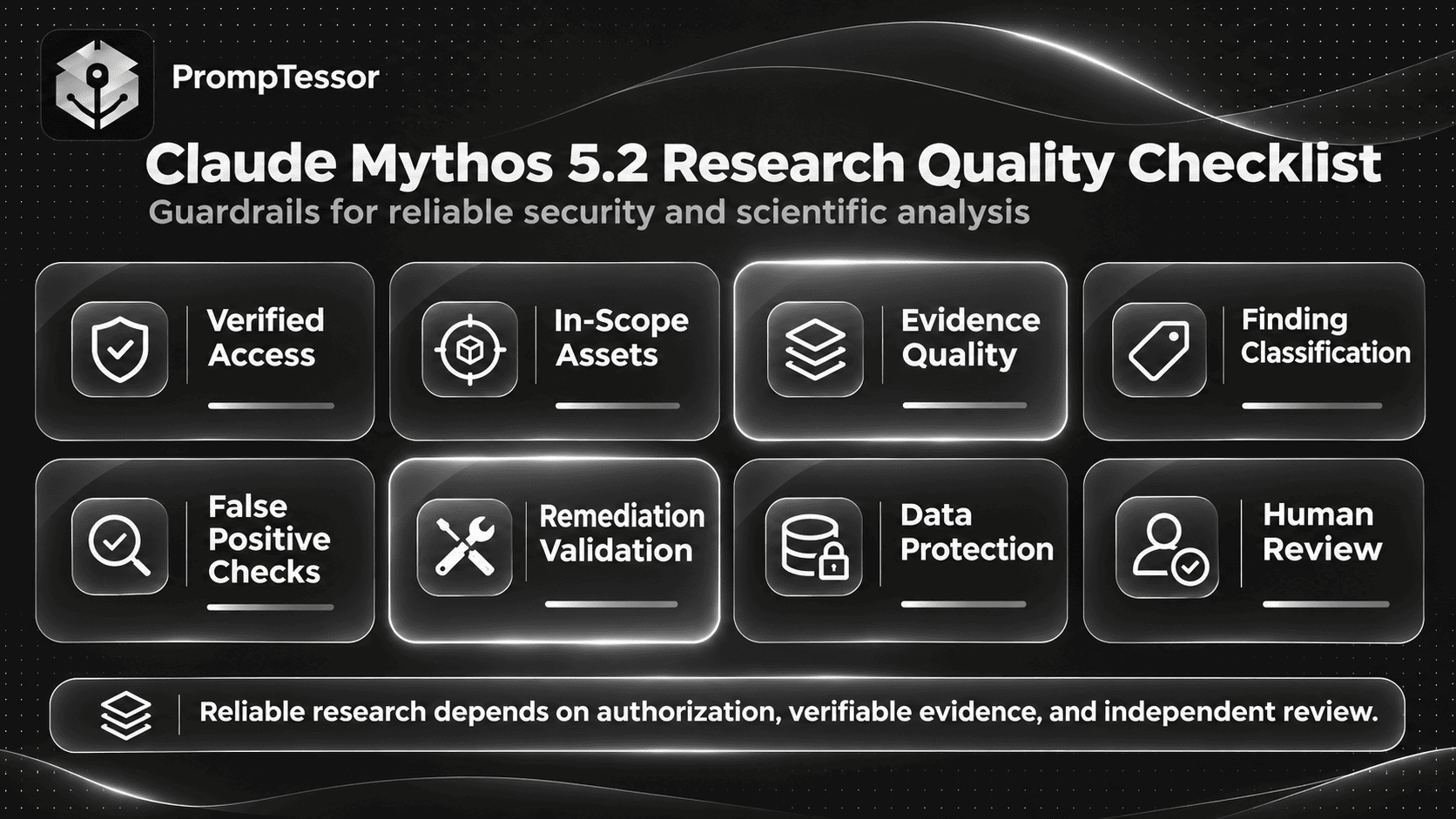
Claude Mythos 5.2 Prompting Checklist
Before running a significant security research workflow, review the following:
- Model access: The user or organization has the required Mythos access.
- Authorized targets: The relevant system owner has approved the specific work.
- Program tier: The research activity falls within the granted verification tier.
- Research objective: The question and expected defensive outcome are explicit.
- Asset scope: Included and excluded systems are documented.
- Data protection: Secrets and unnecessary personal information are excluded.
- Evidence: Research sources are identified and appropriately current.
- Tool access: Available operations are known and enforced.
- Approvals: Protected actions require actual runtime authorization.
- Findings: Hypotheses and confirmed observations use different classifications.
- Severity: Impact claims and scores are supported by suitable evidence.
- False positives: Environmental context and compensating controls are considered.
- Remediation: Proposed fixes preserve relevant behavior and receive review.
- Verification: Tests and results are recorded accurately.
- Effort: Runtime effort has been calibrated for the task.
- Agent behavior: Progress, delegation, and completion rules are defined.
- API compatibility: Model-specific parameters and tool integrations are supported.
- Research integrity: Sources and conclusions remain traceable.
- Final reporting: The completed work, limitations, and next decisions are clear.
- Human oversight: Appropriate experts review consequential decisions.
Frequently Asked Questions About Claude Mythos 5.2 Prompting
What is Claude Mythos 5.2?
Claude Mythos 5.2 is an Anthropic model released on November 9, 2026, for verified organizations and researchers working on specialized tasks, including cybersecurity engineering and certain scientific research workflows.
Is Claude Mythos 5.2 the same model as Claude Fable 5.2?
They use the same underlying model. Their main differences concern safeguards, verification requirements, and permitted access to specialized capabilities.
What is the Claude Mythos 5.2 API model ID?
The Claude API model ID is claude-mythos-5-2.
How can I access Claude Mythos 5.2?
Access requires approval through an applicable Anthropic verification program, such as the Cyber Verification Program or Life Sciences Verification Program. Eligibility and the permitted activities depend on the program and access tier.
Can individuals apply for Claude Mythos 5.2 access?
Qualifying individual security researchers can apply for Defense Access under Anthropic's Cyber Verification Program. Other access tiers may require an organization.
Can I use Mythos 5.2 without verification?
Direct Mythos access requires applicable approval. Some managed enterprise security features may provide Mythos-powered analysis without granting unrestricted access to the underlying model.
What is the best way to prompt Claude Mythos 5.2?
Define the objective, authorization, asset scope, evidence, permitted tools, action boundaries, verification, and final report. Keep findings grounded in actual research material.
Can Mythos 5.2 review code for security vulnerabilities?
Yes. Authorized users can use it to analyze source code and identify potential security problems. Findings still need verification against actual code, configuration, and the relevant environment.
Can Claude Mythos 5.2 conduct penetration testing?
Some authorized testing activities may be available under the appropriate Cyber Verification Program tier. Model access alone does not authorize testing, and the system owner's permission and applicable program restrictions still apply.
Can Mythos 5.2 help fix vulnerabilities?
Yes. It can help explain confirmed issues, propose defensive remediation, and draft approved code changes. Tests and human review remain necessary before deploying fixes.
Can Mythos 5.2 analyze security logs?
Yes. It can help organize authorized log data, identify unusual patterns, and recommend investigations. An anomaly should not be treated as confirmed malicious activity without supporting evidence.
Can Mythos 5.2 perform scientific research?
It can assist with specialized scientific tasks under applicable verification and oversight requirements. Access and permitted activities depend on the research field and approval conditions.
What is the context window of Claude Mythos 5.2?
Anthropic lists a 1 million-token context window and a maximum output of 128,000 tokens.
Does Mythos 5.2 support adaptive thinking?
Yes. Adaptive thinking is always on, and the effort parameter controls the model's reasoning depth.
What effort level should I use for Mythos 5.2?
Anthropic recommends starting with high. Lower or higher effort levels should be evaluated against representative workloads, using quality, latency, and token cost as decision factors.
How much does Claude Mythos 5.2 cost?
Standard published API pricing is $8 per million input tokens and $40 per million output tokens. Caching, batching, fast mode, and deployment arrangements may change actual costs.
Can I reuse Mythos 5.1 prompts with Mythos 5.2?
Many prompts remain useful starting points, but developers should retest effort, scope adherence, task completion, API compatibility, and preserved-thinking behavior.
Does Mythos 5.2 guarantee accurate security findings?
No. Security results can include false positives, missed issues, and unsupported conclusions. Important findings require appropriate validation and review.
Can PrompTessor optimize Claude Mythos 5.2 prompts?
Yes. PrompTessor can help generate, analyze, optimize, refine, and reuse prompts. It does not grant Mythos access, authorize security operations, or replace the target application's permissions, tools, and verification requirements.
Final Thoughts: Advanced Security Prompting Requires Evidence and Boundaries
Claude Mythos 5.2 brings advanced model capabilities to specialized research and engineering work. Its value for cybersecurity teams comes not only from analyzing complex information but from helping organize difficult technical investigations.
However, a capable model is not a substitute for authorization, evidence, validation, or responsible engineering.
A useful security prompt must identify the permitted research scope, the information available, the intended defensive outcome, and the actions that require approval.
Potential vulnerabilities should remain potential until the evidence supports a stronger conclusion. Generated patches require testing. Incident analysis must preserve the distinction between observations, interpretations, and confirmed impact.
For long-running tasks, effort calibration, tool permissions, and completion criteria should be managed alongside the prompt itself.
The 12 examples in this guide provide a practical starting point for approved security review, threat modeling, vulnerability triage, remediation, incident response, and research analysis.
For general-purpose Claude prompting techniques, review the existing Fable and Opus guides. For Mythos-specific work, make authorization and evidence quality the foundation of every workflow.
To create clearer and reusable instructions, start with the PrompTessor AI Prompt Generator and adapt the output to your actual research objective, available evidence, and operational boundaries.
The most useful Claude Mythos 5.2 prompt is not the one that produces the most security findings. It is the one that helps a verified team reach accurate, defensible conclusions and take appropriate actions within its authorized scope.
Official Sources and Further Reading
- Anthropic — Introducing Claude Fable 5.2 and Claude Mythos 5.2
- Claude Platform — Mythos 5.2 Model Overview
- Claude Platform — Prompting Fable 5.2 and Mythos 5.2
- Claude Platform — Fable 5.2 and Mythos 5.2 Migration Guide
- Claude Help Center — Cyber Verification Program
- Anthropic — Life Sciences Verification Program
- Claude Platform — Refusals and Fallback
Build better prompts in one workspace
Generate prompts from ideas, analyze and optimize quality, refine with feedback, reverse-engineer content, and save reusable prompts in your Prompt Library.
Try PrompTessor Free