15 ChatGPT Resume and Cover Letter Prompts for Job Applications (2026)
Writing a resume is one thing. Writing a resume that clearly explains why you are qualified for a specific job is another.
Every job posting emphasizes different skills, responsibilities, tools, and qualifications. A resume that works well for a technical support position may not highlight the right evidence for a product analyst or software engineering role.
Cover letters introduce another challenge. They need to explain why you are interested in the employer, connect your actual experience to the position, and communicate something meaningful that a resume alone may not explain.
AI tools like ChatGPT can make this process easier.
ChatGPT can analyze job descriptions, identify relevant qualifications, improve resume bullet points, organize work experience, draft professional summaries, and help personalize cover letters for different applications.
But there is an important distinction between improving how you communicate your experience and inventing qualifications you do not have.
An AI-generated resume might include a percentage improvement you never measured. A cover letter might claim you have used software you have never touched. An applicant tracking system (ATS) optimization tool might give your resume a high score without knowing how the employer's actual hiring system works.
These mistakes can make a job application misleading rather than stronger.
The best approach is to use ChatGPT as a career writing assistant that works from your real professional history, not as a tool that manufactures an ideal candidate.
This guide provides 15 copy-and-paste ChatGPT resume and cover letter prompts for job applications. The templates cover job description analysis, experience inventories, professional summaries, achievement-focused resume bullets, ATS-friendly formatting, role-specific tailoring, career transitions, employment gaps, and final application reviews.
You will also see a practical example of one fictional candidate applying for three different jobs using the same underlying experience.
The goal is simple: create clearer, more relevant, and more accurate job application materials while retaining your own voice and professional credibility.
Quick Answer: What Is the Best ChatGPT Prompt for a Resume?
A useful ChatGPT resume prompt includes your actual experience, the job description, verified achievements, relevant skills, and the type of resume you want to produce.
It should also explicitly prohibit invented qualifications and distinguish supported experience from missing information.
Here is a reusable prompt for tailoring a resume to a specific position:
ROLE:
Act as an experienced US resume
writer and career advisor.

TARGET ROLE:
{job_title}

JOB DESCRIPTION:
{complete_job_posting}

MY VERIFIED EXPERIENCE:
{career_history}

MY SKILLS:
{actual_skills_and_proficiency}

MY EDUCATION:
{education_and_certifications}

MY VERIFIED ACHIEVEMENTS:
{documented_results}

CURRENT RESUME:
{existing_resume}

TASK:
Create a tailored resume draft
for the target position.

REQUIREMENTS:
- Use only my real experience.
- Prioritize relevant qualifications.
- Rewrite weak bullets clearly.
- Use accurate action verbs.
- Include measurable results
  only when supported by my data.
- Use standard resume headings.
- Keep formatting simple.
- Integrate relevant keywords
  only when they truthfully apply.
- Preserve employers,
  job titles, dates, and credentials.
- Do not invent certifications,
  technologies, or achievements.
- Do not claim experience
  I have not demonstrated.

OUTPUT:
1. Job requirements summary
2. Evidence-to-requirement mapping
3. Tailored resume draft
4. Missing qualification notes
5. Suggested improvements
6. Factual accuracy checklist

If important information is missing,
ask focused questions rather
than manufacturing details.
This prompt is most effective when you provide your existing resume alongside the complete job posting.
For example, a candidate applying to a data analyst position should highlight relevant SQL, reporting, and analytical work already present in their background. They should not claim professional data analysis experience merely because the job advertisement asks for it.
Key Takeaways
- ChatGPT can help draft, rewrite, organize, and tailor resumes and cover letters using verified career information.
- Analyze the specific job description before deciding which experience to emphasize.
- Keep a master resume or career inventory containing your accurate job history, projects, skills, dates, and achievements.
- Use action verbs and concrete evidence in resume bullets, but never invent percentages or business impact.
- ATS-friendly formatting generally favors clear headings, readable text, and simple layouts.
- ATS optimization does not guarantee that an employer's system will select your resume.
- Include job-related keywords naturally when your experience supports them.
- Entry-level candidates can use relevant coursework, projects, internships, volunteering, and leadership activities.
- Career changers should emphasize transferable skills without misrepresenting their previous jobs.
- Cover letters should explain your interest and relevant evidence instead of merely repeating your resume.
- Employment gaps do not require fabricated positions, false dates, or unnecessary disclosure of personal circumstances.
- Resume and cover letter drafts should receive a final factual, formatting, and consistency review before submission.
What Are ChatGPT Resume and Cover Letter Prompts?
ChatGPT resume and cover letter prompts are structured instructions that help an AI model assist with different parts of a job application.
Some prompts help you understand what an employer is asking for. Others improve how you present your professional history or explain why your experience is relevant to a particular role.
Different application tasks require different inputs.
| Job Application Task | Useful Input | Expected Output |
|---|---|---|
| Job description analysis | Actual job posting | Requirements and keyword matrix |
| Career evidence inventory | Employment, projects, education | Verified master experience record |
| Professional summary | Relevant experience and target role | Concise resume summary |
| Achievement bullets | Responsibilities, actions, outcomes | Improved experience bullets |
| Resume tailoring | Master resume and job posting | Role-specific resume |
| ATS review | Resume text and job requirements | Readability and keyword audit |
| Skills mapping | Actual skills and evidence | Relevant skills section |
| Entry-level resume | Projects, education, internships | Entry-level resume draft |
| Career transition | Previous experience and new role | Transferable-skills resume |
| Employment gap | Accurate timeline and preferences | Neutral presentation options |
| General cover letter | Experience and job description | Cover letter draft |
| Tailored cover letter | Verified employer details and evidence | Employer-specific letter |
| Career change letter | Transferable strengths and motivation | Career-transition letter |
| Application audit | Resume, letter, posting | Accuracy and consistency report |
| Complete application package | Approved candidate information | Final draft materials and checklist |
These prompts create drafts and analyses. They do not independently verify employment history, access an employer's private applicant tracking system, guarantee an interview, or submit applications unless a separate authorized tool actually performs those actions.
Resume vs. Cover Letter: What Should Each Document Do?
Resumes and cover letters are related, but they have different purposes.
A resume summarizes relevant qualifications, employment history, education, skills, and accomplishments in a structured format.
A cover letter explains the connection between your background and the specific opportunity, adding motivation and context that may not fit naturally into a resume.
| Element | Resume | Cover Letter |
|---|---|---|
| Primary purpose | Present qualifications and evidence | Explain fit, motivation, and relevance |
| Typical structure | Sections, bullet points, concise statements | Introduction, evidence, conclusion |
| Emphasis | Experience, skills, achievements | Why this role, employer, and candidate align |
| Evidence | Roles, projects, responsibilities, outcomes | Selected examples from verified experience |
| Customization | Reorder and emphasize relevant qualifications | Connect qualifications to the employer's needs |
| Common AI mistake | Invented metrics and qualifications | Generic praise and fabricated company details |
Harvard's resume and cover letter guidance recommends concise, factual writing, active language, relevant achievements, and materials tailored to the position.
A cover letter should complement the resume, not reproduce it paragraph by paragraph.
Before You Start: Create a Verified Career Evidence Inventory
One of the best ways to improve AI-assisted resume writing is to organize your career information before asking ChatGPT to draft anything.
A master experience inventory can be longer than the resume you eventually submit. It acts as the source of truth for different applications.
| Information | What to Include |
|---|---|
| Employment history | Actual employer names, job titles, dates, and responsibilities |
| Achievements | Projects, improvements, results, and evidence |
| Skills | Technologies and capabilities you genuinely possess |
| Education | Completed degrees, relevant coursework, or current studies |
| Certifications | Credentials actually earned, with accurate status |
| Projects | Personal, academic, volunteer, or professional work |
| Tools | Software you have used and your relevant proficiency |
| Portfolio | Real projects and appropriate links |
| Career goals | Roles and industries you are targeting |
| Constraints | Relevant location, availability, or work requirements you choose to disclose |
Use an Evidence Classification System
When working with ChatGPT, it can be helpful to classify claims before incorporating them into final application materials.
VERIFIED
Supported by actual work,
education, projects, or records.

SELF-REPORTED
Based on the candidate's
truthful first-hand description.

NEEDS_CONFIRMATION
A potentially accurate detail
that has not been checked.

UNSUPPORTED
Not established by supplied data.

NOT_APPLICABLE
A qualification or requirement
that does not fit the candidate.

DO_NOT_CLAIM
A statement the candidate
cannot honestly represent.
For example, completing a personal Python project is valid experience, but it should not automatically become "three years of professional Python engineering."
Similarly, improving a workflow does not justify claiming a 40% performance increase unless the candidate has actual evidence for that figure.
Protect Your Personal and Employer Information
Resumes may contain phone numbers, email addresses, home addresses, professional references, and employment details.
Consider removing unnecessary personally identifiable information before using AI tools. Do not share passwords, confidential employer data, client records, protected internal documents, or other information you are not authorized to disclose.
For most resume drafting tasks, a city or region is sufficient context. Your full street address is generally not needed in an AI prompt.
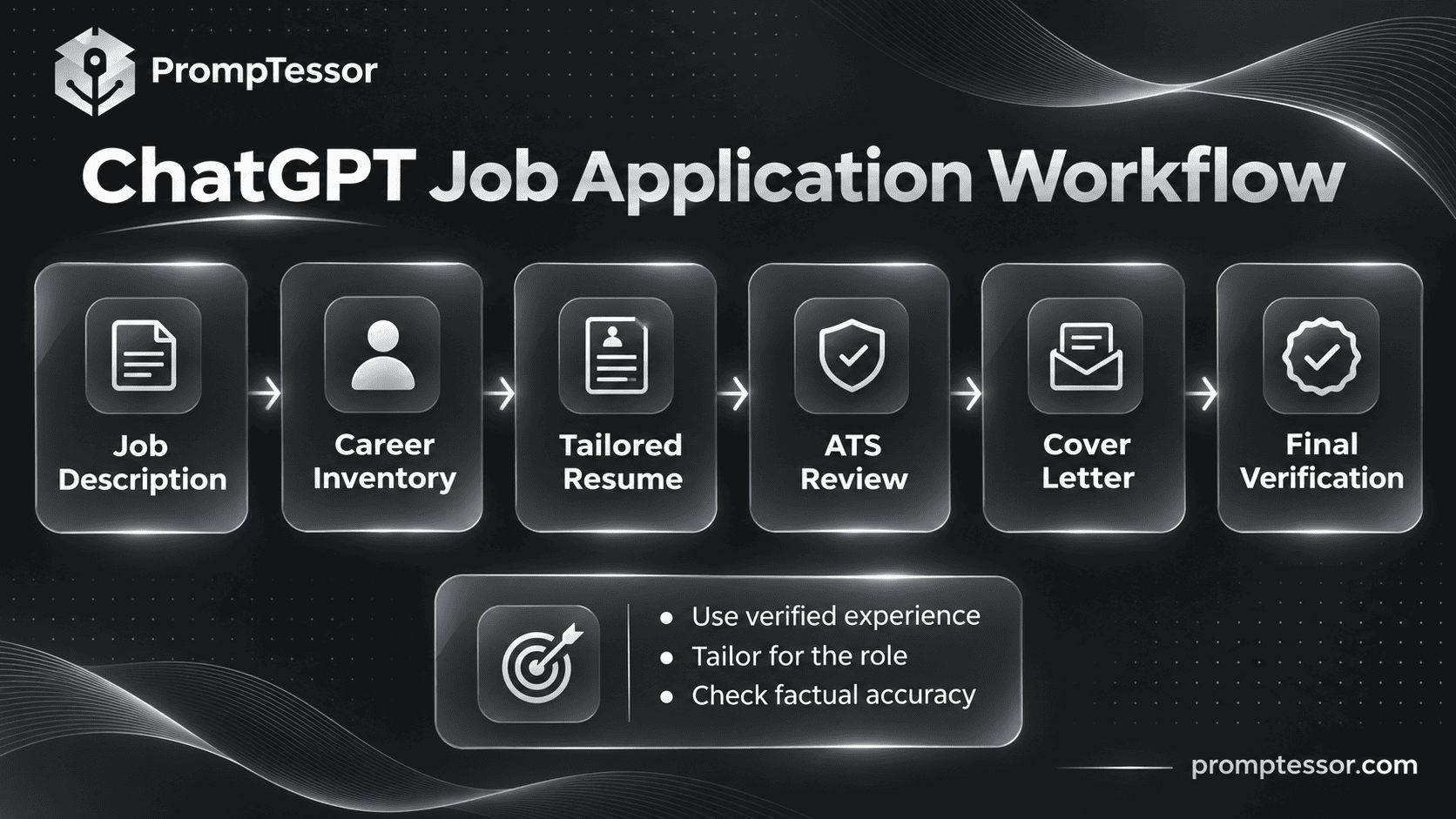
The ChatGPT Job Application Workflow
Rather than generating an entire application from a vague instruction, use a series of focused steps.
REAL JOB POSTING
        |
        v
JOB REQUIREMENT ANALYSIS
        |
        v
VERIFIED CAREER INVENTORY
        |
        v
RELEVANT EXPERIENCE MAPPING
        |
        v
TAILORED RESUME DRAFT
        |
        v
ATS READABILITY REVIEW
        |
        v
PERSONALIZED COVER LETTER
        |
        v
FACTUAL CONSISTENCY AUDIT
        |
        v
HUMAN REVIEW + FORMATTING
        |
        v
APPLICATION READY FOR SUBMISSION
Each stage has a different purpose. The job description defines the employer's stated needs, while your career inventory defines the qualifications you can truthfully present.
The final application should combine those two sources without changing the underlying facts.
The Best Prompt Structure for Resume and Cover Letter Writing
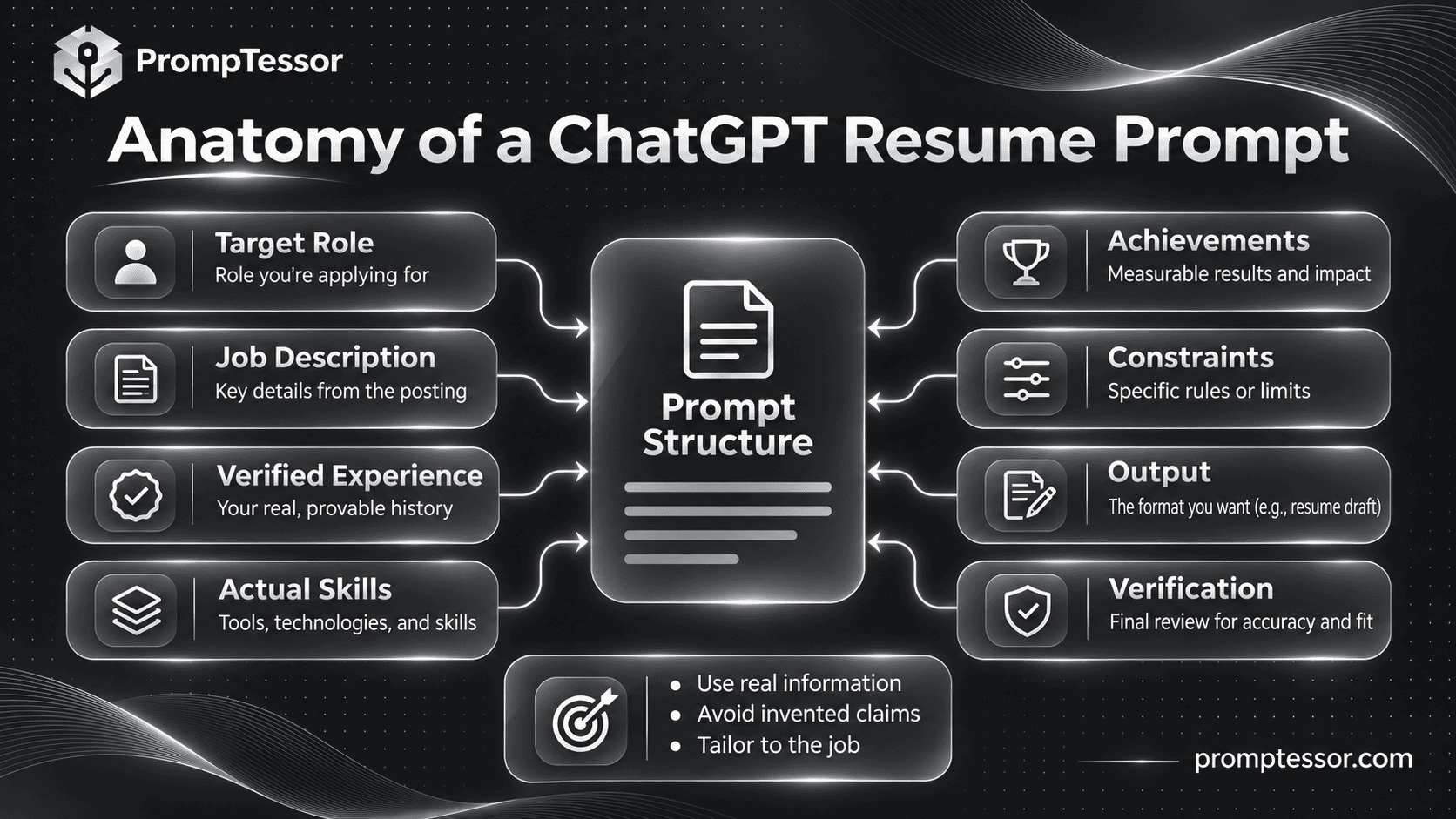
A reusable career writing prompt should separate the candidate's facts from the job posting and the requested writing task.
ROLE
Act as a resume writer
or career writing advisor.

TARGET POSITION
Which job am I applying for?

JOB DESCRIPTION
What qualifications does
the employer actually request?

CANDIDATE FACTS
What have I genuinely done?

VERIFIED ACHIEVEMENTS
Which results can I support?

WRITING TASK
What document or section
should be drafted?

STYLE
What tone and format fit the role?

TRUTHFULNESS RULES
Which claims must not be invented?

OUTPUT
What finished draft is required?

VERIFICATION
How should claims, dates,
skills, and formatting be checked?
When the same task must be repeated for multiple job applications, make the changing information explicit through variables such as {job_description}, {candidate_experience}, and {target_role}.
See Prompt Templates and Variables: How to Build Reusable AI Prompts for guidance on repeatable prompt structure.
15 Copy-and-Paste ChatGPT Resume and Cover Letter Prompts
The following prompts are organized into three stages: understanding the job, building the resume, and preparing a complete application.
Each template can be copied into ChatGPT or adapted for another capable text model.
Replace the variables in braces with your actual information. Review every draft before it becomes part of an application.
Job Description and Career Evidence
1. ChatGPT Job Description Analysis Prompt
Best for: Identifying the employer's stated requirements, responsibilities, technical skills, and relevant resume keywords.
Required Input: Complete job description, role title, and any additional verified hiring requirements.
Example Use Case: A candidate wants to understand which requirements matter most for a product analyst position before rewriting their resume.
Act as an experienced
job description analyst.

TARGET ROLE:
{job_title}

COMPANY:
{company_name}

JOB POSTING:
{complete_job_description}

TASK:
Analyze the job description
without adding requirements
that are not stated.

Identify:

1. Core responsibilities
2. Required qualifications
3. Preferred qualifications
4. Technical skills
5. Transferable skills
6. Relevant tools and frameworks
7. Experience requirements
8. Education or credential requirements
9. Important job-related keywords
10. Unclear or ambiguous requirements

For each requirement include:
- Exact relevant wording
- Requirement category
- Required or preferred status
- Evidence a candidate
  could reasonably provide

RULES:
- Do not invent employer priorities.
- Do not claim to know
  unpublished screening criteria.
- Do not invent salary ranges.
- Do not assume keywords
  guarantee ATS selection.
- Preserve meaning and context.
- Mark unclear language explicitly.

OUTPUT:
- Job requirements matrix
- Keyword and phrase list
- Resume evidence checklist
- Questions requiring clarification
Expected Output: A structured job posting analysis showing which qualifications the employer requests and what candidate evidence could demonstrate them.
Verification: Compare the results with the original advertisement. Do not treat ChatGPT's inferred priorities as confirmed statements from the employer.
2. ChatGPT Career Experience Inventory Prompt
Best for: Turning scattered career notes into a master inventory of real experience that can be reused across multiple applications.
Required Input: Employment timeline, duties, projects, education, skills, certifications, and known outcomes.
Example Use Case: A professional wants one reliable career record before applying to software engineering, product analysis, and technical support roles.
Act as a resume preparation
and career evidence specialist.

EMPLOYMENT HISTORY:
{actual_roles_and_dates}

RESPONSIBILITIES:
{work_performed}

PROJECTS:
{real_projects}

EDUCATION:
{education}

SKILLS:
{actual_skills}

CERTIFICATIONS:
{verified_credentials}

ACHIEVEMENTS:
{documented_results}

TASK:
Create a master career
experience inventory.

Organize information into:
1. Employment timeline
2. Responsibilities by role
3. Projects and contributions
4. Technical skills
5. Transferable skills
6. Verified outcomes
7. Relevant education
8. Missing details to confirm

For each achievement record:
- Action taken
- Context
- Tools actually used
- Outcome
- Evidence status

RULES:
- Preserve actual job titles.
- Preserve employer names and dates.
- Do not invent accomplishments.
- Do not estimate missing metrics.
- Do not infer certifications.
- Do not turn academic work
  into professional employment.
- Ask questions when evidence
  is incomplete.

OUTPUT:
- Master experience inventory
- Verified achievement bank
- Skills evidence map
- Missing-information checklist
Expected Output: A structured master record containing the candidate's verified history and evidence that can support future resume drafts.
Verification: Check employers, dates, education, project ownership, and results against your own records.
Resume Writing and Optimization
3. ChatGPT Professional Resume Summary Prompt
Best for: Writing a concise professional summary that reflects genuine strengths relevant to a particular position.
Required Input: Target role, verified work history, relevant capabilities, and supported achievements.
Example Use Case: A technical support professional wants a summary that emphasizes problem-solving, documentation, and cross-functional collaboration.
Act as a professional
US resume writer.

TARGET ROLE:
{job_title}

RELEVANT EXPERIENCE:
{verified_experience}

ACTUAL SKILLS:
{skills}

VERIFIED ACHIEVEMENTS:
{results}

TARGET JOB REQUIREMENTS:
{job_requirements}

TASK:
Write three professional
resume summary options.

OPTION A:
Concise and direct.

OPTION B:
Achievement-focused.

OPTION C:
Skills and specialization-focused.

REQUIREMENTS:
- Use accurate career details.
- Emphasize relevant experience.
- Avoid generic buzzwords.
- Avoid unsupported adjectives
  such as "industry-leading."
- Do not invent years of experience.
- Do not claim seniority
  unsupported by the record.
- Do not fabricate metrics.
- Keep each option brief
  and appropriate for a resume.

OUTPUT:
1. Three summary options
2. Recommended version
3. Supporting experience
4. Any unsupported claims to avoid
Expected Output: Three focused professional summaries with different emphasis while preserving the same verified facts.
Verification: Confirm that every claimed specialization and duration of experience is accurate. Summaries should be easy to scan and relevant to the target job.
4. ChatGPT Resume Bullet Point Rewriting Prompt
Best for: Rewriting generic job responsibilities into clear, achievement-oriented statements using real actions and outcomes.
Required Input: Existing bullets, actual responsibilities, tools, scope, and verified results.
Example Use Case: A candidate wants to improve "responsible for weekly reports" without inventing an unsupported performance improvement.
Act as a resume bullet
writing specialist.

TARGET ROLE:
{job_title}

ORIGINAL BULLETS:
{current_resume_bullets}

WHAT I ACTUALLY DID:
{verified_responsibilities}

TOOLS USED:
{actual_tools}

VERIFIED RESULTS:
{documented_outcomes}

TASK:
Rewrite each bullet
to communicate specific
actions, relevant skills,
and supported outcomes.

Prefer a structure such as:
Action + Work + Result

If a result is unavailable:
Use Action + Work + Purpose
without inventing a metric.

REQUIREMENTS:
- Use clear action verbs.
- Preserve my actual responsibility.
- Keep wording concise.
- Prioritize relevant evidence.
- Quantify only when supported.
- Do not add new technologies.
- Do not exaggerate ownership.
- Do not convert team results
  into sole personal achievements.
- Avoid repetitive verbs.

OUTPUT:
For each bullet:
1. Original
2. Improved version
3. Evidence used
4. Missing details worth asking
5. Accuracy risk, if any
Expected Output: Clearer experience bullets that communicate actions and results without overstating the candidate's contribution.
Verification: Review each action verb and outcome carefully. The revised bullet must still describe the work you genuinely performed.
5. ChatGPT Resume Tailoring for a Specific Job Prompt
Best for: Reordering and rewriting an existing resume to emphasize the strongest evidence for one position.
Required Input: Master resume, specific job posting, verified achievements, and skills evidence.
Example Use Case: A professional uses one career history to prepare a resume for a technical support role and a different resume for a product analyst role.
Act as a senior career
advisor and resume editor.

TARGET JOB:
{job_title}

COMPLETE JOB POSTING:
{job_description}

MASTER RESUME:
{master_resume}

VERIFIED SKILLS:
{skills}

VERIFIED ACHIEVEMENTS:
{achievement_bank}

TASK:
Create a targeted resume draft.

STEP 1:
Map job requirements
to supported candidate evidence.

STEP 2:
Identify the most relevant
experience, skills, and projects.

STEP 3:
Reorder and rewrite content
to emphasize those qualifications.

STEP 4:
Create a complete resume draft
using clear standard headings.

STEP 5:
Identify gaps between
the resume and job requirements.

RULES:
- Do not change employment facts.
- Do not invent work experience.
- Do not conceal missing qualifications
  through misleading language.
- Do not invent metrics.
- Do not fabricate tools or skills.
- Do not guarantee ATS success.
- Keep the document readable.
- Preserve career chronology.

OUTPUT:
1. Requirements matching table
2. Tailored resume draft
3. Changes from the master resume
4. Missing qualifications
5. Factual verification checklist
Expected Output: A role-specific resume that prioritizes relevant qualifications while preserving the underlying career history.
Verification: Compare the final draft with the master resume and job description. Every change should improve relevance or clarity, not alter the candidate's facts.
6. ChatGPT ATS-Friendly Resume Review Prompt
Best for: Reviewing resume text and formatting choices for readability, conventional headings, and relevant job terminology.
Required Input: Resume draft, job description, file format, and any employer-specific submission instructions.
Example Use Case: A candidate wants to check whether an elaborate two-column design might be harder for some systems to parse.
Act as a resume
readability and ATS
preparation reviewer.

TARGET JOB:
{job_title}

JOB POSTING:
{job_description}

RESUME:
{resume_text}

DOCUMENT FORMAT:
{docx_pdf_or_other}

EMPLOYER FILE REQUIREMENTS:
{submission_instructions}

TASK:
Review the resume for
common ATS parsing and
human readability concerns.

CHECK:
1. Standard section headings
2. Clear employment chronology
3. Readable contact information
4. Relevant keyword coverage
5. Unnecessary keyword repetition
6. Tables and multicolumn layouts
7. Headers and footers
8. Unusual symbols or graphics
9. Acronyms and expanded terms
10. File format compatibility

FOR EACH ISSUE:
- Describe the concern.
- Explain the possible impact.
- Recommend a specific change.
- Distinguish actual text findings
  from formatting assumptions.

RULES:
- Do not claim access
  to the employer's ATS.
- Do not fabricate an ATS score.
- Do not guarantee an interview.
- Do not insert unsupported keywords.
- Do not invent qualifications.
- Follow actual employer instructions.

OUTPUT:
- ATS readability checklist
- Relevant keyword gap analysis
- Suggested formatting changes
- Revised text where appropriate
- Final manual review steps
Expected Output: A practical ATS-oriented readability audit without pretending to know the employer's proprietary screening rules.
Verification: Inspect the final DOCX or PDF visually and test whether copied text preserves the correct reading order. The University of Maryland's resume guidance discusses job-description keywords, simple layouts, standard headings, and potential parsing problems.
7. ChatGPT Resume Skills Section Optimization Prompt
Best for: Identifying which real skills deserve emphasis for a target job and organizing them into a clear resume section.
Required Input: Complete skills inventory, proficiency evidence, job posting, and relevant work or projects.
Example Use Case: A candidate wants to emphasize SQL and Python projects for an analyst position without claiming tools they have never used.
Act as a resume
skills-mapping specialist.

TARGET JOB:
{job_title}

JOB REQUIREMENTS:
{job_description}

MY ACTUAL SKILLS:
{skill_inventory}

SUPPORTING WORK:
{projects_and_experience}

SKILL PROFICIENCY:
{honest_proficiency_details}

TASK:
Create a job-relevant
resume skills section.

CLASSIFY EACH SKILL:
- Supported and relevant
- Supported but less relevant
- Mentioned in the job
  but not supported
- Requires clarification

GROUP SUPPORTED SKILLS INTO:
- Technical skills
- Tools and platforms
- Domain knowledge
- Relevant methods
- Other role-specific categories

REQUIREMENTS:
- Use only actual skills.
- Avoid redundant synonyms.
- Include important terminology
  naturally when accurate.
- Do not invent certifications.
- Do not claim expert proficiency
  without evidence.
- Keep categories readable.
- Preserve important qualifications.

OUTPUT:
1. Evidence-to-skill matrix
2. Recommended skills section
3. Unsupported requirements
4. Clarifying questions
5. Final accuracy checklist
Expected Output: A relevant skills section with a clear distinction between demonstrated qualifications and gaps.
Verification: Be prepared to discuss or demonstrate the skills you list. Do not represent tutorial familiarity as professional expertise.
8. ChatGPT Entry-Level Resume Writing Prompt
Best for: Helping students, recent graduates, and first-time applicants present relevant experience without requiring a long employment history.
Required Input: Education, relevant coursework, projects, internships, volunteering, leadership, actual skills, and target role.
Example Use Case: A recent graduate wants to apply for a junior analyst role using academic projects and a part-time internship.
Act as an entry-level
career resume advisor.

TARGET JOB:
{job_title}

JOB POSTING:
{job_description}

EDUCATION:
{verified_education}

RELEVANT COURSEWORK:
{actual_courses}

ACADEMIC PROJECTS:
{real_projects}

INTERNSHIPS:
{actual_internships}

VOLUNTEER OR CLUB EXPERIENCE:
{verified_activities}

SKILLS:
{actual_skills}

TASK:
Prepare an entry-level
US-style resume draft.

PRIORITIZE:
- Relevant education
- Practical projects
- Internships and work
- Demonstrated skills
- Meaningful leadership
- Verified achievements

REQUIREMENTS:
- Do not invent employers.
- Do not create fake internships.
- Label academic projects correctly.
- Do not invent GPA or awards.
- Do not claim professional
  experience without evidence.
- Use relevant accomplishments
  when they are supported.
- Avoid generic filler.

OUTPUT:
- Recommended section order
- Complete resume draft
- Strongest relevant evidence
- Missing details to confirm
- Formatting review checklist
Expected Output: An entry-level resume centered on genuine experience, relevant projects, and demonstrated capabilities.
Verification: Confirm academic details and project ownership. Do not disguise school assignments as paid employment.
9. ChatGPT Career Change Resume Prompt
Best for: Presenting transferable skills and relevant projects when moving into a new professional field.
Required Input: Actual prior experience, target job posting, transferable skills, relevant training, and completed projects.
Example Use Case: A support operations professional wants to transition into product analysis while retaining their true employment history.
Act as a career transition
resume strategist.

CURRENT OR PREVIOUS FIELD:
{previous_career}

TARGET FIELD:
{new_career}

TARGET JOB:
{job_description}

ACTUAL CAREER HISTORY:
{employment_history}

TRANSFERABLE SKILLS:
{supported_skills}

RELEVANT PROJECTS:
{completed_projects}

EDUCATION AND TRAINING:
{actual_training}

TASK:
Create a career-transition
resume strategy and draft.

1. Identify overlapping
   requirements and experience.
2. Highlight relevant achievements.
3. Emphasize transferable skills.
4. Include appropriate projects.
5. Identify genuine skill gaps.
6. Recommend a suitable section order.
7. Explain the transition
   without exaggerating experience.

RULES:
- Preserve previous job titles.
- Do not relabel old positions
  as new-field employment.
- Do not invent credentials.
- Do not pretend a personal project
  was paid professional work.
- Do not hide genuine gaps
  behind false qualifications.
- Use accurate, specific language.

OUTPUT:
- Transferable-skills map
- Tailored resume draft
- Career transition summary
- Missing qualifications
- Recommended learning priorities
- Factual accuracy checklist
Expected Output: A resume that makes real transferable experience visible without changing the candidate's employment record.
Verification: Confirm that a recruiter could interpret the resume accurately without additional explanation or correction.
10. ChatGPT Employment Gap Resume Prompt
Best for: Presenting an accurate employment timeline and deciding whether a brief explanation would help provide professional context.
Required Input: Actual employment dates, target job, any verified activities during the gap, and disclosure preferences.
Example Use Case: A candidate returning to work wants to explain a career break without sharing private circumstances or inventing work.
Act as a respectful
career writing advisor.

TARGET JOB:
{job_description}

ACTUAL EMPLOYMENT TIMELINE:
{employment_dates}

CAREER BREAK PERIOD:
{dates}

ACTIVITIES I CHOOSE TO DISCLOSE:
{verified_activities}

RELEVANT SKILLS:
{actual_skills}

DISCLOSURE PREFERENCES:
{privacy_preferences}

TASK:
Recommend truthful ways
to present my employment history.

CREATE:
1. Resume timeline options
2. Optional neutral explanation
3. Relevant skills presentation
4. Short interview answer
5. Cover letter wording
   only if appropriate

REQUIREMENTS:
- Preserve the actual dates.
- Do not invent employment.
- Do not invent freelancing.
- Do not fabricate coursework.
- Do not assume I must reveal
  private medical or family details.
- Do not shame employment gaps.
- Avoid defensive language.
- Keep explanations proportionate
  to the hiring context.

OUTPUT:
- Recommended resume presentation
- Optional brief gap explanation
- Interview response draft
- Privacy review checklist
Expected Output: Accurate resume and interview wording that explains relevant career context without misleading the employer.
Verification: Check dates and any activities included. Candidates should not be pressured to disclose unnecessary sensitive information simply to make the timeline look complete.
Cover Letters and Final Applications
11. ChatGPT Professional Cover Letter Writing Prompt
Best for: Creating a factual, professional cover letter based on the target job and the candidate's strongest relevant experience.
Required Input: Job description, verified resume, relevant achievements, and genuine motivation for applying.
Example Use Case: A candidate wants a first draft of a cover letter that introduces their qualifications without repeating every resume bullet.
Act as a professional
US cover letter writer.

TARGET POSITION:
{job_title}

COMPANY:
{company_name}

JOB DESCRIPTION:
{job_description}

VERIFIED RESUME:
{resume}

RELEVANT ACHIEVEMENTS:
{achievements}

MY REASONS FOR APPLYING:
{genuine_motivation}

TASK:
Write a concise,
professional cover letter.

STRUCTURE:
1. Opening with the position
   and genuine reason for interest
2. Relevant experience
   supported by actual examples
3. Connection to the role
4. Confident, courteous closing

STYLE:
- Natural American English
- Specific and professional
- Avoid generic enthusiasm
- Avoid excessive self-praise
- Do not repeat the full resume
- Keep the letter within
  approximately one page

TRUTHFULNESS RULES:
- Do not invent employer facts.
- Do not invent referrals.
- Do not fabricate qualifications.
- Do not invent achievements.
- Do not guess the hiring
  manager's identity.
- Use a neutral salutation
  when necessary.

OUTPUT:
- Complete cover letter draft
- Key evidence used
- Claims requiring confirmation
- Personalization suggestions
Expected Output: A professional cover letter draft that connects the candidate's background to the role with clear, supported examples.
Verification: Confirm all employer details and personal claims. Harvard career guidance recommends concise letters with specific examples rather than restating the entire resume.
12. ChatGPT Tailored Cover Letter for a Specific Company Prompt
Best for: Personalizing a cover letter using verified information about the employer, the role, and the candidate's relevant accomplishments.
Required Input: Job description, official employer information, verified resume, and genuine reasons for interest.
Example Use Case: A candidate wants to explain why a particular product analyst role matches their experience in reporting and customer issue analysis.
Act as a career writing
and employer research advisor.

COMPANY:
{company}

TARGET JOB:
{job_title}

OFFICIAL JOB POSTING:
{job_description}

VERIFIED COMPANY INFORMATION:
{official_company_sources}

MY RESUME:
{resume}

MY RELEVANT EXPERIENCE:
{evidence}

WHY I AM INTERESTED:
{genuine_reasons}

TASK:
Draft a company-specific
cover letter.

INCLUDE:
1. Specific job title
2. Authentic reason for interest
3. One or two strong
   professional examples
4. Connection between
   my experience and job needs
5. Professional closing

REQUIREMENTS:
- Use company information
  only from supplied sources
  or verified accessible evidence.
- Do not fabricate admiration.
- Do not invent company milestones.
- Do not invent personal connections.
- Do not claim referrals
  unless confirmed.
- Avoid vague phrases like
  "your esteemed company."
- Keep the letter concise.
- Preserve my writing voice.

OUTPUT:
- Full tailored cover letter
- Company-specific references
- Candidate evidence used
- Facts to verify before sending
- Optional personalization notes
Expected Output: A cover letter that explains a credible connection to the specific employer and position.
Verification: Confirm the employer's name, role title, product or mission claims, and whether the referenced information is current. The University of Maryland cover letter guide emphasizes genuine personalization and relevant supporting examples.
13. ChatGPT Career Change Cover Letter Prompt
Best for: Explaining an intentional career transition through transferable skills, completed preparation, and relevant evidence.
Required Input: Current or previous profession, target role, actual transferable skills, projects, and reasons for changing careers.
Example Use Case: A technical support professional wants to apply for a product analyst role and explain the value of their customer-facing and reporting experience.
Act as an experienced
career transition writer.

PREVIOUS CAREER:
{previous_roles}

TARGET CAREER:
{new_field}

TARGET JOB:
{job_description}

VERIFIED WORK HISTORY:
{career_history}

TRANSFERABLE SKILLS:
{skills}

RELEVANT PROJECTS:
{projects}

TRAINING:
{completed_training}

MOTIVATION:
{genuine_career_goal}

TASK:
Write a persuasive but
truthful career-change
cover letter.

EXPLAIN:
1. Why I want the new role
2. How my previous work
   provides relevant experience
3. Evidence of transferable skills
4. Relevant projects or learning
5. How I can contribute
6. Interest in further discussion

RULES:
- Do not apologize excessively
  for changing careers.
- Do not invent direct experience.
- Do not fabricate credentials.
- Do not claim completed training
  that remains unfinished.
- Avoid exaggerated promises.
- Use a positive, credible tone.

OUTPUT:
- Career transition cover letter
- Evidence-to-role mapping
- Missing qualifications
- Personalization suggestions
- Final truthfulness checklist
Expected Output: A targeted career-change letter that gives a credible reason for the transition and highlights relevant qualifications.
Verification: Ensure that previous roles remain accurately described and that completed projects, learning, and skills can be discussed in an interview.
14. ChatGPT Resume and Cover Letter Accuracy Review Prompt
Best for: Checking both documents against the same verified career information and identifying contradictions, unsupported claims, or generic wording.
Required Input: Final resume draft, cover letter draft, master experience record, and job posting.
Example Use Case: A candidate has tailored their resume and cover letter for a new position and wants to catch inconsistencies before submission.
Act as an independent
job application quality reviewer.

TARGET JOB:
{job_description}

MASTER CAREER RECORD:
{verified_career_history}

RESUME DRAFT:
{resume}

COVER LETTER DRAFT:
{cover_letter}

TASK:
Audit the application
for accuracy and consistency.

CHECK:
1. Employer names
2. Job titles
3. Employment dates
4. Education and certifications
5. Technical skills
6. Years of experience
7. Achievement metrics
8. Project ownership
9. Company-specific statements
10. Resume and letter consistency
11. Job requirement relevance
12. Grammar and readability
13. Unsupported superlatives
14. Missing or ambiguous claims

CLASSIFY FINDINGS:
VERIFIED
NEEDS_CONFIRMATION
UNSUPPORTED
INCONSISTENT

For each issue:
- Quote the relevant claim.
- Explain the concern.
- Suggest a truthful correction.
- Identify what evidence is needed.

Do not silently invent facts
to resolve inconsistencies.

OUTPUT:
- Quality audit table
- High-priority corrections
- Revised wording suggestions
- Final manual checklist

Do not declare the application
verified unless the evidence
supports that conclusion.
Expected Output: A factual and editorial review that identifies discrepancies before the application is sent.
Verification: Make corrections using actual records and personal knowledge. ChatGPT can help flag inconsistencies, but you remain the authoritative source for your own experience.
15. ChatGPT Complete Job Application Package Prompt
Best for: Combining verified candidate data and one job posting into a coherent, ready-to-review resume and cover letter package.
Required Input: Master resume, target job posting, verified achievements, employer information, application requirements, and preferred tone.
Example Use Case: A candidate has completed their career inventory and wants a consistent application package for a specific opportunity.
Act as a senior job
application preparation advisor.

TARGET COMPANY:
{company}

TARGET POSITION:
{job_title}

JOB DESCRIPTION:
{job_posting}

MASTER RESUME:
{verified_resume}

ACHIEVEMENT BANK:
{supported_results}

SKILLS AND PROJECTS:
{verified_skills}

GENUINE MOTIVATION:
{reason_for_applying}

EMPLOYER INSTRUCTIONS:
{application_requirements}

TASK:
Prepare one complete
job application package
for human review.

WORKFLOW:
1. Analyze job requirements.
2. Map actual qualifications.
3. Select the strongest evidence.
4. Draft a tailored resume.
5. Review readability
   and relevant terminology.
6. Draft a personalized
   cover letter.
7. Check consistency.
8. Identify missing information.
9. Prepare a final review checklist.

REQUIREMENTS:
- Preserve career facts.
- Never fabricate achievements.
- Never invent work experience.
- Do not exaggerate proficiency.
- Do not invent company research.
- Follow actual application rules.
- Do not guarantee interviews
  or ATS acceptance.
- Do not submit the application.
- Mark unverified claims.

OUTPUT:
A. Job requirements summary
B. Tailored resume draft
C. Personalized cover letter draft
D. Evidence matching table
E. ATS readability checklist
F. Factual accuracy audit
G. Items requiring candidate review
H. Submission preparation checklist

Stop at drafting and reviewing.
Do not claim anything was submitted.
Expected Output: A complete application draft containing a targeted resume, personalized letter, evidence matrix, and final review checklist.
Verification: Review every field, confirm the job is still open, check employer formatting requirements, and submit through the appropriate channel yourself or through an explicitly authorized tool.
Which ChatGPT Resume Prompt Should You Use?
Use the template that matches your current stage of the application process.
| Your Goal | Recommended Prompt | Output |
|---|---|---|
| Understand a job advertisement | #1 Job Description Analysis | Requirements matrix |
| Organize your experience | #2 Career Inventory | Master experience record |
| Improve your resume introduction | #3 Professional Summary | Targeted summary |
| Rewrite weak experience statements | #4 Resume Bullet Points | Achievement-focused bullets |
| Tailor a resume to one job | #5 Resume Tailoring | Role-specific resume |
| Improve ATS readability | #6 ATS Review | Formatting and keyword audit |
| Organize relevant qualifications | #7 Skills Section | Skills mapping |
| Apply without extensive work history | #8 Entry-Level Resume | Entry-level draft |
| Move into a new profession | #9 Career Change Resume | Transition-focused resume |
| Present an employment gap | #10 Employment Gap | Accurate timeline wording |
| Draft a cover letter | #11 Professional Cover Letter | General role-focused draft |
| Personalize for one company | #12 Tailored Cover Letter | Company-specific draft |
| Explain a career transition | #13 Career Change Cover Letter | Transition narrative |
| Check the completed documents | #14 Application Accuracy Review | Quality report |
| Prepare the entire application | #15 Complete Application Package | Resume, letter, and checklist |
Practical Example: One Candidate, Three Different Job Applications
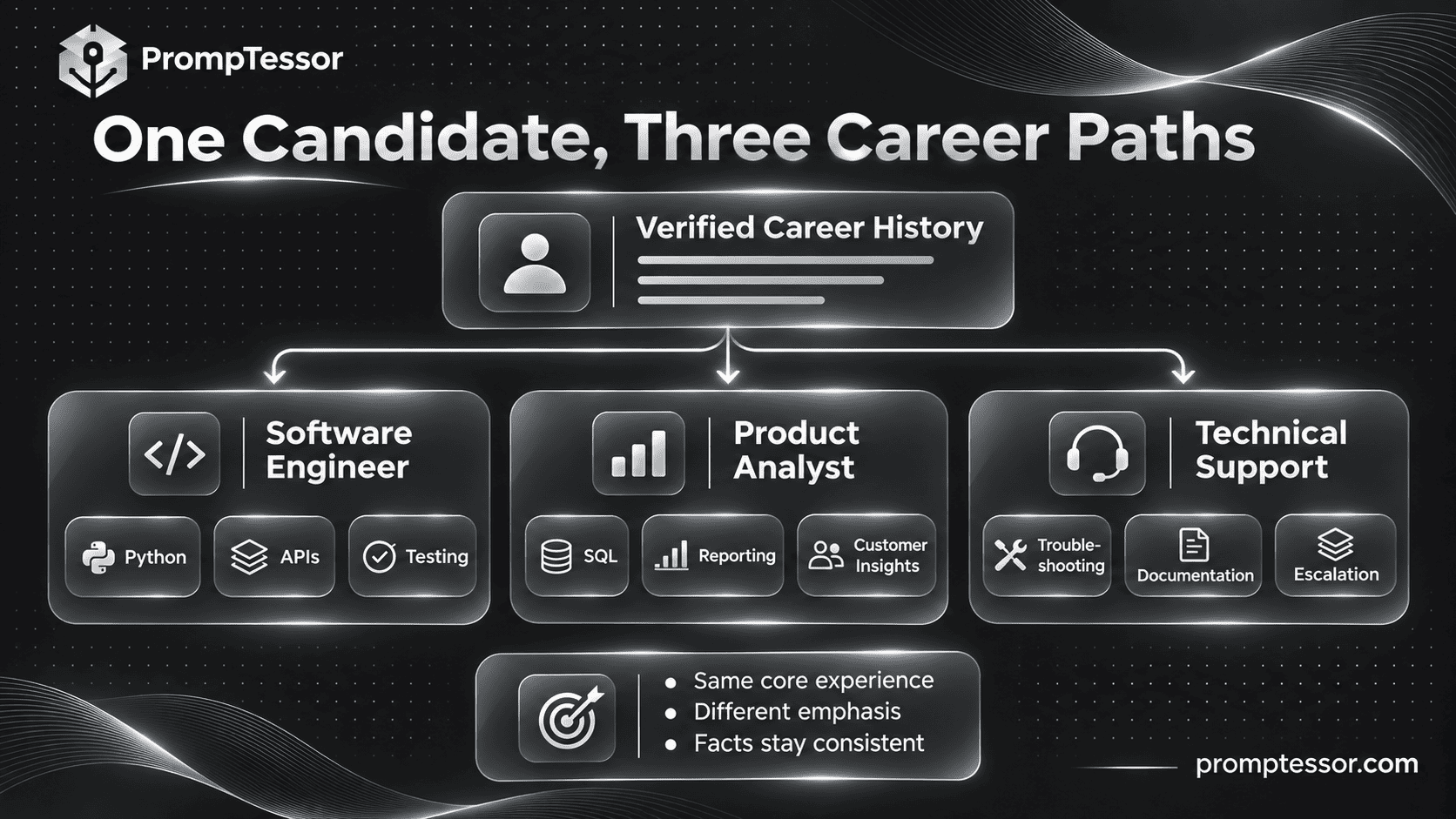
To illustrate how resume tailoring works, consider a fictional candidate named Alex Morgan.
Alex is a hypothetical professional with a background in customer support operations, reporting, and small technical projects.
Alex is considering three different positions: Software Engineer, Product Analyst, and Technical Support Specialist.
Important: All names, positions, employer details, accomplishments, and metrics in this demonstration are fictional. They are examples of how to structure an application, not actual professional references.
Step 1: Establish the Candidate's Verified Example Record
For the demonstration, assume Alex has the following background:
| Category | Fictional Candidate Evidence |
|---|---|
| Professional role | Support Operations Associate at fictional company Northstar Desk, 2024–2026 |
| Core responsibilities | Technical support triage, issue documentation, coordination with developers |
| Reporting work | Used SQL queries and spreadsheet reports to review support issue categories |
| Automation project | Built a Python script to organize weekly support ticket exports |
| Software project | Created a personal Flask-based task tracking API with basic automated tests |
| Documentation | Wrote internal troubleshooting guides for recurring user issues |
| Illustrative measured result | Reduced weekly report preparation from 90 minutes to 30 minutes |
| Not established | Professional software engineer experience, large-scale production system ownership, A/B testing leadership |
For this fictional case, treat the 90-to-30-minute improvement as a documented result. In a real application, the candidate would need to verify the number before using it.
Notice that the underlying career history does not change between applications.
Step 2: Compare the Three Target Roles
Assume the fictional job postings request the following qualifications:
| Target Role | Illustrative Requirements | Strongest Candidate Evidence |
|---|---|---|
| Software Engineer | Python, web APIs, testing, collaborative development | Python automation, personal Flask API project, bug reproduction |
| Product Analyst | SQL, reporting, customer insight, analytical communication | SQL queries, support trend analysis, spreadsheet reports |
| Technical Support Specialist | Troubleshooting, customer support, documentation, escalation | Direct support experience, issue triage, troubleshooting guides |
Alex does not become three different people.
The application changes which true experiences receive the most emphasis.
Step 3: Tailor the Resume Summary for Each Role
Use Prompt #3 or Prompt #5 with the respective job posting.
Software Engineer Resume Summary
Technical support operations professional with hands-on Python automation experience and a personal Flask API project. Experienced in troubleshooting, documenting software issues, and collaborating with engineering teams. Seeking to build on practical programming experience in a software engineering role.
This summary emphasizes software-related evidence without claiming that Alex has already worked as a professional software engineer.
Product Analyst Resume Summary
Support operations professional experienced in SQL reporting, support issue analysis, and cross-functional communication. Built Python automation for recurring reporting tasks and worked with technical teams to investigate user problems. Interested in applying operational data and customer insights to product decisions.
This version highlights analysis and reporting. It does not claim experience designing experiments or owning a formal product analytics function.
Technical Support Specialist Resume Summary
Technical support operations professional experienced in issue triage, troubleshooting documentation, and coordination with software engineering teams. Skilled in investigating recurring user problems, maintaining support resources, and improving reporting workflows through practical automation.
This version gives greater attention to directly relevant professional responsibilities.
Step 4: Tailor Resume Bullet Points Without Changing Facts
Now consider the same fictional Python reporting project.
Its actual result was reducing weekly report preparation from 90 minutes to 30 minutes.
Software Engineer Emphasis
Built a Python script to process
weekly support ticket exports,
automating recurring reporting
steps and reducing preparation
time from 90 to 30 minutes.
Product Analyst Emphasis
Improved recurring support
reporting by using SQL,
spreadsheets, and Python
automation to organize ticket
data, reducing weekly report
preparation from 90 to 30 minutes.
Technical Support Emphasis
Streamlined weekly support
report preparation through
Python automation, reducing
manual preparation time
from 90 to 30 minutes.
All three statements represent the same hypothetical achievement.
None adds a new employer, qualification, project, or performance claim.
Step 5: Identify Missing Qualifications
A good resume tailoring prompt also tells Alex where their evidence is insufficient.
For example, a Software Engineer job might require professional experience maintaining large production services.
Alex has a personal Flask project and support engineering collaboration, but the provided record does not establish that specific experience.
ChatGPT should not solve that gap by inventing professional backend engineering responsibilities.
Instead, it should identify the missing qualification and recommend emphasizing relevant authentic projects.
For a Product Analyst role, the model should likewise distinguish SQL reporting experience from advanced experimentation or predictive modeling.
Step 6: Write Different Cover Letter Introductions
After tailoring each resume, use Prompt #12 or #13.
The opening should reflect a genuine interest in each position and the available background.
Software Engineer Cover Letter Opening
I'm interested in the Software Engineer position because it offers an opportunity to build on my experience solving technical problems and developing practical automation tools. In my support operations role, I created a Python reporting script and collaborated with developers to investigate software issues. I have also built a personal Flask API project to strengthen my backend development skills.
Product Analyst Cover Letter Opening
I'm applying for the Product Analyst position because I enjoy turning operational information into clearer decisions. My experience includes analyzing support issue categories with SQL, preparing recurring reports, and working with technical teams to understand user problems. I'm interested in bringing that combination of data analysis and customer context to product improvement work.
Technical Support Cover Letter Opening
I'm interested in the Technical Support Specialist position because it closely matches my experience investigating customer issues, documenting solutions, and working with engineering teams. My background includes support triage, troubleshooting documentation, and workflow improvements that made recurring support reporting more efficient.
These examples are role-specific, but they do not yet include verified facts about particular employers. In a real application, additional company-specific personalization should come from official employer information and the candidate's genuine motivation.
Step 7: Complete an Accuracy Audit
Use Prompt #14 to check all three application packages against the same underlying career record.
| Claim | Software Engineer | Product Analyst | Technical Support |
|---|---|---|---|
| Support operations role, 2024–2026 | Preserved | Preserved | Preserved |
| Python reporting script | Emphasized | Emphasized | Relevant |
| SQL reporting | Supporting | Emphasized | Supporting |
| Flask personal project | Emphasized | Optional | Optional |
| Technical support experience | Relevant | Relevant | Emphasized |
| Professional software engineering history | Not claimed | Not claimed | Not claimed |
| Unsupported A/B testing experience | Not claimed | Not claimed | Not claimed |
The final result is three different applications built from one consistent candidate history.
The lesson: Tailoring changes relevance and presentation, not the truth of a candidate's experience.
How to Make a Resume ATS-Friendly With ChatGPT
Applicant tracking systems help employers manage applications, organize candidate records, and support different stages of hiring.
Many candidates assume an ATS uses one universal scoring system and that adding enough keywords will automatically secure an interview.
That assumption is misleading.
Employers use different software and screening configurations. Resume parsing, keyword search, recruiter review, screening questions, and automated assessment may play different roles depending on the organization.
ChatGPT cannot determine how a particular employer evaluates candidates without access to reliable information about that hiring process.
1. Use Clear, Standard Section Headings
Conventional headings such as Professional Experience, Education, Skills, and Projects help organize information for human readers and many resume-processing tools.
Creative headings can be appropriate in certain portfolios, but conventional resume structure is generally a safer starting point for standard online applications.
2. Prefer Readable Layouts
Complex multicolumn layouts, text boxes, tables, decorative graphics, and unusual placement of important information may create parsing problems in some systems.
A simple single-column resume is often a practical choice.
The University of Maryland advises candidates to consider standard headings and avoid layout elements that can interfere with parsing.
3. Match Relevant Job Terminology Truthfully
If a job posting mentions SQL and you genuinely used SQL for reporting, that experience should be visible in the resume.
If the posting requires Kubernetes and you have never used Kubernetes, adding the term will not make the qualification real.
Relevant terminology should communicate authentic expertise, not manipulate a keyword scanner.
4. Use a File Format the Employer Accepts
Some employers request DOCX, others accept PDF, and some specify a particular upload format.
Follow the job posting's actual submission instructions.
A PDF can preserve visual appearance, but applicants should still verify that its text can be selected and copied correctly. A DOCX file can be convenient where requested, but layout and formatting also need review.
5. Check Contact Information
Ensure that essential contact information is easy to locate and readable.
Do not rely on images or decorative headers to communicate information that may need to be extracted as text.
6. Avoid Keyword Stuffing
Repeating job terms without evidence makes a resume less readable and can create misleading claims.
Use terms in the context of actual responsibilities, skills, and achievements.
7. Do Not Trust an Invented ATS Match Score
Some AI tools produce an apparent percentage showing how closely a resume matches a job description.
Such a value may be a proprietary heuristic or model judgment. It is not necessarily the score used by the employer.
Ask ChatGPT for a transparent requirements-to-evidence table instead of treating a speculative number as a guarantee.
How to Write Better Resume Achievement Bullets
Resume bullets should make the candidate's contribution understandable.
Strong bullets often include three elements: a relevant action, the work performed, and a supported outcome.
ACTION
What did you do?

WORK
What system, problem, or
responsibility was involved?

RESULT
What changed, improved,
or was delivered?

EVIDENCE
How do you know the
claimed outcome is accurate?
Example: Weak vs. Improved Resume Bullets
| Weak Bullet | Improved Direction |
|---|---|
| Responsible for customer support. | Describe the support work performed, issue types handled, and any verified outcome. |
| Worked with SQL. | Explain what the SQL queries analyzed or produced. |
| Helped with documentation. | Identify the documentation created and its intended audience. |
| Improved team efficiency. | Explain the specific process improved and include a measured result if available. |
| Worked on software development. | Specify the actual contribution, technologies used, and project context. |
For example, "Created a Python script to organize weekly support exports" is meaningful even without a percentage.
Adding a fabricated "increased efficiency by 80%" would make the bullet less trustworthy.
Harvard's strong resume guide recommends specific, active, factual writing and appropriate quantification.
How to Write a Cover Letter That Doesn't Sound AI-Generated
A common problem with AI-generated cover letters is generic language.
Letters may repeatedly describe the applicant as passionate, enthusiastic, highly motivated, and excited without providing concrete evidence of fit.
The result sounds polished but tells the employer very little.
Start With a Real Connection to the Role
Identify what interests you about the actual responsibilities or organization.
Do not invent personal connections, company achievements, or a referral.
Select One or Two Relevant Examples
A cover letter does not need to repeat every resume bullet.
Choose a small number of examples that demonstrate why your experience matters for the role.
Use Your Own Voice
ChatGPT can improve grammar and structure, but the final letter should sound like something you could genuinely say in an interview.
If a sentence feels exaggerated or unnatural, rewrite it.
Keep It Concise
For many traditional US applications, a cover letter of approximately one page is an appropriate target, unless the employer requests a different format.
Verify Employer-Specific Statements
Company names, product descriptions, mission statements, recent developments, and job responsibilities should come from current, reliable sources.
Do not pretend to have researched an employer if the information was never checked.
How to Use ChatGPT for Entry-Level and Career Change Applications
Not every applicant has years of directly relevant employment experience.
Recent graduates and career changers can still present evidence of useful skills through education, completed projects, internships, voluntary work, and professional responsibilities in other fields.
Entry-Level Applicants
Relevant academic and personal projects can demonstrate initiative, technical ability, communication, research, and problem-solving.
Label projects accurately and describe what you personally contributed.
Career Changers
Identify skills that apply across professions, such as stakeholder communication, data analysis, documentation, process improvement, or technical troubleshooting.
Then explain how those skills connect to the target position.
A career changer should not relabel a former job to make it appear as though they already held the desired position.
Employment Gaps
An employment gap should not be hidden by inventing freelance work, extending employment dates, or listing certifications that were never completed.
Use an accurate chronology. Include relevant activities when genuine and useful, while respecting your privacy and the employer's actual requirements.
How to Review a ChatGPT-Generated Job Application
A final resume and cover letter review should cover more than grammar.
There are three separate questions:
- Accuracy: Is every claim supported by the candidate's actual experience?
- Relevance: Does the application clearly communicate qualifications related to the job?
- Presentation: Is the document readable, professional, and compliant with the employer's instructions?
A well-formatted resume with invented information fails the accuracy test.
A truthful resume that hides its most relevant qualifications may fail the relevance test.
A strong resume submitted in the wrong file format may encounter an avoidable application problem.
Review all three dimensions before submitting.
Common ChatGPT Resume and Cover Letter Mistakes
1. Asking ChatGPT to Invent Professional Experience
AI can generate convincing job titles and achievements that never happened.
Better approach: Provide a verified career record and prohibit new factual claims.
2. Adding Unsupported Achievement Percentages
A bullet containing "improved productivity by 40%" sounds precise but is misleading without evidence.
Better approach: Use documented results or explain the contribution without invented numbers.
3. Using One Resume for Every Role
Different positions emphasize different qualifications.
Better approach: Tailor the presentation of actual experience to each job posting.
4. Copying Job Description Keywords Without Relevant Experience
Keyword matching does not create qualifications.
Better approach: Include job-related terminology only where your background supports it.
5. Believing ATS Optimization Guarantees an Interview
Employers use different systems, requirements, and selection processes.
Better approach: Focus on clear formatting, accurate qualifications, and relevant evidence rather than a claimed universal ATS score.
6. Replacing Your Voice With Generic AI Writing
Generic statements can make a cover letter feel interchangeable.
Better approach: Add authentic motivation, specific examples, and natural phrasing.
7. Inventing Employer Research
AI may confidently mention a company's values, products, or accomplishments without checking them.
Better approach: Use verified information from the official company website and the current job posting.
8. Claiming Skills You Cannot Demonstrate
Listing unfamiliar technologies creates a credibility risk during interviews and practical assessments.
Better approach: Describe actual exposure and proficiency accurately.
9. Misrepresenting Personal Projects
A personal project can be valuable evidence, but it is not automatically equivalent to paid professional experience.
Better approach: Label projects correctly and explain the actual work performed.
10. Fabricating Career Gap Activities
Invented freelancing or false employment dates are not a suitable response to a gap.
Better approach: Keep the timeline accurate and share only appropriate, truthful context.
11. Overcomplicating Resume Formatting
Decorative layouts may reduce readability or interfere with some parsing systems.
Better approach: Prefer clear headings, readable structure, and formats accepted by the employer.
12. Writing an Overly Long Cover Letter
A long letter can bury the most important reason the employer should consider the candidate.
Better approach: Use a concise structure with a small number of strong examples.
13. Repeating the Resume Word for Word
The cover letter should explain relevance and motivation, not merely duplicate experience bullets.
Better approach: Connect selected evidence to the employer's needs and explain why the role matters to you.
14. Sharing Unnecessary Sensitive Information
Career documents may contain private contact information or confidential employer material.
Better approach: Minimize sensitive inputs and follow applicable privacy and data-handling requirements.
15. Submitting Without a Final Review
AI-generated documents can contain incorrect dates, inconsistent role titles, fabricated claims, and formatting problems.
Better approach: Compare the final documents with your actual history and the original job advertisement.
How to Improve Resume and Cover Letter Prompts With PrompTessor
PrompTessor can help transform vague job application requests into clearer, reusable prompts with better context, constraints, and output requirements.
It supports the prompt-design process rather than automatically verifying candidate backgrounds or making hiring decisions.
1. Generate a Structured Resume Prompt
Use the PrompTessor AI Prompt Generator when you have a general goal such as tailoring a resume, improving achievement bullets, or writing a cover letter.
Include the target role, evidence you can provide, required format, and truthfulness constraints.
2. Optimize an Existing Resume Prompt
Use the AI Prompt Optimizer when an existing prompt produces generic language, invents accomplishments, or ignores important job requirements.
For example:
ORIGINAL:
Make my resume better
for a software engineering job.

IMPROVED:
Using my verified resume
and the supplied job posting,
create a role-specific draft.

Identify relevant skills
and completed projects.

Preserve employers, titles,
education, and dates.

Do not invent achievements,
professional experience,
certifications, or technologies.

Use clear, standard headings.

Include a requirements
matching table and a
final factual accuracy audit.
The revised instruction identifies the evidence sources, intended output, and limits on factual changes.
3. Save Reusable Application Templates
Once a prompt works reliably, keep the core structure and change only the relevant variables for new applications.
JOB TITLE:
{job_title}

EMPLOYER:
{company}

JOB DESCRIPTION:
{job_description}

CANDIDATE EXPERIENCE:
{verified_history}

SKILLS:
{actual_skills}

ACHIEVEMENTS:
{verified_results}

OUTPUT:
{resume_or_cover_letter}

TONE:
{desired_tone}

CONSTRAINTS:
{truthfulness_and_formatting}

VERIFICATION:
{final_checks}
This makes it easier to tailor multiple applications while retaining consistent rules.
4. Refine Based on Real Feedback
If a draft sounds generic, ask for more specific wording based on real examples. If an experience bullet is unclear, explain the actual work and request a revision.
If ChatGPT suggests unsupported metrics, correct the prompt so missing measurements remain unknown.
5. Evaluate the Final Draft Yourself
Read the resume and cover letter as if you were the recruiter reviewing your application.
Ask whether the relevant qualifications are visible, whether the examples support the claims, and whether you can confidently explain everything during an interview.
For repeated prompt workflows, see AI Prompt Evaluation: How to Test, Compare, and Improve Prompts.
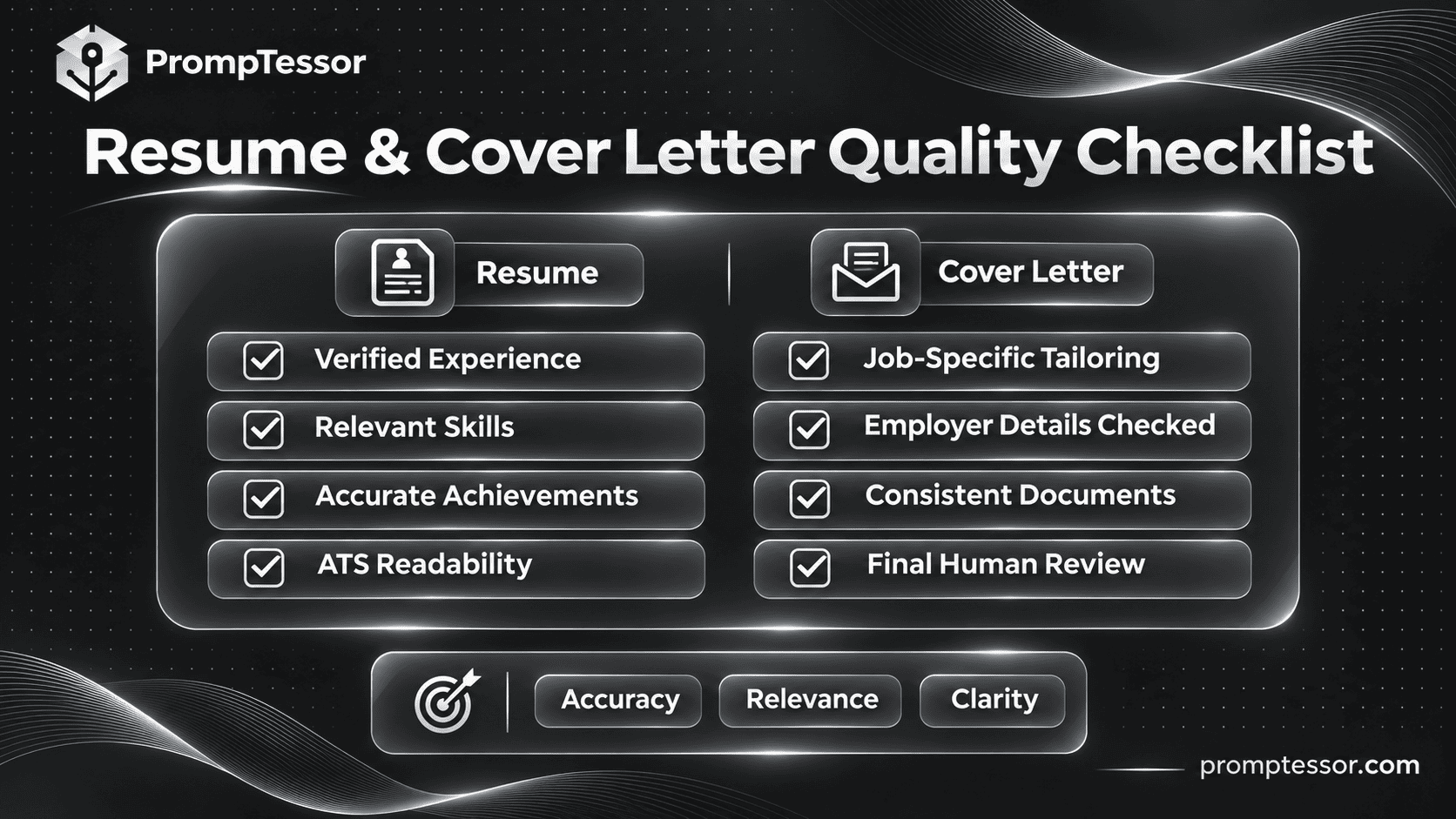
ChatGPT Resume and Cover Letter Quality Checklist
Before submitting an application, review the following checklist.
- Target role: The correct job title and employer are identified.
- Career history: Employers, positions, and dates match actual records.
- Achievements: Claimed results are accurate and appropriately supported.
- Skills: Every listed capability reflects genuine experience or training.
- Credentials: Degrees, certifications, and qualifications are represented correctly.
- Projects: Personal, academic, and professional work are labeled accurately.
- Job relevance: The resume emphasizes qualifications connected to the posting.
- ATS readability: Headings, layout, file format, and text order have been reviewed.
- Keywords: Relevant terms are included naturally and truthfully.
- Professional summary: The summary is concise and evidence-based.
- Bullet points: The candidate's actions and outcomes are understandable.
- Cover letter: The letter explains fit and genuine interest without repeating the resume.
- Company information: Employer-specific claims have been verified.
- Employment gaps: Dates remain accurate and unnecessary private information is excluded.
- Consistency: Resume and cover letter contain no contradictory details.
- Privacy: Sensitive information is handled appropriately.
- Writing quality: Grammar, spelling, tone, and formatting are checked.
- Application instructions: The required file types and other submission rules are followed.
- Personal credibility: The candidate can discuss every substantial claim during an interview.
- Final review: The documents have been read and approved by the candidate before submission.
Frequently Asked Questions About ChatGPT Resume and Cover Letter Prompts
What are ChatGPT resume prompts?
ChatGPT resume prompts are structured instructions that help an AI model organize career information, rewrite experience statements, tailor a resume, improve readability, and review application materials. They should use the candidate's real qualifications as the source of truth.
What is the best ChatGPT prompt for writing a resume?
A useful prompt includes the target job description, verified career history, actual skills, supported achievements, formatting requirements, and explicit rules against invented qualifications. The best prompt depends on the applicant's background and intended role.
Can ChatGPT write my entire resume?
ChatGPT can prepare a complete resume draft from supplied information. However, the candidate should review every claim, correct errors, verify important details, and ensure that the final document accurately reflects their experience.
Can ChatGPT tailor my resume to a job description?
Yes. ChatGPT can compare the job posting with your verified experience, identify relevant evidence, and emphasize appropriate qualifications. Tailoring should not involve inventing experience or skills that you do not possess.
Can ChatGPT optimize my resume for ATS?
ChatGPT can help review standard headings, relevant keywords, readability, and possible formatting problems. It cannot guarantee how a particular employer's applicant tracking system will process or rank the resume.
What are ATS-friendly resume prompts?
ATS-friendly resume prompts ask an AI model to review plain-text readability, conventional section headings, job-related terminology, and file format considerations while preserving accurate candidate information.
Can ChatGPT generate resume bullet points?
Yes. ChatGPT can rewrite real responsibilities and achievements into more concise bullet points using clear action verbs and supported outcomes. It should not invent percentages, results, or project ownership.
Should I use AI-generated achievement metrics?
Only if the numbers accurately reflect actual evidence. When reliable metrics are unavailable, describe the work and its purpose without fabricating quantitative results.
Can ChatGPT write an entry-level resume?
Yes. ChatGPT can help present relevant education, internships, academic projects, volunteer work, extracurricular activities, and demonstrated skills without requiring extensive professional employment history.
Can ChatGPT help with a career change resume?
Yes. ChatGPT can identify transferable skills, highlight relevant projects, and explain the connection between previous experience and a new career direction. It should preserve actual job titles and employment history.
Can ChatGPT explain an employment gap?
ChatGPT can help draft a brief, truthful explanation or organize a resume timeline. It should not fabricate work history or pressure the applicant to disclose unnecessary sensitive personal circumstances.
What is the best ChatGPT prompt for a cover letter?
A useful cover letter prompt includes the actual job description, verified resume, relevant achievements, genuine motivation, and trustworthy employer information. It should ask for a concise, professional letter without invented qualifications or generic praise.
Can ChatGPT write a personalized cover letter?
Yes. ChatGPT can connect a candidate's relevant experience to a specific employer and position when accurate information is provided. The resulting letter should be reviewed for factual accuracy and authentic tone.
Should a cover letter repeat my resume?
No. A cover letter should complement the resume by explaining interest, fit, and selected examples. Repeating every resume bullet generally makes the letter less useful.
How long should a cover letter be?
For many traditional US job applications, a concise letter of approximately one page is suitable. Always follow the employer's instructions if they specify a different format or length.
Can employers detect AI-written resumes?
Employers may notice generic or inconsistent writing, and various AI-detection tools make claims about generated text. Such detection is not a reliable substitute for evaluating factual accuracy or candidate qualifications. A better approach is to personalize and verify the application rather than focus on avoiding detection.
Does an ATS-friendly resume guarantee an interview?
No. Hiring decisions depend on the role, applicant qualifications, employer requirements, competition, and the organization's selection process. Clear formatting and relevant evidence can improve the presentation of a resume but do not guarantee an interview.
Can ChatGPT compare my resume with a job description?
Yes. ChatGPT can create a requirements-to-evidence comparison and identify potential gaps. It should not claim to know the employer's private assessment criteria or generate an unsupported hiring probability.
Is it safe to upload my resume to ChatGPT?
Before sharing a resume, review the service's privacy and data-handling settings. Consider removing unnecessary personal identifiers, confidential employer information, or other sensitive material that the drafting task does not require.
Can PrompTessor improve ChatGPT resume prompts?
Yes. PrompTessor can help generate, analyze, optimize, refine, save, and reuse prompts for resumes, cover letters, and other writing tasks. The candidate remains responsible for accurate career information, final documents, and application submission.
Final Thoughts: Use ChatGPT to Communicate Your Experience More Clearly
ChatGPT can be a helpful assistant during a job search. It can analyze descriptions, organize career evidence, improve resume bullets, draft professional summaries, tailor applications, and help write more relevant cover letters.
But the quality of a job application still depends on what the candidate has actually done.
AI cannot replace genuine experience with a convincing paragraph. It cannot turn a personal project into professional employment, create credentials that were never earned, or guarantee that a recruiter will select a resume.
The 15 prompts in this guide provide practical starting points for turning verified information into clearer and more relevant application materials.
Start by understanding the target role. Build a truthful master career inventory. Emphasize the strongest relevant evidence, improve readability, and personalize the cover letter using genuine information about the employer.
Then perform a final review before submitting anything.
If a prompt produces generic language or unsupported claims, refine the instruction, provide better context, and test the revised result.
To create clearer and reusable resume or cover letter instructions, try the PrompTessor AI Prompt Generator and improve the prompt using your actual job description, career evidence, and writing preferences.
The best ChatGPT resume prompt does not invent a stronger candidate. It helps you present your genuine qualifications more clearly, accurately, and persuasively.
Official Sources and Further Reading
- Harvard Career Services — Harvard College Guide to Creating a Strong Resume
- Harvard Career Services — Create Impactful Resumes and Cover Letters
- University of Maryland Career Center — Resume How-To Guide
- University of Maryland Career Center — Cover Letter Resources
- U.S. Department of Labor — Resume Essentials Participant Guide (2026)
Build better prompts in one workspace
Generate prompts from ideas, analyze and optimize quality, refine with feedback, reverse-engineer content, and save reusable prompts in your Prompt Library.
Try PrompTessor Free