15 AI SEO Prompts for Keyword Research, Content Briefs, and Optimization (2026)
AI can generate hundreds of SEO keyword ideas in seconds. It can also confidently invent search volumes, recommend pages that already exist on your website, or suggest technical fixes without ever inspecting your site.
That is the difference between using AI to generate SEO ideas and using AI to support a reliable SEO workflow.
Effective SEO requires evidence. Keyword research benefits from real search data. Content briefs need an understanding of search intent and competing results. Technical audits depend on actual crawl information. Performance analysis requires metrics from tools such as Google Search Console.
AI can help organize, interpret, and act on that information, but it should not pretend to have data it has never received.
This guide provides 15 copy-and-paste AI SEO prompts for keyword research, content briefs, and optimization. The templates cover keyword discovery, search intent, topic clustering, competitor analysis, on-page SEO, internal linking, content updates, technical audits, structured data, Google Search Console, keyword cannibalization, and SEO reporting.
Each prompt includes required inputs, a defined output, and verification rules designed to make its recommendations easier to evaluate.
You can adapt these prompts for ChatGPT, Claude, Gemini, and other compatible AI models.
The objective is not to replace SEO expertise or guarantee rankings. It is to reduce repetitive analysis, create more useful documentation, and support better decisions using information you can verify.
Quick Answer: What Is the Best AI Prompt for SEO?
The best AI SEO prompt depends on the task. For keyword research, it should specify the audience, market, existing keyword data, and search intent. For content optimization, it should include the actual page and its search performance. For a technical audit, it should use verified crawl or indexing evidence.
A reusable starting point is:
ROLE:
Act as an evidence-focused SEO analyst.

WEBSITE:
{website_url}

BUSINESS AND AUDIENCE:
{business_context}

TARGET MARKET:
{country_and_language}

SEO OBJECTIVE:
{specific_goal}

AVAILABLE DATA:
{gsc_export_keyword_csv_crawl_or_page_content}

CURRENT WEBSITE CONTENT:
{relevant_existing_urls}

TASK:
{seo_task}

RULES:
- Use supplied data as the source of truth.
- Do not invent keyword search volumes.
- Do not fabricate ranking positions.
- Do not invent competitor findings.
- Do not assume an inaccessible URL
  has been analyzed.
- Separate verified findings,
  hypotheses, and unknowns.
- Preserve source URLs and metrics.
- Flag missing information.
- Avoid recommendations that duplicate
  existing content unnecessarily.

OUTPUT:
1. Executive summary
2. Evidence-backed findings
3. Recommended actions
4. Priority and rationale
5. Data limitations
6. Verification checklist

Do not claim a ranking outcome
is guaranteed.
Replace the variables with the appropriate data for your task. A prompt with strong instructions can still produce weak SEO recommendations when the necessary evidence is missing.
Key Takeaways
- AI SEO prompts are most useful when paired with real website, keyword, or performance data.
- ChatGPT and other language models should not be treated as authoritative sources of search volume, keyword difficulty, or current ranking positions.
- Keyword discovery and keyword validation are different steps.
- Search intent should be evaluated using relevant search results and the needs those results satisfy.
- Content briefs should describe what readers need, not merely copy competitors' heading structures.
- On-page optimization should improve clarity, accuracy, usefulness, and relevance instead of forcing more keyword repetitions.
- Internal linking recommendations need verified source and destination URLs.
- Technical SEO recommendations should identify the underlying evidence, possible cause, and verification method.
- Structured data must accurately represent content that exists on the page.
- Google Search Console data needs careful interpretation, particularly average position, query coverage, and CTR.
- Pages targeting similar keywords are not automatically cannibalizing one another.
- AI-generated recommendations should be tested and evaluated rather than assumed to improve rankings.
What Are AI SEO Prompts?
AI SEO prompts are instructions that guide an AI model through a search engine optimization task.
They can help identify keyword themes, analyze search intent, organize content plans, review existing pages, interpret crawl exports, and summarize organic search performance.
Different tasks require different kinds of evidence.
| SEO Task | Useful Input | Expected Output |
|---|---|---|
| Keyword research | Seed topics, audience, market, keyword export | Keyword ideas and validation priorities |
| Search intent | Relevant query and observed search results | Intent classification and page recommendation |
| Keyword clustering | Validated keyword list and existing URLs | Topic groups and page mapping |
| Competitor content gaps | Accessible competitor and website content | Evidence-backed content opportunities |
| Content briefs | Primary topic, intent, sources, existing coverage | Editorial SEO brief |
| On-page optimization | Existing HTML, search queries, audience context | Prioritized recommendations |
| Technical SEO | Crawl export, HTTP data, indexing evidence | Issue register and verification plan |
| Performance reporting | Google Search Console and analytics data | Performance analysis and next actions |
AI can assist with analysis and drafting, but it does not automatically gain access to Google Search Console, Ahrefs, Semrush, or your website's internal systems.
If current data is needed, the model must receive that data through an upload, authorized tool, or another verifiable source.
Can ChatGPT Do SEO Keyword Research?
Yes, ChatGPT can help brainstorm keyword ideas, group existing queries, interpret search intent, and develop content plans.
However, there is an important distinction between generating plausible search phrases and measuring actual search demand.
A model may suggest that people search for "best project management software for startups." That does not prove the query receives a particular number of searches per month.
Likewise, a model cannot reliably establish current keyword difficulty, CPC, or SERP rankings without relevant external data.
Where Should SEO Data Come From?
Depending on the task, useful sources include:
- Google Search Console: Actual search performance data for a verified website property, including clicks, impressions, CTR, and average position.
- Google Keyword Planner: Keyword planning information and advertising-related search estimates.
- Ahrefs or Semrush: Third-party estimates of keyword demand, competition, backlinks, and related SEO metrics.
- Website crawl tools: Internal URLs, status codes, canonical signals, links, and technical page information.
- Actual search results: Evidence about the types of pages and experiences appearing for a query.
- Website analytics: Engagement, conversions, and other business outcomes associated with organic traffic.
These sources measure different things. Their metrics should not be treated as interchangeable.
For example, Google Search Console impressions represent occasions when your site appears in eligible search results under Google's counting rules. They are not a complete estimate of total monthly searches for that keyword.
Similarly, keyword difficulty is a third-party metric whose methodology varies between providers.
The practical rule is simple: use AI to interpret SEO data, not to invent it.
How to Prepare Data for AI SEO Analysis
Before using the prompts, decide which information is available and which still needs to be collected.
For many workflows, a spreadsheet or CSV export is a useful starting point.
| Data Field | Example | Purpose |
|---|---|---|
| Keyword | project management software | Identifies the query or topic |
| Country | United States | Defines the target market |
| Search intent | Commercial investigation | Guides the recommended page type |
| Search volume | Value from a named research provider | Helps estimate demand |
| Keyword difficulty | Provider-defined estimate, if available | Adds a competition signal |
| GSC impressions | Value from an actual export | Shows existing search visibility |
| GSC clicks | Value from an actual export | Shows recorded search visits |
| Current URL | Existing relevant page | Helps prevent unnecessary content duplication |
| Observed SERP | Search result types and URLs | Supports intent and competition review |
Keep source names, export dates, country filters, search types, and measurement periods with the data.
Do not merge metrics from different tools without identifying their sources.
For Google Search Console, consider filtering by search type, country, device, and comparable time ranges. Search Console may omit anonymized queries and apply data limits, so exported query rows should not be assumed to represent every search.
For details, see Google's Search Console Performance report documentation.
The Reusable AI SEO Prompt Formula
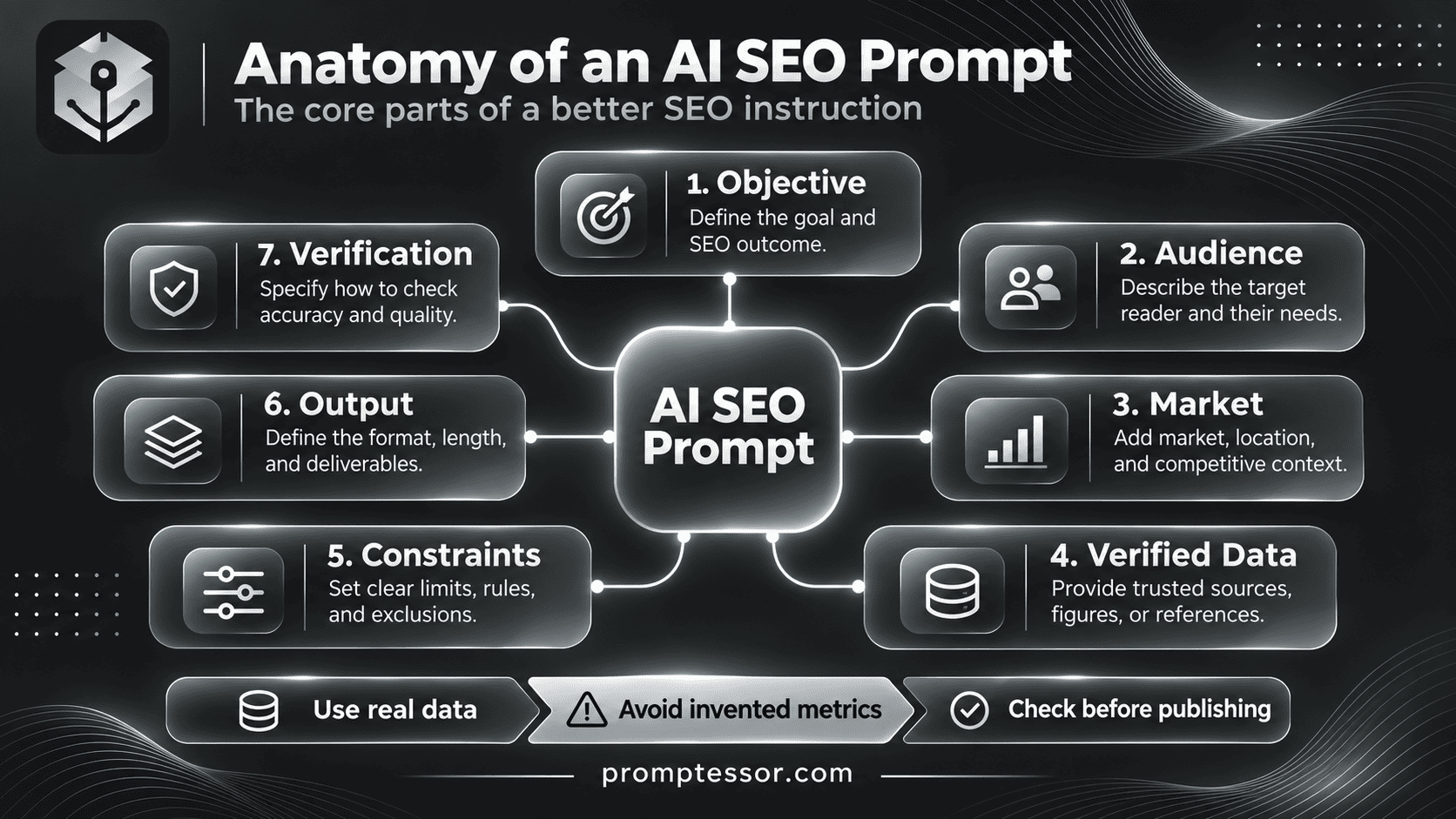
Most SEO prompts become more useful when they clearly separate the business goal, available evidence, task scope, and desired output.
SEO OBJECTIVE
What needs to improve or be investigated?

TARGET AUDIENCE
Who should the page help?

MARKET
Which country and language matter?

INPUT DATA
Which verified datasets,
URLs, or source documents exist?

PAGE CONTEXT
What content already exists?

TASK
What analysis or draft is needed?

CONSTRAINTS
What must not be invented,
assumed, or changed?

OUTPUT
What table, brief, report,
or recommendation is required?

VERIFICATION
How can the results be checked?
The format can remain stable while variables change between projects.
For example, keyword clustering requires a keyword list and existing URL inventory, while a technical audit needs crawl and indexing data.
See Prompt Templates and Variables: How to Build Reusable AI Prompts for more guidance on reusable structures.
15 Copy-and-Paste AI SEO Prompts
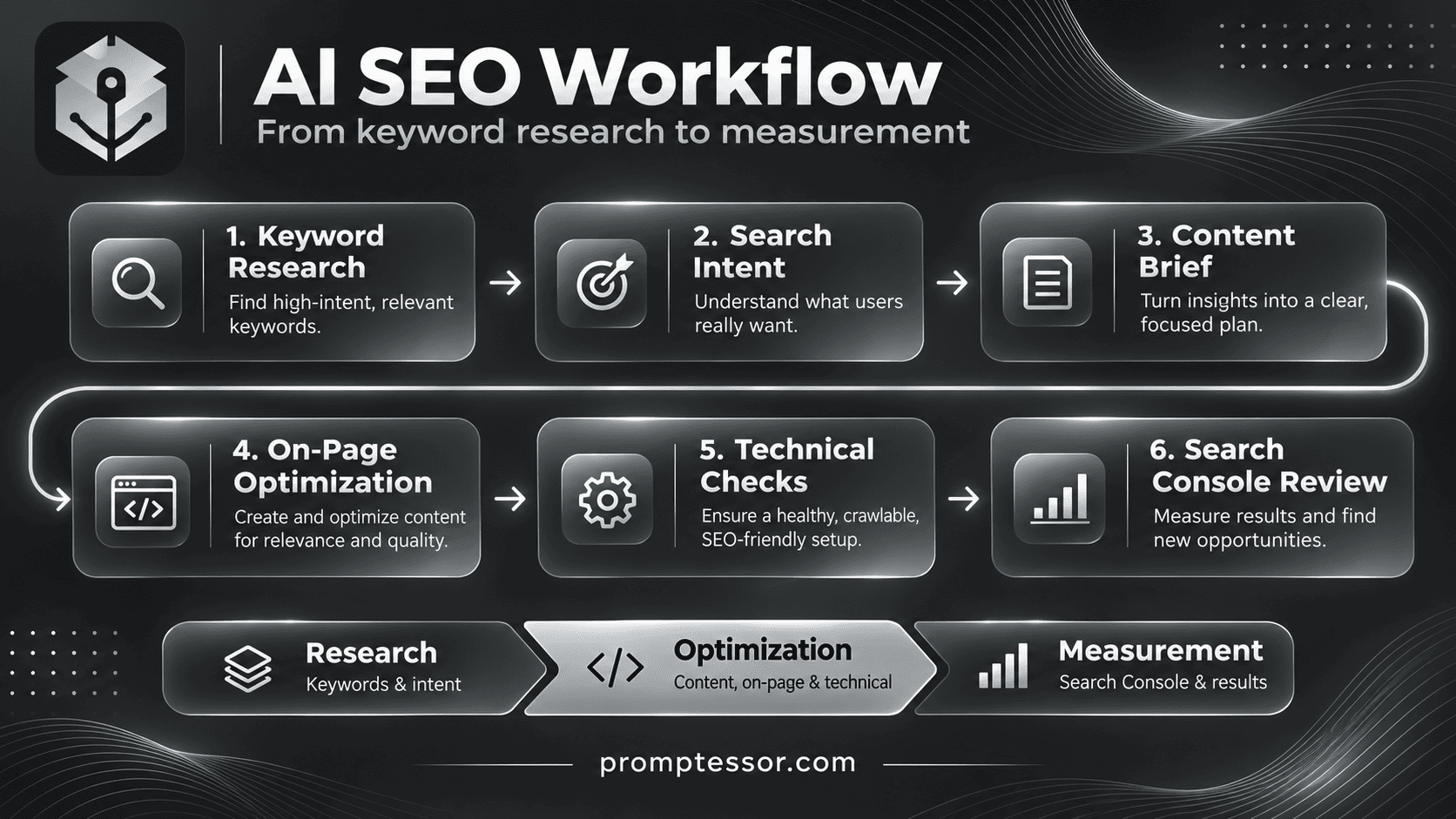
The following prompts are organized around a practical SEO workflow, from identifying opportunities to evaluating results.
Replace the placeholders in braces with your own data. Upload the requested CSV files, page content, crawl exports, or other documentation when necessary.
Unless the environment includes authorized browsing or analytics tools, these prompts analyze only information you provide. They do not independently retrieve live rankings, inspect websites, or access private accounts.
Keyword Research and Search Intent
1. AI SEO Keyword Research Prompt
Best for: Generating relevant keyword ideas from a product, audience, and initial topic, then preparing those ideas for validation with real keyword data.
Required input: Product description, target audience, country, seed topics, existing relevant pages, and optional keyword research export.
Example use case: A SaaS company wants to identify informational and commercial topics related to project management software.
Act as an SEO keyword
research strategist.

Website:
{website_url}

Business and product:
{business_description}

Target audience:
{target_audience}

Target country and language:
{market}

Seed topics:
{seed_topics}

Existing relevant pages:
{existing_urls}

Verified keyword dataset:
{keyword_data_if_available}

Your tasks:

1. Generate relevant keyword ideas
   connected to real user needs.

2. Group them into:
   - Informational
   - Commercial investigation
   - Transactional
   - Navigational, when applicable

3. Identify:
   - Primary keyword candidates
   - Related queries
   - Long-tail possibilities
   - Questions worth investigating

4. Check proposed topics against
   the supplied existing pages.

5. Recommend which terms should
   be validated using keyword tools.

Rules:
- Do not invent monthly search volume.
- Do not fabricate keyword difficulty.
- Do not invent CPC or search trends.
- Do not claim current SERP rankings.
- Preserve all provided source metrics.
- Label unvalidated ideas as
  HYPOTHESIS.
- Do not recommend duplicate pages
  without explaining the need.

Return a table with:
Keyword, Intent, Audience Need,
Suggested Page Type,
Existing URL Match,
Available Evidence,
Validation Status, Priority Rationale.

Finish with a keyword validation
and research checklist.
Expected output: An organized keyword opportunity list with intent classifications and clear validation requirements.
Verification: Check actual search demand and competition using appropriate tools. Compare candidates against existing pages and review relevant search results before committing to new content.
2. AI Search Intent Analysis Prompt
Best for: Understanding what searchers likely want from a query and identifying the page format most suited to satisfying that need.
Required input: Target keyword, country, language, and a current SERP snapshot or supplied search result data.
Example use case: An SEO specialist wants to determine whether a keyword should target a tutorial, comparison page, free tool, or product landing page.
Act as a search intent
and SERP analysis specialist.

Target query:
{keyword}

Country and language:
{market}

Observed search results:
{serp_snapshot}

Existing website pages:
{current_pages}

Business objective:
{business_goal}

Analyze:

1. Likely primary search intent.
2. Possible secondary intents.
3. Types of pages visible
   in the supplied results.
4. Common user questions.
5. Content formats appearing.
6. Features of useful answers.
7. Potential gaps in the
   available result set.
8. Recommended page type.

For each observation,
reference the supplied
result or URL.

Distinguish:
OBSERVED SERP EVIDENCE
REASONABLE INTERPRETATION
UNVERIFIED HYPOTHESIS

Do not claim to have inspected
live Google results unless
they were actually retrieved.

Do not invent search features,
ranking positions, or page contents.

Do not assume every keyword
has only one intent.

Return:
- Intent summary
- SERP evidence table
- Recommended content format
- Existing page suitability
- Research gaps
- Validation checklist
Expected output: A search intent assessment explaining what the query requires and which content format is worth evaluating.
Verification: Review the actual search results in the intended market. Search results vary by location, device, language, and other conditions.
3. AI Keyword Clustering and Topic Mapping Prompt
Best for: Organizing validated keyword data into logical topics and mapping them to existing or proposed website pages.
Required input: Keyword CSV, intent information if available, page inventory, and a target market.
Example use case: A content marketer has several hundred related queries and wants to avoid publishing separate articles for near-identical questions.
Act as an SEO keyword
clustering specialist.

Target market:
{market}

Keyword dataset:
{keyword_csv}

Existing page inventory:
{existing_pages}

Website topic areas:
{topic_categories}

Your tasks:

1. Normalize obvious formatting
   differences in keyword text.

2. Group keywords by:
   - Shared user objective
   - Closely related intent
   - Topic relationship
   - Suitable page format

3. Distinguish:
   - Primary query
   - Supporting queries
   - Related subtopics
   - Separate search intents

4. Map clusters to current URLs
   when coverage already exists.

5. Recommend new pages only when
   the need is meaningfully distinct.

6. Identify groups requiring
   manual SERP validation.

Rules:
- Do not treat similar wording
  as proof of identical intent.
- Do not invent keyword metrics.
- Do not fabricate page URLs.
- Preserve keyword source data.
- Do not force every query into
  a single broad article.
- Do not create one new URL
  for every keyword variation.

Return:
- Keyword cluster table
- Primary intent per cluster
- Existing URL mapping
- Proposed page type
- Possible overlap flags
- SERP validation requirements
- Publication priority rationale
Expected output: A topic-to-page map that organizes related keywords while keeping meaningfully different user needs separate.
Verification: Review search results for ambiguous clusters. Two terms can share vocabulary while requiring different content formats or solutions.
Content Planning and Competitor Analysis
4. AI Competitor Content Gap Analysis Prompt
Best for: Comparing your website's existing coverage with accessible competitor content and identifying potentially useful topics or missing information.
Required input: Your page inventory, competitor URLs or extracted page text, and a defined set of target topics.
Example use case: A SaaS company wants to determine whether competing guides answer important product-related questions that its own documentation does not address.
Act as an SEO competitor
content gap analyst.

My website:
{website}

My accessible page content:
{own_pages}

Competitor URLs and
accessible content:
{competitor_pages}

Target topics:
{topics}

Target audience:
{audience}

Your tasks:

1. Identify the user needs
   addressed by each page.

2. Compare meaningful coverage,
   not just keyword repetitions.

3. Identify:
   - Missing useful topics
   - Underexplained questions
   - Different content formats
   - Distinct examples or tools
   - Opportunities for original value

4. Check whether my existing pages
   already satisfy those needs.

5. Recommend improvements or
   new content where justified.

For each finding include:
- Topic
- Supporting competitor source
- Current website coverage
- User benefit
- Proposed action
- Evidence limitations

Do not invent competitor page content.

Do not claim a competitor ranks
for a keyword without ranking data.

Do not assume copying competitor
headings produces better SEO.

Do not reproduce substantial
competitor text.

Return:
- Coverage comparison matrix
- Evidence-backed gaps
- Original content opportunities
- Improvement priorities
- Research needed
Expected output: A competitor coverage matrix that focuses on useful missing information rather than duplicating another website's structure.
Verification: Inspect the referenced pages, confirm that the content remains current, and evaluate whether the proposed additions genuinely serve your audience.
5. AI SEO Content Brief Prompt
Best for: Creating a structured editorial brief before writing a new article or improving an existing page.
Required input: Target keyword, search intent, audience, verified sources, SERP observations, existing content, and business objectives.
Example use case: An SEO manager needs a detailed brief that a writer can follow without inventing data or repeating an existing article.
Act as a senior SEO
content strategist.

Create a detailed content brief.

Primary topic:
{topic}

Primary keyword:
{keyword}

Secondary keywords:
{related_keywords}

Audience:
{audience}

Target country:
{market}

Search intent evidence:
{intent_research}

Relevant SERP observations:
{serp_data}

Existing related content:
{internal_pages}

Approved reference sources:
{sources}

Business objective:
{business_goal}

Create:

1. Search intent summary
2. Target reader and needs
3. Unique editorial angle
4. Suggested H1
5. Recommended H2/H3 structure
6. Questions the page must answer
7. Original examples to develop
8. Evidence and sourcing requirements
9. Internal linking opportunities
10. CTA recommendation
11. Potential FAQ questions
12. Content review checklist

For every recommended section,
explain the reader need it serves.

Avoid keyword stuffing.

Do not invent studies,
statistics, or expert quotations.

Do not create sections solely
to repeat competitor headings.

Flag potential overlap with
existing site content.

Return a publication-ready
editorial brief and a list
of unresolved research tasks.
Expected output: A content brief describing the target reader, search intent, editorial structure, research needs, and internal links.
Verification: Check that the brief matches current SERP intent, adds original value, and does not unnecessarily compete with an existing article on the same website.
6. AI SEO Blog Outline and Content Structure Prompt
Best for: Turning an approved content brief into a logical article structure before drafting the full page.
Required input: Approved brief, audience, topic, research notes, existing related content, and available examples.
Example use case: A content writer wants an outline that answers the main query quickly and explores supporting questions in a useful order.
Act as an SEO-focused
editorial structure specialist.

Develop an article outline.

Approved content brief:
{content_brief}

Primary reader question:
{main_question}

Target audience:
{audience}

Verified source material:
{research_sources}

Relevant internal pages:
{internal_urls}

Original examples available:
{examples}

Your tasks:

1. Write a direct opening angle.
2. Place the core answer early.
3. Organize sections in
   a natural reading order.
4. Create useful H2/H3 headings.
5. Identify evidence needed
   for each major section.
6. Suggest tables or diagrams
   where they improve understanding.
7. Identify practical examples.
8. Propose relevant internal links.
9. Remove redundant sections.
10. Include a useful conclusion.

For each heading include:
- Reader question answered
- Key points to cover
- Supporting evidence needed
- Suggested content format

Do not:
- Repeat keywords unnaturally.
- Invent search demand.
- Add filler sections.
- Copy a competitor outline.
- Invent source claims.
- Duplicate an existing page's
  primary purpose.

Return:
- Recommended H1
- Complete article outline
- Research checklist
- Internal link opportunities
- Editorial quality notes
Expected output: A structured outline built around the reader's information needs, not an arbitrary keyword count.
Verification: Review the order of sections and confirm that each contributes information the intended audience needs.
On-Page SEO and Content Optimization
7. AI SEO Title Tag and Meta Description Prompt
Best for: Drafting clear, distinctive search result titles and meta descriptions that accurately represent existing page content.
Required input: Page URL, current title, existing description, primary topic, search intent, and actual page content.
Example use case: A marketer wants alternative title tags for a page that receives impressions but has a weak or unclear search result presentation.
Act as an SEO metadata
optimization specialist.

Optimize the metadata
for the following page.

URL:
{page_url}

Current title:
{current_title}

Current meta description:
{current_description}

Actual page content:
{page_content}

Primary keyword:
{keyword}

Target search intent:
{intent}

Important brand context:
{brand}

Create:

1. Five distinct title tag options.
2. Three meta description options.
3. One recommended combination.
4. A clear rationale for each.

Editorial targets:
- Title: roughly 50-60 characters
  when suitable for readability.
- Description: approximately
  140-155 characters as a
  working editorial target.

These are not strict Google limits.

Requirements:
- Describe the actual page.
- Keep titles distinctive and useful.
- Include the primary topic naturally.
- Avoid keyword stuffing.
- Avoid unsupported superlatives.
- Do not invent prices,
  features, or offers.
- Avoid misleading clickbait.
- Do not promise rankings or CTR gains.

Show exact character counts.

Return:
- Title options
- Description options
- Recommended pairing
- Search intent explanation
- Final verification notes
Expected output: Several metadata options that can be evaluated against the real page and query intent.
Verification: Check character counts with a reliable counter and preview the result. Google does not enforce a universal character limit for titles or meta descriptions and may generate different search result text. See Google's snippet guidance.
8. AI On-Page SEO Optimization Prompt
Best for: Reviewing a published page and identifying improvements to content usefulness, relevance, clarity, structure, and internal navigation.
Required input: Actual page content or HTML, target queries, search intent, and performance information if available.
Example use case: A content marketer wants to improve a guide that covers the right topic but may not answer important user questions clearly.
Act as an evidence-focused
on-page SEO reviewer.

Review this existing page.

URL:
{url}

HTML or page content:
{content}

Target queries:
{keywords}

Search intent:
{intent}

Available performance data:
{gsc_data}

Relevant internal pages:
{internal_pages}

Evaluate:

1. Main topic and page purpose
2. Opening answer clarity
3. Heading organization
4. Information completeness
5. Accuracy and freshness
6. Original examples or evidence
7. Readability and accessibility
8. Title and metadata alignment
9. Internal link relevance
10. User next-step clarity

For each issue provide:
- Exact observed evidence
- User or SEO implication
- Recommended change
- Priority
- Verification method

Separate:
OBSERVED ISSUE
POTENTIAL IMPROVEMENT
REQUIRES MORE DATA

Do not invent ranking problems.

Do not recommend repetitive
keyword insertion.

Do not remove useful sections
solely to shorten the page.

Do not claim technical issues
without appropriate evidence.

Return:
- Page assessment
- Prioritized improvements
- Suggested revisions
- Evidence gaps
- Final review checklist
Expected output: An actionable on-page review that distinguishes actual content weaknesses from unverified hypotheses.
Verification: Compare proposed changes with the page's intended audience, known search intent, original sources, and current performance before publishing revisions.
9. AI SEO Internal Linking Strategy Prompt
Best for: Identifying useful internal links between existing website pages and improving how users navigate related topics.
Required input: URL inventory, page titles, page content or summaries, and an internal link export if available.
Example use case: A SaaS website has dozens of related guides and free tools but wants a more coherent internal navigation structure.
Act as an SEO internal
linking strategist.

Website:
{website}

Verified URL inventory:
{page_inventory}

Page titles and content:
{page_content}

Existing internal link data:
{link_export}

Priority pages:
{priority_pages}

Your tasks:

1. Identify topically relevant
   relationships between pages.

2. Suggest contextual links
   that benefit the reader.

3. Recommend accurate
   descriptive anchor text.

4. Identify important pages
   lacking relevant incoming links
   when the supplied crawl supports it.

5. Suggest links between:
   - Supporting informational guides
   - Topic overview pages
   - Relevant tools
   - Appropriate conversion pages

For each recommendation provide:
- Source URL
- Destination URL
- Suggested anchor text
- Suggested placement context
- Reader benefit
- Confidence or evidence status

Rules:
- Use only verified existing URLs.
- Do not invent destinations.
- Do not recommend irrelevant links
  solely to increase link counts.
- Avoid repetitive exact-match anchors.
- Do not claim a page is orphaned
  without sufficient crawl evidence.
- Check destination relevance.

Return:
- Internal link opportunity table
- High-priority page recommendations
- Potential orphan-page checks
- Implementation checklist
Expected output: A source-to-destination linking plan with contextual anchor suggestions and explicit URL verification requirements.
Verification: Confirm every URL exists, is accessible, and provides useful information for readers. Google recommends relevant internal links and descriptive anchor text, not a fixed target number of links per page.
10. AI SEO Content Refresh and Update Prompt
Best for: Updating older pages whose information, screenshots, product descriptions, or supporting references may no longer be accurate.
Required input: Current article, published and modified dates, current authoritative sources, performance data, and relevant change history.
Example use case: A technical tutorial discusses a software feature whose interface and documentation have changed since publication.
Act as an SEO content
refresh and quality reviewer.

Existing article:
{article_content}

Page URL:
{url}

Original publication date:
{publication_date}

Current verified references:
{updated_sources}

Known product or topic changes:
{confirmed_changes}

Search performance:
{gsc_data}

Your tasks:

1. Identify outdated statements.
2. Check time-sensitive claims.
3. Find broken or obsolete references
   using supplied link evidence.
4. Identify missing current context.
5. Preserve useful evergreen sections.
6. Recommend specific updates.
7. Propose revised wording
   where supporting evidence exists.
8. Identify changes requiring
   subject-matter review.
9. Recommend whether a meaningful
   update is justified.

For each recommendation include:
- Existing wording or section
- Verified reason for change
- Proposed replacement
- Supporting source
- Priority
- Verification status

Do not invent product updates.

Do not change dates merely
to make the page look fresh.

Do not rewrite the entire article
without identifying a need.

Do not fabricate new statistics.

Return:
- Content refresh audit
- Recommended revisions
- Source checklist
- Internal link updates
- Publication QA checklist
Expected output: A targeted content update plan grounded in documented changes rather than cosmetic freshness edits.
Verification: Compare revised claims with official documentation and ensure publication dates accurately reflect actual updates. Google does not recommend changing dates solely to imply fresh content.
Technical SEO and Structured Data
11. AI Technical SEO Audit Prompt
Best for: Reviewing crawl and indexing evidence to identify potential technical problems requiring investigation.
Required input: Website crawl export, HTTP statuses, indexability flags, canonical information, redirects, robots directives, and available Search Console indexing data.
Example use case: A developer wants to triage possible technical SEO issues across a large website before implementing fixes.
Act as a technical SEO
audit analyst.

Website:
{website}

Crawler export:
{crawl_data}

HTTP response data:
{http_statuses}

Canonical and indexability data:
{indexing_signals}

Internal link information:
{links}

Search Console indexing evidence:
{gsc_indexing_data}

Review for potential issues involving:

1. HTTP errors
2. Redirect chains and loops
3. Canonical inconsistencies
4. Noindex directives
5. Robots.txt restrictions
6. Internal linking problems
7. Duplicate URL patterns
8. Sitemap inconsistencies
9. Missing or confusing metadata
10. Rendering or crawlability concerns

For each issue provide:
- Affected URL or URL pattern
- Observed evidence
- Possible technical cause
- Potential consequence
- Severity rationale
- Recommended diagnostic check
- Candidate fix
- Post-fix verification

Distinguish a confirmed problem
from a suspected problem.

Do not:
- Invent a crawl result.
- Assume every excluded URL
  should be indexed.
- Recommend removing noindex
  without understanding intent.
- Treat robots.txt as a
  canonicalization mechanism.
- Claim a canonical hint
  guarantees Google's selection.

Return:
- Technical issue register
- Prioritized diagnostic plan
- Candidate fixes
- Implementation dependencies
- Verification checklist

Do not apply changes.
Expected output: A technical audit register that helps developers investigate high-value issues before modifying production configurations.
Verification: Check server responses, rendered pages, robots directives, canonical tags, and Google Search Console before acting. A crawl warning is not automatically a confirmed SEO problem.
12. AI Schema Markup and Structured Data Prompt
Best for: Preparing structured data that accurately represents a real page and identifying whether a Google-supported rich result feature is relevant.
Required input: Page URL, visible page content, page type, confirmed author/publisher details, image URL, publication information, and relevant schema requirements.
Example use case: A publisher wants to add BlogPosting JSON-LD to an article without creating inaccurate fields or duplicating existing markup.
Act as a structured data
and technical SEO specialist.

Target URL:
{url}

Page type:
{page_type}

Visible page content:
{content}

Verified author and publisher:
{author_information}

Verified images:
{image_urls}

Publication and update dates:
{dates}

Existing structured data:
{current_schema}

Official feature requirements:
{google_documentation}

Your tasks:

1. Select a schema.org type
   appropriate for the page.

2. Explain which supported
   properties are relevant.

3. Generate valid JSON-LD
   using only verified values.

4. Identify required and
   recommended properties
   for the intended Google feature.

5. Check consistency with
   visible page content.

6. Identify duplicate or
   conflicting markup.

7. Provide validation steps.

Do not fabricate:
- Ratings
- Reviews
- Prices
- Author credentials
- Product availability
- FAQs not present on the page
- Publication dates
- Image URLs

Do not assume every schema.org type
qualifies for Google rich results.

Do not guarantee enhanced
search appearance.

Return:
- Recommended schema type
- JSON-LD draft
- Property evidence map
- Missing information
- Rich Results Test checklist
- Implementation notes
Expected output: A JSON-LD draft supported by the page's real content and a verification checklist.
Verification: Validate the output using Google's Rich Results Test and, when appropriate, the Schema Markup Validator. Valid schema does not guarantee enhanced search appearance.
Google's FAQ rich results are generally restricted to eligible well-known, authoritative government and health websites. Most commercial blogs should not expect visible FAQ enhancements simply because FAQPage markup is present.
Search Console and Content Performance
13. AI Google Search Console Performance Analysis Prompt
Best for: Interpreting organic search performance from an actual Google Search Console export.
Required input: GSC query and page data, reporting period, country, device, search type, and relevant comparison period.
Example use case: A website owner wants to identify pages with improving visibility, declining clicks, or potential search result presentation issues.
Act as a Google Search Console
performance analyst.

Website:
{website}

GSC exported dataset:
{gsc_data}

Current reporting period:
{date_range}

Comparison period:
{comparison_range}

Country:
{country}

Device:
{device}

Search type:
{search_type}

Business goals:
{goals}

Analyze:

1. Click trends
2. Impression changes
3. CTR changes
4. Average position changes
5. Top queries and pages
6. Emerging query themes
7. Potential low-CTR opportunities
8. Pages with declining visibility
9. Branded vs non-branded patterns,
   if classification data permits
10. Possible next investigations

Requirements:
- Preserve all reported metrics.
- Calculate changes using
  explicit comparable periods.
- Use weighted totals where
  mathematically appropriate.
- Treat average position as
  an aggregate metric.
- Do not infer fixed daily rankings
  from average position.
- Account for date, country,
  device, and search type filters.
- Flag anonymized-query
  and export limitations.
- Do not invent missing rows.
- Do not infer causality
  from correlation alone.

Return:
- Executive summary
- Performance comparison tables
- Evidence-backed observations
- Candidate opportunities
- Limitations
- Prioritized next actions
Expected output: A performance report grounded in actual clicks, impressions, CTR, position, and query-page data.
Verification: Check formulas, filtering, aggregation, date comparisons, and whether the dataset covers the relevant pages and query types. Search Console query exports may omit anonymized queries.
14. AI SEO Keyword Cannibalization Analysis Prompt
Best for: Investigating whether multiple pages compete for the same search intent and whether consolidation or differentiation may be useful.
Required input: GSC query-page export, URL inventory, page titles, content summaries, and relevant search intent research.
Example use case: A website has several articles about closely related AI prompting topics and wants to determine whether they serve distinct search needs.
Act as an SEO content
overlap and cannibalization analyst.

Website:
{website}

GSC query-page dataset:
{gsc_data}

Current URL inventory:
{url_list}

Page titles and summaries:
{page_content}

Search intent observations:
{serp_research}

Business priorities:
{site_goals}

Your tasks:

1. Identify queries associated
   with multiple existing URLs.

2. Compare each page's:
   - Primary purpose
   - Intended audience
   - Search intent
   - Unique information
   - Content overlap

3. Distinguish:
   - Healthy related coverage
   - Intent differentiation
   - Potential unnecessary overlap
   - Cases requiring SERP review

4. Investigate whether pages
   provide distinct useful answers.

5. Recommend one of:
   - Keep both pages
   - Differentiate content
   - Improve internal linking
   - Consolidate where justified
   - Investigate further

For each case include:
- Query
- Related URLs
- Evidence
- Intent comparison
- Suggested action
- Risk
- Verification requirements

Do not assume that two pages
ranking for one query automatically
means harmful cannibalization.

Do not invent current rankings.

Do not recommend redirects
or canonical changes solely
because topics are similar.

Return:
- Overlap assessment matrix
- High-priority review cases
- Proposed actions
- Risks and dependencies
- Post-change measurement plan
Expected output: A content overlap review that identifies real candidates for improvement without treating all related pages as duplicates.
Verification: Compare the pages' actual purposes and user needs. If consolidation is proposed, review internal links, redirects, canonical signals, traffic, and the information that would be lost.
15. AI SEO Performance Reporting and Action Plan Prompt
Best for: Turning SEO performance data into a concise report and a prioritized plan for the next reporting period.
Required input: GSC data, website analytics, completed SEO changes, relevant business conversions, reporting period, and technical issues.
Example use case: An SEO consultant needs a monthly report that explains changes in organic performance and recommends work for the following month.
Act as a senior SEO
performance and reporting analyst.

Website:
{website}

Reporting period:
{period}

Comparison period:
{comparison_period}

Google Search Console data:
{gsc_export}

Website analytics:
{analytics_data}

Business conversion data:
{conversion_data}

Completed SEO work:
{completed_actions}

Known incidents or changes:
{site_changes}

Create a management-ready
SEO performance report.

Include:

1. Executive summary
2. Organic search performance
3. Query and page trends
4. Content performance
5. Technical SEO observations
6. Completed work and outcomes
7. Business impact where measured
8. Important uncertainties
9. Opportunities for improvement
10. Prioritized next-month action plan

For each proposed action include:
- Problem or opportunity
- Supporting evidence
- Intended outcome
- Suggested owner or role
- Priority rationale
- Verification metric
- Dependencies

Do not invent:
- Revenue
- Search volume
- Rankings
- Conversions
- Causal relationships
- Completed work

Do not attribute performance
changes to an SEO action
without sufficient evidence.

Separate observed changes
from possible explanations.

Return:
- Executive summary
- KPI tables
- Findings
- Action plan
- Risks
- Next reporting checkpoints
Expected output: A decision-focused SEO report connecting measurable performance with practical next steps.
Verification: Confirm every metric, completed action, and business result against actual exports or records. A change in organic traffic does not automatically demonstrate that one particular SEO modification caused it.
Which AI SEO Prompt Should You Use?
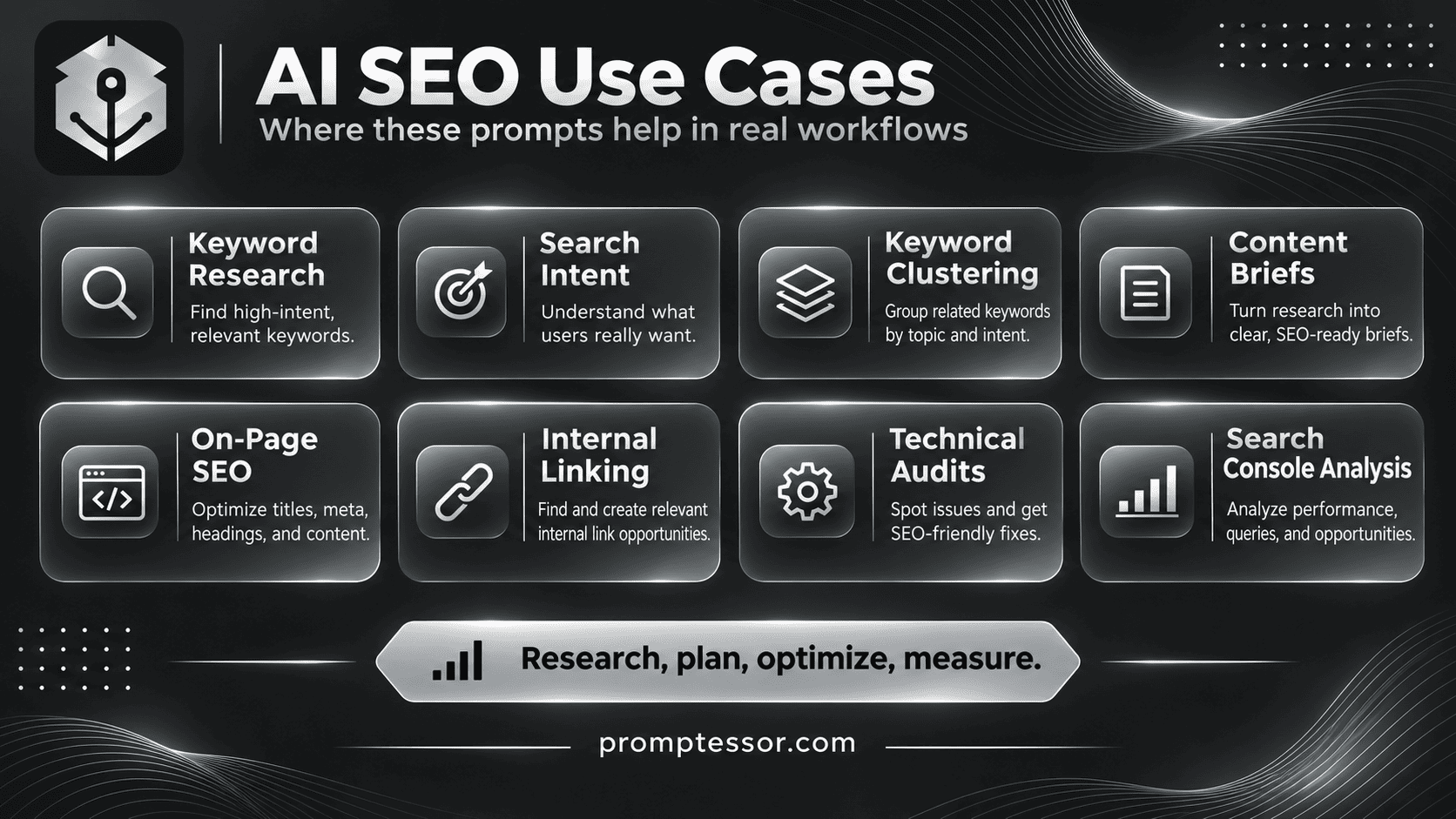
Choose the template based on the decision you need to make and the evidence you have available.
| SEO Goal | Recommended Prompt | Main Output |
|---|---|---|
| Discover relevant queries | #1 Keyword Research | Keyword ideas and validation plan |
| Understand what searchers need | #2 Search Intent | Intent assessment |
| Organize related keywords | #3 Keyword Clustering | Topic-to-page map |
| Find missing useful content | #4 Competitor Content Gaps | Coverage comparison |
| Plan a new article | #5 Content Brief | Editorial SEO brief |
| Create a logical article structure | #6 Blog Outline | H2/H3 outline |
| Improve search result copy | #7 SEO Metadata | Titles and descriptions |
| Review existing page quality | #8 On-Page Optimization | Prioritized page improvements |
| Connect related website pages | #9 Internal Linking | Source-to-destination link map |
| Update an older article | #10 Content Refresh | Evidence-backed update plan |
| Investigate crawl and indexability issues | #11 Technical SEO Audit | Technical issue register |
| Prepare structured data | #12 Schema Markup | JSON-LD and validation plan |
| Analyze organic search visibility | #13 Search Console Analysis | Performance insights |
| Investigate overlapping pages | #14 Cannibalization Analysis | Content overlap assessment |
| Report SEO results | #15 Performance Reporting | SEO report and action plan |
Practical Example: From Keyword Data to an SEO Content Brief
Consider a fictional SaaS website offering project management software.
The company wants to create a guide for people looking for ways to organize projects. It has an existing product page, but it has not yet verified monthly search demand for new informational topics.
The following example illustrates how a staged AI workflow can produce a more useful plan.
Step 1: Generate Keyword Ideas
Start with a verified product description and intended audience.
Product:
Project management software

Verified features:
- Task boards
- Due-date reminders

Audience:
Small teams managing projects

Market:
United States, English

Task:
Suggest informational keyword ideas
related to task organization.

Do not invent search volume,
keyword difficulty, or rankings.

Label every idea as unvalidated.
Possible brainstorming outputs might include "how to organize project tasks," "project task tracking methods," and "how to manage project due dates."
These are illustrative candidate queries, not claims about actual keyword demand.
Step 2: Validate With Real Research Data
Use a suitable research tool or actual Search Console export to assess whether the candidate phrases are relevant to the website and whether they have measurable demand.
Check the target country and the current search results. Some queries may favor tutorials, others may favor templates or software landing pages.
Do not rely on a language model's guessed search volume.
Step 3: Compare With Existing Pages
Check whether a current article, product page, or help guide already satisfies the same intent.
If an existing page adequately answers the question, improving it may be preferable to creating another URL.
Step 4: Create the Content Brief
Once the keyword and intent have been evaluated, use Prompt #5 with the actual research.
A useful brief might describe the intended reader, key questions to answer, original screenshots to include, related product documentation, and practical examples.
It should not simply reproduce the headings of the highest-ranking pages.
Step 5: Publish, Measure, and Improve
After publishing, verify the page's indexability, internal links, and technical accessibility.
Monitor relevant Search Console data over an appropriate period. Consider changes in impressions, clicks, query coverage, and the actual business value of the traffic.
Do not assume that publishing an AI-assisted article will generate rankings or organic traffic immediately.
How to Use AI for SEO Without Inventing Data
A recurring failure in AI-assisted SEO is confusing plausible output with verified findings.
For example, a model might produce a table containing keyword volume, difficulty, and estimated traffic even though no source dataset was provided.
The formatting may look authoritative, but the numbers are not evidence.
Use Explicit Evidence Labels
Add the following rule to analytical SEO prompts:
Classify each finding as:

VERIFIED:
Directly supported by supplied data
or a source actually accessed.

INFERRED:
A reasonable interpretation
of the available evidence.

UNVERIFIED:
A hypothesis requiring
additional research.

UNKNOWN:
Information not available
from the current sources.

Do not promote an inference
or hypothesis to a verified fact.
Preserve Source Information
When working with keyword exports, keep the data provider, export date, country, and metric definitions.
When working with Search Console, preserve filters, dates, grouping dimensions, and the distinction between query-level and page-level data.
When working with competitor pages, record which URLs were actually inspected.
Use Deterministic Validation Where Possible
AI-generated calculations, character counts, structured data, and URL lists should be checked using appropriate tools.
Use spreadsheet formulas or code to validate numerical calculations, an HTML validator or crawl tool for relevant page checks, and Google's Rich Results Test for supported structured data.
A prompt can request validation, but the model's claim that validation succeeded is not evidence that the check was performed.
Common AI SEO Prompt Mistakes
1. Asking AI to Generate Search Volumes
A model may produce realistic-looking figures without a research dataset.
Better approach: Use AI to brainstorm keywords, then obtain search estimates from a named tool before prioritizing them.
2. Treating Keyword Difficulty as a Universal Metric
Keyword difficulty scores are third-party estimates and may differ between providers.
Better approach: Keep the provider and methodology context and avoid comparing scores as though they use identical definitions.
3. Assuming AI Has Reviewed the Current SERP
Without live search access, a model may describe common result patterns rather than the actual current results.
Better approach: Supply a verified SERP snapshot or use authorized search tools before performing result-based analysis.
4. Creating One Article for Every Keyword Variation
Closely related phrases may express the same user need.
Better approach: Group keywords by intent and evaluate whether an existing page already addresses the topic.
5. Copying Competitor Outlines
Duplicating competing pages may result in content that adds little original value.
Better approach: Identify genuine reader questions and develop original examples, research, tools, or practical explanations.
6. Treating Keyword Density as the Main Optimization Goal
Repeating a target phrase does not automatically make a page more useful.
Better approach: Focus on accurate coverage, natural language, clear structure, and reader needs.
7. Inventing Internal Links
AI may recommend destinations that do not exist.
Better approach: Supply an actual page inventory and verify proposed URLs before publishing links.
8. Assuming Every Crawling Warning Is a Serious Problem
Some excluded URLs, redirects, and canonical relationships may be intentional.
Better approach: Compare technical evidence with the site's intended architecture before recommending changes.
9. Adding Structured Data That Misrepresents the Page
Markup containing fabricated ratings, reviews, or FAQs can misrepresent the visible content.
Better approach: Use verified page facts and follow the applicable schema and Google guidelines.
10. Treating Average Position as a Fixed Ranking
Search Console's average position is an aggregated measurement, not a permanent ranking for every searcher.
Better approach: Analyze it alongside impressions, clicks, queries, pages, filters, and reporting periods.
11. Assuming Multiple Ranking URLs Always Mean Cannibalization
Related pages can legitimately satisfy different search intents.
Better approach: Compare actual content purpose, query overlap, and search intent before consolidating pages.
12. Publishing AI-Generated Content Without Original Value
Google's guidance emphasizes helpful, reliable content created primarily for people. Its spam policies address scaled content created mainly to manipulate rankings without adding value.
Better approach: Review accuracy, original insight, usefulness, and editorial quality before publication.
How Google Evaluates AI-Assisted SEO Content
Google does not evaluate a useful article solely by whether AI participated in its production.
Its people-first content guidance emphasizes helpfulness, reliability, originality, and whether content fulfills a genuine user need.
Google also publishes spam policies addressing scaled content abuse, including low-value content produced using automation.
For AI-assisted SEO writing, this means:
- Check important factual statements against reliable sources.
- Use real examples, original analysis, or practical experience where possible.
- Explain the topic thoroughly enough to satisfy the reader.
- Avoid creating multiple near-duplicate pages for keyword variations.
- Do not invent author qualifications, test results, or firsthand experiences.
- Review generated writing for errors, omissions, and misleading claims.
- Use appropriate attribution and transparency about content creation when relevant.
Prompt optimization can improve clarity and workflow consistency, but no prompt can guarantee better Google rankings.
How to Measure the Results of AI-Assisted SEO Work
AI can help produce a report, but deciding whether an SEO initiative worked requires actual performance data and an appropriate comparison.
| Metric | What It Indicates | Important Limitation |
|---|---|---|
| Organic search clicks | Recorded clicks from eligible Google Search results | Depends on search type, filters, and measurement rules |
| Impressions | Recorded appearances in search results | Not the same as total keyword search demand |
| CTR | Clicks divided by impressions | Influenced by query mix and result appearance |
| Average position | Aggregated result position metric | Not a fixed position for every searcher |
| Indexed pages | Pages included in Google's index | Indexing does not guarantee visibility or traffic |
| Organic conversions | Business actions attributed to organic sessions | Depends on analytics and attribution setup |
| Content engagement | How visitors interact with content | Engagement alone does not establish search quality |
| SEO task completion time | Effort needed to produce an approved deliverable | Less time is not useful if quality declines |
| Recommendation accuracy | How often AI findings survive human review | Requires a defined evaluation process |
Evaluate AI-assisted work on two levels: whether it produced an accurate and useful SEO deliverable, and whether the implemented work contributed to the intended business outcome.
The first can often be tested immediately. The second may require longer observation periods and careful interpretation.
How to Improve AI SEO Prompts With PrompTessor
SEO work contains many recurring tasks. Keyword clustering, content briefs, audits, and performance reports often follow similar structures across projects.
PrompTessor can help create and refine the instructions used in these workflows.
1. Generate a Structured SEO Prompt
Use the PrompTessor AI Prompt Generator to turn a rough SEO task into a clearer set of instructions.
For example, instead of entering "find SEO keywords," describe the website, audience, market, available keyword data, and required output.
2. Analyze Prompt Clarity and Completeness
Use the AI Prompt Analyzer to review a prompt's clarity, specificity, context, structure, and constraints.
For SEO analysis, this can help identify whether the prompt lacks a source requirement, reporting period, target market, or output format.
3. Optimize the Prompt
Use the AI Prompt Optimizer to improve an existing instruction.
For example:
ORIGINAL PROMPT:
Find the best SEO keywords
for my business.

IMPROVED TASK DEFINITION:
Analyze the supplied keyword export
for a US-focused B2B software website.

Group keywords by user intent.

Preserve source search volumes,
difficulty scores, and dates.

Do not invent missing metrics.

Map opportunities to verified
existing URLs when appropriate.

Return an evidence-backed
prioritization table and
validation checklist.
This revised version provides clearer instructions without claiming that the AI has access to data it does not have.
4. Create Reusable SEO Templates
Save common task structures and replace the variable data for each new project.
TASK:
{seo_task}

WEBSITE:
{website}

MARKET:
{country_and_language}

AUDIENCE:
{audience}

DATA:
{verified_input}

EXISTING PAGES:
{url_inventory}

OBJECTIVE:
{desired_result}

SOURCE RULES:
{evidence_requirements}

OUTPUT:
{required_format}

VERIFICATION:
{quality_checks}
Reusable templates reduce repeated prompt writing while keeping important evidence and review requirements consistent.
5. Evaluate the Output Using Real SEO Data
PrompTessor helps improve the prompt itself. It does not automatically verify live rankings, retrieve private Search Console data, or execute technical website changes.
Actual SEO execution and measurement depend on the relevant tools, current data, publishing systems, and review process.
When comparing prompt variations, evaluate their accuracy and usefulness using the same source datasets.
For additional guidance, read AI Prompt Evaluation: How to Test, Compare, and Improve Prompts.
AI SEO Quality Checklist Before Implementing Recommendations
Before acting on an AI-generated SEO recommendation, check whether it is supported by the available evidence and whether the proposed change actually helps users.
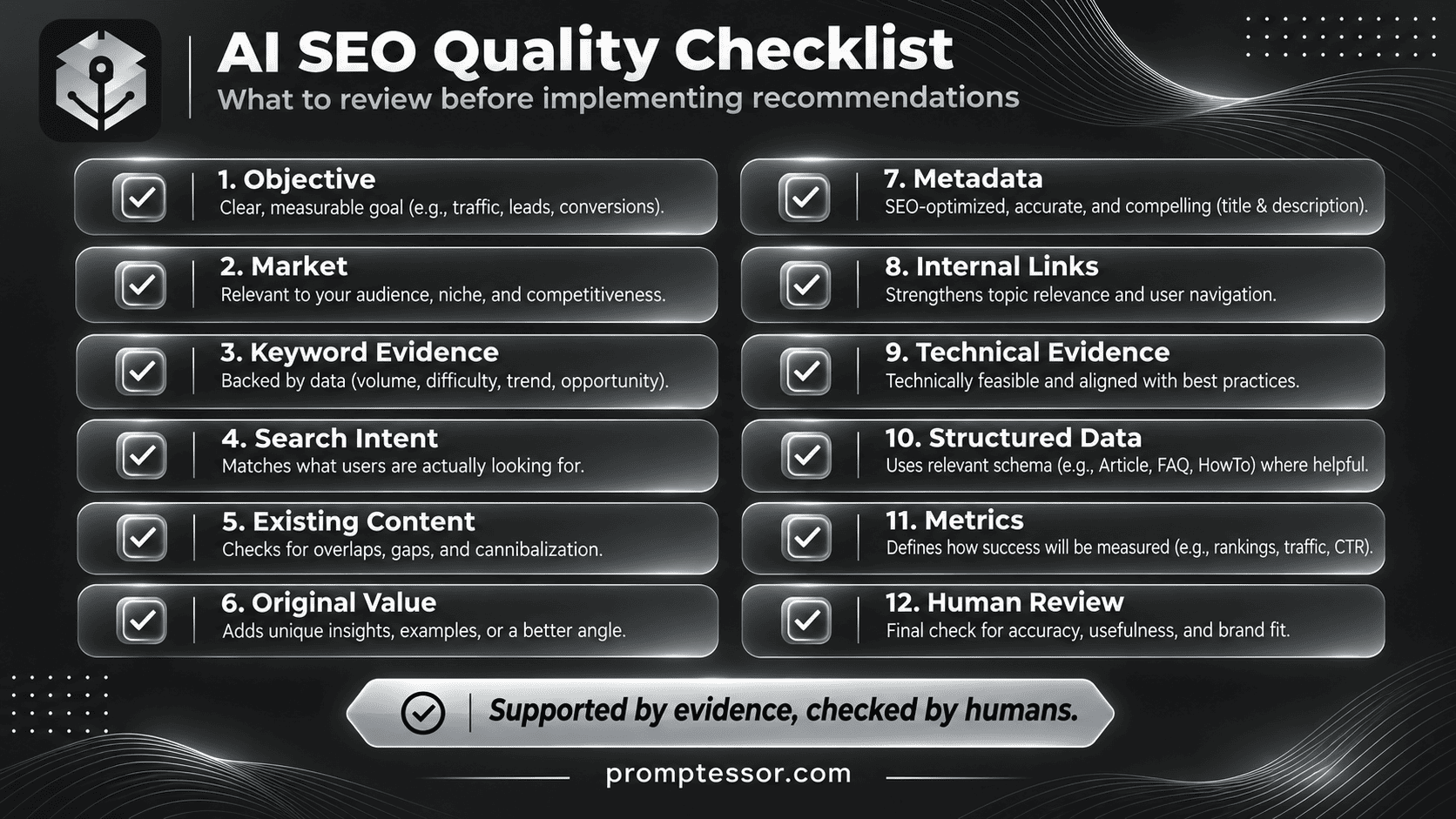
- Objective: The task has a clear SEO or business purpose.
- Target market: Country, language, and audience are defined.
- Keyword evidence: Search volumes and difficulty scores come from identifiable sources.
- Search intent: Relevant current search results have been reviewed where necessary.
- Existing content: The recommendation accounts for pages already published.
- Original value: New content adds information useful to readers rather than simply repeating competitors.
- Metadata: Titles and descriptions accurately represent the destination page.
- Internal links: Recommended source and destination URLs are verified and relevant.
- Technical evidence: Crawl, canonical, indexing, and rendering recommendations have supporting data.
- Structured data: Markup is valid and accurately represents visible content.
- Metric interpretation: Search Console data uses appropriate filters and comparable periods.
- Missing information: Unverified values and unknowns are clearly identified.
- Implementation risk: Redirects, canonical changes, noindex directives, and other consequential changes receive appropriate review.
- Measurement: A post-change verification and evaluation plan exists.
- Human approval: The recommendation is reviewed before implementation.
Frequently Asked Questions About AI SEO Prompts
What are AI SEO prompts?
AI SEO prompts are structured instructions used to guide AI models through SEO tasks such as keyword research, search intent analysis, content briefs, on-page optimization, technical audits, internal linking, and performance reporting.
What are the best ChatGPT prompts for SEO?
The best prompt depends on the task. Keyword research prompts need audience and market context. Content optimization prompts need actual page information. Technical audits need crawl evidence, while performance analysis requires real Search Console or analytics data.
Can ChatGPT do keyword research?
Yes. ChatGPT can generate keyword ideas, classify search intent, organize related queries, and analyze supplied keyword exports. However, actual search volumes, keyword difficulty, and current rankings require external research data.
Can AI find low-competition keywords?
AI can help identify potentially relevant long-tail topics and evaluate supplied keyword metrics. It cannot reliably determine current search competition without appropriate research data and SERP analysis.
Can ChatGPT create SEO content briefs?
Yes. ChatGPT can develop structured briefs containing reader intent, suggested headings, key questions, source requirements, examples, internal links, and an editorial checklist. The brief should be reviewed against real research and existing website content.
Can AI optimize title tags and meta descriptions?
Yes. AI can draft title and description variations that accurately represent a page. Google does not enforce a universal character limit for these elements and may generate different search result text. Character counts and factual claims should be checked before implementation.
Can AI help with internal linking?
Yes. AI can suggest contextual internal links when provided with an actual URL inventory and relevant page content. Each destination should be verified, accessible, and useful to readers.
Can ChatGPT perform a technical SEO audit?
ChatGPT can help interpret verified crawl exports, HTTP data, indexing information, and technical reports. It cannot confirm live website problems without access to appropriate evidence or tools. Suggested fixes require technical verification.
Can AI create SEO schema markup?
Yes. AI can prepare JSON-LD drafts using verified page information and current schema guidelines. The markup must accurately represent the visible content, pass appropriate validation, and meet any applicable Google feature requirements.
Can ChatGPT analyze Google Search Console data?
Yes. When given a Search Console export or authorized data access, ChatGPT can analyze queries, pages, clicks, impressions, CTR, and average position. Results should account for filters, reporting periods, aggregation, and omitted or anonymized queries.
Can AI detect keyword cannibalization?
AI can help identify overlapping queries and compare existing pages. However, multiple pages appearing for similar queries do not automatically indicate harmful cannibalization. Search intent, page purpose, and actual performance need review.
Is AI-generated SEO content allowed by Google?
Google's guidance focuses on useful, reliable, people-first content rather than simply whether AI was involved. Creating large amounts of low-value content primarily to manipulate search rankings may violate Google's spam policies.
Will using AI SEO prompts improve Google rankings?
Not automatically. AI prompts can help organize research, improve analysis, and create clearer content plans, but rankings depend on many factors. There is no prompt that guarantees higher positions or organic traffic.
How do I verify AI-generated SEO recommendations?
Check keyword metrics against source tools, validate relevant search results, inspect existing URLs, confirm technical evidence, review source claims, and monitor actual performance after implementation. Treat unsupported recommendations as hypotheses.
Can PrompTessor help improve SEO prompts?
Yes. PrompTessor can help generate, analyze, optimize, refine, and reuse SEO prompts. Real keyword data, live search results, Search Console access, technical execution, and performance measurement still require the appropriate external sources and tools.
Final Thoughts: Better SEO Prompts Start With Better Evidence
AI can make SEO workflows easier to organize and execute. It can help generate keyword ideas, analyze search intent, prepare content briefs, review existing pages, interpret technical data, and summarize organic search performance.
But useful output depends on reliable inputs.
A keyword list without verified demand is a starting hypothesis. A content brief without search intent research is an editorial draft. A technical recommendation without crawl evidence is an investigation, not a confirmed fix.
The 15 AI SEO prompts in this guide provide practical templates for different stages of search optimization.
Start with the task you need to complete, supply the right data, identify the required output, and verify important conclusions before making changes.
For recurring tasks, save the template and improve it using actual errors, feedback, and performance results.
If you want to develop clearer, reusable instructions for keyword research, content planning, or SEO audits, try the PrompTessor AI Prompt Generator and refine the result around your real website and data.
Better SEO does not come from asking AI to generate more keywords or pages. It comes from understanding what people need, using evidence responsibly, and making improvements that can be verified.
Official Sources and Further Reading
- Google Search Central — Creating Helpful, Reliable, People-First Content
- Google Search Central — Spam Policies
- Google Search Central — SEO Link Best Practices
- Google Search Central — Title Links in Google Search
- Google Search Central — Control Your Snippets
- Google Search Central — Canonical URL Guidance
- Google Search Central — Introduction to Structured Data
- Google Search Console — Performance Report Documentation
Build better prompts in one workspace
Generate prompts from ideas, analyze and optimize quality, refine with feedback, reverse-engineer content, and save reusable prompts in your Prompt Library.
Try PrompTessor Free