15 AI Business Plan Prompts for Startups and Entrepreneurs (2026)
Starting a business is exciting until you have to explain how it will actually work.
Who is the customer? What problem are you solving? How large is the market? Why would someone choose your product over existing alternatives? How will you attract customers, cover expenses, and eventually become profitable?
These are the questions a useful business plan should answer. But organizing everything from scratch can be difficult, especially if you are building your first startup or running a business on your own.
AI tools like ChatGPT, Claude, and Gemini can help you structure ideas, examine assumptions, prepare research questions, compare business models, and develop financial planning frameworks.
However, asking AI to "write a complete business plan" can create a document that looks professional without being grounded in reality. The model might invent market statistics, assume customers are ready to buy, fabricate competitor weaknesses, or produce revenue forecasts based on unexplained growth rates.
A useful business plan needs something more important than confident writing: verifiable information, clear assumptions, and practical decisions.
This guide provides 15 copy-and-paste AI business plan prompts for startups and entrepreneurs. They cover idea validation, market research, competitive analysis, pricing, business models, customer acquisition, operations, financial projections, funding, and executive summaries.
Each prompt includes required inputs, a defined output, and a verification method so you can build your business plan one section at a time.
You will also find a practical SaaS startup example, a comparison of traditional and lean business plans, and a checklist for reviewing the complete document before sharing it with lenders, investors, partners, or your team.
Quick Answer: What Is the Best AI Prompt for a Business Plan?
The best AI business plan prompt defines the business idea, target customers, available evidence, intended audience, planning timeframe, and required sections. It should also tell the model to distinguish confirmed facts from assumptions and identify missing information.
Here is a general-purpose starting point:
ROLE:
Act as an evidence-focused
business planning advisor.

BUSINESS IDEA:
{business_idea}

PRODUCT OR SERVICE:
{product_description}

TARGET MARKET:
{customer_segment_and_geography}

BUSINESS STAGE:
{idea_validation_mvp_early_revenue_or_growth}

AVAILABLE EVIDENCE:
{customer_interviews_research_or_financial_data}

BUSINESS PLAN AUDIENCE:
{founder_team_lender_investor_or_partner}

PLANNING PERIOD:
{planning_period}

OBJECTIVE:
{business_plan_goal}

Create a structured business plan with:

1. Executive summary
2. Problem and solution
3. Target customers
4. Market research
5. Competitive landscape
6. Value proposition
7. Business and revenue model
8. Pricing strategy
9. Go-to-market strategy
10. Marketing and sales plan
11. Operations and resources
12. Milestones and KPIs
13. Financial projections
14. Funding needs and risks
15. Next steps

RULES:
- Use verified data where available.
- Label unsupported claims as assumptions.
- Do not invent market size or demand.
- Do not fabricate customer interviews.
- Do not invent competitors or funding.
- Explain financial formulas.
- Preserve currencies and time periods.
- Identify critical missing information.
- Highlight inconsistencies between sections.
- Avoid claims of guaranteed profitability.

OUTPUT:
A business plan draft, an assumptions
register, a research checklist,
and a list of decisions requiring review.

Do not present an unsupported
financial forecast as a validated result.
This prompt can create an initial structure, but it is not a substitute for completing the underlying research. For a stronger plan, use the specialized prompts below to develop each section independently before combining them.
Key Takeaways
- AI can help structure a business plan, but it cannot independently validate customer demand or guarantee commercial success.
- Start with the problem, customer, and evidence before writing financial projections.
- Traditional business plans are useful when detailed financing, operational, or stakeholder information is required.
- Lean startup plans are better suited to concise initial planning and frequent iteration.
- Market sizing should use traceable sources, explicit definitions, and transparent calculations.
- Competitor research should include direct competitors, indirect alternatives, and the option of doing nothing.
- Business model and pricing decisions should connect to realistic costs and customer willingness to pay.
- Financial forecasts should separate known figures, assumptions, formulas, and scenario outputs.
- Cash flow, accounting profit, and revenue are different concepts.
- Funding requests must connect to specific uses of capital and a realistic operating plan.
- Every major assumption should have a validation method, owner, or follow-up research task.
- A business plan is most useful when it supports real decisions and can be updated as new evidence becomes available.
What Are AI Business Plan Prompts?
AI business plan prompts are structured instructions that guide an AI model through a business planning task.
Instead of requesting a complete plan without context, a specialized prompt focuses on one business question and the information required to answer it.
For example, a market research prompt might organize interview findings and estimate potential demand using supplied data. A pricing prompt might compare subscription models using actual costs and approved assumptions. A financial forecasting prompt might build a monthly revenue model based on customer acquisition, churn, expenses, and payment timing.
Different tasks require different inputs.
| Business Planning Area | Useful Input | Expected Output |
|---|---|---|
| Idea validation | Business hypothesis, customer evidence | Validation plan |
| Problem and solution | Observed problems, product capabilities | Problem-solution statement |
| Customer segmentation | Customer research, market context | Target customer profiles |
| Market sizing | Market data, geography, pricing assumptions | TAM, SAM, and SOM scenarios |
| Competitive analysis | Verified competitor information | Competitive landscape matrix |
| Business model | Product, pricing, delivery and cost structure | Business model framework |
| Pricing strategy | Cost data, positioning, willingness-to-pay research | Pricing hypotheses |
| Go-to-market | Customer segment, channel evidence, resources | Launch strategy |
| Operations | Resources, workflows, dependencies | Operating plan |
| Financial projections | Assumptions, actual financial records, costs | Forecast and scenarios |
| Funding and risk | Capital requirements, available funding | Funding and risk plan |
You can use the prompts independently, but their greatest value often comes from connecting the outputs into one consistent business plan.
Traditional vs. Lean Startup Business Plans
Before generating a plan, decide who will read it and which decisions it needs to support.
The U.S. Small Business Administration's business plan guide distinguishes between traditional and lean startup formats.
Traditional Business Plan
A traditional business plan is a detailed document describing the business, market, management, products or services, marketing strategy, funding needs, and financial projections.
It may be useful when seeking a business loan, working with formal partners, or documenting a complex operating model.
Common sections include:
- Executive summary
- Company description
- Market analysis
- Organization and management
- Service or product line
- Marketing and sales
- Funding request, when applicable
- Financial projections
- Appendix and supporting evidence
The exact sections should reflect the business and the reader's requirements. Not every startup needs the same structure.
Lean Startup Business Plan
A lean startup business plan summarizes the most important elements of the business and can be updated as assumptions are tested.
It may include customer segments, value proposition, channels, customer relationships, revenue streams, cost structure, key activities, resources, and partnerships.
This approach is useful when the business is still validating its concept or when a concise plan is sufficient for internal decisions.
| Aspect | Traditional Plan | Lean Startup Plan |
|---|---|---|
| Level of detail | Comprehensive | Concise |
| Typical use | Detailed planning and financing | Early planning and iteration |
| Market analysis | Detailed research and evidence | Key insights and assumptions |
| Financial information | Detailed forecasts when needed | High-level economics and assumptions |
| Update cycle | Periodic or event-based revisions | Frequent refinement |
| Best starting point | Established requirements and evidence | Early hypotheses and validation |
Neither format automatically makes a business more likely to succeed. The right choice depends on the business stage, complexity, and intended audience.
Before Using AI: Prepare a Business Planning Brief
AI-generated business plans become more useful when the model receives a coherent set of inputs instead of being asked to fill gaps with plausible assumptions.
Prepare the information you already know and make missing details explicit.
| Input | Example | Why It Matters |
|---|---|---|
| Business idea | Subscription software for project coordination | Defines the concept |
| Target customer | Small teams with recurring project tasks | Establishes who may benefit |
| Geographic market | United States | Defines market boundaries |
| Current stage | Prototype with no paying customers | Prevents premature growth assumptions |
| Product capabilities | Task boards and due-date reminders | Sets factual product boundaries |
| Customer evidence | Interview notes or actual signup data | Supports demand evaluation |
| Competitor information | Verified alternative products and prices | Supports positioning |
| Financial information | Available capital and expected costs | Supports cash planning |
| Constraints | Small team and limited acquisition budget | Shapes feasible actions |
| Planning objective | Validate demand before investing further | Defines success criteria |
Separate Facts, Assumptions, and Unknowns
Not all information should be treated with equal confidence.
VERIFIED FACT
Supported by a reliable source
or actual business records.

Example:
The current software hosting bill
is $120 per month.

ASSUMPTION
A testable planning estimate
that has not been confirmed.

Example:
The first pricing hypothesis
is $20 per customer per month.

UNKNOWN
Information that has not been
established.

Example:
The percentage of target customers
willing to pay for the service.

EXTERNAL ESTIMATE
A third-party market or industry
estimate with a named source,
date, and methodology.

Example:
A market research figure from
an identified published report.
Using these labels prevents a hypothetical pricing assumption from becoming a supposed customer preference, or an illustrative market estimate from becoming an investor-facing fact.
Include source dates, currencies, geographic definitions, and measurement periods whenever they matter.
The Reusable AI Business Plan Prompt Formula
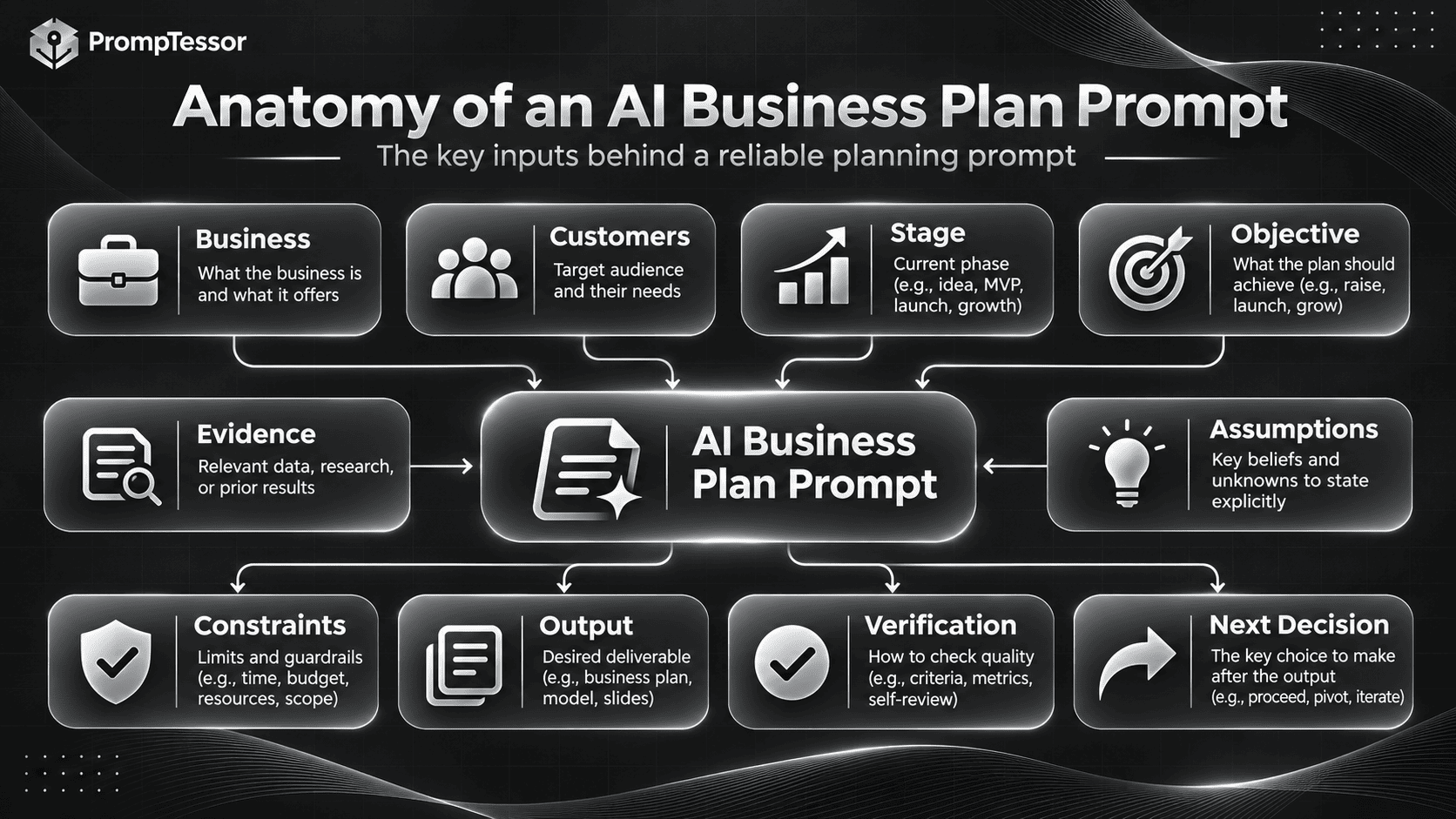
Most business planning tasks can use the same underlying prompt structure:
BUSINESS
What product or service is planned?

CUSTOMER
Who is expected to pay or benefit?

STAGE
What has already been built or validated?

OBJECTIVE
Which planning question needs an answer?

EVIDENCE
Which facts, research results,
or financial records are available?

ASSUMPTIONS
Which estimates are being tested?

CONSTRAINTS
What budget, resources, time,
or operational limitations apply?

OUTPUT
Which analysis, model,
or document section is needed?

VERIFICATION
How will the findings be checked?

NEXT DECISION
What should the founder decide
after reviewing the output?
You can reuse this format across different planning stages by changing the dynamic inputs.
For a deeper explanation of reusable prompt structures, see Prompt Templates and Variables: How to Build Reusable AI Prompts.
15 Copy-and-Paste AI Business Plan Prompts
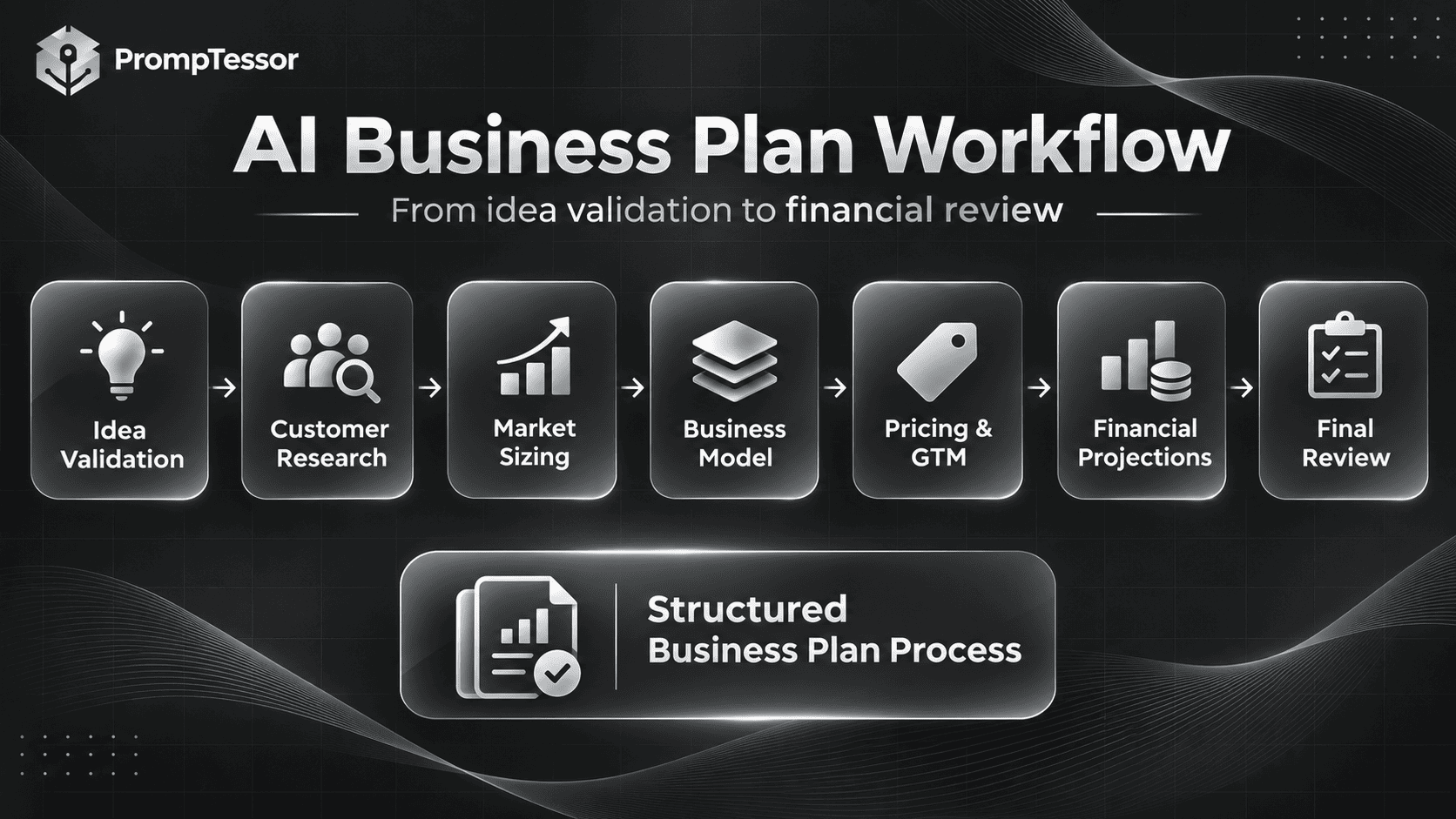
The prompts below follow a business planning workflow from idea validation to final document review.
Replace the variables in braces with your information and provide relevant documents when available.
For research-intensive tasks, the model must have access to actual sources. For financial tasks, calculations should be independently checked using a spreadsheet or other appropriate financial modeling tool.
Business Idea and Customer Validation
1. AI Business Idea Validation Prompt
Best for: Identifying the assumptions behind a business idea and designing practical experiments before committing significant resources.
Required input: Business idea, intended customer, current evidence, available resources, and validation timeframe.
Example use case: An entrepreneur wants to evaluate whether there is enough evidence to justify building a new SaaS product.
Act as an early-stage
startup validation advisor.

Business idea:
{business_idea}

Target customers:
{customer_segment}

Problem being addressed:
{problem_hypothesis}

Proposed solution:
{solution}

Current evidence:
{interviews_signups_or_research}

Available budget:
{validation_budget}

Validation period:
{timeframe}

Your tasks:

1. Identify the five most
   important business assumptions.

2. Classify each as:
   - SUPPORTED
   - PARTIALLY SUPPORTED
   - UNTESTED
   - CONTRADICTED

3. Explain which assumptions
   create the greatest risk.

4. Propose low-cost experiments
   such as interviews, prototypes,
   landing-page tests, or
   appropriately designed pilots.

5. Define a measurable
   success criterion for each test.

6. Identify the evidence needed
   before investing more resources.

Rules:
- Do not invent customer demand.
- Do not fabricate interviews.
- Do not predict guaranteed success.
- Do not claim product-market fit
  without supporting evidence.
- Distinguish willingness to try
  from willingness to pay.
- Use realistic resource constraints.

Return:
- Assumptions register
- Risk prioritization
- Validation experiments
- Success criteria
- Next decision framework
Expected output: A validation roadmap showing what needs to be tested and which assumptions matter most.
Verification: Compare recommendations with actual customer feedback. A positive reaction to an idea is weaker evidence than consistent real usage or a verified purchase.
2. AI Problem and Solution Statement Prompt
Best for: Clearly describing the customer problem, available alternatives, proposed solution, and evidence that the solution addresses a meaningful need.
Required input: Customer research, product description, observed problems, and verified capabilities.
Example use case: A founder wants to replace vague messaging such as "revolutionizing productivity" with a specific problem-solution statement.
Act as a startup strategy
and product positioning advisor.

Business concept:
{business_idea}

Target customer:
{customer_segment}

Observed customer problems:
{verified_customer_evidence}

Current alternatives:
{known_alternatives}

Proposed solution:
{product_or_service}

Verified capabilities:
{approved_features}

Your tasks:

1. Describe the problem
   from the customer's perspective.

2. Separate observed problems
   from unverified assumptions.

3. Identify the current workaround
   or alternative solutions.

4. Explain what the proposed
   product actually changes.

5. Draft:
   - One-sentence problem statement
   - One-sentence solution statement
   - Short company description
   - Longer business-plan description

6. Identify missing evidence
   of problem severity or frequency.

Requirements:
- Use plain business language.
- Avoid exaggerated promises.
- Do not invent customer quotations.
- Do not fabricate productivity gains.
- Do not imply the problem affects
  every customer in the segment.
- Preserve known product limitations.

Return:
- Problem-solution summary
- Evidence mapping
- Statement alternatives
- Important unknowns
- Validation questions
Expected output: A concise explanation of whom the business serves, which problem it addresses, and how its offering works.
Verification: Test the language with real potential customers. Confirm that the problem statement describes their experience rather than merely the founder's preferred story.
3. AI Target Market and Customer Segmentation Prompt
Best for: Identifying potentially suitable customer groups and selecting a realistic initial market.
Required input: Product capabilities, target geography, customer observations, segment data, and resource constraints.
Example use case: A small software startup wants to choose between freelancers, agencies, and small internal operations teams.
Act as a customer segmentation
and market entry strategist.

Product:
{product}

Verified product capabilities:
{features}

Geographic market:
{geography}

Existing customer evidence:
{customer_data}

Possible customer groups:
{candidate_segments}

Available sales and
marketing resources:
{resources}

Your tasks:

1. Identify up to five
   relevant customer segments.

2. For each segment, describe:
   - Defining characteristics
   - Potential use case
   - Current alternatives
   - Evidence of need
   - Potential barriers
   - Possible buying process
   - Questions requiring research

3. Distinguish user, buyer,
   and decision-maker roles.

4. Compare product fit
   using supplied evidence.

5. Propose a primary segment
   for initial validation.

6. Suggest customer interview
   and willingness-to-pay questions.

Rules:
- Do not invent segment sizes.
- Do not assume purchasing power.
- Do not fabricate customer personas
  as actual research participants.
- Do not treat hypothetical needs
  as validated pain points.
- Respect the geographic scope.

Return:
- Segmentation matrix
- Primary customer hypothesis
- Supporting evidence
- Unknowns and risks
- Research plan
Expected output: A comparison of potential customer segments and a specific hypothesis about which group to validate first.
Verification: Review real customer interviews, purchase patterns, product usage, or other relevant evidence before selecting a target segment.
Market Research and Positioning
4. AI Market Research and TAM, SAM, SOM Prompt
Best for: Creating a transparent market-sizing framework using supplied data, geographic constraints, and explicit assumptions.
Required input: Market research, customer population, geography, pricing or spending assumptions, eligibility criteria, and potential acquisition capacity.
Example use case: A founder wants to estimate the opportunity for a subscription software product in a defined customer segment.
Act as a market research
and sizing analyst.

Business:
{business}

Product:
{product}

Target geography:
{geography}

Customer segment:
{customer_segment}

Available market data:
{verified_sources}

Potential pricing:
{pricing_assumptions}

Customer eligibility criteria:
{eligibility_rules}

Operational reach:
{distribution_capacity}

Build a market sizing framework.

Define:

TAM:
The total market opportunity
under a clearly stated definition.

SAM:
The portion of TAM that the
business can realistically serve.

SOM:
A time-bound share or number
of customers the business may
reasonably pursue.

For each estimate include:
1. Definition
2. Source data
3. Calculation formula
4. Assumptions
5. Geographic boundaries
6. Time period
7. Limitations

Use bottom-up calculations
where supported by the data.

Avoid double-counting customers.

Do not invent published
market research statistics.

Do not confuse revenue opportunity
with actual sales forecasts.

Do not present SOM as guaranteed.

If required inputs are missing,
provide formulas and explicitly
identify the missing values.

Return:
- Market sizing table
- Calculation methodology
- Low/base/high scenarios
- Evidence quality assessment
- Further research requirements
Expected output: A transparent market sizing model showing how each estimate was derived and which assumptions require validation.
Verification: Check the source data, segment definitions, geographic boundaries, customer counts, and arithmetic. TAM, SAM, and SOM are planning estimates, not proof of demand or future revenue.
5. AI Competitor Analysis Prompt
Best for: Comparing existing alternatives and identifying possible positioning opportunities based on actual competitor evidence.
Required input: Competitor names, official product pages, verified pricing or feature information, and target customer needs.
Example use case: A founder wants to understand how a new software product differs from established tools and manual workflows.
Act as a competitive
landscape analyst.

My business:
{business}

Verified product capabilities:
{product_features}

Target customers:
{customer_segment}

Known competitors:
{competitor_list}

Accessible competitor sources:
{source_documents_or_urls}

Research date:
{research_date}

Your tasks:

1. Separate:
   - Direct competitors
   - Indirect alternatives
   - Manual workarounds
   - Doing nothing

2. Compare:
   - Target customer
   - Main use case
   - Verified features
   - Public pricing, if available
   - Distribution approach
   - Strengths supported by evidence
   - Known limitations

3. Identify underserved needs
   supported by research.

4. Suggest differentiation
   hypotheses worth testing.

5. List claims that require
   additional verification.

Rules:
- Do not invent competitors.
- Do not fabricate pricing.
- Do not invent market share.
- Do not fabricate weaknesses
  or customer dissatisfaction.
- Do not claim current information
  was verified if sources
  were not actually accessed.
- Record source dates.

Return:
- Competitor comparison matrix
- Direct and indirect alternatives
- Positioning opportunities
- Evidence gaps
- Validation plan
Expected output: A competitor matrix that identifies real alternatives and potential sources of differentiation.
Verification: Review original pricing pages, product documentation, and relevant market research. Competitor offerings change, so note when each source was checked.
6. AI Unique Value Proposition Prompt
Best for: Developing a clear value proposition that explains why a particular customer might prefer the product.
Required input: Customer needs, verified product capabilities, competitive research, and supporting proof.
Example use case: A startup has several useful features but struggles to explain its main value in one sentence.
Act as a startup positioning
and messaging strategist.

Business:
{business}

Primary customer segment:
{target_customer}

Verified customer need:
{customer_evidence}

Current alternatives:
{alternatives}

Product capabilities:
{verified_features}

Approved proof:
{testimonials_results_or_demo_evidence}

Your tasks:

1. Identify the most relevant
   customer problem.

2. Match that problem to
   a verified product capability.

3. Identify differentiators
   supported by evidence.

4. Create five candidate
   value propositions.

5. For each candidate provide:
   - Target customer
   - Primary benefit
   - Supporting evidence
   - Relevant alternative
   - Unverified assumptions

6. Recommend one positioning
   hypothesis for testing.

Do not invent customer outcomes.

Do not claim market leadership
or superiority without evidence.

Avoid vague claims such as
"revolutionary" or "best-in-class."

Do not make guarantees
the business cannot support.

Return:
- Value proposition options
- Positioning statement
- Evidence map
- Customer testing questions
- Approval checklist
Expected output: Several clear value proposition options grounded in actual product capabilities and customer relevance.
Verification: Test whether target customers understand the positioning and consider it relevant. Do not assume a message is differentiated merely because it sounds unique.
Business Model and Pricing
7. AI Business Model Development Prompt
Best for: Mapping how the business creates value, delivers it, earns revenue, and incurs costs.
Required input: Product, target customers, delivery process, pricing hypotheses, cost structure, distribution channels, and available resources.
Example use case: A founder wants to compare subscription, usage-based, and service-supported revenue models.
Act as a business model
and startup economics advisor.

Business concept:
{business}

Customer segments:
{segments}

Product or service:
{offering}

Verified delivery requirements:
{delivery_process}

Potential revenue models:
{revenue_options}

Available cost data:
{costs}

Distribution channels:
{channels}

Available resources:
{resources}

Your tasks:

1. Create a business model
   framework covering:
   - Customer segments
   - Value proposition
   - Channels
   - Customer relationships
   - Revenue streams
   - Key activities
   - Key resources
   - Key partnerships
   - Cost structure

2. Compare viable revenue
   model options.

3. Identify major economic
   and operational tradeoffs.

4. Explain which assumptions
   need customer validation.

5. Recommend early metrics
   for testing model viability.

Do not invent validated demand.

Do not invent margins,
retention, or customer lifetime value.

Do not assume a recurring
subscription is always optimal.

Label each untested assumption.

Return:
- Business model summary
- Revenue model comparison
- Cost and dependency map
- Key risks
- Validation experiments
Expected output: A business model framework connecting customer value, revenue, costs, distribution, and operations.
Verification: Confirm delivery costs, resource requirements, customer purchasing preferences, and legal or payment-processing constraints.
8. AI Pricing Strategy and Unit Economics Prompt
Best for: Comparing pricing approaches and understanding how price, variable costs, customer acquisition, and retention affect the business.
Required input: Cost data, pricing research, customer segments, product limits, transaction fees, and acquisition assumptions.
Example use case: A SaaS founder wants to compare monthly subscription pricing with usage-based billing.
Act as a startup pricing
and unit economics analyst.

Product:
{product}

Customer segments:
{segments}

Current or proposed prices:
{pricing_options}

Variable costs:
{variable_cost_data}

Fixed operating costs:
{fixed_cost_data}

Acquisition costs:
{marketing_and_sales_data}

Customer research:
{willingness_to_pay_evidence}

Retention or churn data:
{retention_data}

Your tasks:

1. Compare potential pricing models.

2. For each model, examine:
   - Price and billing unit
   - Customer value proposition
   - Revenue assumptions
   - Variable cost per unit
   - Contribution margin
   - Operational complexity
   - Potential customer objections

3. Calculate relevant unit economics
   only when data supports them.

4. Show formulas for:
   - Revenue per customer
   - Variable contribution
   - Contribution margin
   - Customer acquisition cost,
     when measurable

5. Identify missing inputs
   for LTV and payback calculations.

6. Recommend pricing experiments
   that can test real willingness to pay.

Rules:
- Do not invent customer willingness
  to pay or conversion rates.
- Do not invent competitor pricing.
- Do not estimate lifetime value
  without defensible assumptions.
- Separate gross margin,
  contribution margin, and profit.
- Preserve all fees and units.

Return:
- Pricing comparison table
- Unit economics calculations
- Assumptions register
- Key risks
- Validation experiments
Expected output: A pricing comparison supported by cost calculations and explicit market assumptions.
Verification: Confirm pricing acceptance through appropriate research or real transactions. Validate unit economics using actual billing, infrastructure, support, and acquisition costs.
Go-to-Market and Operations
9. AI Go-to-Market Strategy Prompt
Best for: Planning an initial product launch or entry into a new customer segment.
Required input: Product readiness, customer segment, verified positioning, launch resources, channels, budget, and timeline.
Example use case: A startup wants to launch a new SaaS product to one clearly defined market before expanding.
Act as a go-to-market
strategy advisor.

Product:
{product}

Product readiness:
{current_stage}

Primary target segment:
{target_customers}

Verified value proposition:
{positioning}

Available channels:
{channels}

Budget:
{budget}

Team and resources:
{resources}

Launch timeframe:
{timeline}

Your tasks:

1. Define the launch objective.
2. Identify the initial customer
   segment and main use case.
3. Review channel suitability.
4. Propose a phased launch:
   - Preparation
   - Initial release
   - Customer feedback
   - Iteration
5. Identify key dependencies.
6. Define measurable
   launch success criteria.
7. Propose contingency actions
   if early assumptions fail.

For each action include:
- Activity
- Purpose
- Owner or role
- Resource requirement
- Timing
- Success metric
- Risk

Do not invent channel performance.

Do not assume viral growth.

Do not promise acquisition
or revenue results.

Do not recommend channels
requiring unavailable resources
without identifying the gap.

Return:
- Go-to-market roadmap
- Channel comparison
- Launch checklist
- KPIs
- Risks and decision points
Expected output: A phased launch plan based on available resources, actual product readiness, and testable acquisition assumptions.
Verification: Confirm channel access, costs, product readiness, and the ability to measure results before implementing the plan.
10. AI Marketing and Customer Acquisition Plan Prompt
Best for: Planning how the business will attract, convert, and retain customers while staying within real budget constraints.
Required input: Customer segments, approved channels, budget, observed conversion data, available content assets, and revenue model.
Example use case: A small business wants to compare organic search, partnerships, referrals, and paid acquisition.
Act as a customer acquisition
and growth planning strategist.

Business:
{business}

Target customers:
{segments}

Product and approved offer:
{offering}

Available acquisition channels:
{channels}

Marketing budget:
{budget}

Current website or campaign data:
{actual_performance}

Sales process:
{sales_workflow}

Planning period:
{timeframe}

Your tasks:

1. Map the customer journey
   from discovery to conversion.

2. Compare available channels
   using existing evidence.

3. Propose acquisition experiments
   appropriate to the resources.

4. Define funnel stages and metrics.

5. Estimate potential costs only
   using supplied assumptions.

6. Identify retention or
   referral opportunities.

7. Create a prioritized
   90-day marketing plan.

For each experiment include:
- Channel
- Hypothesis
- Required work
- Budget assumption
- Primary metric
- Stop or continue criteria

Do not invent CAC, CTR,
conversion rates, or ROI.

Do not assume paid advertising
is profitable without evidence.

Do not promise rankings,
traffic, or customer growth.

Return:
- Acquisition strategy
- Channel comparison matrix
- Customer funnel
- Experiment plan
- Measurement checklist
Expected output: A customer acquisition plan with clear experiments, resource requirements, and metrics.
Verification: Review actual conversion tracking and acquisition economics. For more detailed execution-level outreach, see 15 AI Sales Prompts for Prospecting, Follow-Ups, and Outreach.
11. AI Operations Plan Prompt
Best for: Documenting how the business will deliver its product or service, manage resources, and handle operational responsibilities.
Required input: Delivery process, staffing, suppliers, software systems, costs, operational constraints, and known legal requirements.
Example use case: A solo SaaS founder wants to plan product operations, customer support, infrastructure, and incident management.
Act as a small business
operations planning advisor.

Business model:
{business_model}

Product or service:
{offering}

Delivery workflow:
{delivery_process}

Available team:
{team}

Suppliers and services:
{vendors}

Operational systems:
{tools}

Budget constraints:
{budget}

Known legal and
regulatory requirements:
{verified_requirements}

Your tasks:

1. Map the core activities
   required to deliver value.

2. Identify:
   - Staffing and responsibilities
   - Infrastructure
   - Suppliers and dependencies
   - Customer support
   - Quality control
   - Security and data handling
   - Financial administration
   - Business continuity

3. Identify operational risks,
   bottlenecks, and single
   points of failure.

4. Create an initial
   responsibility matrix.

5. Recommend realistic
   process improvements.

6. Identify activities
   requiring external expertise.

Rules:
- Do not invent licenses,
  certifications, or obligations.
- Do not assume vendors
  provide undocumented services.
- Do not invent staffing capacity.
- Do not overlook relevant costs.
- Separate confirmed requirements
  from legal research questions.

Return:
- Operations plan
- Responsibility matrix
- Vendor dependency map
- Risk register
- Resource gaps
- Review checklist
Expected output: An operations plan showing how the business will function and which resources or dependencies need attention.
Verification: Check actual vendor terms, service limits, staffing availability, and applicable legal requirements. Operational planning should be tailored to the specific industry and jurisdiction.
Milestones, Financial Projections, and Funding
12. AI Business Milestones and KPIs Prompt
Best for: Translating a business strategy into measurable milestones and a manageable operating roadmap.
Required input: Business stage, validated priorities, resources, planned activities, baseline metrics, and planning period.
Example use case: A startup wants to define its most important milestones over the next six months.
Act as a startup planning
and performance advisor.

Business stage:
{stage}

Strategic objectives:
{objectives}

Current measurable baseline:
{baseline_metrics}

Available resources:
{resources}

Major dependencies:
{dependencies}

Planning period:
{timeframe}

Your tasks:

1. Translate objectives into
   measurable milestones.

2. For each milestone define:
   - Intended outcome
   - Measurable success condition
   - Required work
   - Owner or role
   - Target timing
   - Dependencies
   - Risks

3. Recommend a small set
   of relevant KPIs.

4. Distinguish leading indicators
   from outcome metrics.

5. Identify early warning signs.

6. Define review and
   decision checkpoints.

Requirements:
- Do not invent baseline metrics.
- Do not promise achievement.
- Do not set arbitrary growth targets
  without labeling them as assumptions.
- Match activities to available
  people, capital, and time.
- Avoid too many vanity metrics.
- Flag milestones that depend
  on unvalidated assumptions.

Return:
- Milestone roadmap
- KPI scorecard
- Baseline and target status
- Risk and dependency register
- Review calendar
Expected output: A practical roadmap that connects strategy to measurable outcomes and regular review.
Verification: Confirm baseline numbers, resources, deadlines, and dependencies. A target is a desired outcome, not a forecast of what will necessarily happen.
13. AI Financial Projections and Break-Even Analysis Prompt
Best for: Developing a transparent forecast based on pricing, customer activity, expenses, and financing assumptions.
Required input: Actual revenue, customer counts, pricing, operating costs, acquisition assumptions, churn, cash balance, payment timing, and planning period.
Example use case: A subscription startup wants to model revenue, expenses, break-even, and cash runway under different acquisition scenarios.
Act as a startup financial
modeling assistant.

Business:
{business}

Revenue model:
{revenue_model}

Current actual revenue:
{actual_revenue}

Current customer counts:
{customer_data}

Pricing and billing assumptions:
{pricing}

Customer acquisition assumptions:
{acquisition}

Churn and retention data:
{retention}

Variable costs:
{variable_costs}

Fixed operating expenses:
{fixed_expenses}

Startup investments:
{startup_costs}

Starting cash balance:
{cash_balance}

Debt, equity, and financing:
{financing}

Payment and collection timing:
{cash_timing}

Currency:
{currency}

Forecast period:
{period}

Create a monthly financial model.

Include:

1. Starting customer count
2. New customers
3. Churned customers
4. Ending customer count
5. Recognized revenue
6. Variable costs
7. Gross profit
8. Operating expenses
9. Operating result
10. Capital expenditures
11. Financing cash flows
12. Cash receipts and payments
13. Ending cash balance
14. Break-even analysis
15. Cash runway assessment

Build three scenarios:
- Conservative
- Base
- Optimistic

For every forecast:
- Show formulas.
- State assumptions.
- Separate actuals from estimates.
- Preserve monthly periods.
- Identify missing inputs.
- Flag negative cash balances.

Do not invent historical results.

Do not use unsupported
growth or churn statistics.

Do not treat recognized revenue
as identical to cash received.

Do not confuse profit
with available cash.

Do not create a fully balanced
three-statement model unless
the required accounting inputs
are available.

Return:
- Assumptions table
- Monthly forecast
- Scenario comparison
- Break-even calculations
- Cash risk assessment
- Verification checklist

Recommend spreadsheet validation.
Expected output: A monthly scenario model with transparent revenue assumptions, cost categories, break-even analysis, and potential cash shortages.
Verification: Recalculate the model in a spreadsheet, validate accounting treatment and taxes, and review assumptions with a qualified finance professional when the plan will inform significant borrowing, fundraising, or investment decisions.
14. AI Funding Request and Business Risk Assessment Prompt
Best for: Defining why additional capital may be needed, how it could be used, and which risks could affect the plan.
Required input: Actual available cash, forecast, startup costs, funding options, milestones, business risks, and approved commercial assumptions.
Example use case: A small business wants to prepare a funding discussion without fabricating valuation, lender approval, or investor interest.
Act as a startup funding
and risk planning advisor.

Business:
{business}

Current business stage:
{stage}

Available capital:
{capital}

Financial forecast:
{forecast}

Startup and expansion costs:
{costs}

Planned milestones:
{milestones}

Potential funding sources:
{funding_options}

Known financial obligations:
{liabilities}

Business risk information:
{risk_data}

Your tasks:

1. Identify the amount of
   capital implied by the
   supplied operating plan.

2. Create a proposed use-of-funds
   breakdown with supporting
   assumptions.

3. Compare possible financing
   structures at a conceptual level.

4. Describe major:
   - Market risks
   - Financial risks
   - Operational risks
   - Competitive risks
   - Regulatory risks
   - Execution risks

5. Evaluate possible cash shortfalls.

6. Suggest risk mitigation
   and contingency options.

7. Identify evidence that
   lenders or investors may require.

8. Draft a factual funding
   request summary when appropriate.

Rules:
- Do not invent investor interest.
- Do not fabricate a valuation.
- Do not guarantee funding.
- Do not invent loan terms.
- Do not invent legal obligations.
- Do not assume a grant is available.
- Do not hide unfavorable scenarios.
- Label unapproved terms as proposed.

Return:
- Capital needs analysis
- Use-of-funds table
- Financing option overview
- Business risk matrix
- Mitigation actions
- Funding evidence checklist
Expected output: A funding requirements draft and risk register based on actual planning assumptions.
Verification: Confirm costs, cash forecasts, financing eligibility, and applicable terms. Obtain appropriate financial and legal advice before entering into binding financing agreements.
Final Business Plan and Review
15. AI Executive Summary and Business Plan Review Prompt
Best for: Combining completed planning sections into a coherent document while checking factual consistency and identifying unresolved assumptions.
Required input: Drafted business plan sections, approved research, financial model, intended audience, and selected plan format.
Example use case: A startup founder has completed the major planning sections and wants a polished document for internal or external review.
Act as a senior business plan
editor and consistency reviewer.

Business:
{business}

Plan audience:
{audience}

Preferred format:
{traditional_or_lean}

Completed planning sections:
{business_plan_sections}

Verified market research:
{market_research}

Approved financial model:
{financial_data}

Current business stage:
{business_stage}

Source documents:
{sources}

Your tasks:

1. Review every supplied section.

2. Check consistency between:
   - Customer segments
   - Problem and solution
   - Market sizing
   - Competitive position
   - Pricing
   - Revenue model
   - Acquisition strategy
   - Operations
   - Milestones
   - Financial projections
   - Funding requirements

3. Identify:
   - Contradictory assumptions
   - Unsupported statements
   - Missing evidence
   - Arithmetic inconsistencies
   - Unclear business decisions

4. Draft a concise executive summary
   based only on reviewed material.

5. Organize the complete document
   using the chosen format.

6. Create an appendix checklist
   for supporting documents.

7. Produce a prioritized list
   of unresolved planning questions.

Requirements:
- Do not invent new market research.
- Do not fabricate customers,
  funding, revenue, or milestones.
- Do not silently change financial
  figures to make them consistent.
- Do not hide material risks.
- Mark missing information
  as REVIEW_REQUIRED.
- Preserve source attribution.
- Keep claims proportional
  to the supporting evidence.

Return:
- Executive summary
- Complete organized plan draft
- Consistency review table
- Assumptions register
- Supporting evidence checklist
- Final approval recommendations
Expected output: A coherent business plan draft accompanied by an explicit list of inconsistencies, missing evidence, and outstanding decisions.
Verification: Review every material claim against original sources, recalculate financial outputs, and confirm that the plan satisfies the needs of the intended reader.
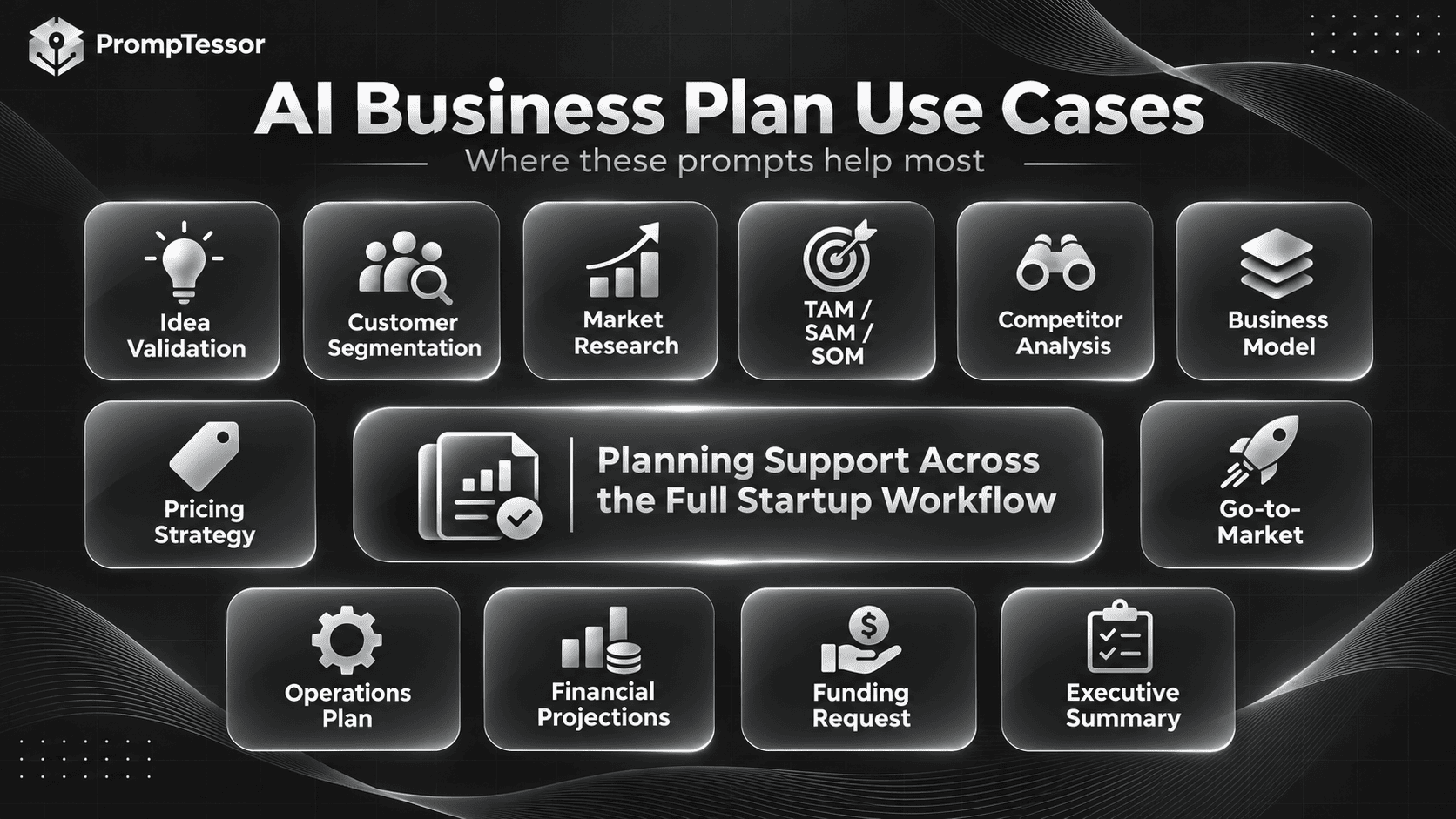
Which AI Business Plan Prompt Should You Use?
Choose the prompt that matches your current business stage and the decision you need to make.
| Business Planning Goal | Recommended Prompt | Main Output |
|---|---|---|
| Test an early idea | #1 Idea Validation | Assumptions and experiments |
| Explain the problem and product | #2 Problem and Solution | Problem-solution statement |
| Choose an initial customer group | #3 Customer Segmentation | Target market matrix |
| Estimate market opportunity | #4 Market Research and Sizing | TAM, SAM, SOM framework |
| Understand available alternatives | #5 Competitor Analysis | Competitor comparison |
| Explain why the product matters | #6 Value Proposition | Positioning options |
| Choose how the company earns money | #7 Business Model | Revenue and operating model |
| Evaluate prices and margins | #8 Pricing Strategy | Pricing scenarios |
| Prepare a product launch | #9 Go-to-Market | Launch roadmap |
| Plan customer acquisition | #10 Marketing and Acquisition | Channel and experiment plan |
| Organize business operations | #11 Operations Plan | Resource and responsibility map |
| Define measurable objectives | #12 Milestones and KPIs | Operating roadmap |
| Forecast revenue, costs, and cash | #13 Financial Projections | Monthly scenarios |
| Assess capital needs and risk | #14 Funding and Risk | Funding and risk plan |
| Review the full business plan | #15 Executive Summary | Final plan and consistency review |
Practical Example: Creating a SaaS Startup Business Plan With AI
To show how the prompts work together, consider a fictional startup called Northstar Desk.
Northstar Desk is an imaginary project coordination tool for small teams. For this example, assume the proposed product includes task boards and due-date reminders.
All figures below are hypothetical teaching inputs. They are not based on actual sales, surveys, market research, or operating results.
Step 1: Define the Business Hypothesis
The initial business hypothesis is that some small teams may want a simpler way to organize recurring project tasks.
However, the company has not established whether enough potential customers have this problem, whether existing tools are inadequate, or whether they will pay for another solution.
Use Prompt #1 to design validation experiments and Prompt #2 to clarify the problem and solution statements.
Step 2: Identify a Customer Segment
Possible segments could include small agencies, internal operations teams, and independent service providers.
Use Prompt #3 to compare these groups, then gather customer interviews or other reliable evidence.
The model should not automatically conclude that one segment has higher demand simply because it is easier to describe.
Step 3: Research Market Alternatives
Use Prompt #5 with accessible competitor documentation and verified product information.
The analysis should include established software products, simple spreadsheets, shared documents, and the possibility that customers prefer their current workflows.
This avoids the misleading assumption that every business seeking to organize tasks is a potential buyer.
Step 4: Test a Pricing Hypothesis
For illustration, assume Northstar Desk is considering a $20 monthly subscription per paying customer.
That is a planning assumption, not a validated willingness-to-pay figure.
Use Prompt #8 to compare the proposed price with variable delivery costs and actual customer research when it becomes available.
Step 5: Create a Simplified Break-Even Model
Assume the following hypothetical steady-state monthly figures:
| Input | Illustrative Value |
|---|---|
| Paying customers | 200 |
| Monthly revenue per customer | $20 |
| Variable cost per customer | $3 |
| Fixed monthly operating costs | $3,000 |
Using those assumptions:
Monthly revenue
= 200 customers x $20
= $4,000

Monthly variable costs
= 200 customers x $3
= $600

Monthly contribution
= $4,000 - $600
= $3,400

Simplified operating surplus
= $3,400 - $3,000
= $400

Contribution per customer
= $20 - $3
= $17

Break-even customers
= $3,000 / $17
= 176.47

Rounded up:
177 paying customers
In this simplified example, 177 active customers would cover the stated monthly fixed costs and variable costs.
But this is not a complete cash flow forecast. The model excludes any relevant costs or accounting items not listed in the assumptions, potentially including taxes, financing costs, additional overhead, capital expenditure, and acquisition expenses.
It also assumes 200 customers are active and paying during the same month, without modeling churn, refunds, payment timing, or the acquisition process.
Those additional factors matter when evaluating whether the business can actually reach and maintain the break-even level.
Step 6: Build Monthly Forecast Scenarios
Use Prompt #13 to create conservative, base, and optimistic customer acquisition scenarios, then calculate the resulting monthly revenue and cash balances.
The model should explain which assumptions change between scenarios and how those changes affect the results.
For instance, a more optimistic acquisition scenario may also require higher marketing costs, additional support, and greater infrastructure usage.
Do not increase projected revenue without considering the associated costs and delivery requirements.
Step 7: Review the Complete Business Plan
Use Prompt #15 after completing the individual sections.
The final review should detect contradictions such as:
- A pricing plan that differs from the financial forecast.
- A target market that changes between the marketing plan and revenue assumptions.
- Acquisition projections that exceed the available marketing budget.
- Operational expenses missing from the cash forecast.
- Funding requirements that do not match the stated use of funds.
The result should be an actionable business document, not simply a polished narrative.
How to Build More Accurate AI Financial Projections
Financial forecasts are one of the most important parts of a business plan to verify independently.
An AI model can organize assumptions and explain formulas, but it should not fabricate an attractive revenue curve when no evidence exists.
1. Separate Historical Data From Forecasts
Actual revenue and expenses should come from business records.
Forecasts should use clearly identified assumptions, such as the expected number of new customers, price per customer, churn, payment timing, staffing costs, and infrastructure expenses.
2. Understand Revenue, Profit, and Cash Flow
Revenue is the amount earned from selling goods or services according to the applicable accounting treatment.
Profit reflects revenue after relevant expenses, while cash flow tracks money entering and leaving the business.
A business can report accounting revenue without immediately receiving the corresponding cash. It can also incur cash expenses before those expenses appear in the income statement in the same way.
Do not treat these measures as interchangeable.
3. Make Forecast Formulas Transparent
A model should expose the drivers behind each output.
For a simple subscription business, useful relationships include:
Ending Customers
= Starting Customers
+ New Customers
- Churned Customers

Simplified Monthly Revenue
= Paying Customers
x Average Monthly Price

Monthly Contribution
= Revenue
- Variable Costs

Operating Result
= Revenue
- Cost of Revenue
- Operating Expenses

Simplified Unit Break-Even
= Fixed Costs
/ Contribution Per Unit

Ending Cash
= Starting Cash
+ Cash Inflows
- Cash Outflows
These simplified formulas are planning tools. A complete financial model may require more detailed accounting treatment, deferred revenue, taxes, debt schedules, capital expenditures, working capital, and other business-specific items.
4. Use Multiple Scenarios
A single forecast may create a false sense of precision.
Consider conservative, base, and optimistic cases driven by explicit assumptions. These could vary customer acquisition, churn, average revenue, payment delays, or operating expenses.
The purpose is to understand the sensitivity of the plan, not to identify which scenario the AI prefers.
5. Validate the Model Outside the Prompt
Use spreadsheet formulas or an appropriate financial modeling tool to verify calculations.
For financially consequential planning, review the model with an accountant or another qualified professional.
The SBA startup cost guidance provides further background on identifying expenses and planning startup capital.
How to Validate Market Research Before Adding It to Your Business Plan
Market research is another area where AI-generated confidence can be misleading.
A model might provide an estimated market size, industry growth rate, or customer segment count without identifying where the number came from.
Do not treat those figures as research findings.
Use Appropriate Primary and Secondary Research
Primary research can include customer interviews, surveys, product usage observations, and real purchasing behavior.
Secondary research can include official statistics, industry reports, regulatory sources, and published market analyses.
Each has limitations. Surveys can contain sampling bias. Published reports can define markets differently. Interviews can reveal important problems without proving that demand exists at scale.
The SBA market research and competitive analysis guide recommends investigating demand, market size, economic factors, customer location, market saturation, pricing, and competition.
Record the Evidence Behind Each Market Claim
A useful market research evidence table might contain:
| Claim | Source | Status | Verification Action |
|---|---|---|---|
| Estimated customer population | Named demographic or industry source | Verified or unverified | Check definition and year |
| Customer willingness to pay | Interview, experiment, or purchase data | Tested or hypothetical | Review sampling and actual behavior |
| Competitor pricing | Official pricing page | Current or outdated | Check plan details and date |
| Market growth rate | Named research report | Supported or unknown | Check methodology and geography |
| Expected market share | Business planning assumptions | Forecast | Review acquisition feasibility |
If no reliable source supports a claim, either remove it or clearly identify it as an assumption requiring research.
Common AI Business Plan Mistakes
1. Asking for a Complete Plan Without Business Context
A vague instruction can produce a generic plan that sounds convincing but does not reflect the actual business.
Better approach: Develop the customer, research, business model, and financial sections separately before creating the executive summary.
2. Inventing Market Size and Demand
AI-generated numbers may look plausible even when no market research was provided.
Better approach: Use real sources, show calculations, and mark missing market information.
3. Treating a Business Idea as a Validated Opportunity
A business idea is a hypothesis until there is relevant evidence.
Better approach: Test whether customers experience the problem and are willing to adopt or pay for the solution.
4. Ignoring Existing Alternatives
Competitors are not limited to businesses selling an almost identical product.
Better approach: Include indirect alternatives, manual workflows, and the option of continuing without a new purchase.
5. Creating Unrealistic Growth Forecasts
Revenue forecasts may assume rapid customer acquisition without explaining the required channels, costs, or conversion process.
Better approach: Build forecasts from explicit acquisition and retention drivers, then test multiple scenarios.
6. Confusing Revenue With Profit
High revenue does not automatically mean the business is profitable.
Better approach: Include cost of revenue, operating expenses, and relevant additional costs.
7. Ignoring Cash Flow
A company may appear profitable in a forecast while running short of cash because of payment timing or upfront investments.
Better approach: Model cash inflows and outflows separately.
8. Choosing Pricing Without Customer Evidence
An attractive pricing table does not prove that customers will pay those amounts.
Better approach: Combine cost analysis, alternative pricing research, and willingness-to-pay validation.
9. Writing an Unsupported Competitive Advantage
Claims such as "the fastest solution" or "the most affordable platform" require suitable evidence.
Better approach: Describe real product capabilities and present untested differentiation as a hypothesis.
10. Underestimating Operational Requirements
Founders may account for product development while overlooking support, infrastructure, compliance, maintenance, and administration.
Better approach: Connect the operating plan to the financial forecast.
11. Inventing Investor Interest or Funding Approval
A model might confidently describe financing opportunities that have not been confirmed.
Better approach: Distinguish possible funding options from verified eligibility, available offers, or actual investor commitments.
12. Treating the Business Plan as a One-Time Document
A plan loses value when market conditions and business evidence change but the assumptions remain unchanged.
Better approach: Establish regular reviews and update the plan when significant new information becomes available.
How to Measure Whether a Business Plan Is Useful
The quality of a business plan should not be judged only by its length, formatting, or how confidently it describes the future.
Its real value is how well it helps the founder make decisions and test assumptions.
| Planning Quality Measure | What It Evaluates |
|---|---|
| Evidence coverage | Whether major claims have supporting sources or clearly stated assumptions |
| Customer validation | Whether the proposed problem and demand have been tested |
| Financial consistency | Whether pricing, acquisition, expenses, and funding assumptions agree |
| Operational feasibility | Whether the plan fits available people, time, and resources |
| Risk transparency | Whether major uncertainties are clearly described |
| Decision usefulness | Whether the plan identifies practical next steps |
| Update readiness | Whether assumptions can be revised as new information arrives |
| Stakeholder suitability | Whether the plan answers the intended reader's important questions |
A business plan with honest uncertainties may be more useful than one filled with optimistic forecasts that cannot be explained.
How to Improve Business Plan Prompts With PrompTessor
Business planning often involves many related AI tasks. Instead of creating one enormous prompt, you can build a set of reusable templates for different parts of the planning process.
PrompTessor can help create, analyze, optimize, refine, and reuse those instructions.
1. Generate a Structured Business Planning Prompt
Use the PrompTessor AI Prompt Generator to convert a rough objective into clearer instructions.
For example, rather than entering "make a business plan," describe your startup, intended customer, current stage, available research, and the specific business question you need to investigate.
2. Optimize an Existing Prompt
Use the AI Prompt Optimizer to improve prompts that produce vague, generic, or poorly structured results.
For business planning, useful improvements include requiring verified data, defining financial assumptions, specifying outputs, and asking the model to flag missing evidence.
For example:
ORIGINAL:
Write financial projections
for my SaaS startup.

IMPROVED:
Create a 12-month monthly financial
forecast from the supplied customer
counts, pricing, costs, and cash data.

Separate actual results
from assumptions.

Show formulas and three scenarios.

Do not invent acquisition rates,
churn, revenue, or expenses.

Identify missing financial inputs.

Return a forecast table,
cash risk analysis,
and spreadsheet verification checklist.
3. Save Reusable Business Planning Templates
A validated prompt structure can be reused for different planning tasks or future business ideas.
BUSINESS:
{business_name}

INDUSTRY:
{industry}

PRODUCT:
{product}

CUSTOMERS:
{customer_segments}

MARKET:
{geography}

BUSINESS STAGE:
{current_stage}

OBJECTIVE:
{planning_task}

AVAILABLE EVIDENCE:
{sources}

ASSUMPTIONS:
{hypotheses}

CONSTRAINTS:
{resources}

OUTPUT:
{deliverable}

VERIFICATION:
{required_checks}
This approach keeps instructions consistent while allowing the business-specific data to change.
4. Refine Prompts Based on Real Feedback
If market research outputs contain unsupported claims, strengthen evidence requirements. If pricing analysis ignores costs, provide a clearer cost model. If forecasts hide assumptions, require a separate assumptions table and calculation audit.
Prompt refinement should respond to observed problems rather than simply making the prompt longer.
5. Use Appropriate Tools for Financial and Research Validation
PrompTessor helps improve AI instructions. It does not independently validate financial statements, guarantee market research accuracy, or approve business financing.
Use appropriate financial models, market research sources, accounting tools, and professional review where necessary.
The final business plan remains the founder's responsibility.
AI Business Plan Quality Checklist
Before using an AI-generated business plan for financing, important decisions, or external presentations, review the following items.
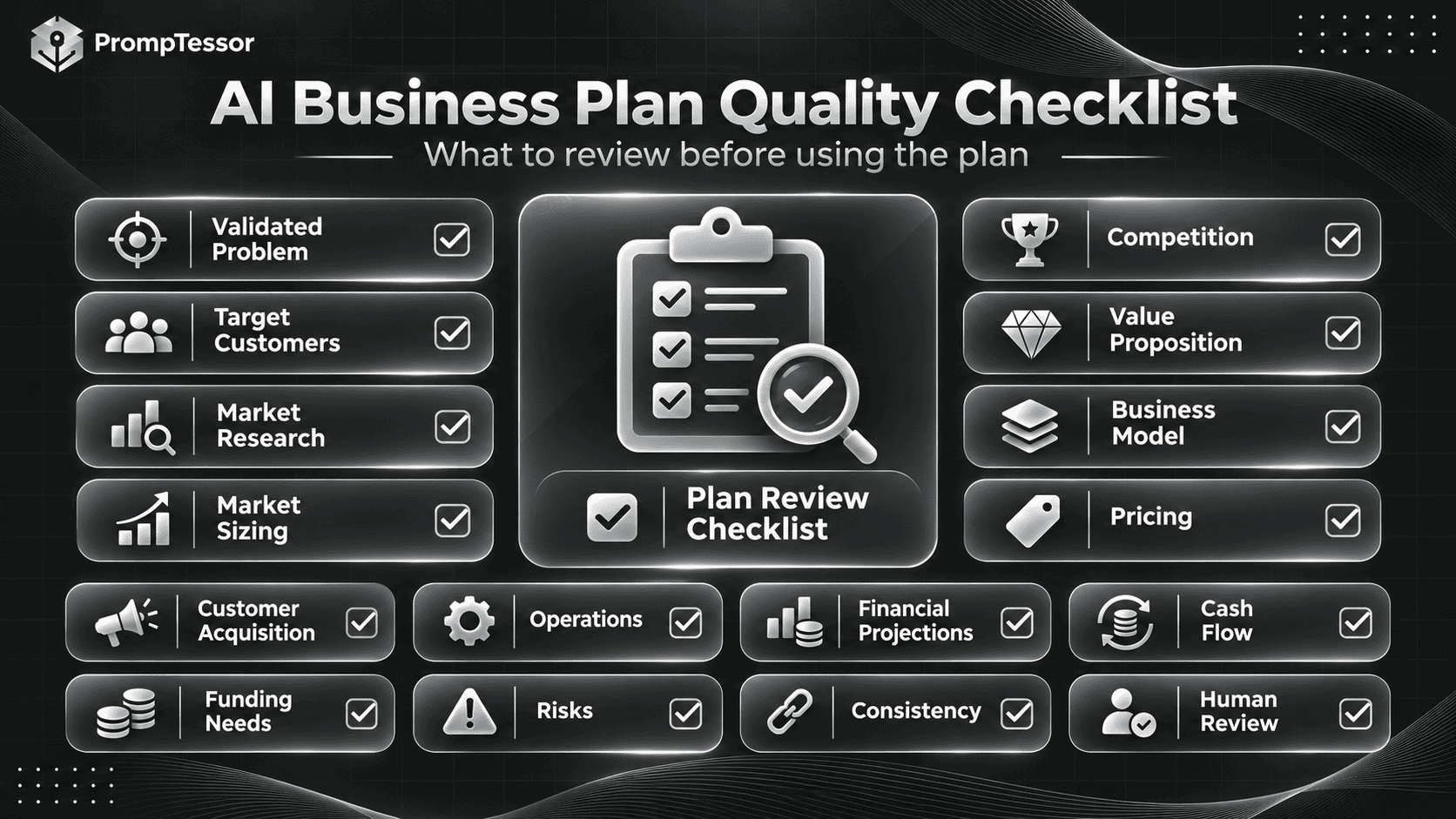
- Business objective: The plan has a clear purpose and intended reader.
- Problem validation: The customer problem is supported by research or marked as a hypothesis.
- Target customers: The proposed audience is specific and appropriate for the offering.
- Market research: Important market statistics have identifiable sources, dates, and definitions.
- Market sizing: TAM, SAM, and SOM calculations are transparent and appropriately qualified.
- Competition: Direct competitors, alternatives, and customer workarounds are considered.
- Product accuracy: The plan describes actual capabilities rather than invented features.
- Value proposition: Differentiation claims are supported by evidence or labeled as hypotheses.
- Business model: Revenue streams, cost structure, and delivery requirements are consistent.
- Pricing: Price assumptions connect to costs and relevant customer research.
- Customer acquisition: Channels and targets fit the available resources.
- Operations: Staffing, vendors, support, and infrastructure needs are addressed.
- Financial projections: Formulas, assumptions, and scenario outputs have been validated.
- Cash flow: Payment timing, cash needs, and potential shortfalls are considered.
- Funding: Capital requirements and planned uses of funds are supported by the model.
- Risks: Major uncertainties and contingencies are transparent.
- Consistency: Market, pricing, revenue, operations, and funding assumptions align.
- Human review: The final plan is checked before being shared or used for consequential decisions.
Frequently Asked Questions About AI Business Plan Prompts
What are AI business plan prompts?
AI business plan prompts are instructions used to guide an AI model through business planning tasks such as idea validation, market research, competitor analysis, pricing, financial projections, and funding preparation. Effective prompts specify available evidence, assumptions, required outputs, and verification rules.
What is the best ChatGPT prompt for a business plan?
A useful prompt identifies the business idea, target customers, current stage, available research, financial data, intended reader, and required planning sections. It should explicitly prohibit invented market statistics, customer evidence, and financial results.
Can ChatGPT write a complete business plan?
Yes. ChatGPT can help draft and organize a full business plan from supplied information. However, market demand, customer research, pricing, financial assumptions, and commercial claims need independent verification before the document is relied upon.
Can AI create a one-page business plan?
Yes. AI can help produce a concise lean startup plan covering customer segments, value proposition, channels, revenue streams, cost structure, key resources, and important assumptions. It is especially useful as a starting document for early business validation.
What is the difference between a traditional and lean business plan?
A traditional business plan provides detailed business, market, operational, and financial information. A lean startup plan summarizes the most important elements and is designed for concise planning and iteration. The appropriate format depends on the business and intended audience.
Can AI validate a startup idea?
AI can help identify assumptions, prepare interview questions, analyze supplied customer evidence, and design validation experiments. It cannot establish real market demand or product-market fit without actual research and customer behavior.
Can ChatGPT perform business market research?
ChatGPT can organize research, compare supplied sources, develop research questions, and analyze available market data. Current statistics, customer population estimates, and competitor information should come from verifiable external sources.
Can AI calculate TAM, SAM, and SOM?
AI can help define market boundaries, create formulas, and calculate estimates using supplied data. These outputs depend on market definitions, assumptions, source quality, and arithmetic validation. They are not guarantees of demand or revenue.
Can AI help choose a business model?
Yes. AI can compare subscriptions, usage-based pricing, direct sales, services, and other models using the supplied customer context, cost structure, and product requirements. The final model should be tested against real customer behavior and operating economics.
Can ChatGPT create financial projections for a startup?
Yes. ChatGPT can prepare a forecasting framework and calculate scenarios from supplied assumptions. Important figures and formulas should be checked independently, especially cash flow, customer acquisition, churn, margins, taxes, and financing requirements.
Can AI calculate a business break-even point?
AI can help calculate a simplified break-even point using fixed costs, selling price, and variable cost per unit. More complete planning may require additional operational costs, payment timing, financing, taxes, and other business-specific considerations.
Can AI write a business plan for investors?
AI can help structure and draft investor-facing business plan materials. But claims about traction, revenue, market size, customers, funding, team qualifications, and financial forecasts must be accurate and appropriately supported. The document should undergo professional review where appropriate.
Does an AI-generated business plan guarantee funding?
No. A polished document does not guarantee lender approval or investor interest. Financing decisions depend on factors such as business viability, financial information, risk, eligibility, and the lender's or investor's criteria.
What should I include in a startup financial forecast?
A useful forecast includes revenue drivers, customer activity, costs, operating expenses, cash flow, major investments, financing assumptions, and scenarios. It should distinguish actual results from estimates and explain how the numbers are calculated.
How often should I update my business plan?
Review the plan when major assumptions change or new customer, financial, operational, or market evidence becomes available. Early-stage startups may benefit from frequent reviews, while more established businesses may use a periodic planning cycle.
Can PrompTessor help create better business plan prompts?
Yes. PrompTessor can help generate, analyze, optimize, refine, and reuse AI prompts for business planning. Market validation, financial accounting, external research, legal requirements, and final business decisions still require appropriate data, tools, and human review.
Final Thoughts: A Useful Business Plan Is Built on Evidence
AI can make business planning easier to organize. It can help founders structure their ideas, identify research questions, compare business models, prepare financial forecasts, and communicate a strategy more clearly.
But the most important business questions cannot be answered by polished writing alone.
Real customers must validate the problem. Market research must support important claims. Financial projections must use transparent assumptions. Operational plans must reflect available resources. Funding requirements must connect to realistic business needs.
The 15 AI business plan prompts in this guide provide a practical workflow from idea validation through final plan review.
Start with the question you need to answer, supply the best available evidence, and treat unsupported outputs as hypotheses rather than facts.
For recurring planning tasks, save the prompt structure and improve it as new information becomes available.
If you want to create clearer and more reusable instructions for startup research, pricing, strategy, or business planning, try the PrompTessor AI Prompt Generator and refine the result around your actual business goals and evidence.
A strong business plan does not predict the future with certainty. It explains what you know, what you assume, what you need to test, and which decisions should come next.
Official Sources and Further Reading
Build better prompts in one workspace
Generate prompts from ideas, analyze and optimize quality, refine with feedback, reverse-engineer content, and save reusable prompts in your Prompt Library.
Try PrompTessor Free